You come home and find a form taped to your door: One Month Notice to End Tenancy for Cause. It says you must move out by the end of next month. You may disagree with every word of it, but the most important thing on the page isn't the reason. It's the deadline.
In British Columbia, a tenant who wants to fight a cause notice has 10 days to apply for dispute resolution. Miss that window and the law presumes you accepted the notice, however weak the landlord's case was.
This guide shows you how to work out your exact deadline, what to file, what it costs, and what to do between filing and the hearing.
BC Cause Notice: 10-Day Renter Checklist
A renter's checklist for disputing a BC One Month Notice for Cause: count your 10 days, apply, pay or waive the fee, serve the landlord and prepare for the hearing.
Get Free PDF →The rule: 10 days, then the presumption
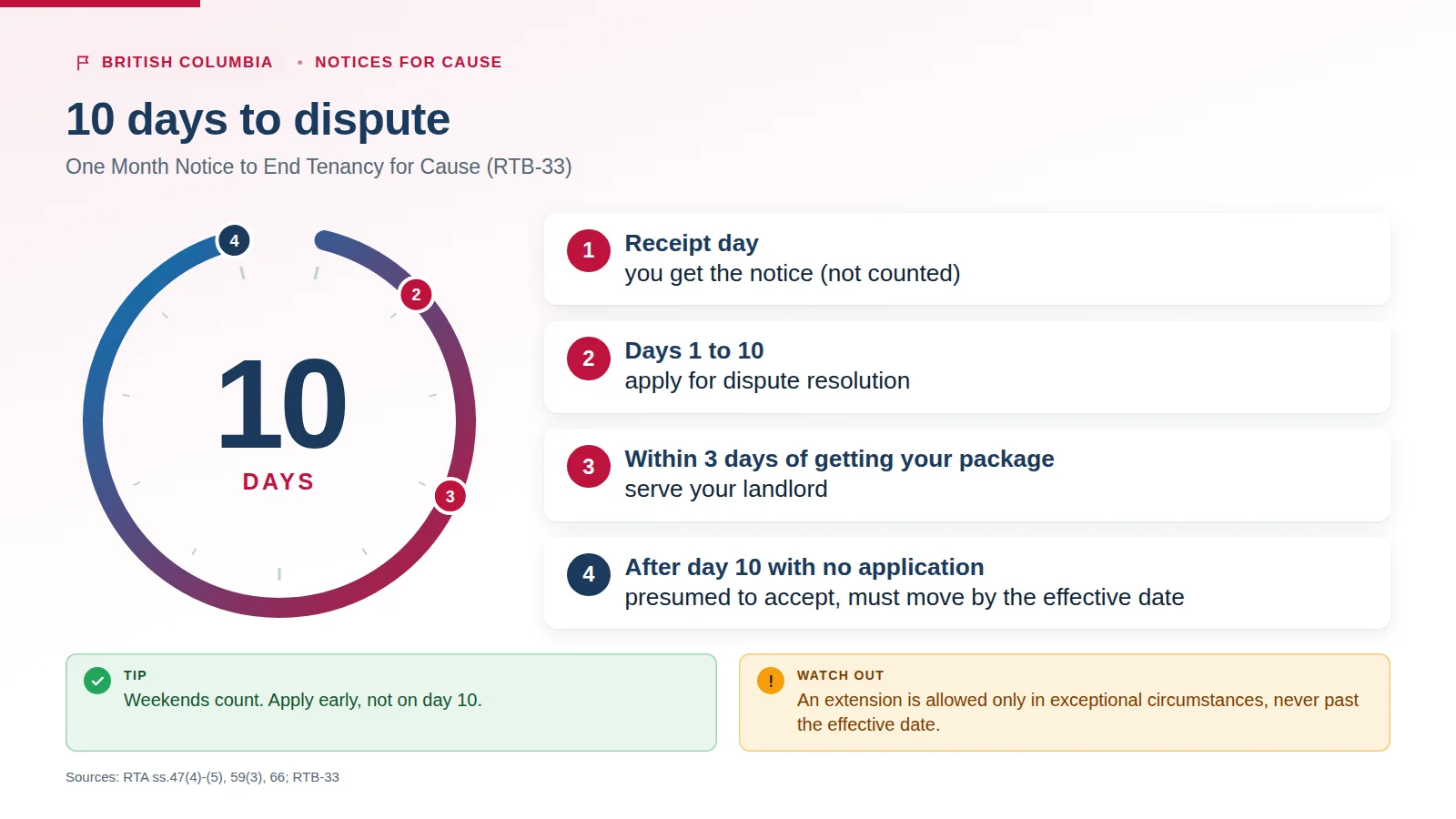
Section 47(4) of the Residential Tenancy Act (RTA) says a tenant may dispute a cause notice by applying for dispute resolution within 10 days after the date the tenant receives the notice.
Section 47(5) says what happens if you don't: you are conclusively presumed to have accepted that the tenancy ends on the notice's effective date, and you must move out by that date. "Conclusively" means you can't argue later that the landlord had no good reason.
The notice itself, form RTB-33, says the same thing on page 1, and page 3 calls it 10 calendar days. Weekends count.
When the clock starts
The clock starts on the day you receive the notice. Page 3 of the RTB-33 explains when you are considered to have received it:
| How the landlord served it | You're considered to have received it |
|---|---|
| Handed to you, or to an adult (19 or older) who appears to live with you | That day |
| Left in your mailbox or mail slot, posted on your door, or emailed or faxed to an address for service you provided | 3 days later |
| Sent by registered or regular mail | 5 days later |
The form adds an important note: the date you actually receive a document is what counts, and the deeming rules don't give you extra time to respond. If the notice was on your door when you got home that evening, don't rely on the extra 3 days.
Working out your deadline
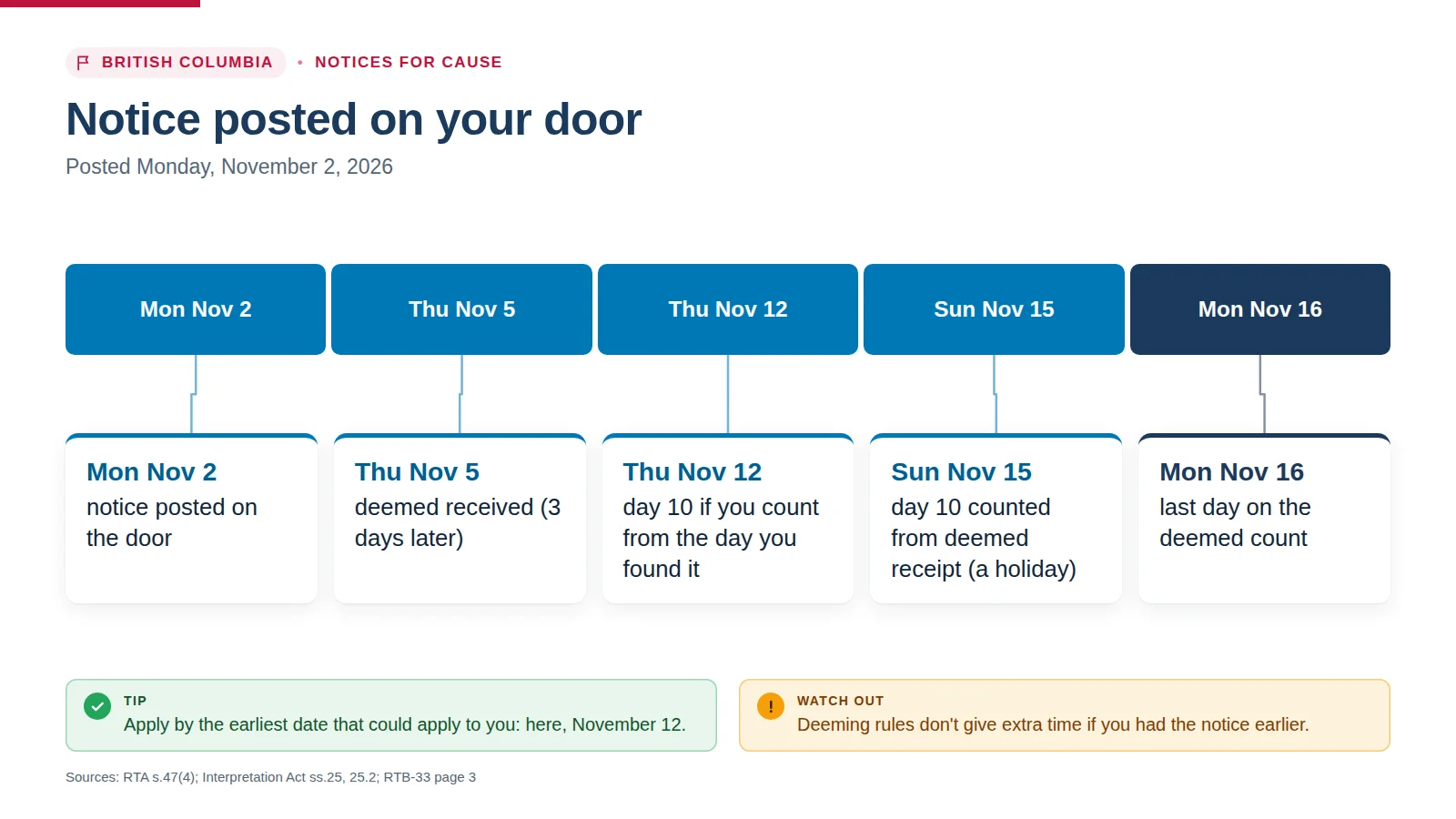
Under the BC Interpretation Act (s.25.2), you count forward starting from the day after you received the notice. Day 10 is your last day. If day 10 falls on a holiday, which includes Sundays and statutory holidays such as Remembrance Day, the period ends on the next day that isn't a holiday (s.25(3)). Saturday is not a holiday.
| Received | Day 1 | Day 10 | Last day to apply |
|---|---|---|---|
| Handed to you Tuesday, November 10, 2026 | Wednesday, November 11 | Friday, November 20 | Friday, November 20, 2026 |
| Deemed received Thursday, November 5, 2026 (posted on the door November 2) | Friday, November 6 | Sunday, November 15 | Monday, November 16, 2026 |
In the second example, if you actually found the notice on November 2, the safer reading is to count from November 2, which puts day 10 on Thursday, November 12. Apply by the earliest date that could apply to you.
Can the deadline be extended?
Rarely. Section 66(1) lets the RTB extend a time limit only in exceptional circumstances, and section 66(3) says it must never extend the time to dispute a notice beyond the notice's effective date. Policy Guideline 36 explains that an ordinary reason for missing a deadline is not exceptional. Treat the 10 days as fixed.
Common mistakes tenants make
- Waiting to talk to the landlord first. Talking is fine, but a conversation doesn't stop the clock. Apply, then talk.
- Counting from the deemed date when you had it earlier. The deeming rules don't add time.
- Assuming a weak notice will fail on its own. The RTB says a tenant should never ignore an eviction notice, even if they are confident the landlord has no grounds.
- Stopping rent. Section 26(1) requires you to pay rent when due unless the Act gives you a right to deduct. Unpaid rent can lead to a separate 10 Day Notice.
- Filing but not serving. You must give the landlord the hearing package within 3 days. The deadline is printed in the notice letter that comes with your package.
What to do next
- Check the notice. It should be on the RTB-33, signed and dated, with your unit address, an effective date, the grounds ticked and the "Details of Cause(s)" filled in. The form says an arbitrator may cancel the notice if details are not provided. You should have every page. Note anything missing, but apply anyway: under section 53 an incorrect effective date is corrected automatically, and the RTB-33 says an error does not make the notice invalid.
- Apply for dispute resolution. You can apply online (you'll need a Basic BCeID), in person at any Service BC office, or at the RTB office at #400 - 5021 Kingsway in Burnaby, as the RTB-33 says. The application asks you to cancel the One Month Notice.
- Pay the fee or ask for a waiver. The fee is $100 (Residential Tenancy Regulation s.8). You can apply for a waiver if your household income is below the federal Low-Income Cut-Offs or you are on income assistance, or if you've had extraordinary expenses in the past 8 weeks. If you apply online but submit a waiver in person, the RTB's fees page says to do it within three days. Under Rules of Procedure 2.4 and 2.6, your application only counts as made once the fee is paid or the waiver is submitted, and that three-day window does not extend your 10 days. Pay or submit the waiver inside the 10 days.
- Serve the landlord within 3 days. Section 59(3) of the Act and the RTB-33 both require you to give the landlord the Notice of Dispute Resolution Proceeding package within 3 days of applying, unless the RTB sets a different period. The RTB's service page says to serve it within 3 days of the date the package became available to you, and the deadline is in your notice letter. Serve it as soon as you have it. The RTB's service page recommends registered mail and lists methods that are not typically allowed, such as text message or sliding it under a door.
- Prepare your evidence. Under the RTB Rules of Procedure, an applicant's evidence must be received by the RTB and the landlord at least 14 days before the hearing (Rule 3.14). Gather rent receipts, messages, photos and names of witnesses that answer the reasons on the notice.
- Keep paying rent and keep proof of every payment.
- Attend the hearing. Under Rules 6.6 and 7.20, when a tenant applies to cancel a notice, the landlord must prove the reason and usually presents first.
If the hearing goes against you
If the arbitrator dismisses your application or upholds the notice, and the notice meets the Act's form rules, section 55(1) says the arbitrator must grant the landlord an order of possession. Review deadlines are short: section 80 allows 2 days after you receive a copy for a review of an order of possession, and 5 days for a decision on a notice to end tenancy other than for unpaid rent. Review is limited to the grounds in section 79, such as being unable to attend for reasons you couldn't foresee or control, or new and relevant evidence that wasn't available.
A landlord still can't remove you without a Writ of Possession from the BC Supreme Court, enforced by a court-approved bailiff, according to the RTB's disputing an eviction page.
How Tenon10 helps
Tenon10 keeps the lease, notices and payment records for a tenancy together. If you dispute a notice, that record is your evidence of what you paid and when, and what was agreed.
Tenon10 doesn't file dispute applications. You apply through the RTB, and Tenon10 links you there.
Frequently asked questions
Do weekends count in the 10 days?
Yes. The RTB-33 calls it 10 calendar days. Only if the last day falls on a Sunday or a statutory holiday does it move to the next day that isn't a holiday.
Does disputing stop the eviction?
The RTB's disputing an eviction page says that if you apply before the deadline, the notice is on hold until the arbitrator decides.
Can I dispute after the 10 days?
You can ask, but an extension is allowed only in exceptional circumstances and never beyond the effective date of the notice (s.66).
What if I can't afford the $100 fee?
Apply for a fee waiver with your application. The RTB assesses low income and extraordinary expenses.
BC Cause Notice: 10-Day Renter Checklist
A renter's checklist for disputing a BC One Month Notice for Cause: count your 10 days, apply, pay or waive the fee, serve the landlord and prepare for the hearing.
Get Free PDF →Keep your tenancy records in one place
Your lease, notices and payment history together, ready if you ever need to show what happened.
Built for Canadian renters, landlords and property managers.
Related BC guides
- Got a 10 Day Notice in BC? What Tenants Should Do Now
- Serving Documents in BC: Every Method the RTA Allows
- Disputing a BC Rent Increase: A Tenant's Guide
Sources: Residential Tenancy Act; Residential Tenancy Regulation; Interpretation Act; RTB-33; RTB Rules of Procedure; RTB: Disputing an eviction; RTB: Fees and fee waivers. This article is a summary of British Columbia rules as of October 2026, not legal advice. Check the Residential Tenancy Branch for your situation.