The bathroom fan has been dead since summer. The window in the bedroom will not close properly, and now the nights are getting cold. You have mentioned it to your landlord more than once. Each time you hear "I'll get someone out," and nobody comes.
In British Columbia you do not have to live with that, and you do not have to withhold rent or fix it yourself to get results. The Residential Tenancy Act gives you a clear path: a written request, then an application to the Residential Tenancy Branch (RTB), which can order the repair, reduce your rent and award compensation.
This guide walks you through each step, what to keep as evidence, and the mistakes that can turn a repair problem into an eviction problem.
BC Tenant Repair Request Checklist
A renter checklist for getting repairs done in BC: the written request, emergency repairs, evidence, and applying to the RTB for an order.
Get Free PDF →The rule: repairs are mostly your landlord's job
Section 32(1) of the Residential Tenancy Act (RTA) says your landlord must keep the rental property in a state of repair that meets the health, safety and housing standards required by law, and that makes it suitable to live in, given its age, character and location. That duty applies even if you knew about the problem when you moved in (section 32(5)).
The RTB's repairs page lists the basics your landlord must maintain: heating, hot water, electricity, locks and access devices, walls, floors and ceilings, fire-safety features, and any appliances or other items listed in your tenancy agreement.
Your side: keep the place reasonably clean, repair damage you or your guests cause, and tell your landlord when something needs fixing. You are not responsible for reasonable wear and tear.
What to do next, step by step
1. Put the request in writing
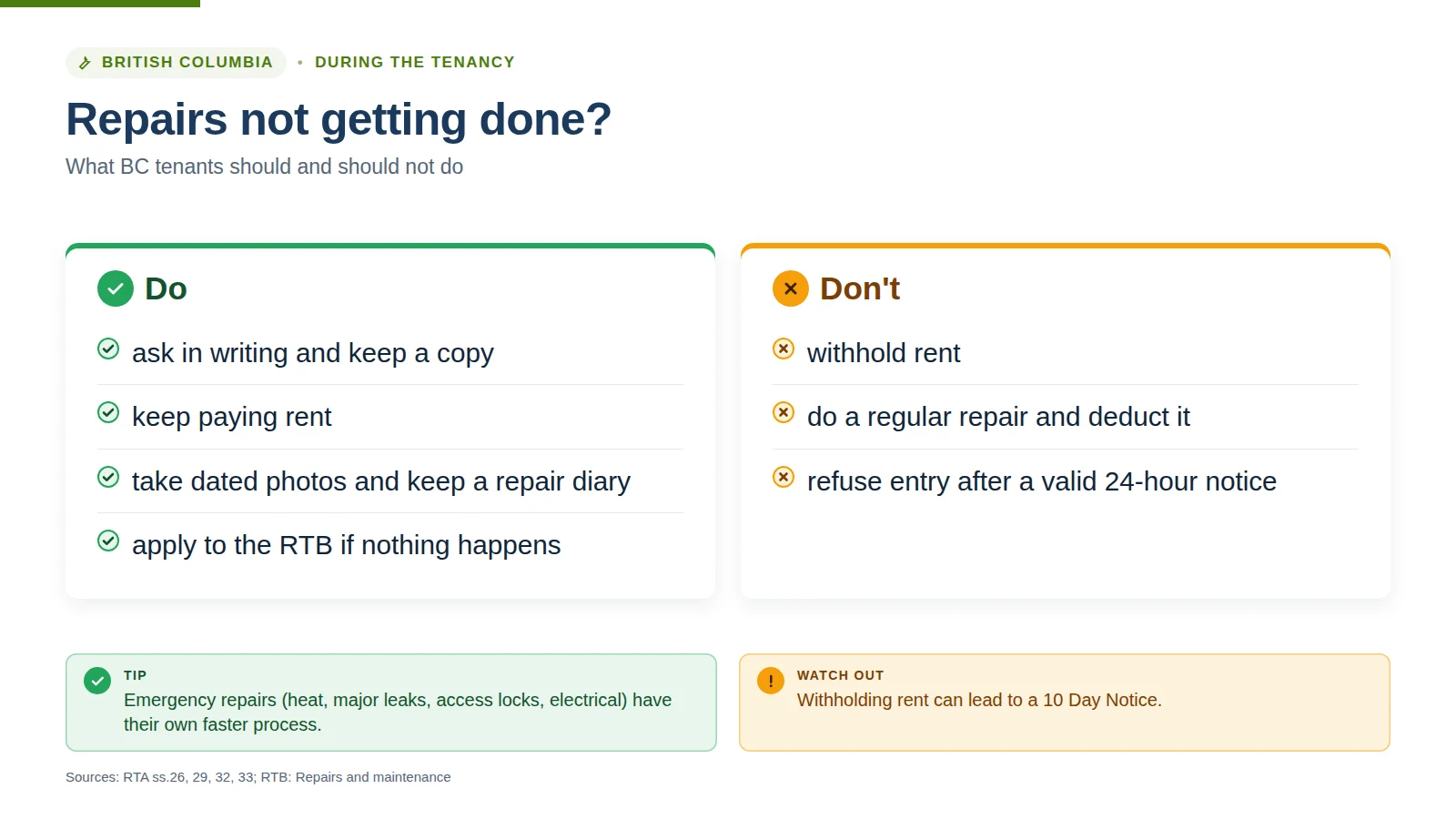
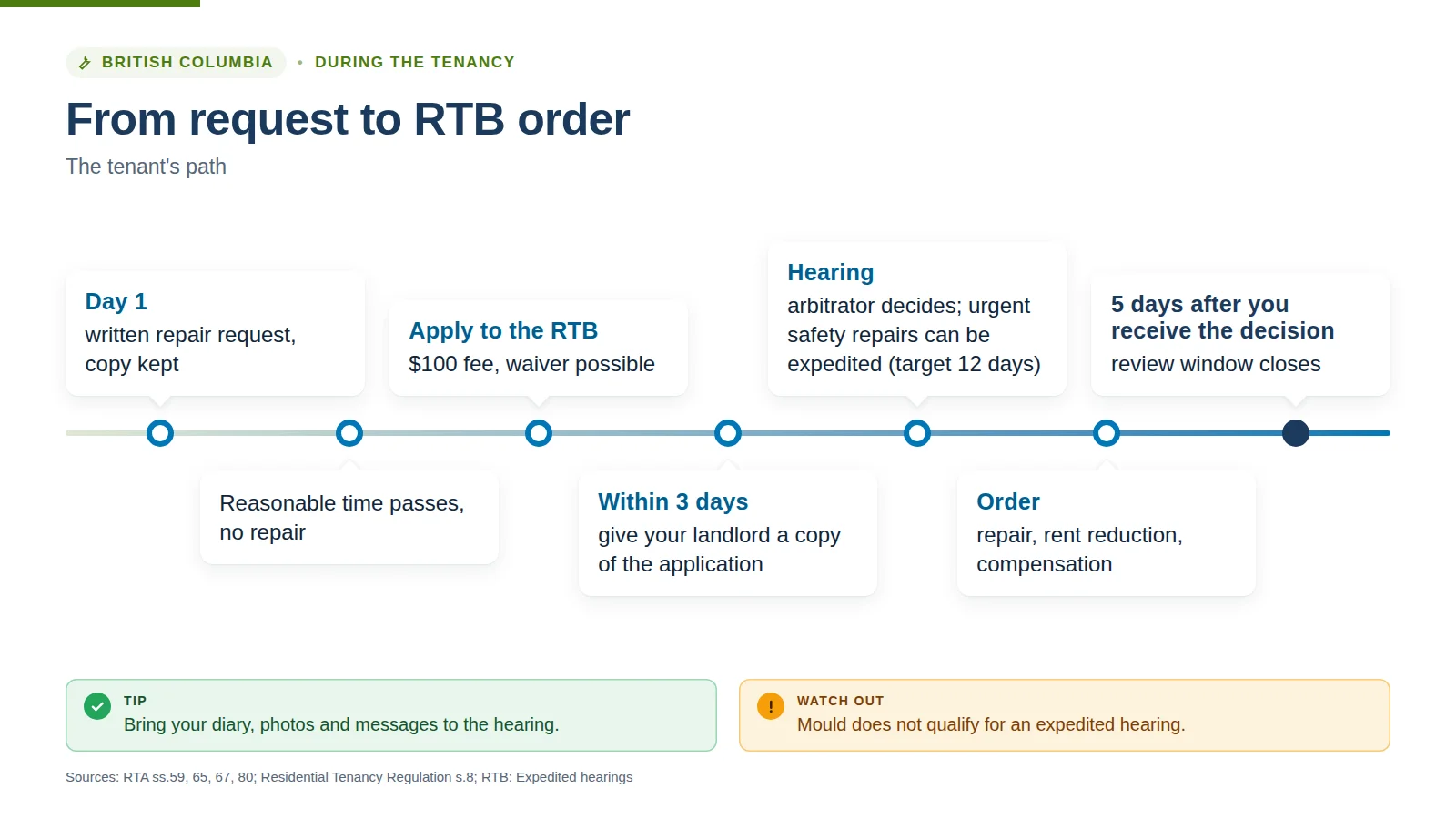
The RTB says tenants must request repairs in writing, by email, letter or text message. Describe the problem, when it started and how it affects you, and give a reasonable time to fix it. Keep a copy. If you already asked verbally, send a written follow-up today that refers to the earlier conversations by date.
2. Check whether it is an emergency
Some repairs are emergencies under section 33: major leaks, damaged or blocked water or sewer pipes or plumbing fixtures, the primary heating system, damaged locks that give access to your unit, or the electrical systems, where the repair is urgent and needed for health, safety or to protect the property. Those have a faster track: call the emergency contact your landlord must give you at least twice, allow a reasonable time, and you may then arrange the repair yourself and claim the cost with receipts.
Everything else is a regular repair. The RTB says you need your landlord's written agreement before you do a regular repair yourself and charge them for it.
3. Keep paying rent
Section 26(1) says you must pay rent when it is due, whether or not your landlord is following the Act, unless the Act gives you a right to deduct. The RTB's dispute resolution page repeats it: keep paying rent, even during a dispute.
4. Gather evidence and limit the damage
Take dated photos or video. Keep every message. Write down how the problem affects daily life, such as rooms you cannot use or extra heating costs. Section 7(2) and Policy Guideline 5 expect you to take reasonable steps to limit the damage, like moving belongings away from a leak and reporting it right away. Compensation is not awarded for loss you could reasonably have avoided.
5. Apply to the RTB for dispute resolution
If the repair is not done in a reasonable time, apply for dispute resolution. Only an RTB arbitrator can decide whether the landlord took too long.
| What | Detail |
|---|---|
| How to apply | Online with a Basic BCeID, or on paper |
| Filing fee | $100 (Regulation s.8). The RTB may waive or reduce it if you cannot reasonably afford it (RTA s.59(4)). |
| Serving your landlord | Give your landlord a copy of the application within 3 days of making it, or the period the RTB sets (RTA s.59(3)) |
| Urgent safety repairs | You can ask for an expedited hearing. The RTB tries to schedule these within 12 days. Mould does not qualify. |
| Review after the decision | Either side has 5 days after receiving a repair decision to apply for a review (RTA s.80) |
What the RTB can order
Under section 65, if your landlord has not complied with the Act or your tenancy agreement, the RTB can order, among other things:
- that you pay your rent to the RTB, to be held in trust for the cost of the repairs,
- that you deduct an amount from rent to spend on the repair,
- that past or future rent be reduced to reflect what you have lost.
The RTB's dispute resolution page also lists an order of compliance, which instructs a person to complete a specific task such as a repair. Section 67 allows compensation for loss caused by the breach. If your landlord is ordered to pay you, section 72(2) lets you deduct the amount from rent.
6. Other routes
- Local bylaws. The RTB notes that most municipalities have standards of maintenance bylaws, covering things like heat, hot water and pests. Your local government can tell you what applies.
- Compliance and Enforcement Unit. The RTB's CEU investigates repeated or serious and deliberate breaches, including landlords refusing health and safety repairs. It can issue administrative penalties, but it is not a replacement for dispute resolution and does not pay you compensation.
- Ending the tenancy. If a material term of your agreement is breached and your landlord does not fix it within a reasonable time after your written notice, section 45(3) lets you end the tenancy.
Common mistakes
- Only asking verbally. Without written requests it is hard to prove when your landlord knew.
- Withholding rent. It puts your tenancy at risk.
- Doing a regular repair and deducting it. Only emergency repairs under section 33 allow that without the landlord's written agreement or an RTB order.
- Asking for upgrades. The RTB says it is unlikely to order repairs that only make a unit more modern or nicer looking, like replacing a stained but intact carpet.
- Refusing entry for the repair. After a valid 24-hour written notice, you must allow access for repairs.
How Tenon10 helps
When your landlord uses Tenon10, your lease, notices and payment records are kept together for the tenancy. That record helps both sides at a hearing, including showing that you kept paying rent. If your landlord uses Tenon10, you can submit repair requests with photos and an emergency priority, and every request can be tracked from the web or the mobile app.
A move-in Condition Inspection Report (RTB-27), which Tenon10 provides as a fillable room-by-room form, also helps show whether a problem was there before you moved in.
Frequently asked questions
How long does my landlord have to make a repair?
A reasonable time, which depends on the problem. If you disagree, an RTB arbitrator decides.
Can I get money back for the time I lived with the problem?
You can ask the RTB for a past rent reduction and compensation for your losses. Bring your diary, photos and messages.
Can my landlord evict me for complaining?
A landlord can end a tenancy only for a reason and in a way the Act allows, and section 95(2) makes retaliation for seeking a remedy an offence. If you receive a notice to end tenancy, read it straight away, because dispute deadlines can be short.
What if a repair decision goes against me?
You have 5 days after receiving a repair decision to apply for a review, but only on the limited grounds in section 79.
BC Tenant Repair Request Checklist
A renter checklist for getting repairs done in BC: the written request, emergency repairs, evidence, and applying to the RTB for an order.
Get Free PDF →A clear record helps everyone
Tenon10 keeps lease, notice and payment records together for each tenancy, with a fillable RTB-27 inspection report.
Built for Canadian landlords and property managers.
Related BC guides
- Got a 10 Day Notice in BC? What Tenants Should Do Now
- Serving Documents in BC: Every Method the RTA Allows
Sources: Residential Tenancy Act; Residential Tenancy Regulation; RTB: Repairs and maintenance; RTB: Tenancy dispute resolution; RTB: Expedited hearings; RTB: Compliance and enforcement; RTB Policy Guideline 5. This article is a summary of British Columbia rules as of October 2026, not legal advice. Check the Residential Tenancy Branch for your situation.