

Here's the strangest comparison in our series: these two tools chose almost the same shape. Rentec Direct's entry plans run $45–$55 USD a month for up to 25 units; Tenon10's Pro runs $49 CAD for the same twenty-five. Both price flat. Both publish their numbers. Neither requires a contract or charges setup fees. Both get praised by reviewers for precisely that honesty — and Rentec goes one further with free tenant ACH, making it the first US platform in this series whose tenants pay nothing to pay rent.
Our earlier comparisons were decided by structure: scale, sales floors, assembled bills, category, the free line. This one has almost no structure left to decide it — which makes it the closest thing to a controlled experiment this series gets. When that much cancels, what remains is refreshingly small: the currency your bill arrives in, and the jurisdiction your forms come from.
The Switcher's Checklist: Moving Your Canadian Rentals to New Software
The 18-point sequence for changing property management software without losing a record, a payment, or a rent cycle — the fit test to run before any demo, the exports to secure before you cancel anything, the parallel month that catches every mapping error, and the clean cutover that keeps CRA-ready archives. Works whichever platform you're leaving and whichever you're joining.
Get Free PDF →The twin brackets
Choose Rentec Direct if you're a US-market operator anywhere from 10 to 5,000 units who wants transparent flat pricing that continues gently past every bracket — roughly $1.00 per unit or less above 25 — plus trust accounting on the PM tier, website hosting for your vacancies, unlimited users, and support whose US base is part of its marketed identity. Or if you're a Canadian operator growing past our 25-unit cap who values exactly that transparency: section six is yours. Choose Tenon10 if you're a Canadian landlord or small property manager at 25 units or fewer who wants the same pricing ethics in your own currency — with tenants free for everything, and your province's forms as the product.
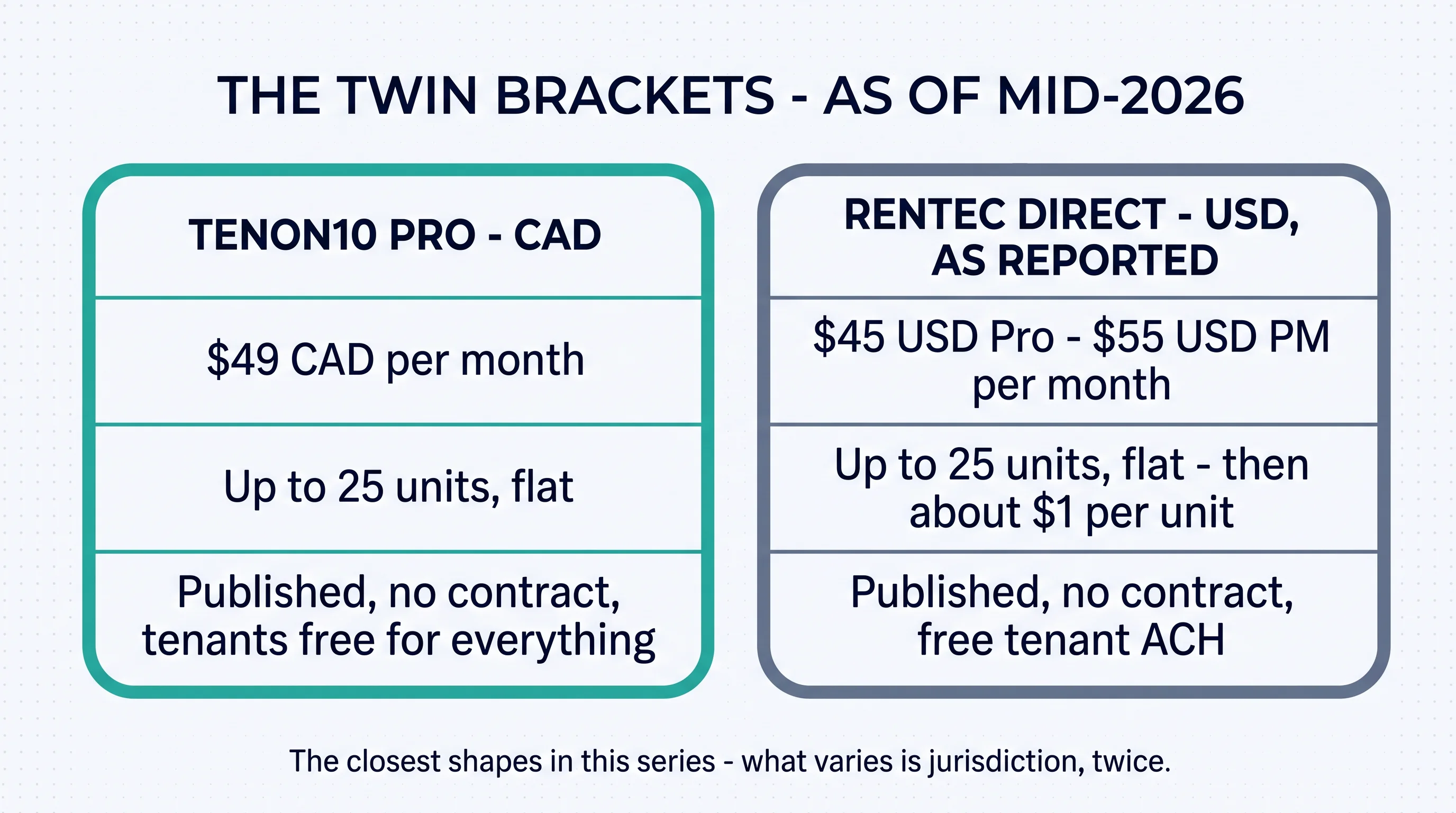
Name the coincidence plainly: near-identical brackets, near-identical stickers, matching ethics. And it's probably not a coincidence at all — both products drew their bracket where small-portfolio reality lives. Twenty-five units is roughly where a landlord stops being a person with properties and starts being a company with staff; software built honestly for the first group converges on the same ceiling from either side of the border, because the buyer's shape, not the vendor's ambition, drew the line. One drift note, once — their pricing appears as $45–$55 by plan, as $2.00–$2.50 per unit on their own blog, or as "$50 usage-based" on Capterra, depending where you read; same structure, different expressions, and their pricing page gives an instant quote by unit count, which is the number to actually use.
The two-question fit test
The shortest fit test in this series, because the twins cancel everything else.
1. Which jurisdiction is your bill in? If your revenue is CAD, then at twin brackets the exchange gap is most of the price gap — every month, permanently, at whatever the rate happens to be.
2. Which jurisdiction are your forms from? Name the notices you actually serve. At twin stickers, the compliance engine is the entire functional difference for an Ontario landlord — section five runs it in full.
And the growers' third question, flagged honestly for section six: past 25 units, their ladder continues and ours ends.
For landlords: When two tools are this evenly priced, decide on the work the subscription removes, not the subscription itself. Count the forms you served last year — every notice, every increase — and ask which platform would have filled them. That count is this comparison's real currency.
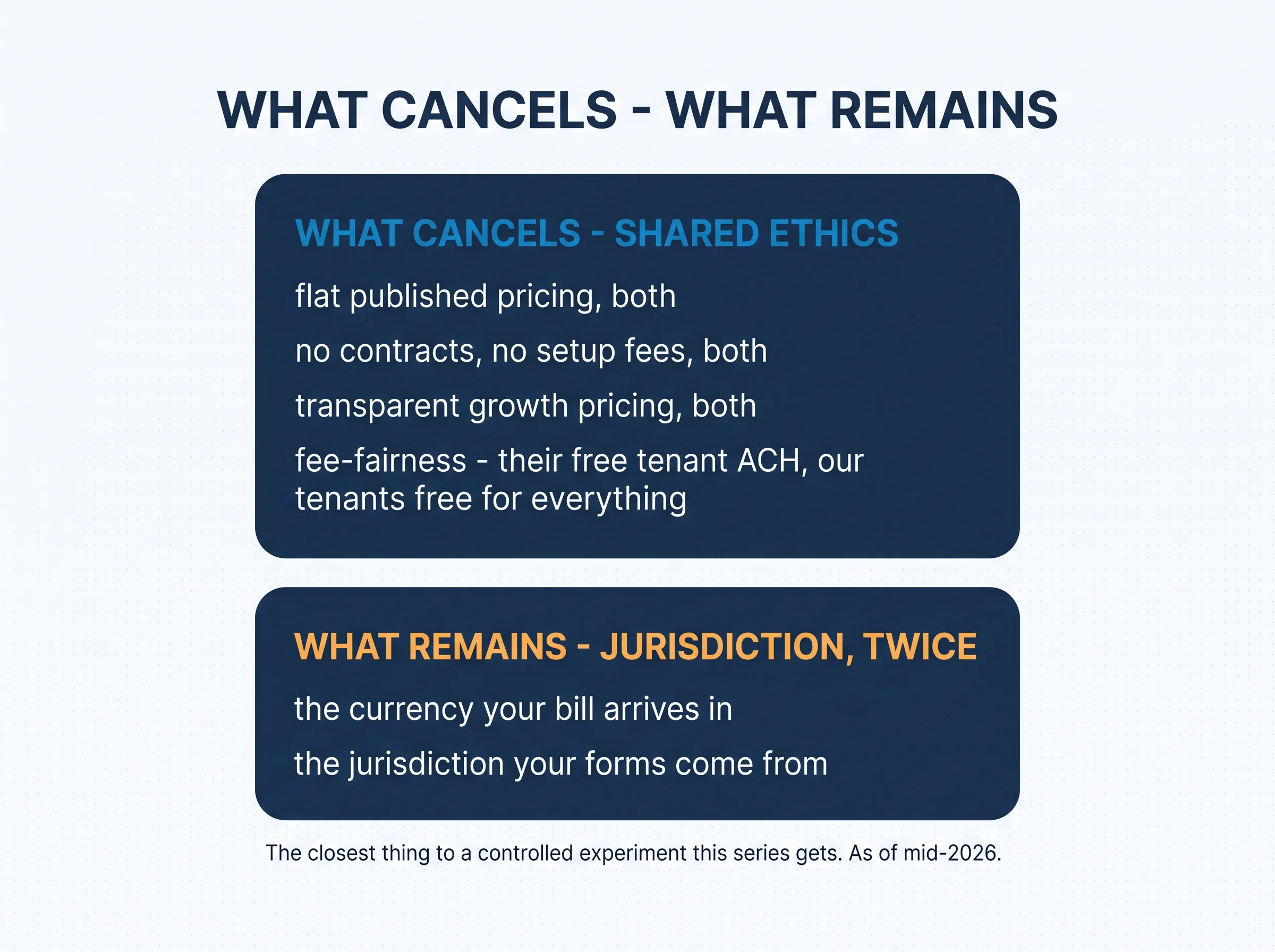
What cancels: the shared ethics
This series hasn't needed this section before, and it's a pleasure to write. Flat, published pricing: both — no sales calls, no quote gates. No contracts, no setup fees, no training costs: both — and their blog fairly claims rarity for a full-featured suite on that count. Transparent growth pricing: both — their roughly $1-per-unit continuation past 25; our published tier steps below it. And fee-fairness, where they've earned the first word: Rentec Direct includes free tenant ACH payments — the strongest tenant-fee credential among the US platforms in this entire series, and it deserves to be printed as exactly that. Ours is the fuller version of the same ethic, stated factually beside theirs: on Tenon10, tenants pay nothing for anything, on any tier — payments, portal, all of it.
The remaining fee facts, short and neutral: screening packages run $10–$18 (the premium package bundles a credit report with FICO score, national criminal search, and national eviction search); an optional electronic-cash route carries a $200 setup and $4.99 per payment, tenant-paid; and a few reviewers note extra charges for linking external services or multiple bank accounts. The consensus otherwise matches the ethos: reviewers call the pricing reasonable, clear, and free of hidden fees — 93% positive sentiment across 179 Capterra reviews, with support singled out as highly responsive.
Why spend a section on what cancels? Because shared ethics change how you should read the rest of this page. When a comparison involves a quote-gated or fee-layered vendor, the honest reviewer's first job is excavation — finding the real price under the advertised one. Here, both vendors put the real price on a public page, which means everything after this section is a genuine product comparison rather than an audit. That's rare enough in this category that it's worth saying: whichever way this page sends you, you'll be buying from a vendor that told you the truth on the first click.
What remains, part one: the currency
Run the twin-bracket math once, cleanly: $45–$55 USD versus $49 CAD, for the same twenty-five units. At the twin brackets, the exchange gap is most of the price gap — and it renews monthly, at whatever the rate is that month. We won't print a conversion table; rates move, and both pricing pages are current in ways this paragraph can't stay. The point is structural: identical brackets make the currency the visible variable it always was.
This is also why the twin brackets are analytically useful beyond this page: they isolate what USD pricing actually costs a Canadian buyer. In our earlier comparisons, the exchange premium hid inside bigger differences — scale floors, fee layers, category gaps. Here there's nowhere to hide: two flat stickers, same bracket, and the entire recurring price difference is the border. If you've ever wanted to know what "priced in USD" costs your operation as a clean number, run your own bank's rate against these two stickers this month — that's the experiment these twins make possible.
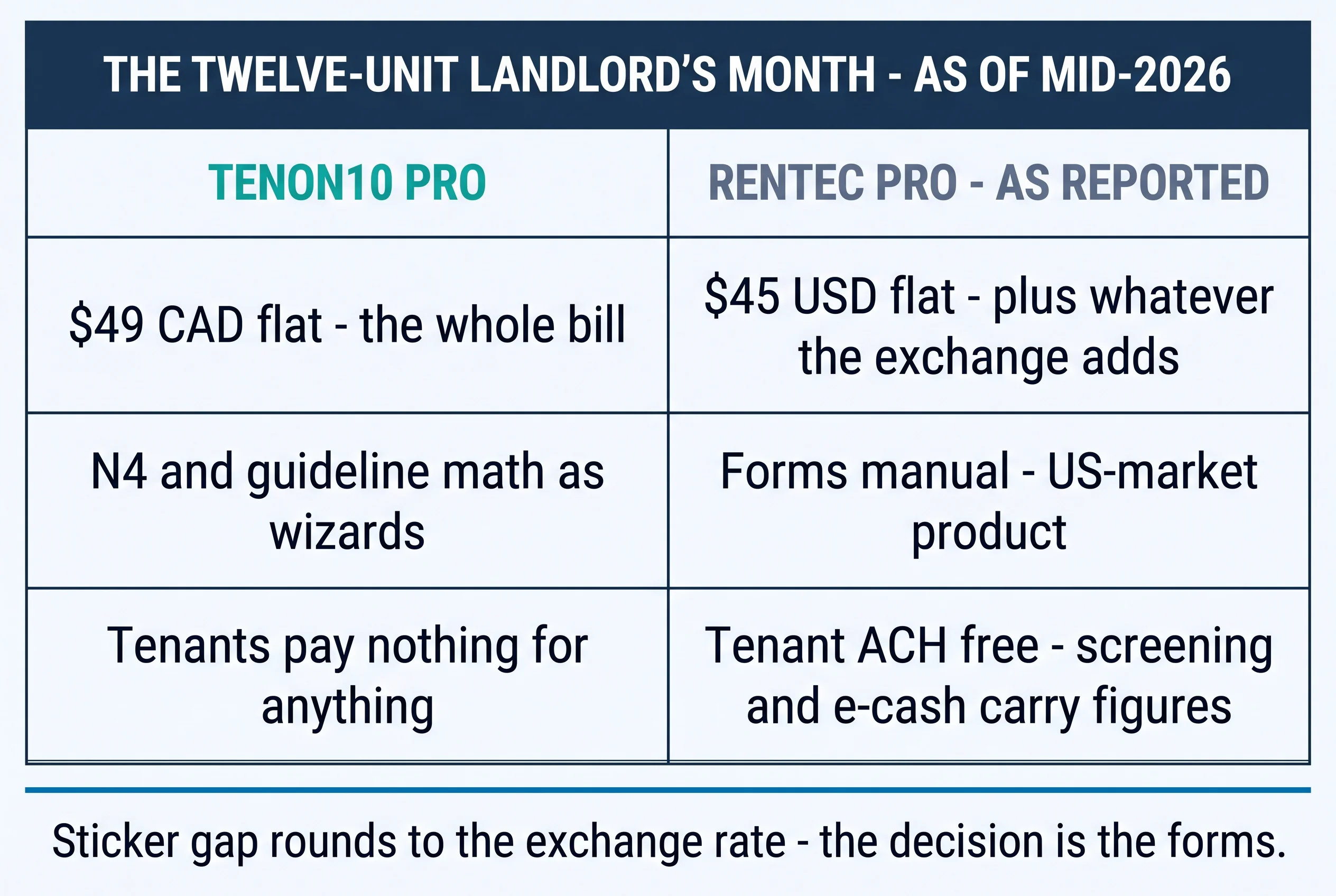
Beneath the sticker sits the quieter currency layer: statements in CAD, payment flows on Canadian rails, and books your accountant hands to the CRA without a conversion column appended to every month. At twin brackets, that operational fit is the part of "currency" that compounds — the exchange rate costs money; the conversion column costs attention, twelve times a year, forever.
What remains, part two: the forms
And here is the compliance gap at its purest — no fee noise, no scale noise, no assembled bill to distract from it. Rentec Direct ships US-market depth, with US-based support as part of its own marketed identity — the home market naming itself, and respectfully noted as exactly that. Which means the Ontario landlord's N4, the N1 with its guideline (2.1% for 2026, 1.9% for 2027 per our rent-increase guides), the standard lease, and the deposit-interest rule all live in the blank-PDF layer there — and as wizards and computed fields here: 20-plus LTB forms, math done, deposit and NSF rules encoded.
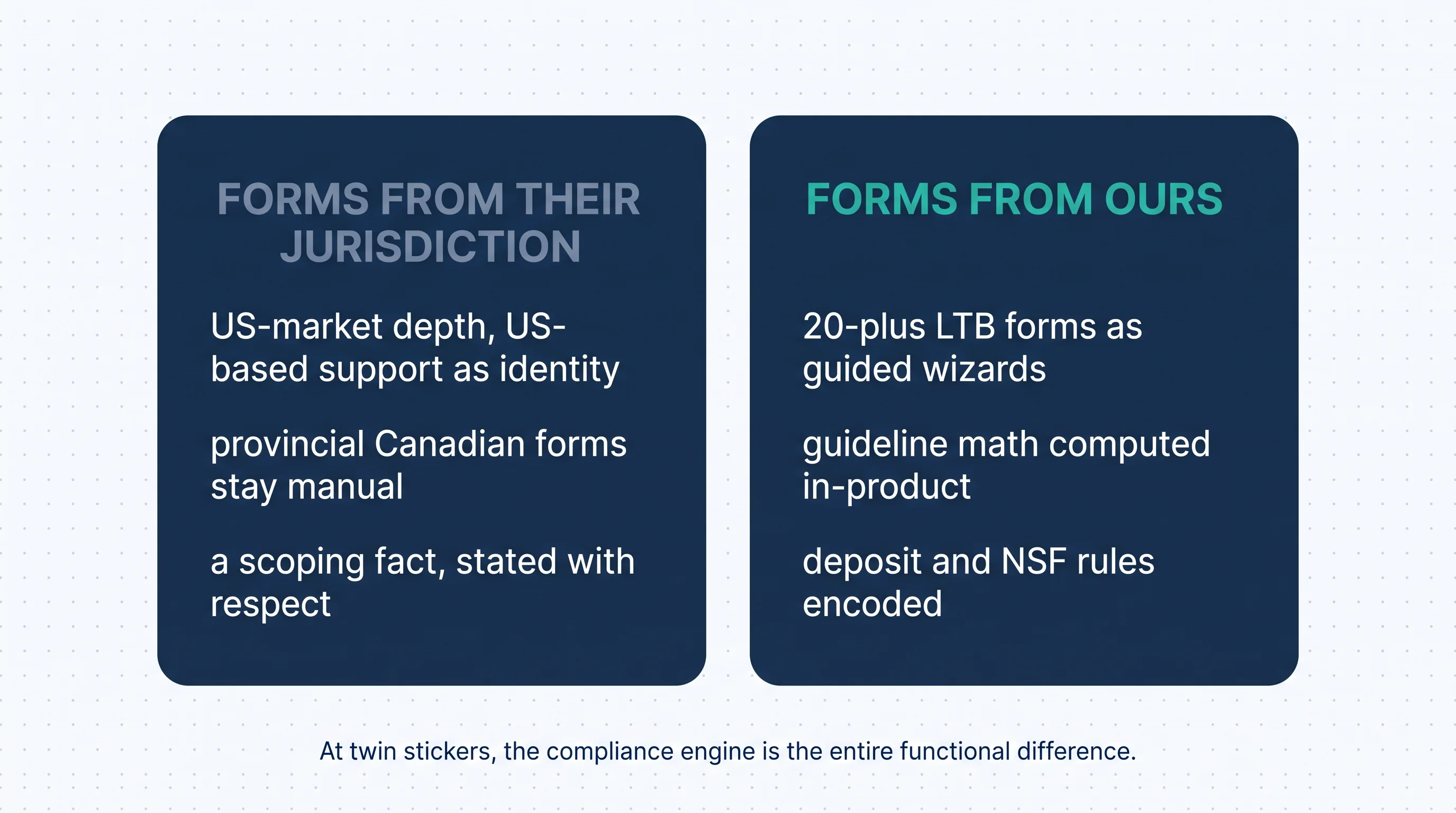
At twin stickers, this is the arithmetic that matters: the subscription gap rounds to the exchange rate; the evenings don't. Every notice drafted by hand, every guideline computed on a phone calculator, every deposit-interest rule held in memory is the actual price difference between these two products for an Ontario landlord — and it's a difference the pricing pages will never show you.
Make it concrete with the form-count test from the fit test above: an Ontario landlord at twelve units who served four notices last year — one N4 that resolved, one N1 round at guideline time across the building, an entry notice cluster for a furnace repair — did an evening's careful work per event by hand, or a few guided minutes per event in-product. Multiply by your own count. That product, not the twin stickers, is this page's real price comparison — and it's different for every reader, which is exactly why the fit test asks you to count.
For property managers: One genuine Rentec specialist feature deserves your attention — trust accounting on the PM tier. If your management model carries trust obligations, that's a real point in their column: check your province's requirements before weighing it, and note honestly that our answer is per-unit records and message history, not trust ledgers. Specialist needs deserve specialist tools.
Past 25 — and the run-both week
The structural difference for growers, printed plainly: Rentec's ladder continues. Past 25 units, pricing runs at roughly $1.00 per unit or less, all the way to 5,000, with the same no-contract transparency the whole way — the gentlest growth pricing in this series. To be precise about how that differs from our TenantCloud page's verdict: that platform was the cheapest willing option past our cap; Rentec is the smoothest — no tier cliffs, no minimums, just a clean per-unit slope with the ethics intact. Ours ends at 25 on purpose, and past it we wave you across with genuine respect: a grower who chose Rentec for its transparency chose it for the right reason.

The run-both week, this series' standing tradition: their two-week trial and our permanent free tier both open without friction. Same three tasks, same day, side by side — log a maintenance request, generate a rent receipt, and draft the notice you most recently served. That third task is this page's sections four and five performed by hand: in one system you'll meet your province's form as a guided wizard; in the other, capable generic tooling and a gap shaped like the RTA. Ten minutes, and the twin brackets stop being twins.
One honest scheduling note for the two-week window: run the test in a normal week, not a quiet one — the comparison you need is between the two tools on the days your rentals actually generate work. A quiet week makes every platform look adequate; a Tuesday with a late payment and a repair request is where the two systems show you who they were built for.
Switching in either direction: the checklist above carries the sequence. One Rentec-specific note: their free one-on-one onboarding is real and marketed, and reviewers speak well of their support — but export-first discipline applies no matter who's helping you move, in both directions, always.
Same ethics, your currency, your forms: the free tier proves it in five minutes — up to 3 units, no card, tenants free for everything, and the N1 as a wizard. Create a free account or see current plans.
The Switcher's Checklist: Moving Your Canadian Rentals to New Software
The 18-point sequence for changing property management software without losing a record, a payment, or a rent cycle — the fit test to run before any demo, the exports to secure before you cancel anything, the parallel month that catches every mapping error, and the clean cutover that keeps CRA-ready archives. Works whichever platform you're leaving and whichever you're joining.
Get Free PDF →Key takeaways
- The twin brackets: $45–$55 USD and $49 CAD for the same 25 units — the closest shapes this series will see.
- What cancels: flat published pricing, no contracts, no setup fees, and real fee-fairness on both sides — their free tenant ACH honoured, our tenants-free-for-everything stated.
- What remains, first: the currency — at twin brackets the exchange gap is most of the price gap; label before comparing, always.
- What remains, second: the forms — at twin stickers, the compliance engine is the entire functional difference for an Ontario landlord; the subscription gap rounds to the exchange rate, the evenings don't.
- For growers: their ~$1-per-unit continuation is the gentlest path past 25 in this series — the smoothest, where our TenantCloud page's verdict was the cheapest; our cap ends at 25 on purpose.
- Run both free — two-week trial there, permanent free tier here; draft your latest notice in each and let ten minutes decide.
Two honest tools, twin brackets, two jurisdictions
That's the cleanest comparison this series runs, and the credit belongs to both vendors' honesty: when two tools publish flat prices at the same bracket with no contracts and no games, a comparison page can't hide behind complexity, and shouldn't want to. Rentec Direct is what transparent US property software looks like — fair to tenants, gentle to growers, clear on every page — and if your operation lives in its jurisdiction or grows past our cap, choose it knowing it runs the same ethics we do. Tenon10 is the same shape drawn in Canadian ink: the twin bracket in your currency, tenants free for everything, and Ontario's forms — the N4, the guideline, the lease, the deposit math — as the product instead of the evening. Twin brackets, two jurisdictions. Pick yours, and either way you'll have chosen honestly-priced software — which, this series keeps finding, is rarer than it should be.
The twin bracket, in your currency
$49 CAD flat for up to 25 units — published, no contract, tenants free for everything, and Ontario's LTB forms as guided wizards. Start on the free tier and meet your forms as wizards in five minutes.
Free for up to 3 units • Tenants always free • See current plans
Related resources
- Property Management Software: What to Look For — the full-market evaluation framework.
- Tenon10 vs TenantCloud — the budget tier's cheapest path past 25, where this page covers the smoothest.
- How to Use the N4 Notice in Ontario — the form at the centre of what remains.
- Ontario Rent Increases: The Complete N1 Guide — the guideline math the twin stickers can't twin.
Frequently asked questions
Is Rentec Direct available in Canada?
It's US-built and USD-priced, with US-based support as part of its marketed identity, and it doesn't market Canadian provincial compliance tooling. Canadian landlords can use it; the practical considerations are the exchange premium at the twin brackets and the forms staying manual — the two things this whole comparison turns on.
How much does Rentec Direct cost?
As of mid-2026: Rentec Pro at $45 USD/month and Rentec PM at $55 USD/month, each covering up to 25 units, then roughly $1.00 per unit or less as portfolios grow toward 5,000 — with no setup fees, no contracts, no training costs, free tenant ACH, free onboarding, and a two-week trial. Their pricing page gives an instant quote by unit count; use that number.
Does Rentec Direct charge tenants fees?
ACH rent payments are free for tenants — the strongest tenant-fee credential among the US platforms in this series, and it deserves the credit. Optional routes carry figures: an electronic-cash option at $4.99 per payment (tenant-paid, after a $200 setup) and screening packages at $10–$18. On Tenon10, tenants pay nothing for anything, on any tier.
Which is better for an Ontario landlord with up to 25 units?
At twin stickers, the decision compresses to two questions: the currency your bill arrives in, and whether your province's forms are in the product. Tenon10's Pro at $49 CAD covers the same 25 units with the N4, N1, guideline math, and deposit rules as wizards; on Rentec those stay manual. Run both free and draft your latest notice in each — ten minutes settles it.
What if I'm growing past 25 units?
Rentec's continuation — about $1 per unit or less past 25, to 5,000 units, with the same transparency — is the gentlest growth pricing this series has found, and our 25-unit cap means we don't compete there. Price the trade honestly: the compliance work stays manual at portfolio scale, and your annual form count is where the real crossover lives.


