

This is the last comparison in our series, and it's about a kinship. Both of these tools care about the same buildings — the scattered houses, duplexes, and townhomes that make up most of Canadian renting. Propertyware has served them for almost twenty years, and its own materials say precisely for whom: the industry's largest and most successful single-family property management companies. RealPage-owned, serving firms up to 10,000 units, built by single-family experts for single-family firms.
That's not a flaw to expose; it's a fact to price. Because a Canadian landlord with three houses and a duplex is a single-family operator too — and every mechanism on Propertyware's pricing page, from the monthly floors to the implementation fee to the fifty-unit billing blocks, is a sentence in a job description that isn't describing them. This page runs that arithmetic honestly, credits what two decades of focus builds, and closes our nine-part series with the finding it kept arriving at from every direction.
The Switcher's Checklist: Moving Your Canadian Rentals to New Software
The 18-point sequence for changing property management software without losing a record, a payment, or a rent cycle — the fit test to run before any demo, the exports to secure before you cancel anything, the parallel month that catches every mapping error, and the clean cutover that keeps CRA-ready archives. Works whichever platform you're leaving and whichever you're joining.
Get Free PDF →The kinship, and the two populations
Choose Propertyware if you run a single-family property management company — dozens to thousands of doors, staff, owner clients — and want twenty years of purpose-built SFR depth: customizable workflows and reports, owner and tenant portals, full accounting, marketing, screening and payments in the Basic core, with two-way texting, eSignature, and inspections arriving at Plus and vendor portals and maintenance projects at Premium, per the official checkmark grid. (One recent read described the three tiers as identical but for price; the vendor's own grid differentiates them, and the grid is the reference.) Optional add-ons extend the fleet toolkit: maintenance and leasing contact centres, professional websites, tenant insurance.
Choose Tenon10 if you are the other population: the person with the handful — flat CAD pricing with no floors, no blocks, and no implementation fees, tenants free on every tier, and your province's forms as the product.
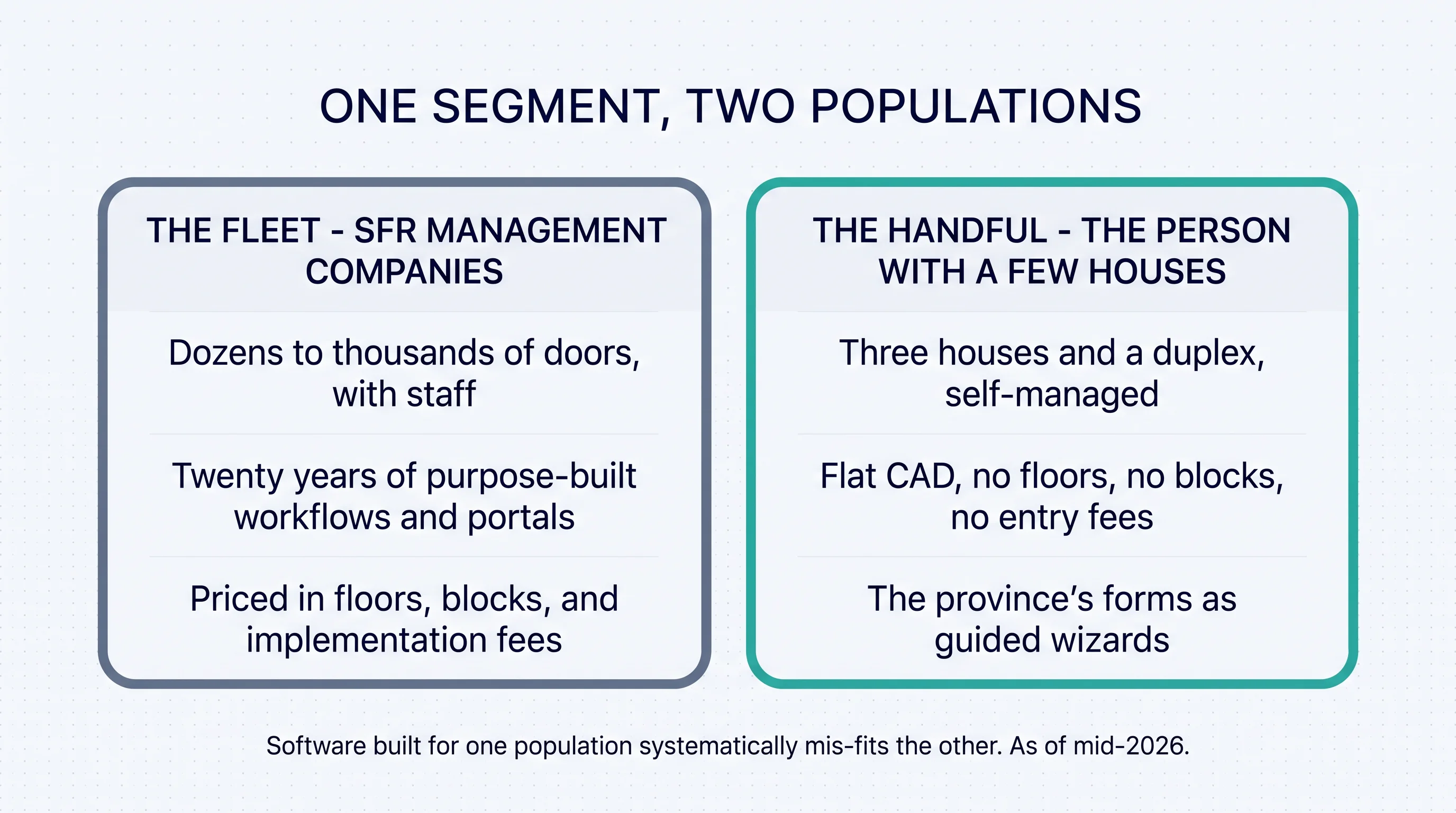
The segment truth this page turns on: single-family is one segment with two populations — companies with fleets, and people with handfuls — and software built for one systematically mis-fits the other, in both directions. Their fleet tooling would drown a four-door landlord in unused process; our handful tooling would starve a two-hundred-door firm of owner reporting. Neither is a criticism. Both are design. And the symmetry is worth a sentence, because this series has mostly run one direction: a fleet on handful software loses the owner statements, the delegation controls, and the process rails that keep forty tenancies from becoming forty inboxes — the mis-fit costs them exactly what the mis-fit in the other direction costs you. Right-sizing isn't settling; it's the whole job of choosing.
The two-question fit test
1. Fleet or handful? Count doors and staff honestly. Dozens-plus with employees and owner clients: their twenty years is genuinely yours, and the next sections price it fairly. A handful, where you serve the notices yourself: the arithmetic below was written about you.
2. The forms, as always. Name the notices you serve — section five gives this series' standing question its most personal frame.
And the closer's method, stated once for the whole series: read any platform's pricing mechanics as a job description — floors, blocks, minimums, meters — and apply to the one describing you.
For landlords: The job-description reading takes five minutes on any pricing page: find the minimum, find the rounding unit, find the entry fee — then ask who those three numbers are rounding errors for. If the answer isn't you, the features were never the question.
The mechanics as a job description, dated
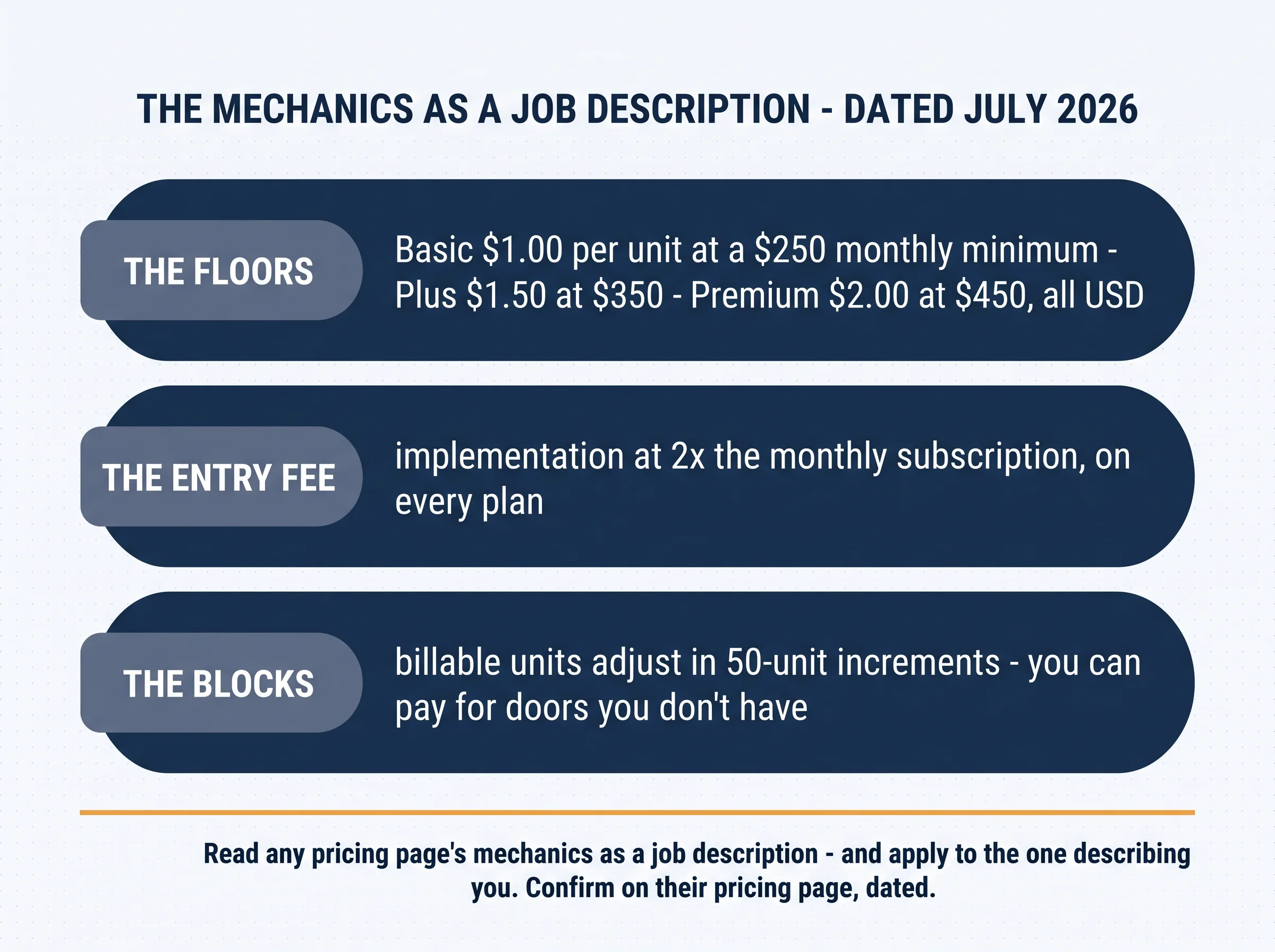
The three floors, per official-page reads from July 2026 (all USD): Basic at $1.00 per unit with a $250 monthly minimum; Plus at $1.50 with $350; Premium at $2.00 with $450. The entry fee: implementation at twice the monthly subscription, on every plan — corroborated across the official page and a February analysis. And a mechanic this series hasn't met before: billable units adjust in 50-unit increments — their own pricing page's words — which a July teardown of that page translates plainly: you can pay for doors you don't have. Rounding portfolios to the nearest fifty is the purest scale statement in these nine comparisons: it only makes sense where fifty is a rounding error. And read fairly, that's precisely the point: billing a 340-door firm in 50-unit blocks simplifies invoicing for both sides, the way a freight carrier bills by the pallet rather than the parcel. The mechanic isn't hostile — it's fluent in a language spoken at a size you may not be. Pallet pricing tells the parcel shipper everything they need to know.
The worked arithmetic, sourced: at 50 units, the floors put the bill at $250–$450 a month — $5 to $9 effective per unit — plus $500–$900 in implementation; at 150 units, the minimums still set the price on every tier. And the kinship case, fresh: a four-door Ontario landlord — three houses and a duplex, the most Canadian portfolio in this series — pays the $250 Basic minimum: an effective $62.50 per unit per month, plus a $500 implementation fee before the first rent posts. Against: $9.99 CAD flat covering all four doors here, with the N4 as a wizard. Nothing is wrong with either product; one of them was priced for someone else.
The fee footnotes, neutral and dated: screening and payments carry per-transaction fees; Enterprise/API access adds $1 per unit to any package; there's no free version and no trial per current directories; and contract length and price-lock terms aren't published on the pricing page — ask for both, in writing.
What twenty years builds
Now the respect section, because it's owed. Two decades of vertical focus builds what generalists can't: workflows shaped by how scattered-site management actually runs, owner reporting that a fleet's clients expect on the first of the month, custom report builders that survive audits, and add-ons that only make sense with real call volume — maintenance and leasing contact centres at $1.10 and $2.85 per unit with $300 setups, professional website hosting at $99 a month, tenant insurance at $12 a policy. That's firm infrastructure, coherently priced for firms — and the reviewer texture matches the deep-tool arc: mixed at first, then strongly positive "once you get the hang of it," which is what twenty years of depth feels like from the inside. Vertical focus compounds in small ways generalists never accumulate: scattered-site maintenance routing that assumes the properties don't share a boiler room, owner statements shaped by two decades of owner questions, make-ready workflows that know a vacant house is different from a vacant unit. None of that shows up in a feature-list comparison, and all of it shows up in the third month of running two hundred doors.
The honest send, plainly: if you're a 60-plus-door single-family management firm reading this page, Propertyware was built about you, by people who have done nothing else for twenty years. Evaluate it seriously — against the company-scale platforms from earlier in this series, not against us, because our 25-unit cap took us off your shortlist before your first paragraph.
The forms — where compliance is most personal
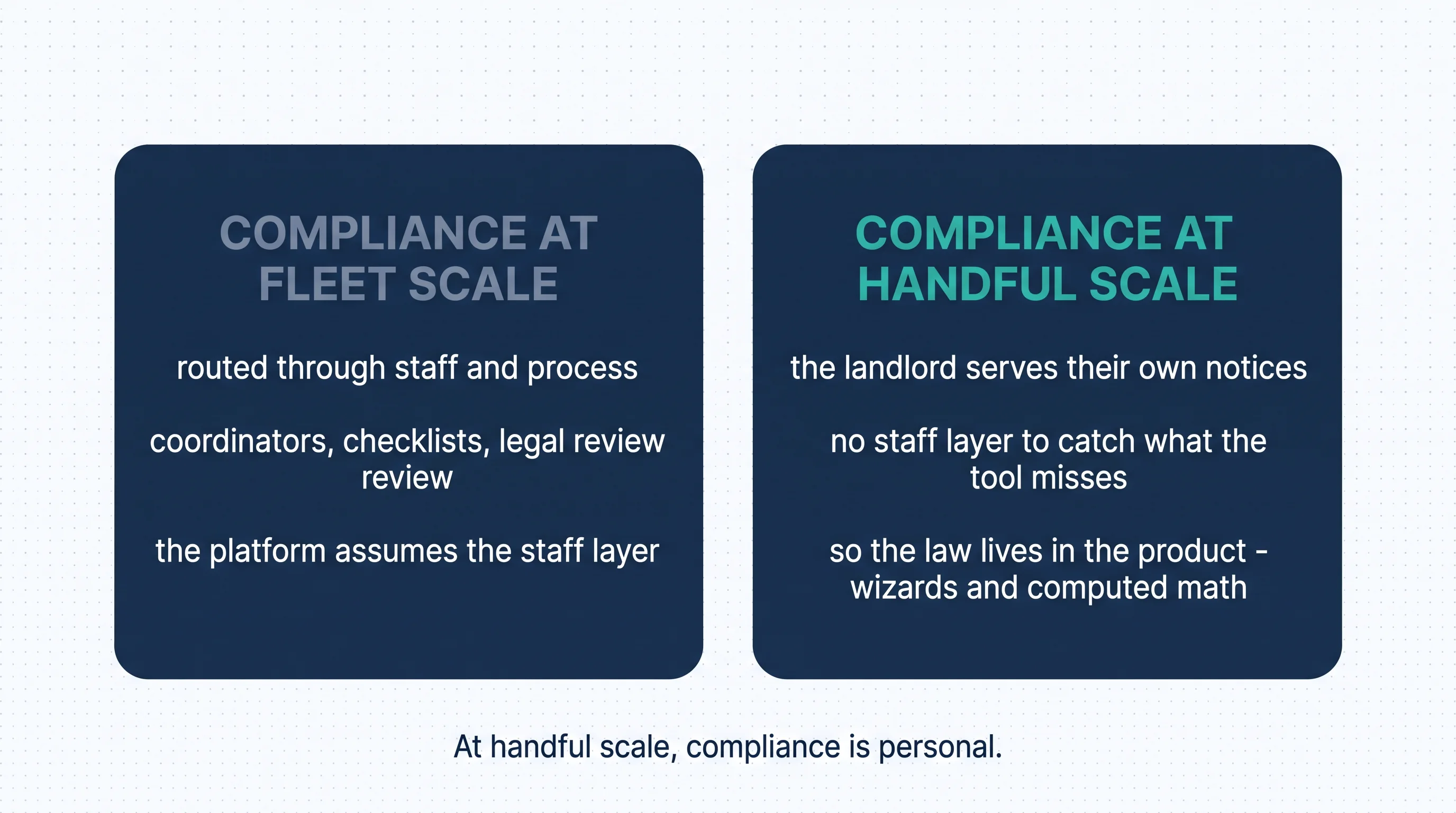
The series' standing question gets its most personal frame on this page, because single-family is where compliance has no buffer. At fleet scale, compliance routes through staff and process: trained coordinators, checklists, legal review — the platform assumes a staff layer, reasonably, because its buyers have one. At handful scale, compliance is personal: the landlord serves their own N4, calculates their own guideline increase, holds their own paper trail — and there's no staff layer to catch what the tool doesn't.
That's exactly why person-scale software has to put the law in the product. On Tenon10: 20-plus LTB forms as guided wizards, the guideline computed at 2.1% for 2026 and 1.9% for 2027 per our rent-increase guides, deposit and NSF rules encoded, and records assembling as they happen — the N4 as fields, not homework. On Propertyware: a US-market product where provincial Canadian compliance isn't part of the toolkit — at fleet scale their buyers staff that gap as a matter of course; at handful scale, you'd be the staff. Concretely: the four-door landlord serving an N4 this month either has a wizard that fills the form, computes the dates, and files the copy — or has an evening with a blank PDF, a government guide, and the quiet hope that the service date math is right. The stakes are personal too: at fleet scale a form error is a process finding; at handful scale it's your hearing, your adjournment, your months.
For property managers: The split runs through PM firms too. Canadian SFR firms at fleet scale: their infrastructure case is real, with the compliance layer remaining your staff's process — price that process into the comparison. Micro-PMs at handful scale under 25 doors: the wizard side is yours, because you ARE the staff layer, and the wizards are how one person absorbs a management book's notice volume.
The series' finding
Nine comparisons, and here's each in one honest clause: Buildium's 20-unit design floor said mid-portfolio. AppFolio's 50-unit sales floor said enterprise. DoorLoop's tier-priced fees said transaction volume. liv.rent filled a different phase of the tenancy — and filled it well. TenantCloud's unlimited units said budget growth. Rentec Direct's twin bracket ran our ethics one border over. Landlord Studio's ledgers served the books-led as genuinely as our wizards serve the forms-led. Yardi Breeze's minimums said ecosystem. And Propertyware's fifty-unit blocks say fleet.
Every platform's mechanics named its buyer — and the Canadian small landlord was nobody's named buyer until the Canadian tools said the name. Flat CAD with no floors, free tiers with no clocks, tenants who never pay, and provincial forms as wizards: those are mechanics too, and they're the same kind of statement — a job description, aimed at last at the person with the handful.
One more thing these nine pages kept finding, worth saying at the close: the honest vendors made honest comparison possible. The published prices, the free trials, the vendors' own buyer guidance that sometimes argued against their own sale — every page in this series leaned on competitors telling the truth about themselves, and the category is better than its reputation because of it. We've tried to return the favour on every page, this one included: our cap printed plainly, our gaps named, our figures dated like everyone else's.

So take the method rather than the prices, because the method is what outlives them: read the mechanics like a job description, and take the job that describes you. The run-what-you-can note, honestly: there's no trial on their side, so the empirical week this series keeps recommending only half-works here — but our free tier runs regardless, and the handful reader can prove one side of this comparison for nothing.
Switching notes, last of the series: the shared checklist above carries the sequence; on this platform specifically, implementation fees are sunk on entry — factor twice-the-monthly into any switch-to-try plan, and with no trial, the parallel month runs on a paid plan from day one.
Built for the handful — free to prove it: flat CAD, no floors, no blocks, no entry fees, tenants free forever, and Ontario's forms as wizards. Up to 3 units free, five minutes to see it. Create a free account or see current plans.
The Switcher's Checklist: Moving Your Canadian Rentals to New Software
The 18-point sequence for changing property management software without losing a record, a payment, or a rent cycle — the fit test to run before any demo, the exports to secure before you cancel anything, the parallel month that catches every mapping error, and the clean cutover that keeps CRA-ready archives. Works whichever platform you're leaving and whichever you're joining.
Get Free PDF →Key takeaways
- Single-family has two populations — companies with fleets and people with handfuls — and both of these tools are honest about which one they serve.
- The mechanics are the job description: $250–$450 monthly floors, implementation at twice the monthly, and 50-unit billing blocks — all dated July 2026, all describing a fleet.
- The kinship arithmetic: four doors at the Basic floor is an effective $62.50 per unit plus implementation; $9.99 CAD flat covers all four here, with the wizards riding along.
- Twenty years of SFR focus is real — fleet-scale firms should evaluate Propertyware seriously, with contract terms and full first-year cost in writing, since there's no trial and terms aren't published.
- At handful scale, compliance is personal — no staff layer catches what the tool misses, which is why the law lives in the product here: wizards, computed guideline, encoded rules.
- The series' method outlives its prices: read any pricing page's mechanics as a job description, and take the job that describes you.
Same houses, different sized owners
Nine comparisons end where they were always heading: at the name on the job description. Propertyware closes the series as the clearest case of the pattern — a genuinely deep tool whose every mechanism, from the floors to the blocks to the entry fee, names a buyer with a fleet; twenty years of focus deserves that clarity, and gets it here. Tenon10 is the other name for the other population: the person with three houses and a duplex, a notice to serve this month, and no staff but themselves — flat CAD, no floors anywhere, tenants free, and Ontario's law as fields instead of homework. Same houses. Different sized owners. Different right tools — and after nine pages of mechanics, the choosing takes five minutes: find the minimum, find the rounding unit, find the entry fee, and take the job that describes you.
Built for the handful
Flat CAD pricing with no floors, blocks, or implementation fees, tenants free forever, and Ontario's LTB forms as guided wizards with the guideline computed. The job description that finally says your name — free for up to 3 units.
Free for up to 3 units • Tenants always free • See current plans
Related resources
- Property Management Software: What to Look For — the durable version of everything this series taught.
- Tenon10 vs Buildium — where the series began, with the full compliance-gap treatment.
- Tenon10 vs AppFolio — the louder scale filter, and the effective-rate method.
- Tenon10 vs Yardi Breeze — the quieter one, with every figure dated.
- How to Use the N4 Notice in Ontario — the form the handful serves personally, done properly.
Frequently asked questions
Does Propertyware have a monthly minimum?
Yes — per official-page reads from July 2026: $250/month on Basic ($1.00/unit), $350 on Plus ($1.50), and $450 on Premium ($2.00), with billable units adjusting in 50-unit increments and an implementation fee of twice the monthly subscription on every plan. Confirm current figures on Propertyware's pricing page, dated.
How much does Propertyware cost for a small landlord?
The floors set the price: four doors under the Basic minimum cost $250 USD/month — an effective $62.50 per unit — plus a $500 implementation fee, before per-transaction fees for screening and payments. The pricing was built for fleets: at 50 units it works out to $5–$9 per unit, which is the scale the mechanics assume.
Is Propertyware good for single-family landlords?
For single-family property management companies, genuinely — twenty years of purpose-built depth, from customizable workflows to owner portals to optional contact centres. For the individual landlord with a handful of houses, every pricing mechanism points elsewhere — and Canadian provincial compliance isn't part of the product at any scale.
Does Propertyware offer a free trial?
No — no free version and no trial per current directories, and contract length and cancellation terms aren't published on the pricing page. Whatever your size, get the full first-year cost and the exit terms in writing before signing.
Which fits a Canadian landlord with a few houses?
The handful population is exactly who Tenon10 was built for: $9.99 CAD flat covers up to ten units (free up to three), with no floors, blocks, or implementation fees, tenants free on every tier, and Ontario's N4, N1, and guideline math as wizards. Same houses as the fleet — different sized owner, different right tool.


