

Here's the shortest honest comparison you'll read: according to third-party pricing verification published in mid-2026, AppFolio doesn't offer its platform to portfolios under 50 units. So if you're a Canadian landlord with a duplex, a fourplex, or anything under two dozen doors, one of these platforms won't take you as a customer — and the other one was built for you. That's most of the answer, and it took one sentence.
The rest of this page covers what the sentence doesn't: how AppFolio's per-unit model actually prices out and where its minimums stop biting, the fee structure worth understanding before your tenants meet it, where its enterprise AI genuinely earns its price at genuine scale — and the three-question fit test for the rare reader who's actually near the line. As with our Tenon10 vs Buildium comparison, the goal is accuracy, not a victory lap: AppFolio is excellent at the job it was built for. The question is only whether that job is yours.
The Switcher's Checklist: Moving Your Canadian Rentals to New Software
The 18-point sequence for changing property management software without losing a record, a payment, or a rent cycle — the fit test to run before any demo, the exports to secure before you cancel anything, the parallel month that catches every mapping error, and the clean cutover that keeps CRA-ready archives. Works whichever platform you're leaving and whichever you're joining.
Get Free PDF →The fifty-unit line
The verdict up front, floor first. AppFolio is premium enterprise software: per-unit priced, AI-equipped on its upper tiers, and — by reviewers' read of its own minimums — genuinely targeting the 200-to-5,000-unit range. Third-party verification published in June 2026 reports that it doesn't take portfolios under 50 units at all; AppFolio doesn't publish pricing openly, so confirm directly, but small landlords should plan on the floor being real. Tenon10 is Canadian-first software that caps at 25 units on purpose: flat CAD pricing that's published, tenants who never pay, and — in Ontario — the LTB forms as guided wizards with the rent-increase guideline computed in-product.
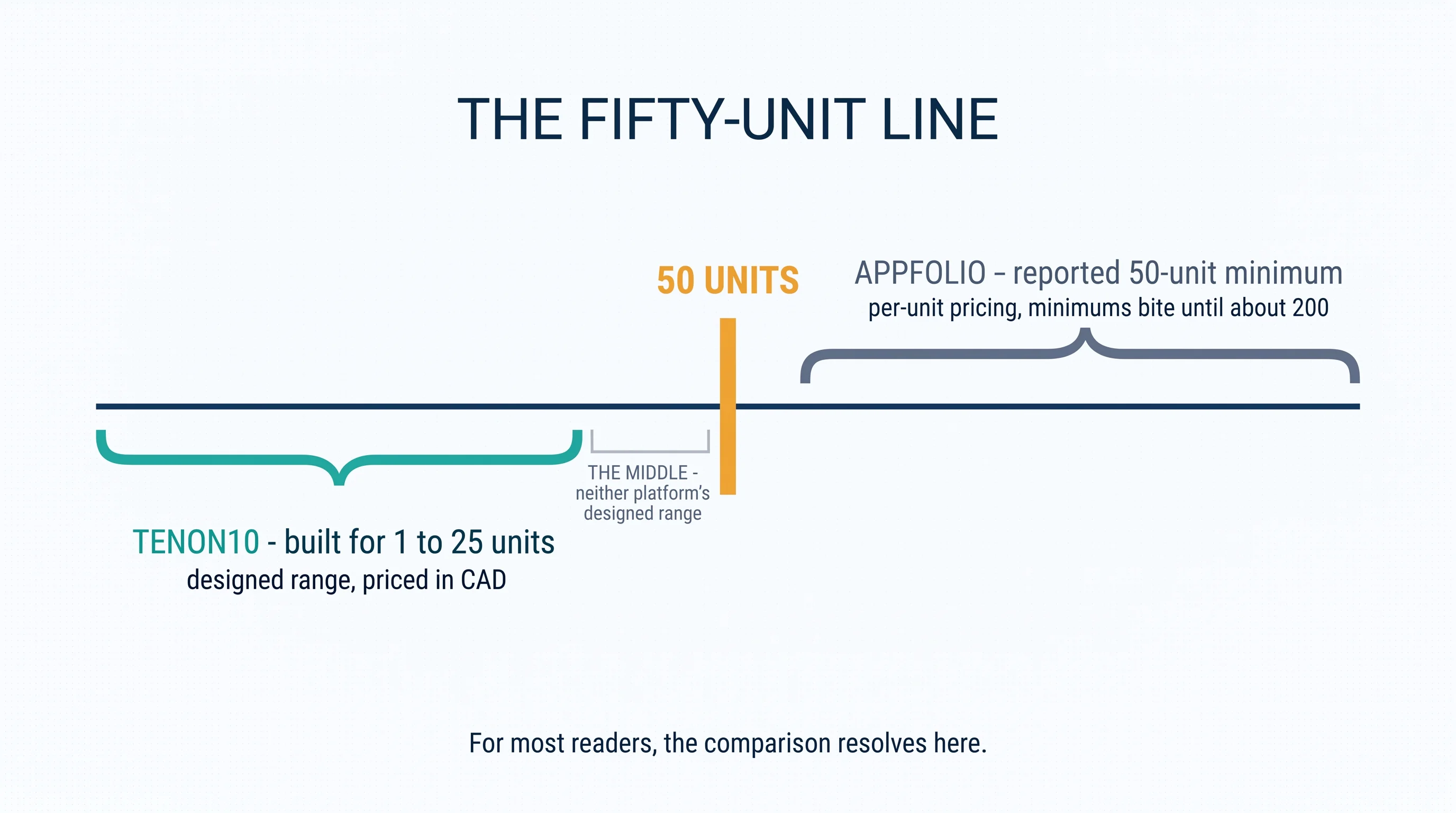
Why does this page exist at all, if the floor decides? Because US software listicles rank AppFolio in their top three for "landlord software" without mentioning it, and Canadian landlords with six units arrive mid-funnel, wondering whether they should be budgeting for it. One sentence saves them a sales call. And for the genuine 50-plus-door Canadian operator, the comparison deserves a real hearing rather than a dismissal — which is the rest of this page.
There's also a diligence lesson in how we know the floor at all: because AppFolio quotes pricing through sales rather than publishing it, the figures on this page come from third-party pricing guides verified between March and June 2026 — and those guides don't perfectly agree with each other, which is why every number here is a range. That's not a criticism; it's the normal texture of enterprise pricing. But it does mean the small landlord's usual research method — open two pricing pages, compare — doesn't work here, and a page like this one has to do the assembling.
The frame in one line: for most readers, this comparison resolves at the sales floor, not the feature list — and that's product focus on both sides, not failure on either.
The three-question fit test
Our Buildium comparison needed five questions; this one needs three, because the floor does most of the work.
1. Doors. Under 25 units: you're in Tenon10's designed range, and the reported floor means AppFolio isn't offering you a decision to make. Between 26 and 49: honestly, you're between both products' designed ranges — above our Pro tier's 25-unit cap, below their reported floor — and our software evaluation guide covering the full market is your better read. Fifty and up: keep going, AppFolio becomes a real option here.
2. Trajectory. If you're heading past 200 professionally managed doors, AppFolio's minimums stop biting, its per-unit model prices as advertised, and its stack starts earning its keep. If you're parked at 50 to 100 with no plans to triple, you're paying 200-unit pricing on the way to somewhere you may not be going — the math below makes that concrete.
3. Who pays. Model the transaction-fee allocation at your actual door count — including vacant units — against a platform where tenants pay nothing. The fee section below lays out both structures.
For landlords: The first diligence question for any platform with unpublished pricing — ours never applies, theirs does: "What are your minimums, monthly and portfolio-wide?" Ask it in writing, before the demo. A platform's minimums tell you who it was built for faster than any feature tour.
Price: the headline rate and the effective rate
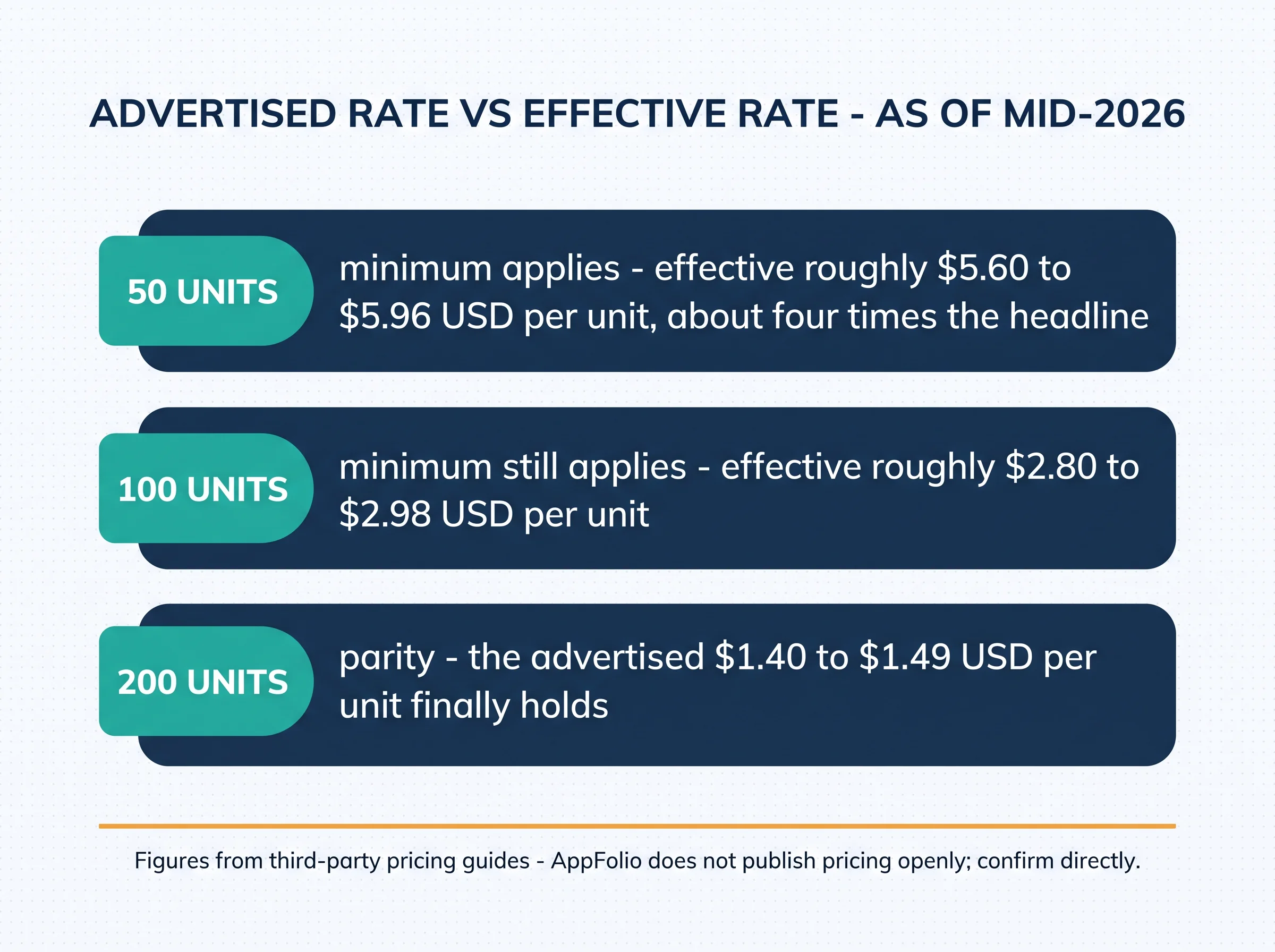
AppFolio's model (all figures USD, as of mid-2026, from third-party pricing guides — AppFolio doesn't publish pricing openly, so confirm directly): per-unit tiers reported at roughly $1.40–$1.49 per unit per month for Core, $3.00–$3.20 for Plus, and $5.00 for Max — with monthly minimums of roughly $280–$298 (Core), $900–$960 (Plus), and $1,500 (Max). Onboarding fees are reported at $400 to $1,000-plus, with some sources describing them as equivalent to two months of service. There's no free trial.
The effective-rate math is the part every small operator needs to run. A headline of $1.40 per unit sounds like $70 a month for 50 units. It isn't — the monthly minimum means a 50-unit portfolio pays roughly $280–$298, which works out to an effective $5.60–$5.96 USD per unit: about four times the advertised rate. The pricing guides' own arithmetic has the minimum only stop biting around 200 units, where $1.40 × 200 finally meets the floor. That's not a trick; it's a floor doing what floors do. The buyer's job is simply to run the numbers at their own count, not the count in the headline.
Tenon10's model (all figures CAD, flat, published): Free at $0 for up to 3 units — the product, not a trial; Essentials at $9.99 CAD/month for up to 10; Pro at $49 CAD/month for up to 25; tenants free on every tier; no per-transaction fee layer. Current figures always on the pricing page. One factual note on the difference in posture: quote-based pricing is normal enterprise practice — and it's also a signal about the intended buyer. Platforms built for procurement processes price through sales calls; platforms built for a landlord with four doors put the number on a public page.
The fee layer, and who pays it
Cost-analysis sites report that AppFolio changed its transaction pricing in 2024, giving property managers a choice: pay $1 USD per unit per month across the entire portfolio — vacant units included — or pass a $2.49 USD fee per ACH transaction onto residents. Card payments run 2.99%, debit cards $9.99 per transaction, and electronic cash payments $3.99.
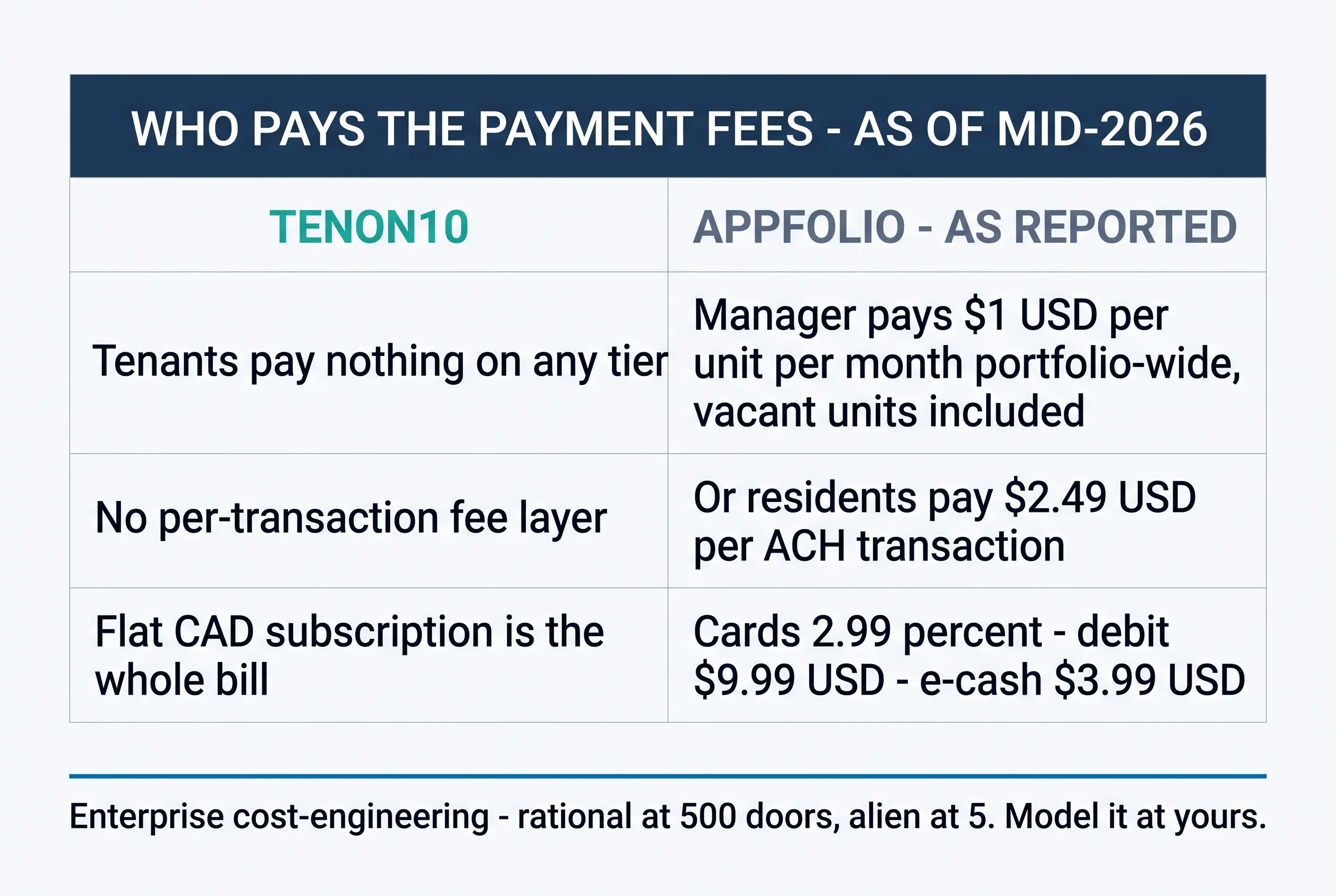
Read that neutrally, because it deserves to be: this is enterprise cost-engineering. At 500 doors, $1 per unit is a predictable budget line, and passing payment fees to residents is a policy decision made by a team that writes policies. It's rational allocation for the market AppFolio serves. At five doors, the same structure is simply an alien frame — you'd be choosing between paying for units that are empty or asking your four tenants to pay $2.49 each to send you rent.
The contrast, stated as plain fact rather than a victory: on Tenon10, tenants pay nothing, ever, on any tier. The tenant portal is never a cost centre passed down the chain, because at retail-portfolio scale, your tenants' payment experience is part of your product — and a fee between your tenant and their rent is a fee inside your most important relationship.
Where AppFolio earns it — and where Tenon10 is built differently
The admiring hearing, because it's deserved at scale: AppFolio's Realm-X AI suite — leasing assistants that handle prospect conversations, maintenance workflow automation, AI-powered communications — ships on its Plus and Max tiers. Add virtual showings, advanced vacancy marketing, revenue-management tools, and enterprise-grade reporting, and you have what comparison sites fairly call one of the most powerful platforms available. Reviewers consistently favour its modern, streamlined interface against deep-customization rivals. At 400 doors, that stack does real work every single day — and Tenon10's 25-unit cap means we're not even a candidate at that size. That's worth saying plainly.
The like-for-like AI note, fair in both directions: Realm-X is gated to AppFolio's upper tiers — it doesn't ship on Core. Keya, Tenon10's built-in AI assistant, ships on every tier including Free. Both are defensible product choices for their respective markets; the buyer's only question is which tier their budget actually lands on, because an AI suite you'd have to double your subscription to reach isn't part of your comparison.

The compliance gap, in one paragraph — the full treatment lives in our Buildium comparison and our evaluation guide: provincial compliance stays manual on US-built platforms at every tier. An Ontario landlord's N4, N1, and guideline math (2.1% for 2026, 1.9% for 2027 per our rent-increase guides) are guided wizards and computed fields on Tenon10 — 20+ LTB forms in the workflow — and blank PDFs plus mental arithmetic anywhere the RTA isn't in the product. Tenon10 is built for Canadian landlords, with the deepest compliance toolkit in Ontario; the CAD pricing, Canadian rails, and record-keeping are national.
For property managers: The 50-to-200-door Canadian firm is this page's only genuinely hard call: you're past the size where our Pro tier can serve you — the 25-door cap takes us off your list, and we'd rather say so than waste your evaluation — but you're also paying enterprise minimums on the way to a scale you should be sure you're actually heading toward. Model three years out, in writing, before committing either way.
Two floors, one market — and how to switch
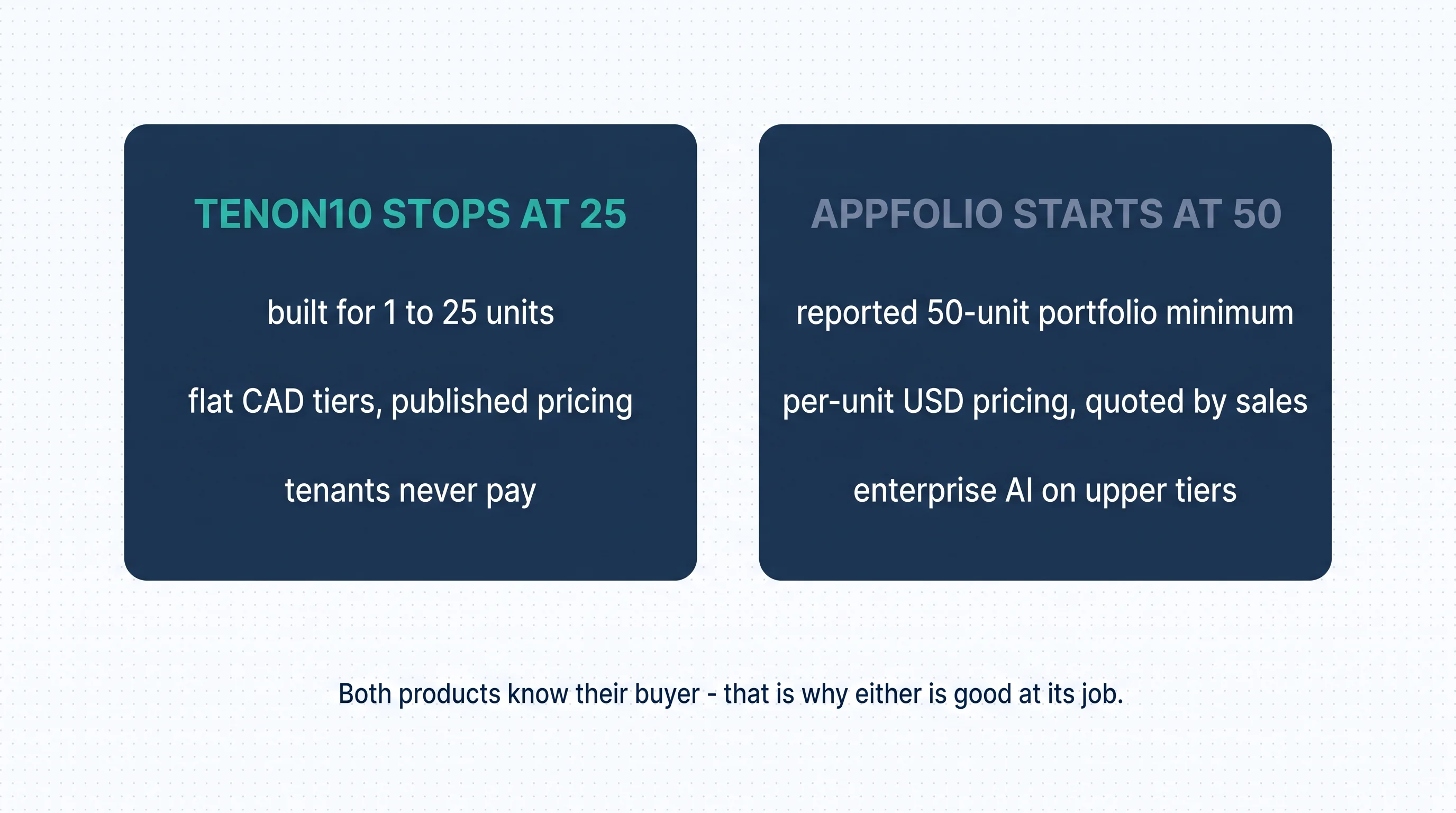
Here's the symmetry that makes this whole comparison make sense: AppFolio won't take portfolios under 50 units; Tenon10 stops at 25. Both are products that know their buyer, and neither is embarrassed about it — in software, it's the platform that claims to fit everyone that deserves your suspicion. If you're between the two floors, at 26 to 49 doors, the honest answer is that neither of us designed our product for you, and our full-market evaluation guide is your better next read.
If you're switching — in either direction — two AppFolio-specific notes on top of the standard sequence in the checklist above: first, there's no free trial, which makes the parallel month essential rather than merely prudent — you can't kick tires before the contract, so you kick them alongside it. Second, onboarding fees are sunk costs; factor them into any leave-or-stay decision honestly, which mostly means refusing to let them anchor you.
The year ahead, in one beat: enterprise platforms keep moving upmarket behind AI suites, Canadian-first tooling keeps the under-25 segment served in CAD, and the 26-to-49 middle stays the market's awkward gap. The fit test will keep giving the same answer for the same buyer — which is what a good test does.
One practical note for the middle: if you're at 26 to 49 doors and choosing anyway, the decision is really about which compromise you can live with — running above a small-portfolio product's designed ceiling, or paying an enterprise product's minimums below its designed floor. Most operators in that band who plan to keep growing lean toward the enterprise side and treat the minimum as tuition; most who plan to hold lean toward the tooling they'll actually use every day. Either way, make the choice on your three-year door count, in writing, and revisit it annually — the middle is a place portfolios pass through, not a place to optimize for.
If the floor decided for you: the free tier is the five-minute way to see what built-for-your-size feels like — up to 3 units, no card required, tenants free forever. Create a free account or see current plans.
The Switcher's Checklist: Moving Your Canadian Rentals to New Software
The 18-point sequence for changing property management software without losing a record, a payment, or a rent cycle — the fit test to run before any demo, the exports to secure before you cancel anything, the parallel month that catches every mapping error, and the clean cutover that keeps CRA-ready archives. Works whichever platform you're leaving and whichever you're joining.
Get Free PDF →Key takeaways
- Confirm the sales floor before anything else — third-party verification reports AppFolio doesn't take portfolios under 50 units; under 25, Tenon10 was built for exactly you.
- Never compare headline per-unit rates — at exactly 50 units, reported effective rates run roughly four times the advertised figure; compute at your count, minimums applied.
- Get unpublished pricing in writing, minimums included — a platform's minimums tell you who it's for faster than any feature tour.
- Model the transaction-fee allocation — including vacant units — and know exactly what your tenants would pay before they do.
- Check which tier the AI ships on, on any platform — an AI suite above your budget tier isn't part of your comparison.
- No trial means the parallel month is mandatory; onboarding is sunk cost in either direction — decide on the next three years, not the last cheque.
Count your doors — the fifty-unit line decides
That's the comparison, honestly run, and it's the rare one that mostly answers itself. AppFolio is genuinely powerful enterprise software for the 200-plus-door operation — per-unit pricing that works as designed at scale, an AI suite doing real leasing work, and reporting built for teams — and its reported 50-unit floor means it was never pretending to want your fourplex. Tenon10 is the product on the other side of that line: built for Canadian landlords with 1 to 25 doors, priced flat in CAD on a public page, with tenants who never pay and Ontario's forms in the workflow. Two floors, one market, no contest — just a line, and your door count on one side of it.
Built for the side of the line AppFolio doesn't serve
CAD pricing on a public page, Canadian rails, Ontario's LTB forms as guided wizards, and tenants who never pay. Free for up to 3 units — no card, no sales call, no minimums.
Free for up to 3 units • Tenants always free • See current plans
Related resources
- Tenon10 vs Buildium: Which Fits Canadian Landlords? — the companion comparison, with the full compliance-gap treatment.
- Property Management Software: What to Look For — the full-market evaluation framework, including the 26-to-49-door middle.
- How to Use the N4 Notice in Ontario — the form at the centre of the compliance gap.
- Becoming a Landlord in Ontario — start the system before the first tenancy.
Frequently asked questions
Does AppFolio have a minimum number of units?
Third-party pricing verification published in mid-2026 reports that AppFolio doesn't offer its platform to portfolios under 50 units, alongside a monthly minimum of roughly $280–$298 USD regardless of count. AppFolio doesn't publish pricing openly, so confirm directly — but small landlords should plan on the floor being real.
How much does AppFolio actually cost at 50 units?
With the monthly minimum applied, third-party guides put the effective rate at roughly $5.60–$5.96 USD per unit — about four times the advertised $1.40–$1.49 — plus reported onboarding fees of $400 to $1,000-plus and the transaction-fee layer. Their arithmetic reaches parity with the headline rate only around 200 units.
Is AppFolio available in Canada?
It's US-built and USD-priced, and it appears in Canadian software roundups as an option for large operators. The practical considerations for Canadian buyers are the reported 50-unit floor, USD pricing at whatever the exchange rate adds, and US-market workflows — provincial compliance features like Ontario's LTB form workflows aren't part of the product. Availability isn't the issue; fit is.
What's the difference between Realm-X and Keya?
Realm-X is AppFolio's AI suite — leasing assistants, maintenance automation, AI communications — available on its Plus and Max tiers, not Core. Keya is Tenon10's built-in AI assistant, included on every tier including Free. Both are real capabilities; the buyer's question is which tier their actual budget lands on.
What if I have 30 or 40 units?
Honestly: you're between both products' designed ranges — above Tenon10's 25-unit Pro cap and below AppFolio's reported 50-unit floor. Read our property management software evaluation guide for the full market, and model your three-year trajectory before committing anywhere; the right answer depends on where your portfolio is going, not where it is.


