

For the first time in this series, the comparison isn't decided before it starts. Our Buildium and AppFolio pages mostly resolved on scale, and our DoorLoop page resolved on the assembled bill and the forms. liv.rent resolves on none of that: it's Canadian — Vancouver-built, CAD-priced, genuinely liked — so the currency argument and the serves-Canada argument simply don't exist here.
What's left is a better question than "which is cheaper in whose currency": what kind of work is your rental business actually made of? Because these are different categories of tool that happen to overlap at the lease. liv.rent is marketplace-first — built to fill units. Tenon10 is management-first — built to run tenancies. One fills, one runs — and this page covers the fit test, the meters versus the flat bill, where each genuinely earns its keep, and the stack most comparison pages won't tell you about.
The Switcher's Checklist: Moving Your Canadian Rentals to New Software
The 18-point sequence for changing property management software without losing a record, a payment, or a rent cycle — the fit test to run before any demo, the exports to secure before you cancel anything, the parallel month that catches every mapping error, and the clean cutover that keeps CRA-ready archives. Works whichever platform you're leaving and whichever you're joining.
Get Free PDF →Two Canadian tools, two phases of the same tenancy
Choose liv.rent if your business lives in the vacancy phase — turnover-heavy portfolios, furnished or student rentals, frequent acquisitions. Its toolkit attacks that phase directly: verified listings syndicated to Craigslist, Kijiji, Zumper, and Facebook Marketplace and rental groups (the reach reviewers name as the selling point), dual ID verification on both sides of the table, Trust Score screening, and digital contracts at the moment of signing. Reviewers consistently praise the team's responsiveness and feedback-driven feature development — one calls it rare for the category, and they're not wrong.
Choose Tenon10 if your business lives in the tenancy phase — stable, multi-year tenancies where the work is records, maintenance, notices, and increases. Management-first: per-unit records and message history, 20+ LTB forms as guided wizards, the rent-increase guideline computed, flat CAD pricing, tenants free on every tier.
The category sentence that organizes everything below: one fills, one runs — and most "vs" confusion between these two tools is a category error, not a close call.
And the mirror, printed with a smile because it deserves one: they have no LTB wizards; we have no marketplace. They're deepest in BC — the Metro Vancouver rent-report franchise is genuinely the best market-data content in Canadian renting; we're deepest in Ontario, where the RTA's forms are our wizards. Canada's rental software is regional because Canada's rental law is, and two Canadian tools wearing their home provinces openly is the market working properly.
It's also why you've probably encountered both companies through their writing before their software: their rent reports are the reference data for BC market coverage, and our Ontario compliance guides serve the same role on this side. Two content engines, two provinces, one country whose rental market genuinely needs both — take the overlap of this very page as a friendly border crossing.
The three-question fit test
1. Where's your work? Count honest hours, not impressions. High churn — furnished, student, frequent turnover — means the vacancy phase is your business, and marketplace-first tooling earns its keep monthly. Long stable tenancies mean your hours live in operations, and management-first tooling carries them.
2. What's metered, and what's flat? Their Growth tier includes 2 syndications and 2 screening reports per month, then per-use beyond — and their own pricing page footnotes that a payout fee may apply to digital rent collection. Ours is flat with no fee layer. Neither structure is wrong; they're bets on different businesses — model both at your vacancy rate.
3. Which province's depth is your home field? A BC landlord gets their market-data engine at full strength; an Ontario landlord gets our compliance engine at full strength. Both tools are national; the depth differs by design.
For landlords: Run the calendar audit before deciding anything: pull last year's calendar and tally the hours you actually spent filling units against the hours you spent running them. Most landlords guess wrong about their own ratio — and the ratio is the whole decision.
Pricing in the same currency, honestly
One novelty worth savouring for a sentence: every figure in this section, on both sides, is in Canadian dollars. For the first time in this series, currency decides nothing — which is how software comparison should feel.
liv.rent (all figures CAD, as of mid-2026 — figures have moved across sources, so confirm on their pricing page): a free Essentials tier; Growth at roughly CA$48–CA$56 per month — their own pricing announcement said $48, reduced from $79; Capterra lists CA$56; a June 2026 review lists $56 — and Business at roughly CA$399–CA$490 for brokerages and seasoned operators, with the same drift across sources. Pay-per-use options are marketed for beginning landlords, and Enterprise is by contact. Growth's inclusions, per Capterra: 2 Facebook Marketplace syndications per month, 2 tenant screening reports per month, standard digital contracts with lease-protection addendums, team management for up to 3 users, and unlimited auto-replies. And the footnote from their own pricing page, printed as-is: a payout fee may be charged for digital rent collection.
Tenon10 (all figures CAD, flat, published): Free at $0 for up to 3 units; Essentials at $9.99/month for up to 10; Pro at $49/month for up to 25. Tenants free on every tier, no meters, no per-use charges, no footnotes — the number on the pricing page is the whole bill.
Worth noting the symmetry at the bottom of both ladders: each platform's free tier is a real product, not a teaser — theirs for the landlord testing the marketplace on a single listing, ours for the landlord running up to three units in earnest. Between two Canadian free tiers, the cheapest possible version of this comparison is simply to hold both accounts and let your next vacancy and your next Tuesday each pick their tool.
Fill: where liv.rent earns it
The vacancy phase is, at bottom, a trust problem — two strangers deciding whether to sign a year-long contract — and liv.rent's toolkit attacks it directly. Dual ID verification runs on both sides of the table, which changes the texture of every conversation that follows: landlords reach renters who are verified, and renters reach listings that are real. Trust Score gives screening an intelligent rating rather than a folder of PDFs. The syndication set — Craigslist, Kijiji, Zumper, Facebook Marketplace and Facebook rental groups — meets renters where they actually scroll, and reviewers name that reach as the reason they came. Add AI-powered matching, digital contracts with lease-protection addendums at the signing moment, payments that even include credit cards and cryptocurrency, and the market-data engine — the Metro Vancouver rent-report franchise — that helps price a listing right before it ever goes live.
The design insight underneath all of it deserves credit: most vacancy pain isn't a tooling problem, it's an information asymmetry — landlords can't tell serious applicants from browsers, renters can't tell real listings from bait, and everyone pays for the uncertainty in time. Verification on both sides collapses that asymmetry, which is why the platform's users describe the applicant quality, not just the applicant volume. It's a genuinely good answer to the phase it serves.
For a furnished-rental or student-market operator, this is the business — and we'll say the uncomfortable half out loud: for that operator, Tenon10 is the wrong lead tool, because we bring no marketplace at all. Our role in that portfolio, if any, is the records layer riding alongside.
Run: the Tuesday work
The distinction that organizes the compliance comparison fairly: lease-formation tooling versus tenancy-operations tooling. liv.rent's digital contracts and lease-protection addendums are real tooling for the signing moment — the marketplace's natural finish line. The years after the signature are a different product: the guideline increase (2.1% for 2026, 1.9% for 2027, per our rent-increase guides), the N4 that ends a bad month properly, the entry notice before every repair, the deposit interest rule that applies whether anyone remembers it. The Tuesday work.
On Tenon10, the Tuesday work is the product: 20+ LTB forms as guided wizards, the guideline computed, deposit and NSF rules encoded, per-unit records and a maintenance trail that remembers what phones forget — deepest in Ontario, with the CAD pricing and Canadian rails national. The record-keeping half matters as much as the forms half, because tenancy operations are cumulative: the entry notice from March, the repair thread from June, and the increase served in September are one story when a dispute asks for it — and three unfindable fragments when they lived in a phone, an inbox, and a memory. And fair in both directions, as this series keeps insisting: liv.rent never claimed the Tuesday work. Marketplace-first is a design, and their lease tooling hands off exactly where a marketplace should. The only question is where your hours actually go.
For property managers: Managing turnover-heavy portfolios in BC or student markets, their Business tier was built for your marketing operation. Managing stable Ontario portfolios under 25 doors, we were built for your compliance operation. Many firms genuinely need both halves of the tenancy served — which is exactly what the next section is for.
The stack — and how to set it up
Here's the recommendation most comparison pages won't print, because it doesn't fit the genre: fill with liv.rent, run with Tenon10. It's a legitimate stack — both halves Canadian, both CAD, each tool doing the phase it was built for. Their free tier or pay-per-use options cover the occasional vacancy; our flat layer runs the tenancy for the years between.
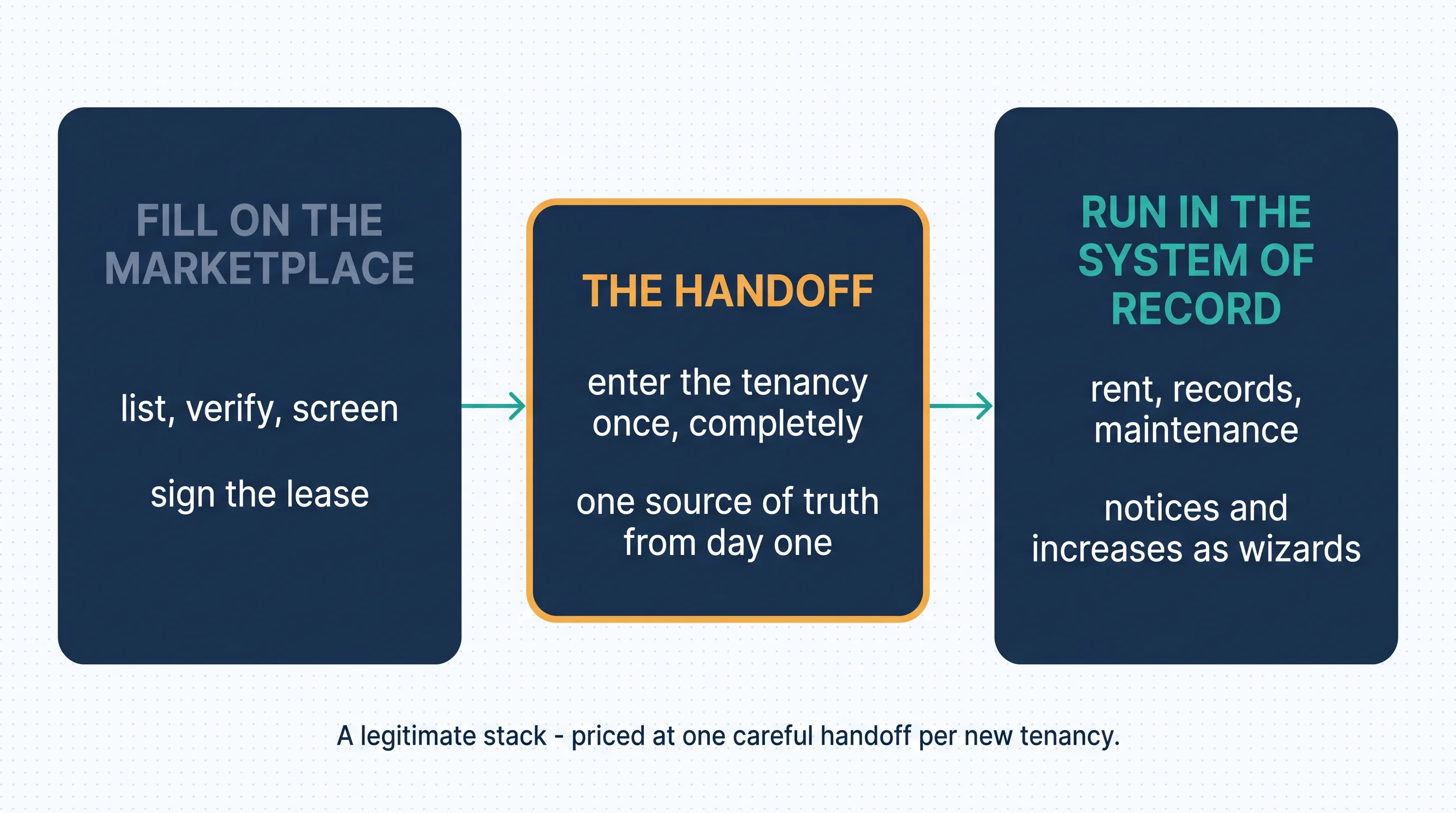
The cost, named plainly: one careful double-entry per new tenancy at the handoff. The day the lease is signed, the tenant enters the system of record once and completely — names, dates, the deposit with its date, the rent, the contacts — and from that day, one source of truth holds the money and the notices. The marketplace's job ended at the signature; letting two systems both believe they own the tenancy is how deposits lose their dates. The rule of thumb that keeps the stack clean: the marketplace owns everything up to and including the signature; the system of record owns everything that recurs — rent, receipts, requests, notices, renewals. Anything that will matter in year three gets its home in the system of record on day one, because year-three questions are always answered by day-one records.

And the reverse pairing's limits, honestly: the stack has a natural direction. Running tenancies inside a marketplace-first tool means the Tuesday work stays manual — which is fine until the first guideline increase, and expensive at the first dispute.
The year ahead, in one beat: marketplaces will keep deepening matching and screening; management platforms will keep deepening compliance; and the stack pattern — the best Canadian tool on each side of the signature — likely becomes the normal answer rather than the clever one.
The run-side is free to start: up to 3 units, no card, tenants free forever — whether you're choosing one tool or building the stack, the system of record takes five minutes to stand up. Create a free account or see current plans.
The Switcher's Checklist: Moving Your Canadian Rentals to New Software
The 18-point sequence for changing property management software without losing a record, a payment, or a rent cycle — the fit test to run before any demo, the exports to secure before you cancel anything, the parallel month that catches every mapping error, and the clean cutover that keeps CRA-ready archives. Works whichever platform you're leaving and whichever you're joining.
Get Free PDF →Key takeaways
- Category first: liv.rent fills units; Tenon10 runs tenancies — most confusion between them is a category error, not a close call.
- Run the calendar audit: your honest fill-versus-run hours ratio is the whole decision, and most landlords guess theirs wrong.
- All CAD for once — compare inclusions and meters, not exchange rates: 2 syndications + 2 screenings monthly on their Growth, then per-use, with a possible payout fee per their own footnote; flat with no layer on ours.
- Depth is regional by design: their BC market engine, our Ontario compliance engine — Canada's rental software mirrors Canada's rental law.
- Screening tools inform decisions — they don't own your human-rights and privacy obligations; the defensible selection stays yours.
- The stack is real: fill with them, run with us — priced at one careful 15-minute handoff per new tenancy, with one source of truth from day one.
Count your hours, not just your doors
That's the comparison, and for once it ends without a line to draw between winners — because the honest line runs through your own calendar. liv.rent is the best-tooled path in Canada from empty unit to signed lease: verified, syndicated, screened, and signed, with a market-data engine underneath. Tenon10 is the system that runs the years after the signature: records, rent, maintenance, and Ontario's forms as wizards, flat and published in CAD. If your business is turnover, lead with the marketplace. If your business is tenancies, lead with the system of record. And if — like most landlords — your business is both phases in different proportions, build the stack and give each phase the Canadian tool that was built for it. One fills, one runs. Count your hours, and choose accordingly.
The run side of your rental business, ready in minutes
Per-unit records, maintenance trail, Ontario's LTB forms as guided wizards, and guideline math done — flat CAD pricing, tenants free forever. Whether you choose one tool or build the stack, the system of record starts free.
Free for up to 3 units • Tenants always free • See current plans
Related resources
- Property Management Software: What to Look For — the full-market evaluation framework.
- Tenon10 vs DoorLoop — the near-peer comparison, and the assembled-bill method.
- Income Verification for Ontario Landlords — the screening ground rules that apply on any platform.
- How to Use the N4 Notice in Ontario — the Tuesday work, done properly.
Frequently asked questions
Is liv.rent good for landlords?
For the vacancy phase, genuinely: verified listings, dual ID verification on both sides, Trust Score screening, and syndication to Craigslist, Kijiji, Zumper, and Facebook — reviewers particularly praise the reach and the team's responsiveness. It's marketplace-first by design; the tenancy-operations work — notices, increases, records — is a different category of tool, which is the distinction this page is built around.
What does liv.rent cost for landlords?
As of mid-2026: a free Essentials tier; Growth around CA$48–CA$56 per month, including 2 syndications and 2 screening reports monthly with per-use beyond; and Business around CA$399–CA$490 for brokerages and seasoned operators. Figures have moved across sources — their own announcement, Capterra, and recent reviews differ — so confirm on liv.rent's pricing page, and note their footnote that a payout fee may apply to digital rent collection.
Can I use liv.rent just for listings and Tenon10 for management?
Yes — that's the stack this page recommends for many landlords: fill the vacancy on the marketplace, then enter the signed tenancy once, completely, into Tenon10 as the system of record for rent, notices, and maintenance. The cost is one careful 15-minute handoff per new tenant; the benefit is the best Canadian tool on each side of the signature, with one source of truth from day one of the tenancy.
Which is better for an Ontario landlord?
For running Ontario tenancies — the N4, the guideline math, entry notices, deposit interest — Tenon10 was built for exactly that, with 20+ LTB forms as wizards. For filling an Ontario vacancy, liv.rent's marketplace serves Toronto among its core cities. Many Ontario landlords reasonably use both phases' tools; the calendar audit tells you which one leads.
Does Tenon10 have a listing marketplace?
No — plainly. Tenon10 is management-first: it runs tenancies rather than advertising vacancies. Landlords fill units through marketplaces — liv.rent among them — and run them here. That's the honest division of labour this whole comparison describes.


