

Yardi Breeze is the friendliest door into one of the oldest houses in property software. Yardi has been building since 1984, and its product line runs from Breeze through Breeze Premier to Voyager — the enterprise platform whose annual cost is reported in the $30,000-to-$150,000-plus range, custom-quoted. That lineage is the honest frame for this comparison: choosing Breeze is partly choosing Yardi, and whether that's a feature or an irrelevance depends entirely on where your portfolio is going.
One warning before any numbers, because this page earned it the hard way: Breeze's published pricing has visibly moved across sources this year — early-2026 guides and the most recent official-page reads disagree on both the per-unit rate and the monthly minimum. So every figure below carries its source date, we won't pretend to resolve the conflict, and Yardi's own pricing page — read today, with today's date — outranks everything on this page, including this page.
The Switcher's Checklist: Moving Your Canadian Rentals to New Software
The 18-point sequence for changing property management software without losing a record, a payment, or a rent cycle — the fit test to run before any demo, the exports to secure before you cancel anything, the parallel month that catches every mapping error, and the clean cutover that keeps CRA-ready archives. Works whichever platform you're leaving and whichever you're joining.
Get Free PDF →The doorway, named honestly
Choose Yardi Breeze if you manage across asset classes — residential, commercial, HOA and condo, affordable, manufactured housing, self-storage, mixed portfolios: breadth nobody else in this series offers — or your five-year plan points toward the ecosystem's centre: a hundred-plus units, multi-entity structures, maybe a Voyager migration on a whiteboard somewhere. For that manager, the doorway is real value: one vendor, one data model, one training investment that compounds from sixty units to six hundred instead of resetting at each re-platform. Add no onboarding, training, or support fees, free implementation, and a 97%-small-business reviewer base that consistently praises ease of use, and the entry tier makes sense as exactly what it is.
It's worth saying what four decades of heritage actually buys at the entry tier, because it's neither everything nor nothing: infrastructure that has survived every interest-rate cycle since 1984, enterprise-grade payment and accounting rails scaled down, and a vendor that will exist in ten years. The honest small-scale notes from the same reviews: integrations run thin at the entry tier and support is chat-based until Premier's account-manager hours. Heritage is depth of foundation, not breadth of doors opened at the bottom rung — both facts print here because both are true.
Choose Tenon10 if you're a Canadian landlord or small property manager under 25 units, staying under 25 — flat CAD pricing with no minimums anywhere, tenants free on every tier, and your province's forms as the product rather than the paperwork.
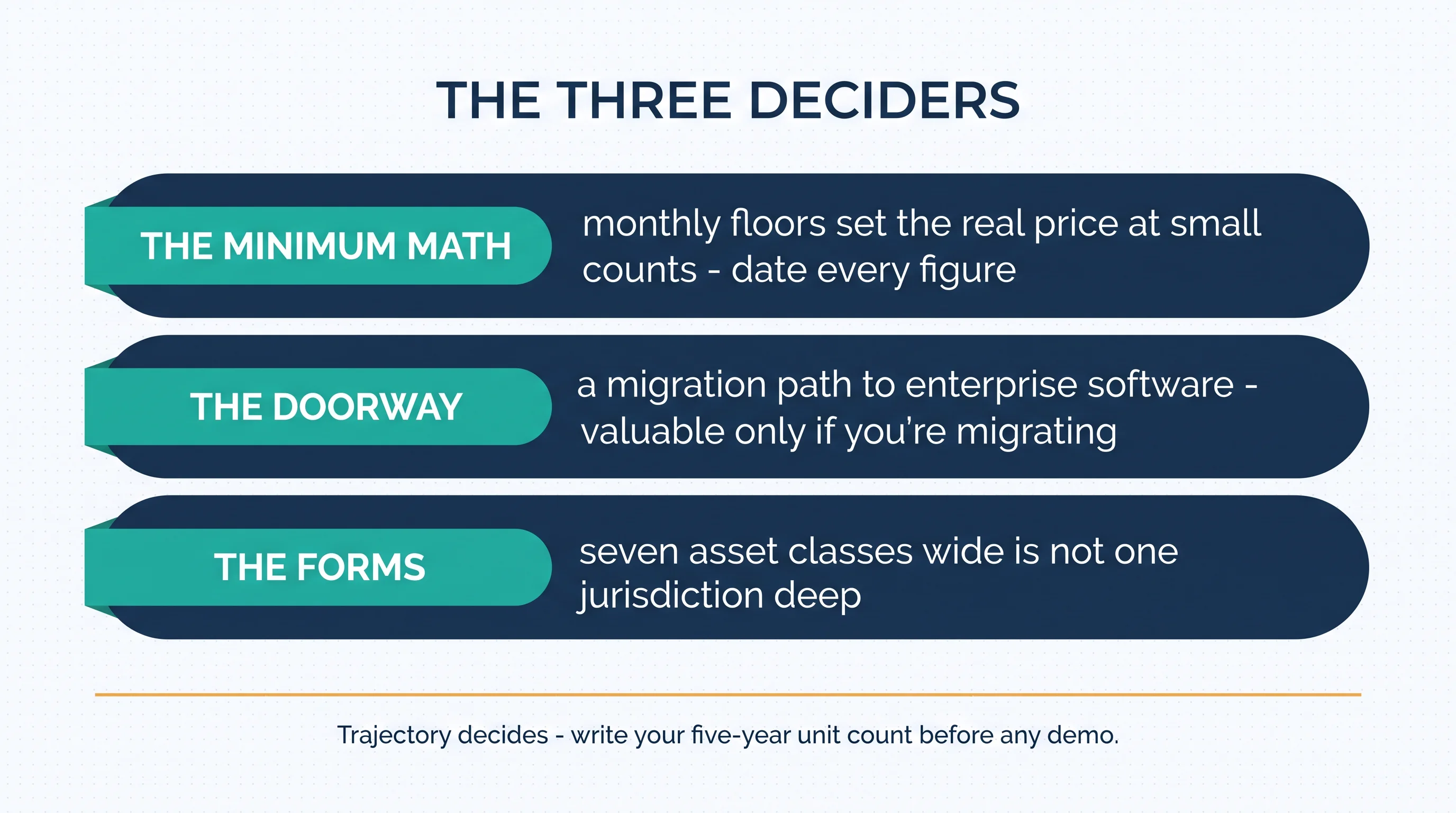
The frame in one line, and it organizes everything below: a doorway is worth what's behind it — and only to the person walking through.
The three-decider fit test
1. The minimum math at your count. Monthly floors set Breeze's real price at small portfolio sizes — section three runs it with dated figures.
2. The doorway. Does a migration path into enterprise software have value in your five-year plan? Heading past 100–200 units with multi-entity ambitions: genuinely yes. Holding under 25: it's paying for a hallway you'll never walk.
3. The forms. Name the notices you serve — section five, where breadth meets depth.
For landlords: Trajectory questions deserve written answers. Draft your five-year unit count — an actual number, on actual paper — before any demo of any ecosystem product. The demo will be beautiful; the number in your drawer is what keeps the beauty relevant to you.
The minimum math, dated
The motion first, because it's the finding: early-2026 sources list Residential Breeze at $1 USD per unit per month with a $100 monthly minimum (a June 9 pricing guide; Capterra's June 3 profile), with Premier and Associations at $400 minimums, Commercial at $2 with a $200 minimum, and Affordable at $3 with a $400 minimum. The most recent official-page read we found — from late May — reports residential at $2 per unit with a $400 monthly minimum, and Premier at $2–$4. Those reads conflict, and we won't resolve them: Yardi's pricing page is the only current source, and the lesson generalizes to every vendor in this category — screenshot, date, compare.
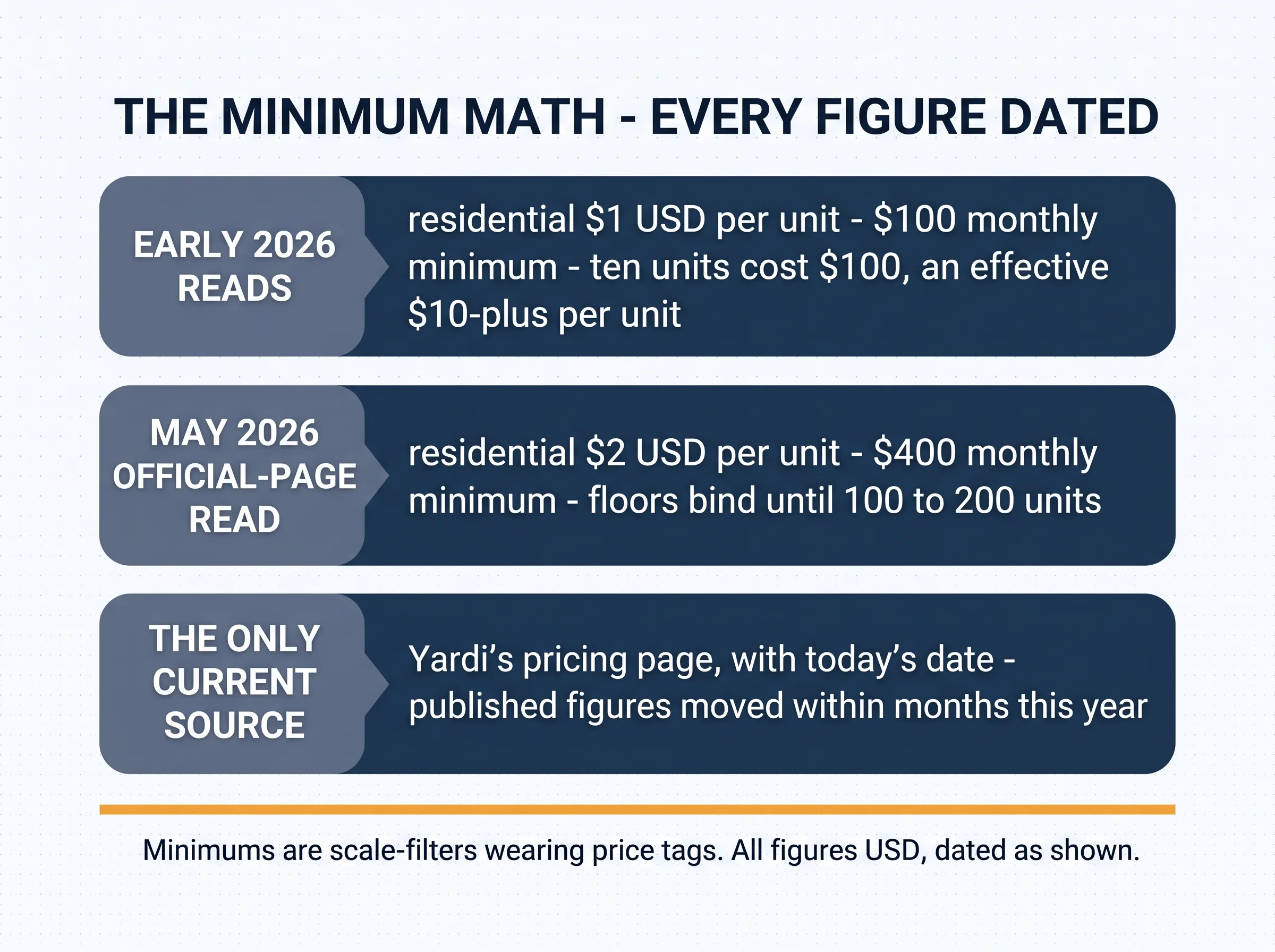
Now the floor arithmetic, at the sizes our readers hold: under the early-2026 minimum, a 10-unit residential portfolio costs $100 a month — an effective $10-plus per unit against a $1 headline, per the worked example in the detailed analyses. The floor stops binding around 100 units at the $1 rate, and around 200 at $2. None of this is a trick: minimums are scale-filters wearing price tags — they name the platform's intended buyer the way AppFolio's sales floor did in our earlier comparison, just more quietly. And the quiet version deserves the fairer reading: a floor lets a vendor publish a low per-unit rate honestly for the buyers it wants, without operating accounts too small to serve profitably. The design isn't aimed at you; it's aimed past you — which is exactly the information a small landlord needs, delivered as arithmetic instead of a sales call.
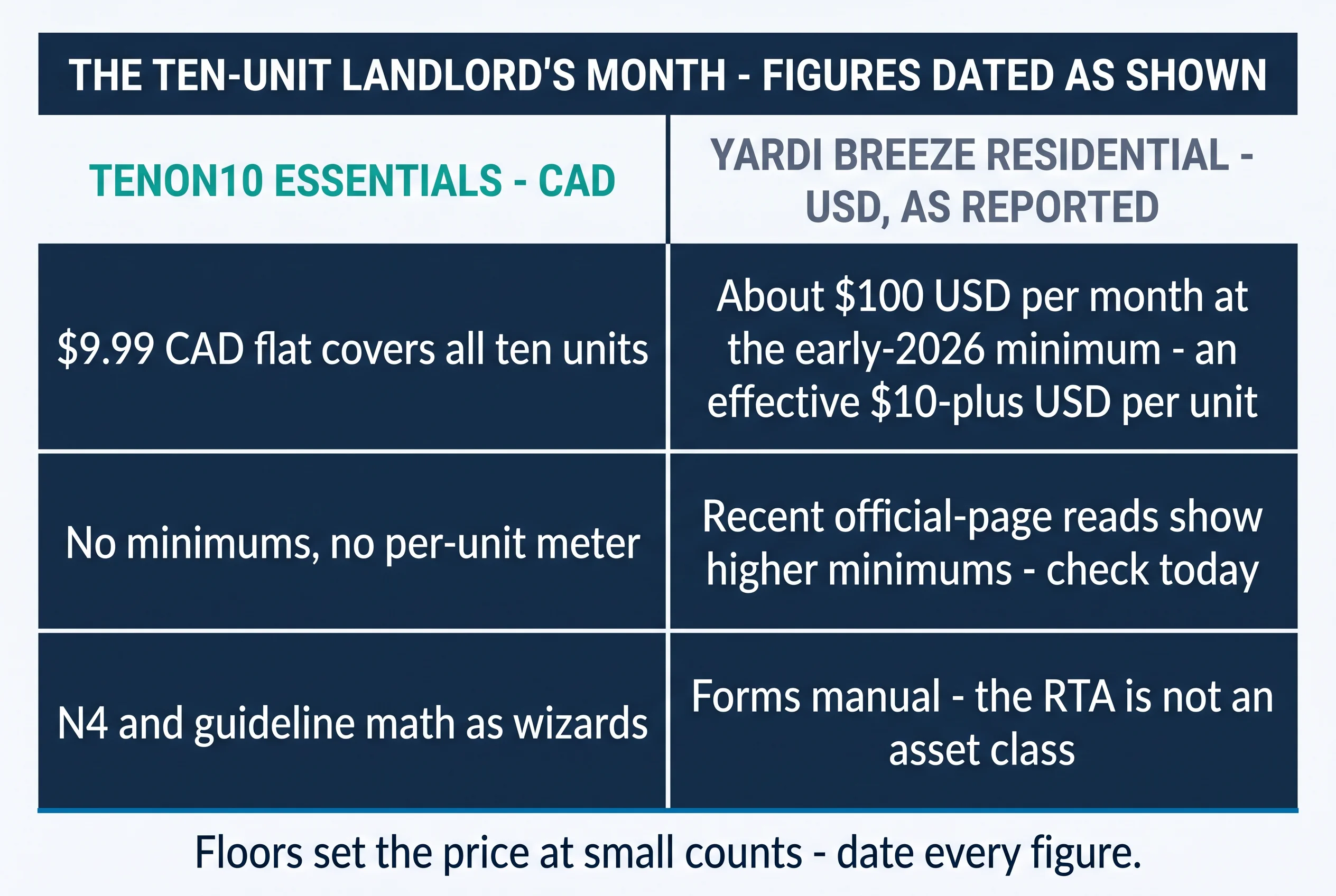
The clean contrast, once, dated as of this writing: Tenon10's Essentials covers ten units entirely at $9.99 CAD flat — no floor, no meter, wizards riding along. And the gentle fee notes on the Breeze side, reported once: an online-payment service charge and transactional screening add-ons appear in the analyses — check current schedules; a 12-month residential bundle reportedly halves the per-unit cost by bundling screening and renters insurance, which is real value priced as a bundle, so price it as one.
The doorway's real value
The case for, made properly, because it's real: Yardi has been building property software since 1984, and the line runs Breeze → Breeze Premier (which adds functionality and 16 hours of dedicated account-manager time) → Voyager, the custom-quoted enterprise platform reported at $30,000–$150,000-plus annually. For the manager genuinely heading toward scale, that lineage means never re-platforming: the data model carries, the vendor relationship deepens, and the team's training compounds instead of resetting at each migration — which anyone who has survived a mid-growth software change knows is worth real money.
Their own buyer guidance walks the fork with unusual honesty, and we credit it: a 60-unit portfolio that plans to stay at 60 belongs on Breeze, full stop; a 60-unit portfolio targeting 300 within two years should think harder, because migrating mid-growth lands an implementation project exactly when the team can least absorb one. That's good advice published by the vendor it might cost — the kind this series respects.
The breadth case, sent plainly: residential, commercial, HOA and condo, affordable, manufactured housing, self-storage, and mixed portfolios under one roof — seven asset classes, unique in this series. The mixed-portfolio operator with an HOA book and two commercial units has exactly one candidate on these nine pages, and it isn't us. And the Canadian thread, precisely: Breeze's named marketing integration is Rentsync — Canadian listings infrastructure — the first named Canadian connection among this series' US platforms: marketing reach, noted as exactly that, no more and no less. It's also a small window into how US platforms touch Canada generally: through marketing infrastructure first, compliance last — listings syndication crosses the border years before provincial form law does, because reach ships faster than rules. A Canadian evaluating any US platform can use that as a quick test: ask what Canadian names appear in the integration list, and then ask what Canadian names appear in the compliance features. The gap between those two answers is this series' entire recurring finding.
Breadth versus depth: the forms
Here's the fresh angle this page earns, and it reframes the compliance question this series always asks. Breeze went wide: seven asset classes, one continent's practices — a coherent design that serves the multi-asset manager nobody else serves. Tenon10 went deep: one country's rails, CAD-native, with one province's law encoded — 20-plus LTB forms as guided wizards, the guideline computed at 2.1% for 2026 and 1.9% for 2027 per our rent-increase guides, deposit and NSF rules built in. Both are coherent designs. Buyers are one or the other.
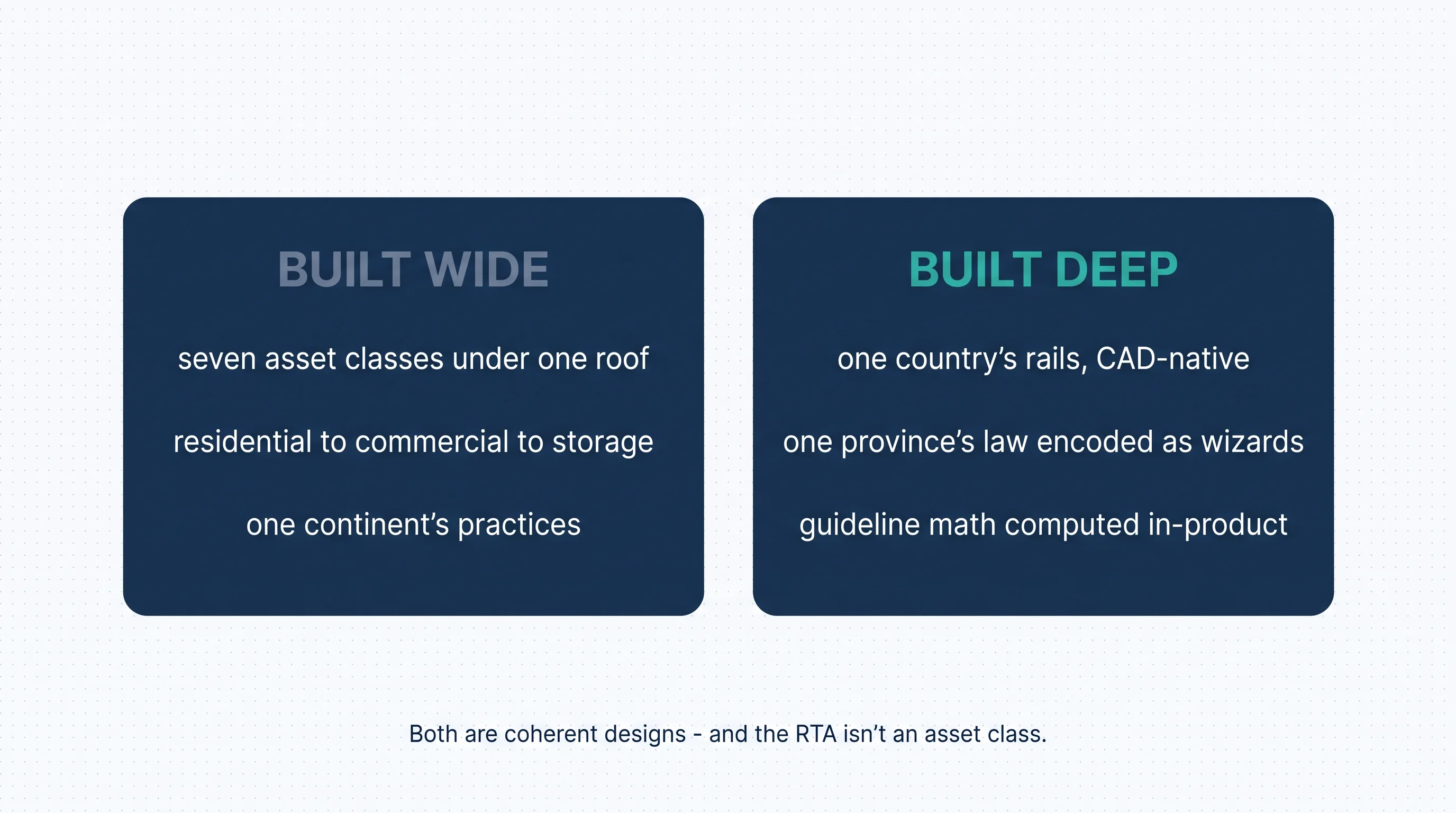
And the sentence that decides it for our reader: the RTA isn't an asset class. An ecosystem spanning storage units and HOA books still leaves the Ontario landlord's N4 as a blank PDF, the guideline as mental math, the deposit interest as a rule remembered. Width and depth are different investments made with the same finite engineering years: every asset class added is a jurisdiction not deepened, and every provincial rule encoded is a market not entered. That's why this series keeps finding the same shape in different vendors — the choice was made early, structurally, and honestly on both sides. Width and depth are different investments, and no amount of the first becomes the second — which cuts both ways: our depth doesn't cover their seven classes either, and this page has already sent the multi-asset reader where they belong.
For property managers: Multi-asset Canadian PMs — commercial mixed with residential, or an HOA/condo book alongside — Breeze's breadth is your genuine shortlist entry, and our residential-only 25-unit cap removes us twice over. Pure-residential Ontario PMs under 25 doors: the depth side is yours, and the notice volume at management scale is exactly what the wizards absorb.
Trajectory decides — and the switch
The fork, plainly. Walking toward the tower — a hundred-plus units, multi-entity, multi-asset, an enterprise future — choose the door with our respect: the ecosystem's compounding is real, and their own guidance will serve you honestly on the way up. Staying home — under 25 units, residential, Canadian — the arithmetic already chose for you: flat CAD with no floors, tenants free, and the forms as wizards, in the tool built for the house you already have.

Switching notes, Breeze-specific: one directory reports annual contracts — confirm the term before planning your parallel month, because a cutover mid-contract has a different cost than one at renewal; trial availability varies across sources — ask directly; and the self-serve checkout keeps the evaluation gate refreshingly low for an enterprise-family product. The checklist above carries the full sequence in both directions.
The year ahead, one beat: entry-tier pricing at heritage vendors has been firming — that's the observed direction of this year's motion — while Canadian-first tools hold the under-25 flat-CAD ground. The doorway question stays the mid-market's real decision, and it gets clearer, not blurrier, as the tiers spread.
Built for the house you already have: flat CAD, no minimums anywhere, tenants free forever, and Ontario's forms as wizards — free for up to 3 units, five minutes to see it. Create a free account or see current plans.
The Switcher's Checklist: Moving Your Canadian Rentals to New Software
The 18-point sequence for changing property management software without losing a record, a payment, or a rent cycle — the fit test to run before any demo, the exports to secure before you cancel anything, the parallel month that catches every mapping error, and the clean cutover that keeps CRA-ready archives. Works whichever platform you're leaving and whichever you're joining.
Get Free PDF →Key takeaways
- Choosing Breeze is partly choosing Yardi — a doorway is worth what's behind it, and only to the person walking through.
- Date every figure: published Breeze pricing moved this year — $1/unit with a $100 minimum in early-2026 reads, $2 with a $400 minimum in the most recent official-page read — and Yardi's page with today's date is the only number that counts.
- The minimum math filters scale: ten units at a $100 floor is an effective $10-plus per unit; $9.99 CAD flat covers ten entirely here, with no floors anywhere.
- Their breadth is unique in this series — seven asset classes; the multi-asset operator has exactly one candidate on these nine pages.
- Breadth isn't depth: the RTA isn't an asset class — name your forms before choosing width.
- Write your five-year unit count before any demo — and re-run the doorway question annually, because trajectory answers expire.
The product line, or the product
That's the doorway comparison, and it closes the way it opened: with respect for what Yardi built and clarity about who it's for. Breeze is a genuinely friendly entry into a four-decade ecosystem — wide across seven asset classes, honest in its own buyer guidance, and valuable in direct proportion to how far up the product line your portfolio intends to travel. Tenon10 is the other answer: not a doorway to anything, just the tool itself — flat CAD with no minimums, tenants free, Ontario's forms as wizards — built and capped for the landlord whose five-year number looks like their current one, give or take a duplex. Write your number, date your figures, name your forms. If the number says tower, take the door with our respect. If it says home, the product — not the product line — is what you're shopping for.
The product, built for the house you have
Flat CAD pricing with no minimums anywhere, tenants free forever, and Ontario's LTB forms as guided wizards with the guideline computed. Free for up to 3 units — no card, no floor, no doorway premium.
Free for up to 3 units • Tenants always free • See current plans
Related resources
- Property Management Software: What to Look For — the full-market evaluation framework.
- Tenon10 vs AppFolio — the louder scale-filter, and the effective-rate method.
- Tenon10 vs Buildium — the first scale comparison, with the full compliance-gap treatment.
- How to Use the N4 Notice in Ontario — the depth side's signature form, explained.
Frequently asked questions
Does Yardi Breeze have a monthly minimum?
Yes — reported at $100/month on the residential base in early-2026 sources (June guides and profiles), with the most recent official-page read from late May showing a $400 residential minimum, and $200–$400 minimums across other asset classes. The figures moved this year, so confirm on Yardi Breeze's pricing page with today's date — the minimum, not the per-unit headline, sets the real cost at small portfolio sizes.
How much does Yardi Breeze cost for 10 units?
Under the early-2026 residential minimum, about $100 USD/month — an effective $10-plus per unit against the $1 headline — and more under the more recently read $400 minimum. The floor stops binding around 100–200 units depending on the rate. Tenon10's Essentials covers ten units at $9.99 CAD flat, with no minimums.
Is Yardi Breeze good for small landlords in Canada?
Its ease-of-use reviews are genuine, its breadth across seven asset classes is unmatched in this series, and its Canadian marketing thread is real (Rentsync is its named listings integration). But its minimums price it for portfolios approaching floor-breakeven, its ecosystem's value lies in the growth path toward Yardi's enterprise platforms, and Canadian provincial compliance isn't part of the product. Under 25 residential units with no enterprise trajectory, the doorway premium buys a path your portfolio has no plans to use.
What's the difference between Yardi Breeze and Voyager?
Breeze is the self-serve entry tier — per-unit pricing with minimums and live-chat support; Breeze Premier adds functionality and 16 hours of dedicated account-manager time at higher minimums; Voyager is the custom-quoted enterprise platform reported in the $30,000–$150,000-plus annual range. Yardi's own guidance frames the choice by trajectory — which is exactly how this page frames choosing Breeze at all.
Which fits an Ontario landlord with 10 units?
The arithmetic and the forms both answer: $9.99 CAD flat covers all ten here, with the N4, N1, and guideline math as wizards; there, the monthly minimum sets the price and the RTA stays manual. If a multi-asset future or an enterprise trajectory is genuinely written into your plan, evaluate Breeze for that future — and date every figure you collect along the way.


