

This is the first comparison in our series without an easy answer built in. Our AppFolio comparison mostly resolved at a reported 50-unit sales floor; our Buildium comparison mostly resolved on portfolio scale. DoorLoop resolves on neither: it names Canada in its own positioning, starts at a price a small landlord can say out loud, offers a real free trial, and earns reviews in the 4.5-to-5-star range on G2. It's a genuine competitor for part of our market.
So this page does the two jobs a genuine comparison requires: it assembles the whole bill — because DoorLoop's pricing is a base plus a metered layer, and the meter is where the money is — and it names the gap that marketing reach can't close: serving Canada is not the same thing as serving Canadian compliance. And because both platforms offer a free way in, this is the rare comparison you can simply run for yourself, this week, for nothing.
The Switcher's Checklist: Moving Your Canadian Rentals to New Software
The 18-point sequence for changing property management software without losing a record, a payment, or a rent cycle — the fit test to run before any demo, the exports to secure before you cancel anything, the parallel month that catches every mapping error, and the clean cutover that keeps CRA-ready archives. Works whichever platform you're leaving and whichever you're joining.
Get Free PDF →A real competitor, said plainly
Choose DoorLoop if you're a manager in the roughly 20-to-200-door band who wants a modern, polished mid-market platform — reviewer praise for its interface is remarkably consistent — or you're a Canadian operator past our 25-unit cap: DoorLoop's own positioning claims owners in the US and Canada managing 10 to 2,000-plus units, making it the first competitor in this series that names Canada at all. Add a marketed migration team and a genuine free trial, and its shortlist case is real.
Choose Tenon10 if you're a Canadian landlord or small property manager with 1 to 25 units who wants flat, published CAD pricing with no fee layer of any kind, tenants who never pay, and — in Ontario — the LTB forms as guided wizards with the rent-increase guideline computed in the product.
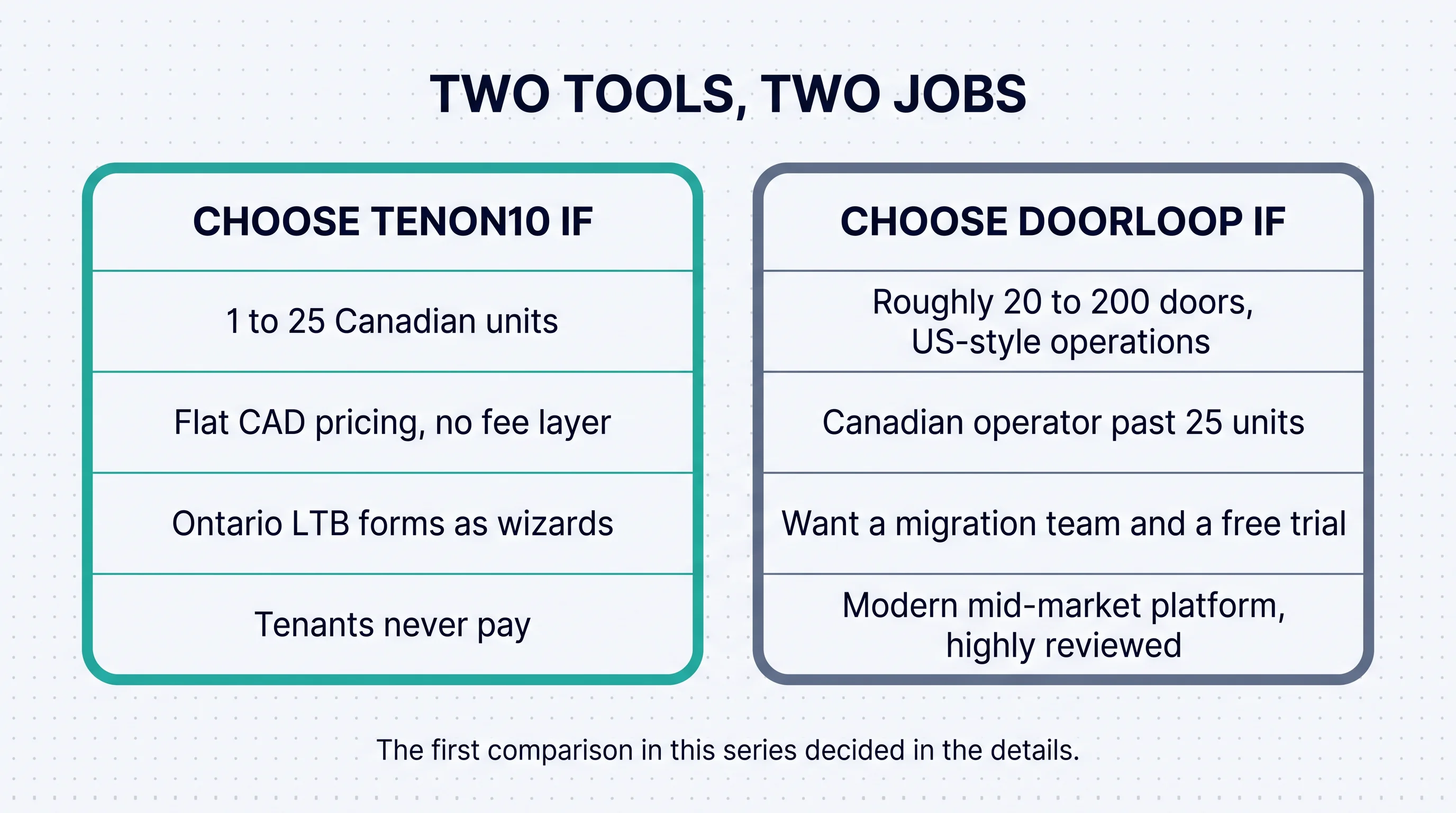
Our first two comparisons were decided by scale mismatches before the details mattered. This one is decided in the details — the assembled bill and the compliance gap — which is exactly where the rest of this page lives.
It's worth pausing on why DoorLoop shows up on Canadian shortlists so often: the company runs one of the most prolific content-marketing operations in the category, and it's genuinely good at it. That's not a criticism — we're a content operation too, as you may have noticed — but it does mean a Canadian landlord's research journey tends to route through DoorLoop's own comparisons early. This page is the counterweight reading: the same comparison run from the Canadian small-portfolio side, with the currency labelled and the forms named.
The four-question fit test
1. Doors. At 1 to 25 Canadian units, you're in Tenon10's designed range. From 26 to about 200, DoorLoop's stated territory begins — and ours ends at 25, plainly. For the reader we keep meeting in this series, the 26-to-49-door Canadian operator that neither Buildium's economics nor AppFolio's floor served well: this is the first page where you have a genuinely willing option, with the compliance trade named below so you take it with open eyes.
2. Forms. Name the notices you actually serve. If the N4 and N1 are part of your year, the question "which platform knows these forms" carries real weight — serving Canada isn't serving the RTA, and section five walks the difference.
3. True cost. Assemble the whole bill at your unit count and transaction volume — the next two sections do it with you, in the right currency.
4. Try. DoorLoop offers a free trial; Tenon10's Free tier covers up to 3 units with no card. Uniquely in this category, the comparison is empirical: run one unit through each for a week and stop reading reviews.
For landlords: The week-long two-trial test costs nothing and answers more than fifty reviews. Set up your smallest unit in both platforms, run one rent cycle's worth of real tasks — log a maintenance request, generate a receipt, draft the notice you most recently served — and keep whichever one felt built for your job.
The sticker and the assembled bill
A diligence note before any figures, because it's genuinely part of the story: published guides disagree about DoorLoop's pricing. G2's pricing data (2026) lists Starter at $69 USD/month with upper tiers at $139 and $199; a software directory lists Starter at $59 USD/month billed annually, covering up to 20 units; one reviewer states all plans include unlimited units — while the most detailed breakdown, sourced from the official pricing page in March 2026, says the base covers the first 20 units with per-unit charges above. We follow that detailed breakdown below and print ranges everywhere — and the real lesson is the disagreement itself: fast-shipping platforms change pricing faster than guides track it, so confirm on DoorLoop's own pricing page, dated, the day you evaluate.
The assembly, per the March 2026 breakdown (all figures USD): a Starter base of $59–$69/month covering your first 20 units; above 20, per-unit charges of $1.00/unit/month on Starter or $1.50/unit/month on the upper tiers; then the fee layer — the next section — where the real variance lives.
Tenon10 (all figures CAD, flat, published): Free at $0 for up to 3 units; Essentials at $9.99/month for up to 10; Pro at $49/month for up to 25. Tenants always free, no fee layer of any kind, and the number sits on a public page where a comparison shopper can simply read it — which, after the paragraph above, is worth what it's worth.
The fee layer: where the tiers earn their names
Here's the mechanic that decides DoorLoop's true cost, printed as the pricing design it is: the transaction fees fall as the tiers rise. Per the March 2026 breakdown: ACH rent payments cost $2.49 USD per transaction on Starter, $0.99 on Pro, and are free on Premium. eSignatures run $3 per document on Starter and $1 on Pro. Tenant screening reports run about $45 each. Their own guides note the ACH spread alone "adds $594–$1,494 per year across a 50-unit portfolio" — and their own upgrade math shows Pro's higher base beating Starter's fees at just 30 units with normal ACH adoption. The tier list is the price list.
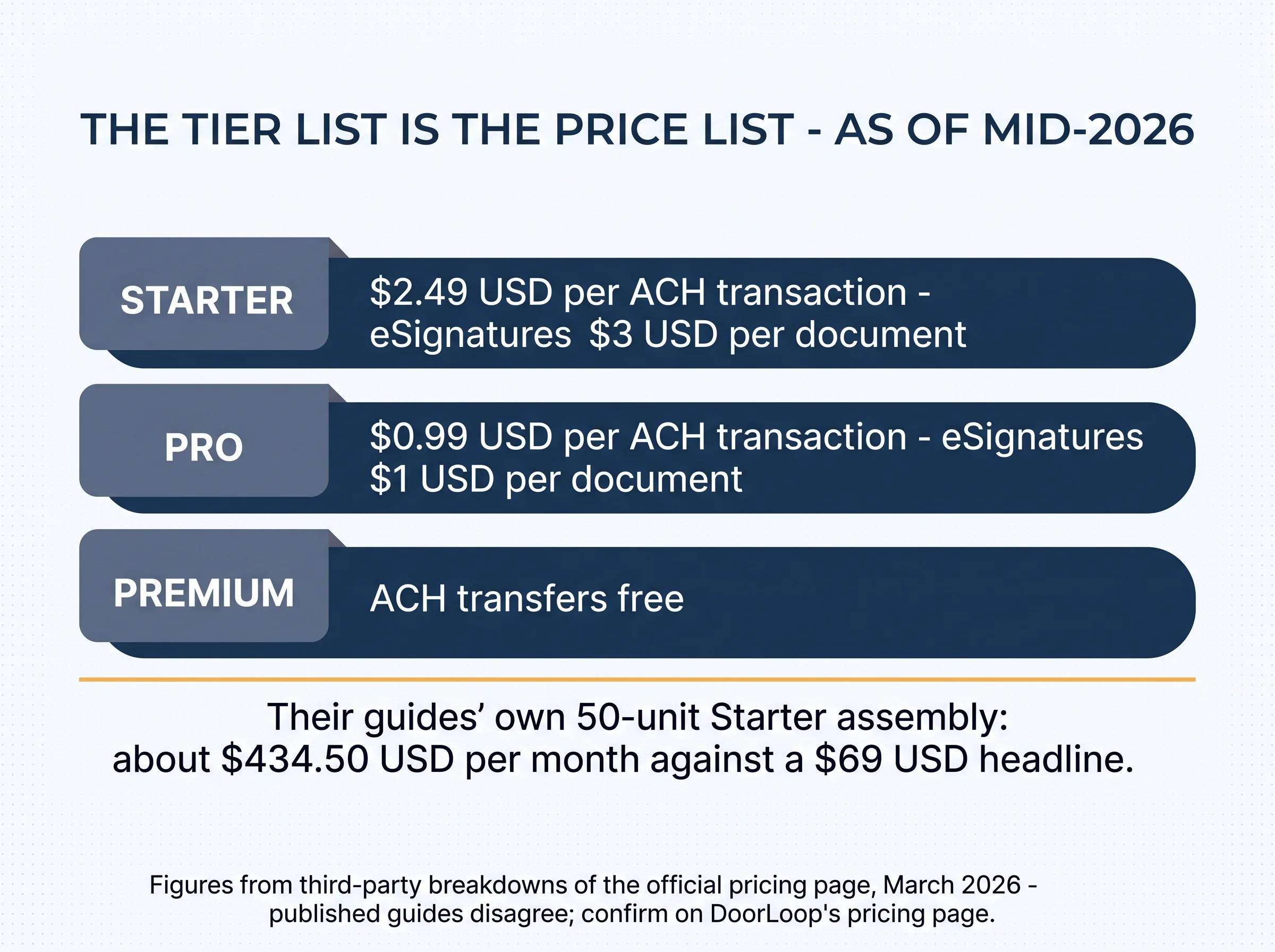
The worked example, with attribution: their own pricing guides assemble a 50-unit Starter portfolio at approximately $434.50 USD per month all-in — a $99 base at that unit count, plus $124.50 in ACH fees, plus screening and eSignatures — against the $69 headline. The base is the smallest part of the bill, which isn't a trick; it's how metered pricing works. The buyer's job is to run the meter at their own volume.
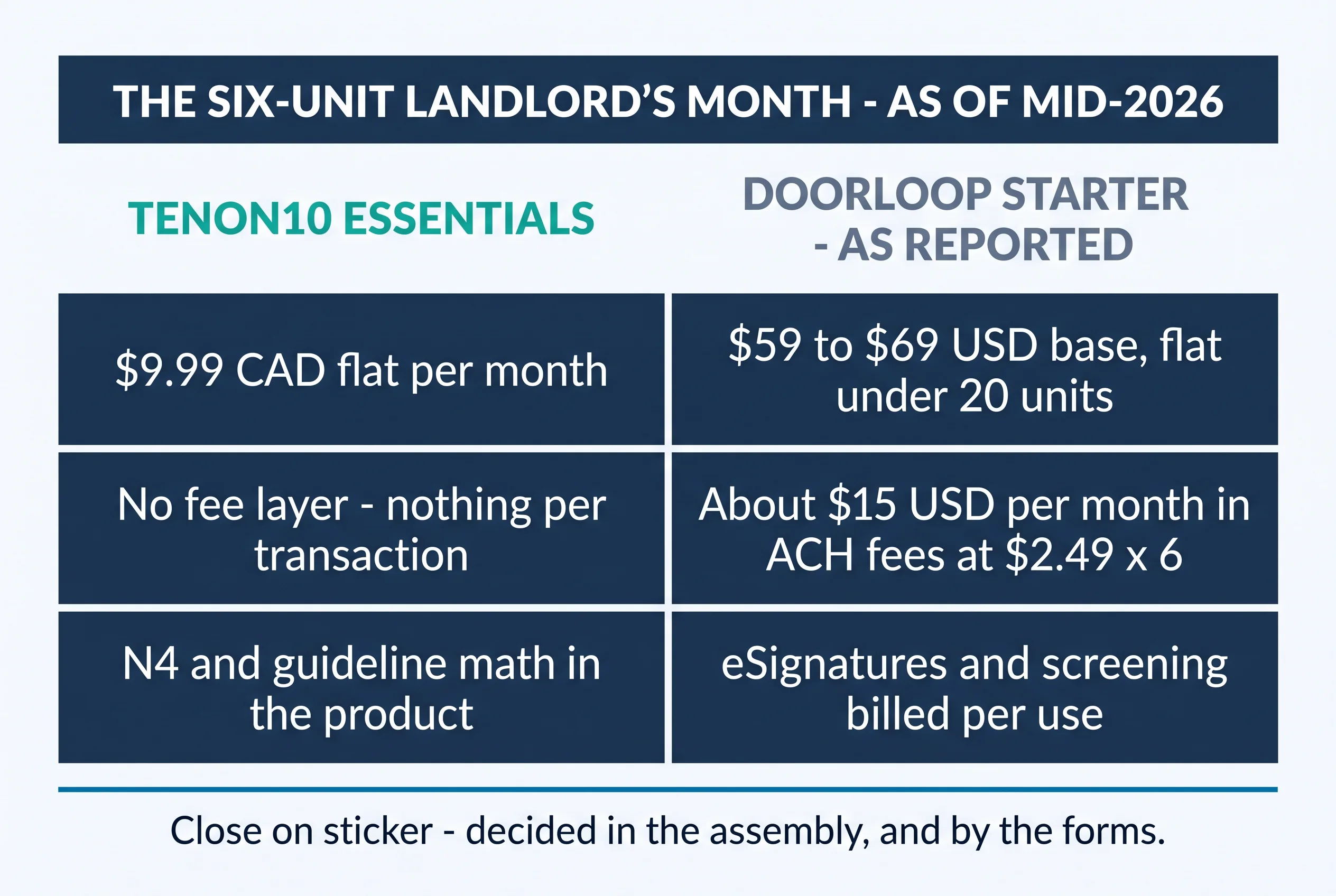
And the small-count version, where most of our readers live: a 6-unit Ontario landlord on DoorLoop Starter pays the $59–$69 USD base (flat, under the 20-unit line) plus roughly $15 USD/month in ACH fees at $2.49 × 6 tenants, plus eSignatures and screening as they occur. On Tenon10 Essentials the same landlord pays $9.99 CAD flat, with nothing metered at all. Close on sticker; decided in the assembly — and by the next section.
Serving Canada vs serving the RTA
Now the distinction this page turns on. DoorLoop genuinely serves Canada — its positioning says so, and Canadian operators use it. But serving Canadian compliance is a different product. Canadian renting is structured by provincial regimes — Ontario's Residential Tenancies Act with its N-series and L-series forms and guideline rent control, and every other province with its own forms, deposits, and clocks — and none of that lives in a US-built workflow. On DoorLoop, an Ontario landlord's N4 is a blank PDF they fill out themselves; the guideline increase — 2.1% for 2026, 1.9% for 2027, per our rent-increase guides — is mental math; the last month's rent interest is a rule remembered.
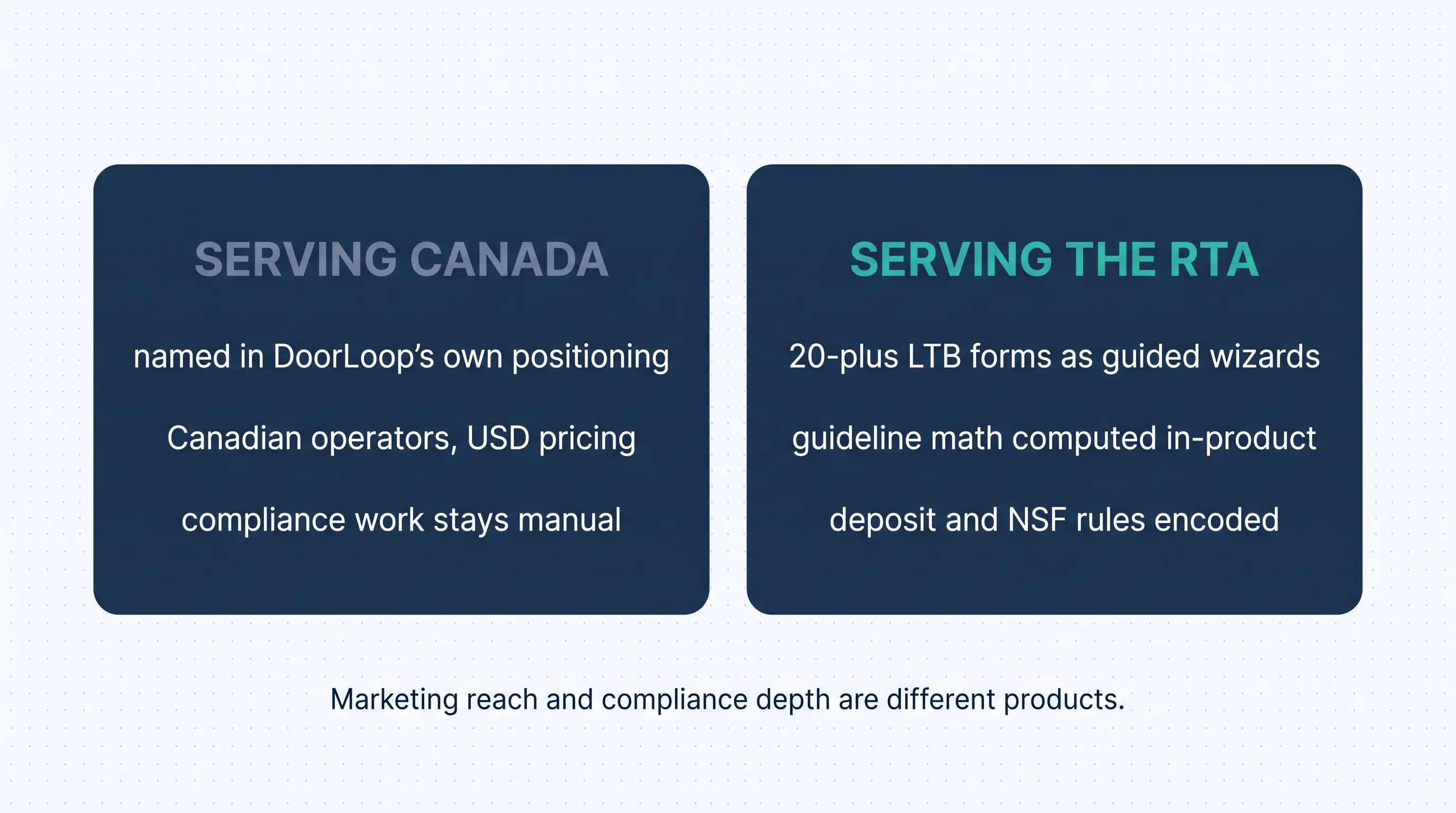
On Tenon10, those same items are the product: 20-plus LTB forms as guided wizards, the guideline computed, deposit and NSF rules encoded — deepest in Ontario, with the CAD pricing, Canadian rails, and per-unit records national. The full compliance-gap treatment lives in our Buildium comparison and our evaluation guide.
And to be fair in both directions: DoorLoop never claimed the RTA. The gap is a scoping fact, not a flaw — its product serves a continental mid-market, and provincial form law isn't that market's common denominator. But for the Ontario landlord comparing the two, it's the difference between software that knows your industry and software that knows your Tuesday. And the gap has a price even when it never causes an error: every manually completed form, every hand-calculated increase, every remembered rule is landlord labour — the least-billed, most-expensive hour in a small operation. Software that encodes the rules isn't saving you from mistakes so much as buying back your evenings, which is a line that belongs in any honest cost comparison right beside the subscription fees.
For property managers: Past our 25-unit cap and under roughly 200 doors, DoorLoop is a legitimate shortlist entry for Canadian PM firms — its stated range wants you, and the platform is genuinely liked. Go in knowing the compliance work stays yours: every notice, every guideline calculation, every provincial form, at portfolio scale. Price that labour into the comparison honestly, because it's real money in staff hours even when it's invisible on the invoice.
Try both — and how to switch
Here's the close this comparison uniquely allows: run it yourself. DoorLoop's free trial plus Tenon10's Free tier means one unit, one week, real tasks, zero dollars. Log a maintenance request in each. Generate a rent receipt in each. Draft the notice you most recently served in each — that last one is where the difference stops being abstract. Then keep whichever platform felt built for your job, with our genuine blessing either way.

If you're switching in either direction, the Switcher's Checklist above carries the full sequence — export everything first and open the files, map units and tenants, run one parallel rent cycle and reconcile to the dollar, move payment authorizations last, archive to CRA retention standards, cancel at cycle end. Two DoorLoop-specific notes: the trial makes the parallel month easy, so actually use it that way; and while their migration team is marketed and reviewers speak well of onboarding, export-first discipline applies no matter who's driving the transfer.
The year ahead, in one beat: the mid-market keeps shipping fast — DoorLoop most of all, founded in 2019, VC-backed and iterating quickly, which one reviewer fairly frames as a young platform still maturing — fee-tier engineering keeps spreading across the category, and the Canadian under-25 segment keeps its flat-CAD alternative exactly where it is. For the buyer, the practical translation of a fast-shipping vendor is simple: whatever this page reports will drift, in both directions — features will improve, and pricing will move — which is one more reason the dated screenshot and the free week beat any static comparison, including this one.
Run your half of the test right now: Tenon10's Free tier covers up to 3 units, no card required, tenants free forever — a five-minute setup and you're comparing for real. Create a free account or see current plans.
The Switcher's Checklist: Moving Your Canadian Rentals to New Software
The 18-point sequence for changing property management software without losing a record, a payment, or a rent cycle — the fit test to run before any demo, the exports to secure before you cancel anything, the parallel month that catches every mapping error, and the clean cutover that keeps CRA-ready archives. Works whichever platform you're leaving and whichever you're joining.
Get Free PDF →Key takeaways
- DoorLoop is a real competitor that names Canada — this comparison is decided in the details, not by a floor or a scale mismatch.
- Assemble the whole bill: base, per-unit charges above 20 units, your ACH tier, eSignatures, and screening, in USD — their own guides land 50 Starter units near $434.50/month against a $69 headline.
- The tier list is the price list: ACH falls from $2.49 to $0.99 to free as tiers rise — your transaction volume picks your tier, and their own upgrade math proves it.
- Serving Canada ≠ serving the RTA: name your forms before you choose — on one platform they're wizards; on the other they're your evening.
- Published guides disagree about their pricing — screenshot the vendor page, dated, the day you evaluate.
- Uniquely, you can just try both free this week — same tasks, same day, side by side.
Assemble the bill, name your forms, run the week
That's the whole method, and this page is the first in our series where you'll actually need it. DoorLoop earns its place on a Canadian shortlist: modern, well-reviewed, willing — the first competitor here that wants smaller portfolios and says so. What the shortlist conversation owes you is the assembled bill in the right currency, the honest note that its tiers price its fees, and the distinction that decides the Ontario case: it serves Canada; it doesn't serve the RTA. Tenon10 is the other answer — flat CAD on a public page, no meter anywhere, tenants free, and the forms as wizards — built for the 1-to-25-door Canadian landlord and capped there on purpose. Two good tools, two different jobs. And for once, you don't have to take our word for any of it: the week is free on both sides.
Your half of the free week starts here
Flat CAD pricing on a public page, no fee layer, tenants who never pay, and Ontario's LTB forms as guided wizards. Free for up to 3 units — no card, no meter, no surprises.
Free for up to 3 units • Tenants always free • See current plans
Related resources
- Tenon10 vs Buildium — the scale-decided comparison, with the full compliance-gap treatment.
- Tenon10 vs AppFolio — the floor-decided comparison, and the effective-rate method.
- Property Management Software: What to Look For — the full-market evaluation framework.
- How to Use the N4 Notice in Ontario — the form at the centre of the gap.
Frequently asked questions
Does DoorLoop work in Canada?
Yes — its own positioning names owners in the US and Canada managing 10 to 2,000-plus units, and Canadian operators use it. What it doesn't include is Canadian provincial compliance tooling: no LTB form workflows, no Ontario guideline math, no encoded deposit rules. Serving Canada and serving Canadian compliance are different products, and that distinction is usually what decides this comparison for Ontario landlords.
How much does DoorLoop actually cost?
Published guides disagree (as of mid-2026): Starter around $59–$69 USD/month, upper tiers reported anywhere from $109 to $199, with the most detailed breakdown showing the base covering the first 20 units plus $1.00–$1.50 per additional unit — and a metered layer of ACH fees ($2.49, $0.99, or free by tier), eSignatures, and roughly $45 screening reports that their own guides assemble to about $434.50/month for 50 Starter units. Confirm current figures on DoorLoop's pricing page, dated.
Is DoorLoop or Tenon10 better for a small Ontario landlord?
Under 25 units, Tenon10 was built for exactly this case: flat CAD pricing with no fee layer, tenants free on every tier, and the N4, N1, and guideline math as wizards and computed fields. DoorLoop's sticker is competitive at small counts, but the assembled bill and the manual compliance work are the real comparison — and the best answer is empirical: run both free for a week.
What if I have more than 25 units?
Tenon10's Pro tier caps at 25 — past that, we don't compete, plainly. DoorLoop's stated range wants Canadian operators from 26 doors well into the hundreds, and it's a legitimate shortlist entry there, with the compliance work staying manual at portfolio scale. Model the fee tiers at your transaction volume; their own math favours the upper tiers as ACH volume grows.
Can I try both before deciding?
Yes — uniquely in this category, completely. DoorLoop offers a free trial and Tenon10's Free tier covers up to 3 units with no card required. Set up one unit in each, run the same three tasks side by side on the same day, and keep whichever platform felt built for your job.


