To appeal an RTDRS order in Alberta, you file a notice of appeal with the Court of King's Bench within 30 days after the order is filed, and only on a question of law or jurisdiction. If you missed the hearing because of an accident, a mistake or insufficient notice, ask the RTDRS to set the order aside instead, within 20 days.
A Residential Tenancy Dispute Resolution Service (RTDRS) order binds both parties unless a tenancy dispute officer sets it aside or varies it, or it is set aside or varied on appeal (RTDRS Regulation, AR 98/2006, s.21). No RTDRS staff member or government official can change an officer's decision, the province says on its Hearings and orders page. That leaves three routes, and picking the wrong one wastes the deadline. For how the service works overall, see RTDRS explained; the costs of a fresh application are in RTDRS filing fees and the claim limit.
Which route fits your problem with an RTDRS order?
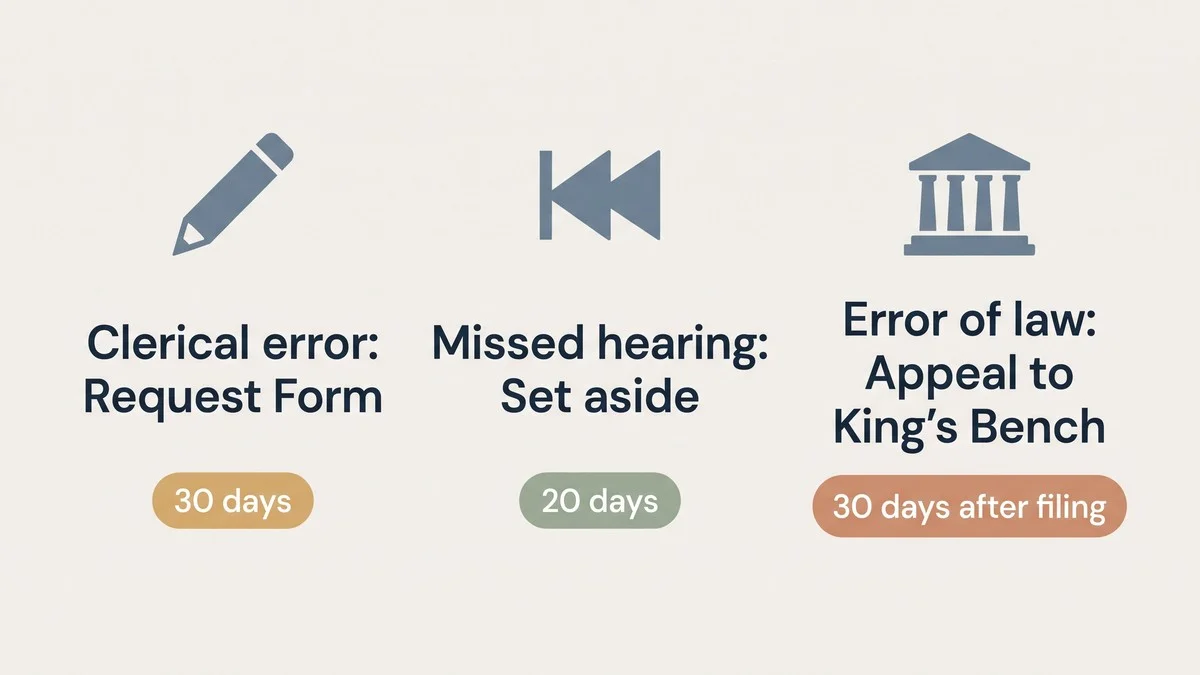
In Alberta the route depends on what went wrong: a typo, an unfair process, or a legal error by the officer.
| Problem | Route | Deadline | Decided by |
|---|---|---|---|
| Typing, arithmetic or similar error, or the order is unclear | Correction or clarification (RTDRS Request Form) | Within 30 days after you receive the order (for a clarification or an obvious error) | The officer who made the order |
| Order made without notice to you, or you missed the hearing because of an accident, a mistake or insufficient notice | Set aside or vary (RTDRS Request Form) | Within 20 days | Usually the officer who made the order |
| The officer got the law wrong or decided something outside their authority | Appeal to the Court of King's Bench | Within 30 days after the order is filed | A Court of King's Bench justice |
Sources: RTDRS Regulation ss.19, 19.1 and 23.
How do you fix a clerical error in an RTDRS order?
You send the RTDRS a completed RTDRS Request Form asking for an amendment or a clarification. Under s.19 of the Regulation an officer may correct typographic, grammatical, arithmetic or similar errors, clarify the order, and deal with an obvious error or inadvertent omission. A party's request for a clarification or to fix an obvious error must be made within 30 days after the party receives the order. The province suggests doing this before the order is filed with the Court of King's Bench where possible.
When can an RTDRS order be set aside or varied?
An Alberta tenancy dispute officer may set aside or vary an order only if it was made without notice to a party, if a party missed the hearing because of an accident, a mistake or insufficient notice of the hearing, or on other grounds consistent with procedural fairness (Regulation s.19.1(5)). The request must be made within 20 days after the earlier of the day the RTDRS provided you a copy of the order and the day the order first came to your attention (s.19.1(3)).
The officer may stay the original order while the request is considered (s.19.1(4)). If the order is set aside, the RTDRS issues a notice of rehearing and the matter is heard again as if it were an original hearing (s.19.1(6)). Once a stay or set-aside order is filed with the Court of King's Bench, the original order is stayed or set aside as that order provides and, unless the Court orders otherwise, any garnishee summons or execution under it is stayed too (s.19.1(7)).
What counts as an error of law or jurisdiction?
An appeal from an RTDRS order is limited to a question of law or of jurisdiction (Regulation s.23(1)). The province's examples are an officer who did not interpret the legislation correctly (law) and an officer who made a decision they are not authorized to make (jurisdiction). Simply disagreeing with the decision is not a valid reason to appeal, and a set-aside request is not an appeal.
How do you appeal an RTDRS order to the Court of King's Bench?
Under s.23 of the Regulation, the appellant must:
- Within 30 days after the order is filed, file a notice of appeal with the Court of King's Bench setting out the grounds, and serve a filed copy on the respondent, the RTDRS and anyone else the Court directs.
- No later than 7 days after the last day for that service, file an affidavit of service and a copy of a requisition to the RTDRS for a transcript of evidence, with a receipt showing the appellant paid for it or written confirmation from the RTDRS that no transcript is available.
- Within 3 months after filing the notice of appeal, file the transcript, unless the Court orders otherwise or the RTDRS confirmed none is available.
An appellant who does not meet these requirements has the appeal dismissed (s.28). On the appeal, the Court hears no new evidence; it may confirm, vary, reverse or cancel the order, or send the matter back to the RTDRS for a rehearing (s.25). Its decision is final and cannot be appealed further (s.24(2)).
What if the order came from the Court of Justice, not the RTDRS?
A different rule applies. Under RTA s.53, a party to a Court of Justice order may appeal to the Court of King's Bench by application within 30 days after the order is entered and served, and that appeal also does not stay the order unless the Court directs. If you have not yet chosen a forum, RTDRS or court compares them.
Frequently asked questions
Can I appeal because the officer believed the other side?
An RTDRS appeal is limited to a question of law or of jurisdiction (Regulation s.23(1)), and the Court hears no new evidence (s.25). The province says simply disagreeing with the decision is not a valid reason to appeal, so frame any appeal around the legal or jurisdictional error you say the officer made.
I never got the hearing notice. What should I do?
Ask for a set-aside on the RTDRS Request Form within 20 days of when the order came to your attention, and say how you learned of it. An order made without notice is one of the listed grounds.
Does a set-aside request stop an eviction?
Only if the officer issues an interim stay and that order is filed with the Court of King's Bench. Ask for the stay in the same request if possession is at stake.
Can I complain about how the officer behaved?
Yes. The RTDRS Administrator can review an officer's conduct under the Code of Conduct, and usually responds in writing within 30 days, but that review does not change the order.
How long is an RTDRS order valid?
The province says RTDRS orders are valid for 10 years, with some exceptions.
Back to the paperwork?
Find Alberta's tenancy notices, the inspection report and the residential tenancy agreement on one page.
Free • No signup required