Late rent fees in Saskatchewan are not set by law: The Residential Tenancies Act, 2006 and its Regulations do not mention late-payment or NSF (returned payment) fees and fix no amount. A fee is only as good as a clear written lease term that is not inconsistent with the Act or unconscionable (s.7(2)), and the Office of Residential Tenancies (ORT) decides any dispute.
At a glance: late and NSF fees in Saskatchewan
- Set amount: none in the Act, the Regulations or the Standard Conditions.
- Lease term: unenforceable if inconsistent with the Act, unconscionable or unclear (s.7(2)).
- Real losses: recoverable through the ORT as compensation (s.8(1), s.70(6)(c)).
- Repeated lateness: a ground for a one-month notice for cause (s.58(1)(b)).
Can a Saskatchewan landlord charge a late fee for rent?
Saskatchewan's tenancy law neither permits nor forbids a late fee in so many words, so the lease decides, subject to the Act. Under s.7(2), a lease provision is not enforceable if it is inconsistent with the Act or the Regulations, is unconscionable, or does not clearly communicate the rights and obligations under it.
The conservative reading for landlords: write any fee into the lease in plain words, keep it modest and tied to the real cost of late payment, and never present it as rent. A fixed charge far above any real cost is the kind of term a hearing officer may refuse to enforce as unconscionable.
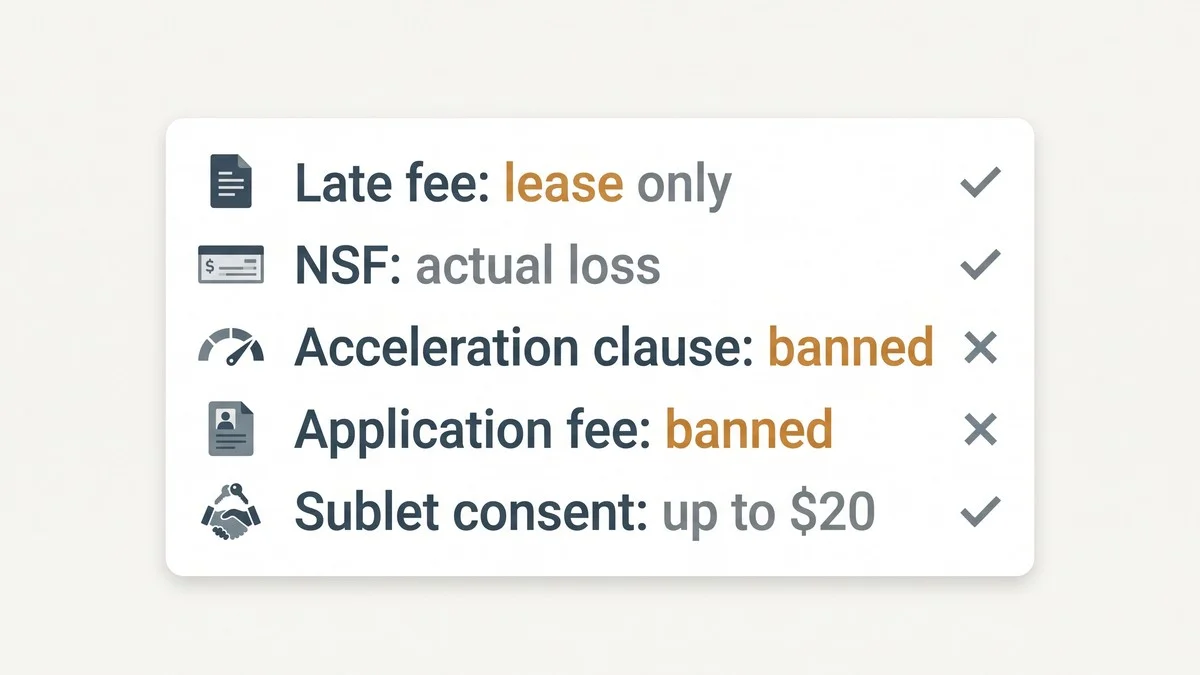
| Charge | What the law says |
|---|---|
| Late-payment fee | Not mentioned; only a clear, fair lease term can support it (s.7(2)). |
| NSF or returned-payment fee | Not mentioned; the landlord's actual loss can be claimed (s.8(1)). |
| Whole rest of the term due on a breach | Prohibited as an acceleration clause (s.41). |
| Application or processing fee | Prohibited (s.23). |
| Assignment or sublet consent fee | Up to $20 (Regulations s.8). |
What about an NSF charge when a rent payment bounces?

When a Saskatchewan tenant's payment is returned, the landlord can recover the loss it actually caused, such as the bank's own charge, because a party who does not comply with the tenancy agreement must compensate the other for resulting loss (s.8(1)). The ORT can order that payment (s.70(6)(c)). The landlord must also do what is reasonable to keep the loss down (s.8(2)).
Can unpaid late fees be added to an Immediate Notice to Vacate?
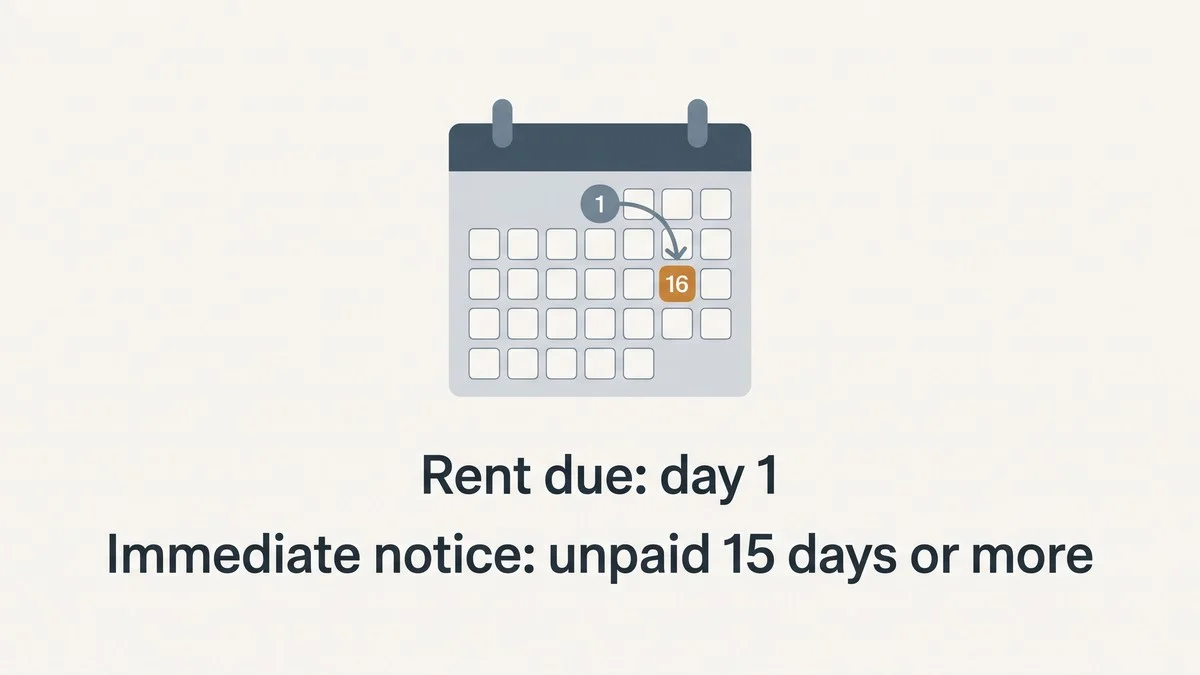
Treat them separately. Saskatchewan's Immediate Notice to Vacate and Notice of Arrears is built on rent that is unpaid for 15 days or more after it is due (s.57(1)), so the conservative approach is to list only unpaid rent as arrears and claim any fee in a monetary claim. Our guide to filling in the Immediate Notice to Vacate covers the arrears field, and when the 15-day clock allows it.
What can a landlord do about a tenant who is always late?
In Saskatchewan, a tenant who is repeatedly late paying rent can be given a notice to end the tenancy for cause, effective at least one month after it is received and on the day before a rent day (s.58(1)(b), (3)). The tenant has 15 days to dispute it in writing (s.58(5)). A fee is not the only tool, and often not the strongest.
Frequently asked questions
Is there a maximum late fee in Saskatchewan?
No figure is set anywhere in the Act, the Regulations or the Standard Conditions. That is not permission to charge any amount: an unclear or unconscionable term is not enforceable (s.7(2)).
Can the landlord take a late fee out of the security deposit?
Not automatically. A lease may not say the landlord keeps all or part of the deposit at the end of the tenancy (s.26(1)(c)); the landlord claims against the deposit through the ORT within seven business days of the tenancy ending. The security deposit rules explain the process.
Can a tenant refuse to pay a late fee?
A tenant who thinks a fee is unenforceable can raise it with the landlord in writing and, if needed, apply to the ORT. Rent itself must still be paid when due (s.42(1)).
Does paying late in cash change anything?
The landlord must give a receipt for rent paid in cash (s.42(2)). Ask for one every time, so the payment date is on record.
Saskatchewan leaves late fees to the lease and the ORT, so clarity and records matter more than the number. More help is in the Canadian Landlord Resource Center and the Canadian Tenant Resource Center.
Put your payment terms in writing
Fill out a Saskatchewan Residential Tenancy Agreement online, with every term s.19(1) requires and the Standard Conditions, and download the PDF.
Free • No signup required