In Saskatchewan, a landlord can take a security deposit (often called a damage deposit) of no more than one month's rent, collect at most half at signing, and must return it, or serve a claim on the approved form, within seven business days after the tenant moves out (The Residential Tenancies Act, 2006, ss.25, 26(4), 32(1)).
At a glance
- Maximum: one month's rent, one deposit per tenancy, taken only at the start (ss.25(1), 26(1)).
- Instalments: no more than 50% at signing; the rest within two months after the tenant moves in (s.26(4)).
- Held in trust: in a trust account at a bank, trust company or credit union, or in Trustee Act investments (ss.28-29).
- Interest: 0% if the tenancy ends within five years; longer tenancies earn the prescribed rate (Regs s.5).
- Return or claim: within 7 business days after the landlord knows the tenant left (s.32(1)).
- Tenant dispute: apply to the ORT within 60 days after the tenancy ends; the fee is $50 (s.33).
Searchers in Saskatchewan usually ask about "damage deposit laws"; the Act calls it a security deposit, and the rules are the same whatever the lease calls it. This guide covers the limit, how it can be paid, where the landlord must keep it, interest, the seven-business-day return, and how the Office of Residential Tenancies (ORT, formerly the Rentalsman) settles a dispute. It is written for landlords and tenants alike.
Saskatchewan Security Deposit Checklist
Get Free PDF →How much can a landlord charge for a damage deposit in Saskatchewan?
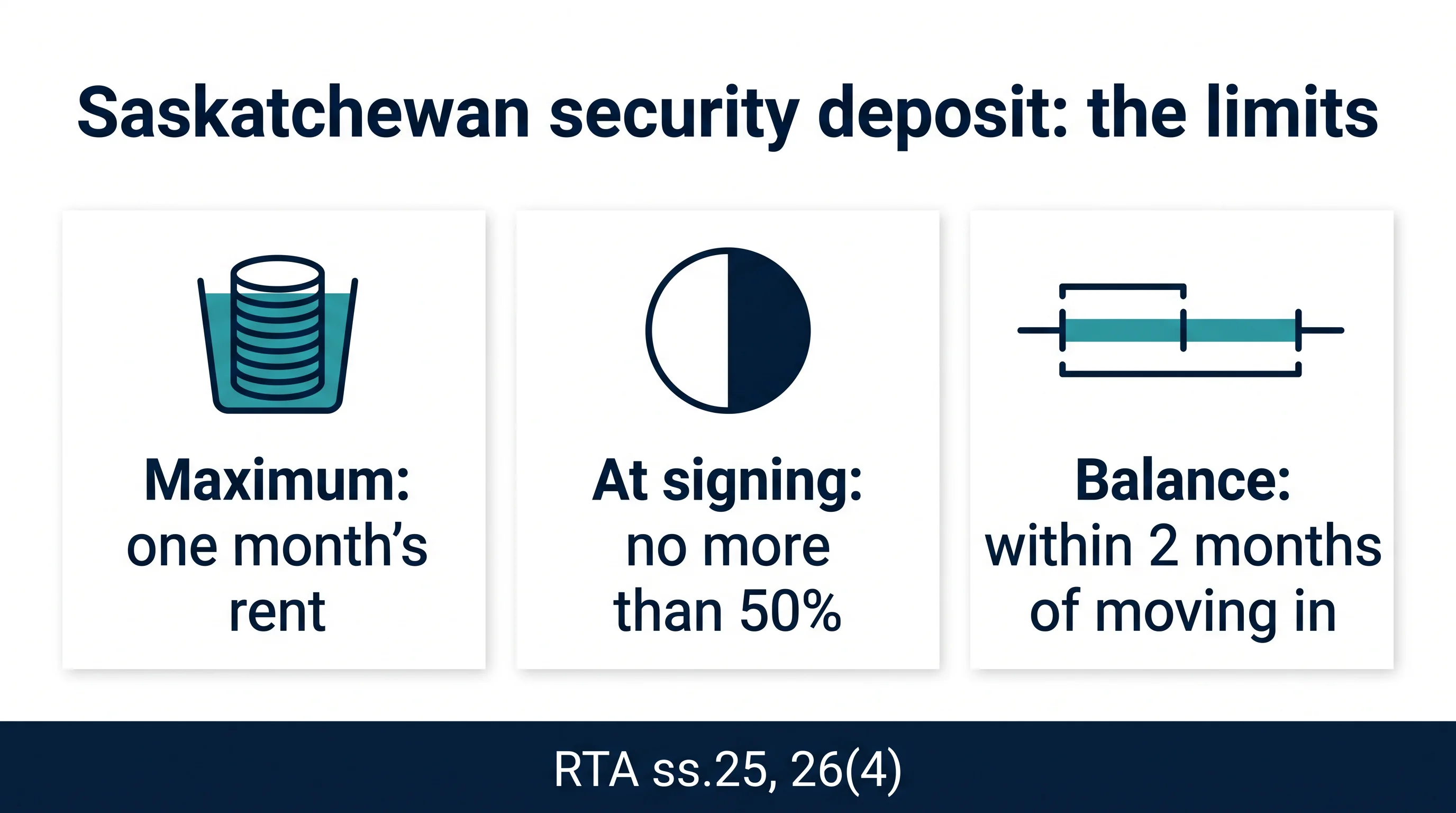
A Saskatchewan landlord cannot require or accept a security deposit greater than one month's rent under the tenancy agreement (s.25(1)). If a landlord takes more, the tenant can deduct the overpayment from rent or otherwise recover it (s.25(2)). Where rent is subsidized by a public housing authority, the month's rent is worked out without the subsidy (s.25(3)).
The Act also limits how and when the deposit is taken:
- Only at the start: a landlord cannot require a deposit at any other time than when the agreement is entered into (s.26(1)(a)), with a narrow exception where a social assistance guarantee is withdrawn (s.26(2)).
- Only one deposit: a landlord cannot require or accept more than one security deposit for a tenancy (s.26(1)(b)). The Act has no separate pet deposit, so the safe reading is that any pet money counts inside the same one-month limit.
- No raising it by ending the tenancy: a landlord cannot give notice to vacate, or refuse to renew, just to increase the deposit (s.26(3)).
- No automatic keep clause: a lease cannot say the landlord automatically keeps all or part of the deposit at the end (s.26(1)(c)).
Can a tenant pay the deposit in instalments in Saskatchewan?

Yes. In Saskatchewan, a landlord can require no more than 50% of the deposit when the tenancy agreement is entered into, and the rest within two months after the tenant takes possession (s.26(4)). The Standard Conditions in every agreement say the same (Regs, Schedule 1, s.3(1)).
If a tenant does not pay the deposit within two months after the tenancy start date, that is a ground for the landlord's Notice to Vacate: Cause (s.58(1)(a)). A tenant cannot use the deposit as the last month's rent unless the landlord agrees in writing (s.27).
Where must a Saskatchewan landlord keep the deposit?
A Saskatchewan security deposit is held by the landlord in trust for the tenant who paid it (s.28). The landlord must either deposit it in a trust account at a bank, trust company or credit union, or invest it in securities authorized by The Trustee Act, 2009 (s.29).
Because it is trust money, a deposit is not subject to seizure, garnishment, attachment or claim by anyone (s.31). When a property is sold, the new landlord takes on the same obligations for every deposit the former landlord held in trust (s.38(2)), so a buyer should account for the deposits at closing.
Do Saskatchewan landlords pay interest on a security deposit?
Only on long tenancies. In Saskatchewan the prescribed interest rate is 0% if the tenancy ends within five years after the agreement was entered into (Regs s.5(1.1)). For a longer tenancy, the rate for each year is the Bank of Canada's chartered bank rate for non-chequable savings deposits for December of the previous year (Regs s.5(2)).
The ORT's interest table (February 2026) lists the rate as 0.01% after December 31, 2020, with older rates for earlier periods. Interest is calculated from the date the landlord receives the full deposit (s.30(1)), and the ORT says it accrues only up to 30 days after the tenancy ends.
How long does a landlord have to return a damage deposit in Saskatchewan?
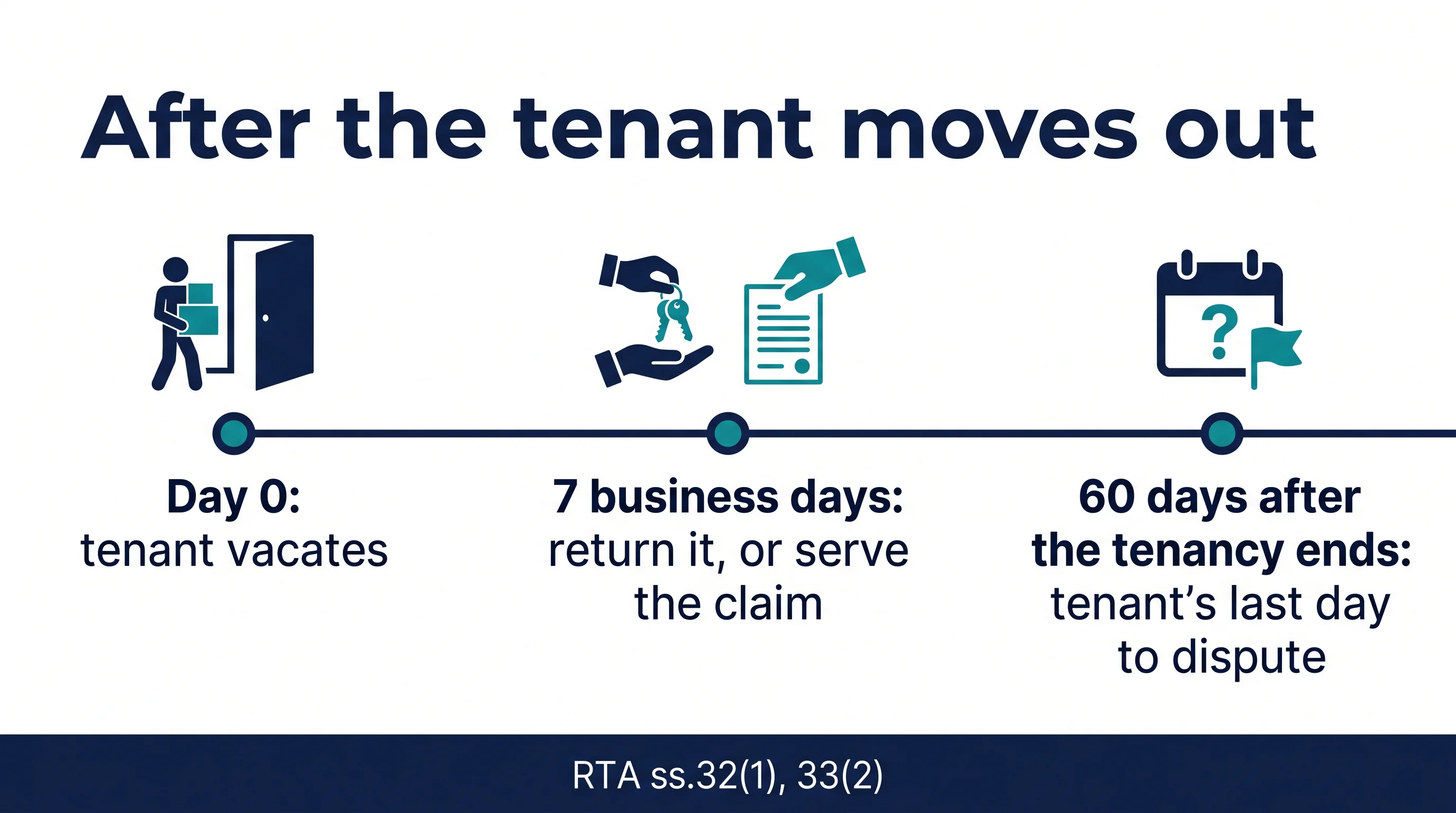
A Saskatchewan landlord has seven business days after the day they know, or should reasonably have known, that the tenant vacated (s.32(1)). Business days exclude Saturdays, Sundays and holidays (s.2(a.1)). Within that time the landlord must do one of two things:
- Return it all: pay the tenant the deposit and any accrued interest (s.32(1)(a)); or
- Claim part or all of it: pay back the part not claimed, serve the approved Notice of Landlord's Claim for Security Deposit, and keep holding the claimed part in trust for 30 days from the end of the tenancy (s.32(1)(b)).
The claim is served at the tenant's forwarding address, which can be an email address, by personal service, ordinary mail or electronically (s.32(1.1), (2)(a)). If the tenant leaves no forwarding address, the landlord does not have to serve the notice (s.32(2)(b)). Where Social Services guaranteed the deposit, the notice goes to the ORT's director instead (s.32(3)).
The process does not apply if the tenant agrees in writing at the end of the tenancy that the landlord can keep a set amount and the landlord pays back the rest (s.32(4)). After a landlord's notice to demolish, or to renovate in a way that needs the unit empty, the whole deposit is returned without deduction, except for outstanding rent or utility arrears (s.32(5)).
| Rule | Saskatchewan | Alberta | British Columbia |
|---|---|---|---|
| Maximum deposit | One month's rent | One month's rent | Half a month's rent (plus a separate pet deposit) |
| Time to return or account | 7 business days | 10 days | 15 days |
| If the landlord skips the step | The ORT must order it returned (s.34(1)) | See the Alberta guide | Can owe double |
For the neighbouring rules, see Alberta's security deposit guide, BC's 15-day rule and when a BC landlord owes double.
How does a tenant dispute a deposit claim in Saskatchewan?
A Saskatchewan tenant disputes a claim, or a deposit that was never returned, by applying to the ORT through its online portal within 60 days after the tenancy ends (s.33(1)-(2)). The application fee is $50, subject to The Fee Waiver Act.
The ORT then notifies the landlord, who has 10 business days after receiving that notice to pay the disputed amount and interest into the ORT and, if the claim has changed, file an updated claim on the approved form (s.33(5)). If the landlord does not, the director can order the deposit paid to the tenant without notice to the landlord (s.33(8)). The ORT page says it may then cancel the hearing.
What happens if a Saskatchewan landlord misses the 7 business days?
If a hearing officer finds that a Saskatchewan landlord did not follow s.32(1)(b), the hearing officer shall immediately order the deposit and interest paid to the tenant (s.34(1)), and the director can do so without hearing the landlord (s.34(2)). The only way out is exceptional circumstances that prevented compliance, where ordering repayment would be grossly inequitable (s.34(3)).
A landlord who failed to comply with s.32, or claimed without reasonable grounds, can also be ordered to pay the tenant's costs of the hearing (s.34(4)): out-of-pocket expenses and lost income, at least $50 and at most $200 (Regs s.13.1). The landlord can still pursue real damage separately through an ORT application, generally within one year of the act or omission (s.71.1).
Frequently asked questions
Is a damage deposit the same as a security deposit in Saskatchewan?
Yes. "Damage deposit" is the everyday name; the Act uses "security deposit", and the same one-month limit and return rules apply (ss.25-34).
Can a Saskatchewan landlord charge a pet deposit on top of the security deposit?
The Act allows only one security deposit per tenancy and caps it at one month's rent (ss.25(1), 26(1)(b)). It has no separate pet deposit, so keep all deposit money, pet-related or not, within that single limit.
Can a landlord keep the deposit for cleaning?
Only through the claim process. A lease cannot say the landlord automatically keeps part of the deposit (s.26(1)(c)), and the ORT says a landlord cannot automatically charge for cleaning in a tenancy agreement. The landlord must serve a claim within seven business days, and the tenant can dispute it.
How long do I have to dispute my landlord's claim?
60 days after the tenancy ends (s.33(2)). Apply through the ORT's online portal, pay the $50 fee and include proof of the deposit you paid.
Does a deposit earn interest in Saskatchewan?
Not if the tenancy ends within five years of the agreement (Regs s.5(1.1)). For longer tenancies, the ORT's table shows 0.01% a year after December 31, 2020.
The Saskatchewan system is short and strict: one month, half up front, trust account, seven business days. Landlords who document the unit and serve a claim on time keep their right to it; tenants who leave a forwarding address and watch the 60-day window keep theirs. More landlord and tenant guides are in the Canadian Landlord Resource Center and the Canadian Tenant Resource Center.
Saskatchewan Security Deposit Checklist
Get Free PDF →Get your rental paperwork right
Browse free landlord and tenant resources.
Free • No signup required