
The net-basis election lets a Canadian who owns US rental property be taxed on net rental income, after expenses and depreciation, at graduated US rates instead of a flat 30% of gross rent; it is made under Internal Revenue Code section 871(d) by attaching a statement to Form 1040-NR, and it stays in force for all later years.
This explainer covers what the election is, what it covers, how long it binds you and how it can be undone, using the statute and IRS Publication 519 (2025). The forms that put it into practice (W-8ECI, the ITIN and the 1040-NR) each have their own article in this series, and the series pillar, Canadians Who Own a US Rental: The Complete Tax Guide, shows how it connects to your Canadian return.
What does the net-basis election actually do?
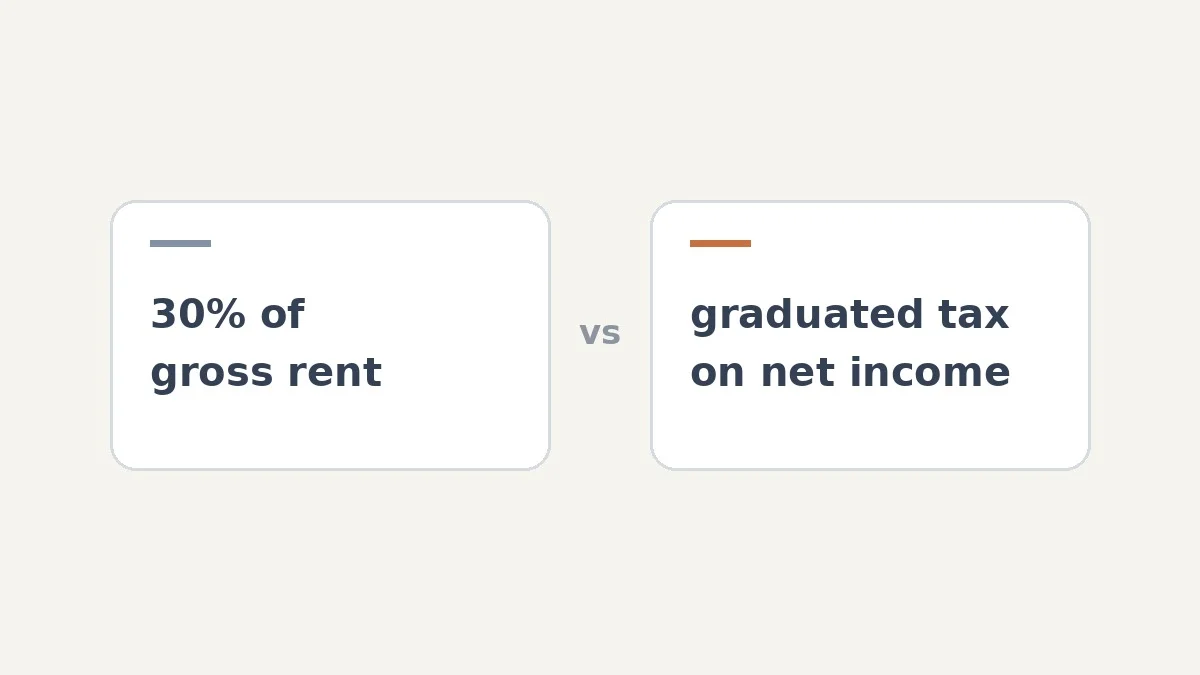
It reclassifies your US real property income as "effectively connected" income. Section 871(d)(1) lets a nonresident alien "elect for such taxable year to treat all such income as income which is effectively connected with the conduct of a trade or business within the United States", taxable under the graduated rates "whether or not such individual is engaged in trade or business". Publication 519 adds that the choice does not treat you as engaged in a US trade or business, and that once you make it "only your net income from real property is taxed".
What income does the election cover?

All of it, not one property. Publication 519 says the choice "applies to all income from real property located in the United States and held for the production of income and to all income from any interest in such property", including rents. You can make it only for real property income that is not already effectively connected with a US business.
How much difference does it make? (illustrative figures only)
Here is the taxable base for one property with US$24,000 of annual rent under three expense levels, with a full year's depreciation of US$7,273 on a US$200,000 building over the 27.5 years in Publication 527:
| Cash expenses | Default: 30% of gross | Election: net income taxed at graduated rates |
|---|---|---|
| US$5,000 | US$7,200 tax | US$11,727 taxable |
| US$9,000 | US$7,200 tax | US$7,727 taxable |
| US$17,000 | US$7,200 tax | US$(273) loss |
The tax under the election depends on your graduated rates and other US income for the year, so the table compares the base, not the final tax. The default column is the actual tax: 30% of US$24,000.
How do you make the election?
Attach a statement to your return, or an amended return, for the first year. Publication 519 and the 2025 Form 1040-NR instructions list what it must contain:
- That you are making the choice.
- Whether it is under section 871(d) or a tax treaty.
- A complete list of your US real property or interests in it.
- The extent of your ownership.
- The location of the property.
- A description of major improvements.
- The dates you owned it.
- Your income from the property.
- Details of any previous elections and revocations.
You then report the rent on Schedule E, carried to Schedule 1 (Form 1040), line 5, and give the payer Form W-8ECI so it stops withholding.
Can you revoke the election?
Two IRS publications describe revocation, and their wording differs. The 2025 Form 1040-NR instructions state: "Once made, the section 871 election will remain in effect until revoked with the consent of the Commissioner."
Publication 519 says you "can revoke the choice without IRS approval by filing Form 1040-X for the year you made the choice and for later tax years", within 3 years from the date your return was filed or 2 years from the time the tax was paid, whichever is later. If that period has expired for the year of choice, it says you cannot revoke the choice for that year, and you may revoke it for later tax years "only if you have IRS approval", following Regulations section 1.871-10(d)(2).
Both texts require IRS consent once Publication 519's window has closed. On a new election after a revocation, the 1040-NR instructions say one "may not be made until after the fifth year in which the revocation occurs", and section 871(d)(2) bars a new election before the fifth taxable year after the revocation takes effect unless the IRS consents.
When might the default 30% be the simpler outcome?
When the gross-rent tax is small and filing every year is a burden. Publication 519's own example is a nonresident whose only US income is rent with 30% properly withheld and reported on Form 1042-S, who "do[es] not have to file" Form 1040-NR. The election trades that simplicity for a lower taxable base and an annual return. Note too that the Canadian foreign tax credit counts only tax you actually owe the US; see our T776 form guide for the Canadian side.
What goes wrong with the election?
- Electing for one property only. It covers all US real property income.
- No statement in year one. The election is made by the statement.
- Late returns. Missing the 16-month window loses the deductions for that year.
- Forgetting depreciation. US depreciation is part of the net figure; keep a schedule. Our bookkeeping guide covers asset records, and our CCA article explains Canada's separate rules.
Frequently asked questions
Do I have to make the election in my first year of ownership?
No. The statement is attached for the year you choose, on a return or an amended return for that year, per Publication 519.
Does the election make me a US resident?
No. It changes how the income is taxed. Residency is a separate test in Publication 519.
Is the election made under the Canada–US treaty?
The statement asks whether it is under section 871(d) or a treaty. Article VI of the Canada–US Convention gives the US the right to tax the rent; the consolidated text does not itself contain a net-basis election, so a Canadian owner relies on section 871(d).
What if I sell the property?
Gain on a US real property interest is already treated as effectively connected, per Publication 519, and FIRPTA withholding applies at the sale.
Plan your rental tax year
Free guides and tools for Canadian landlords
Free • No signup required