The notice of utility arrears in Saskatchewan (formerly Form 7a, now on the Office of Residential Tenancies portal) is the written demand that starts a 15-day clock. Under The Residential Tenancies Act, 2006, a landlord may treat unpaid utility charges as unpaid rent, and give the immediate notice under s.57, when two things are true: the tenancy agreement requires the tenant to pay the utility charges, to the landlord or to the utility provider, and the charges remain unpaid for 15 days or more after the landlord gives the tenant a written demand (s.57(5)).
At a glance: utility arrears
- Condition 1: the lease makes the tenant pay the utility (s.57(5)(a)).
- Condition 2: unpaid 15 days or more after a written demand (s.57(5)(b)).
- Demand form: Notice of Utility Arrears (formerly Form 7a), 15 days.
- Next step: Immediate Notice to Vacate and Notice of Arrears (formerly Form 7).
- At the hearing: the landlord may claim the rent or utility arrears.
Step 1: Check the lease

Every written Saskatchewan lease must say whether the landlord or the tenant pays for utilities (s.19(1)(g)(vi)). If yours says the landlord pays, or says nothing clear, s.57(5) is not available: the precondition is that the agreement requires the tenant to pay. The Standard Conditions put it the same way (Regulations, Schedule 1, s.17(2)).
Step 2: Total what is owed
List each bill: the utility, the billing period, the amount and the tenant's share if the meter is shared. Use the split the lease sets out. Attach copies of the bills.
Step 3: Give the written demand

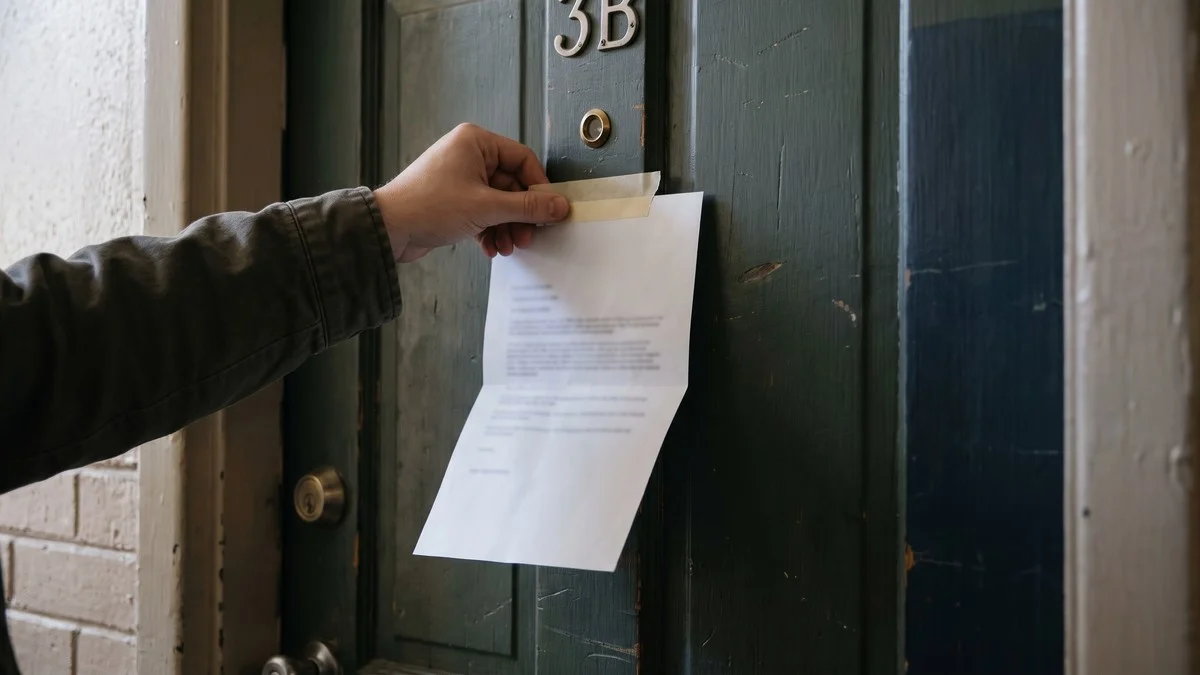
Prepare the Notice of Utility Arrears on the ORT portal and give it to the tenant. Serve it by a method s.82 allows, such as personal delivery, or posting on the door plus ordinary mail or an electronic copy, so you can prove when the tenant got it. A mailed copy is deemed served on the third business day after mailing (s.82(4)).
Step 4: Wait 15 days
If the tenant pays in full, the matter ends there. If the charges are still unpaid 15 days or more after the demand, you may treat them as unpaid rent.
Step 5: Serve the immediate notice
Use the Immediate Notice to Vacate and Notice of Arrears, the same notice used for unpaid rent. Our walkthrough of how to fill in and serve that notice covers each field. If the tenant does not leave, apply to the ORT for possession; the ORT says the landlord may claim outstanding rent or utility arrears at that hearing, along with the filing fee. The full rent route is in evicting for unpaid rent, step by step.
Common questions
Can I skip the demand and serve the immediate notice?
No. The 15 days run from the written demand, not from the utility bill's due date (s.57(5)(b)); the contrast with rent is explained in late rent and the 15-day clock.
Does paying after the notice stop the process?
Accepting money after serving the notice does not, by itself, waive the notice or reinstate the tenancy unless you both agree otherwise in writing (s.60.1).
Can the tenant appeal a possession order on this ground?
Only on law or jurisdiction, and only after filing a certificate of payment of rent (s.72(1.3)).
The 15 days have passed?
Fill out the Saskatchewan Immediate Notice to Vacate and Notice of Arrears online and download the PDF.
Free, no account required.