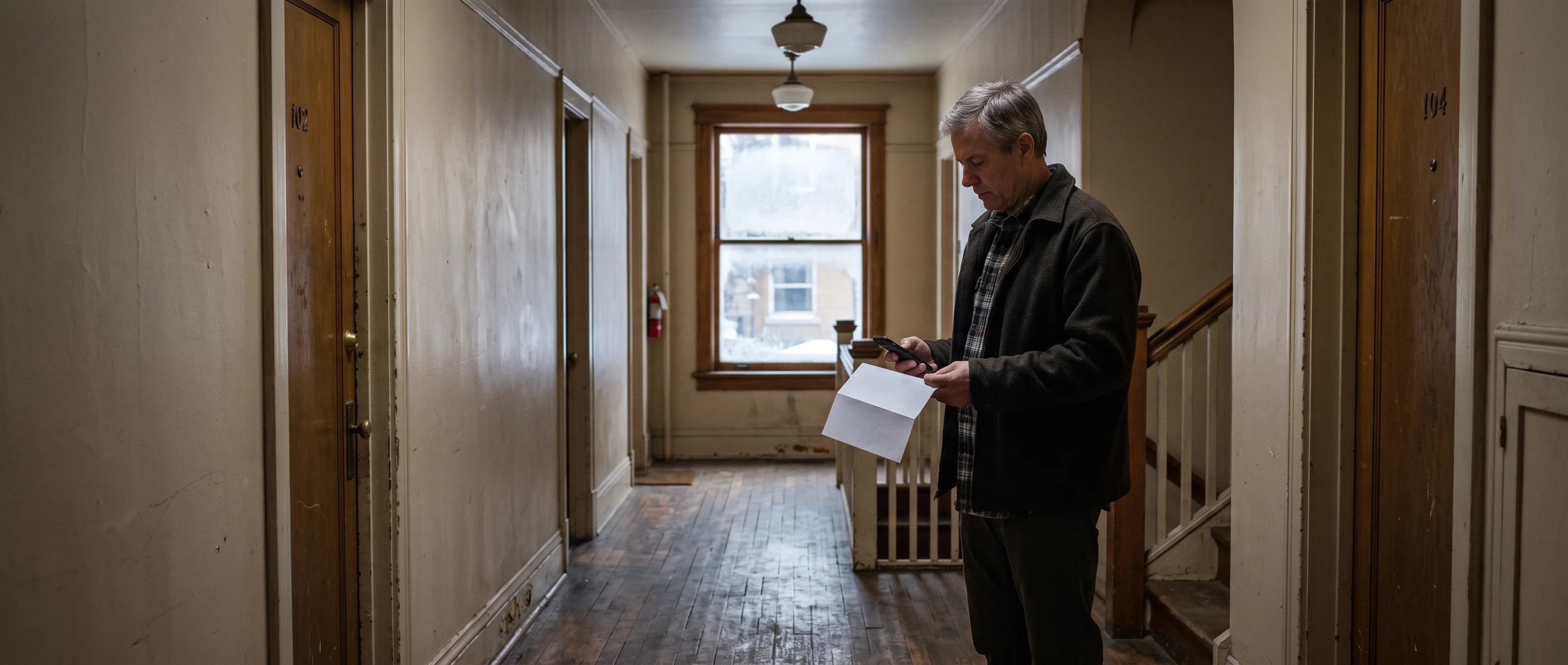
If you pay rent after eviction notice, Saskatchewan law does not say the notice is cancelled. The Residential Tenancies Act, 2006 has no pay-to-stay rule for the Immediate Notice to Vacate (s.57), and a landlord who accepts the money has not waived the notice unless both sides agree otherwise in writing (s.60.1). The hearing officer decides possession.
At a glance: paying after an eviction notice in Saskatchewan
- Before day 16: pay in full and no immediate notice can be served (s.57(1)).
- After the notice: no rule in s.57 makes the notice void on payment.
- Accepting money: not a waiver, a reinstatement or a new tenancy unless agreed in writing (s.60.1(1)).
- Proof: whoever claims a waiver or reinstatement must prove it (s.60.1(2)).
- Who decides: the Office of Residential Tenancies (ORT) hearing officer, who may make any just and equitable order (s.70(6)).
This FAQ is for Saskatchewan landlords and tenants dealing with rent paid after an unpaid-rent notice. It explains what payment does at each stage, why the answer differs from Alberta, BC and Ontario, and how to put a deal in writing. It was checked against the Act, the Regulations, the ORT Rules of Procedure and the ORT's pages on October 26, 2026.
Paying After an Eviction Notice: Saskatchewan Checklist
Get Free PDF →Does paying the rent cancel an immediate notice in Saskatchewan?
No provision of Saskatchewan's Act cancels an Immediate Notice to Vacate when the rent is paid. Section 57 lets a landlord end the tenancy immediately once rent is unpaid for 15 days or more and says the notice has no effect in only one case: when the unpaid amount is one the tenant was allowed to deduct (s.57(3)). Nothing in it says that later payment undoes the notice.
That leaves the outcome to the parties and to the hearing officer. If the landlord applies for possession, the hearing officer can make any order they consider just and equitable (s.70(6)), and the tenant can ask for relief on the grounds in s.70(11). Payment is a fact the hearing will hear about, but the Act does not make it decisive.
How is Saskatchewan different from Alberta, BC and Ontario?

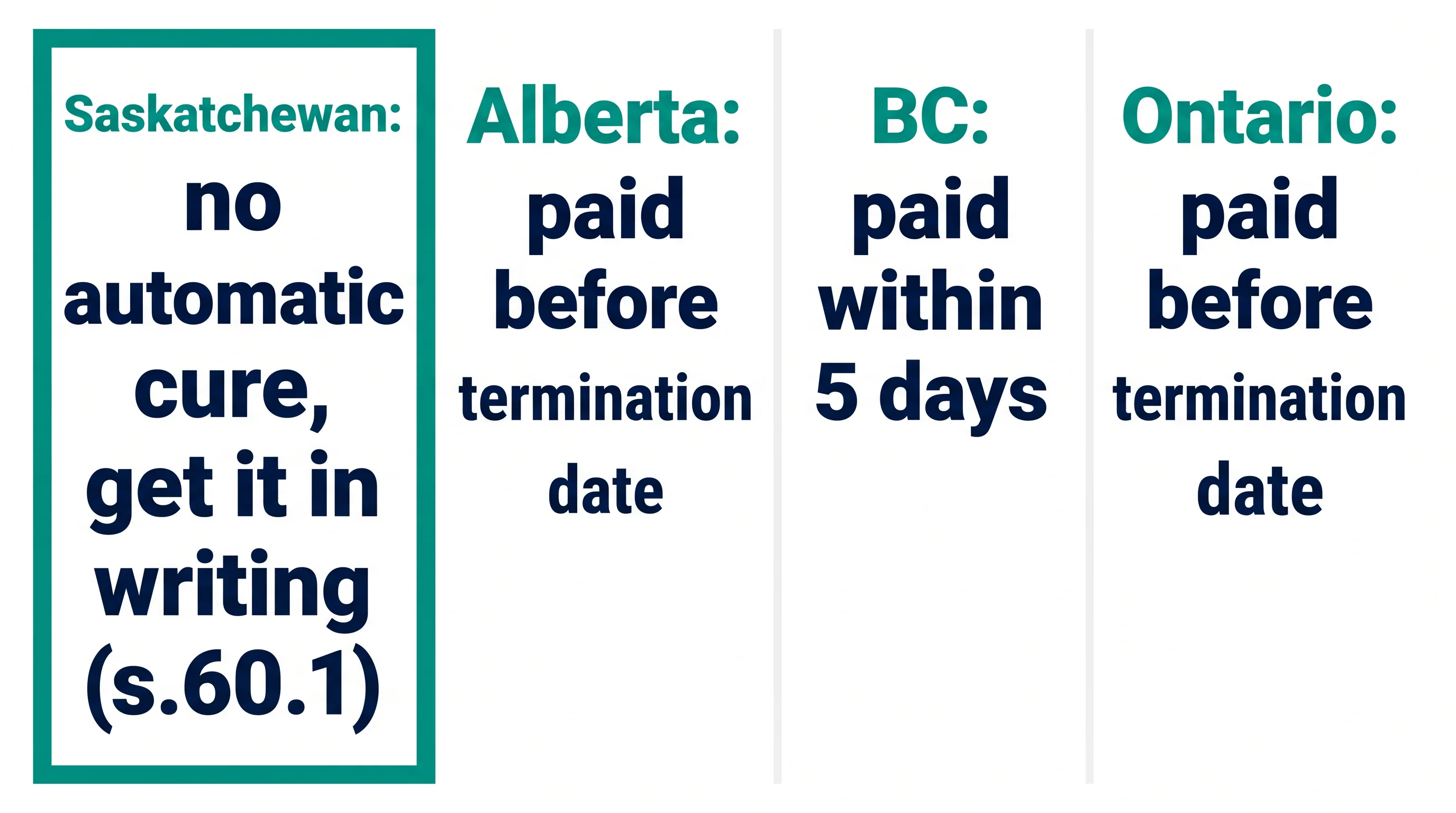
Saskatchewan is the odd one out: its neighbours write a pay-to-stay rule into the notice itself, and Saskatchewan does not.
| Province | Notice for unpaid rent | What paying does |
|---|---|---|
| Saskatchewan | Immediate Notice to Vacate and Notice of Arrears (s.57) | Nothing automatic; written agreement or the hearing officer decides |
| Alberta | 14-day notice | Notice ineffective if all rent due is paid before the termination date |
| British Columbia | 10 Day Notice (RTB-30) | Notice has no effect if paid within 5 days of receipt |
| Ontario | N4 | Notice void if the arrears are paid before the termination date |
Readers moving between provinces can compare Alberta's 14-day notice, BC's five days to pay or dispute and Ontario's N4.
What does payment do at each stage in Saskatchewan?
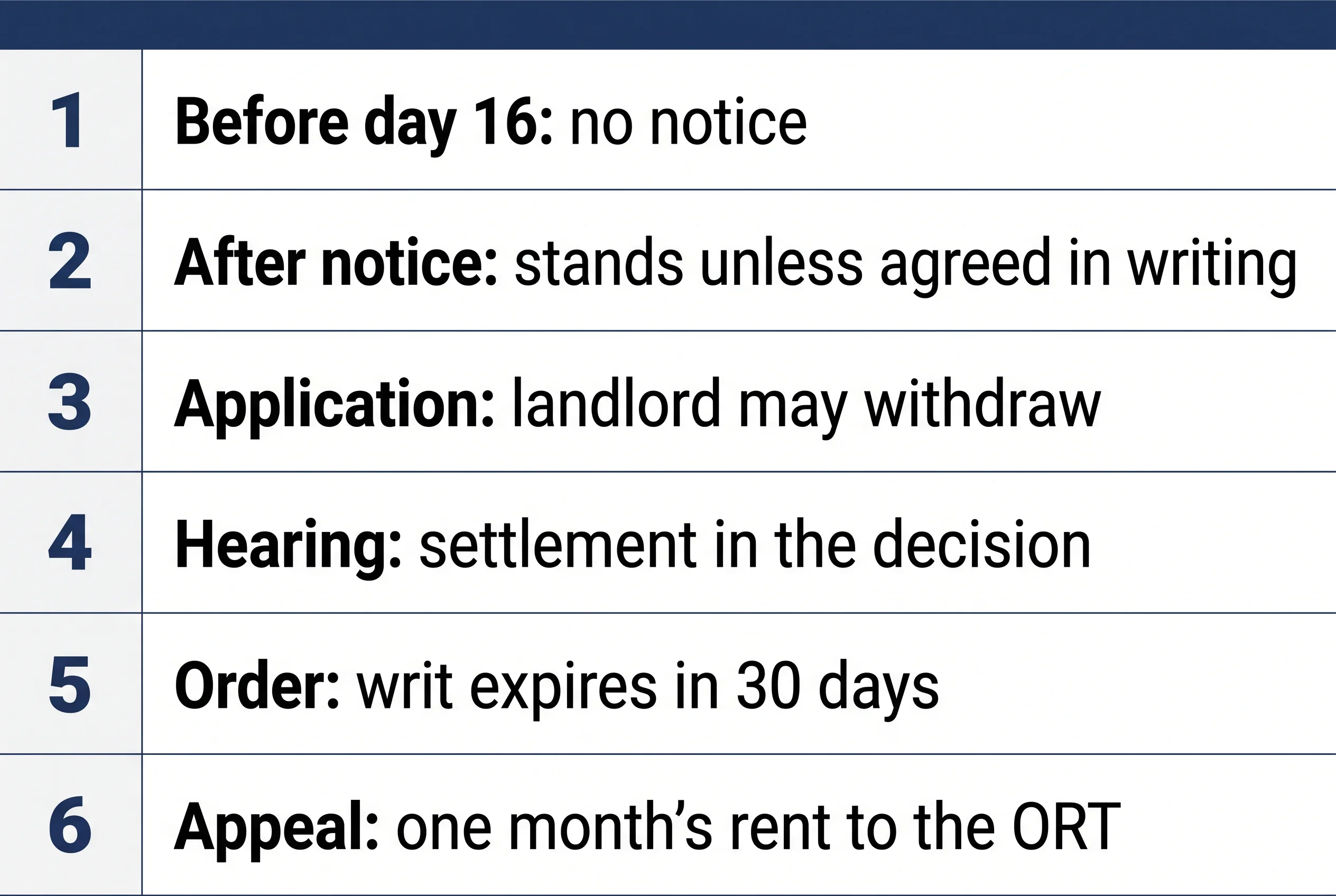
In Saskatchewan the effect of paying depends on when it happens, because each stage of an unpaid-rent eviction has its own rule.
| Stage | Effect of paying in full |
|---|---|
| Before rent is unpaid for 15 days | No immediate notice can be served for that rent (s.57(1)). |
| After the notice, before any application | The notice stands unless the landlord agrees in writing to continue the tenancy (s.60.1). |
| After the landlord applies | The landlord may withdraw the application before or at the start of the hearing (ROP Part 3); otherwise the hearing goes ahead. |
| At the hearing | The hearing officer may help the parties settle, and a settlement is written into the decision (ROP Parts 5 and 6). |
| After an order of possession | The writ expires 30 days after it is ordered unless another date is set (Regs s.10(2)); the landlord decides whether to give it to the sheriff. |
| To appeal the order | The tenant pays one month's rent into the ORT for a Certificate of Payment of Rent, needed to appeal an unpaid-rent writ (s.72(1.3); Regs s.10.1). |
Is accepting rent after the notice a waiver in Saskatchewan?
No. In Saskatchewan, a landlord who accepts arrears, or compensation for the tenant's use of the unit, after giving notice does not waive the notice, reinstate the tenancy or create a new tenancy, unless the landlord and tenant agree otherwise in writing (s.60.1(1)). The person claiming that a waiver or reinstatement happened has to prove it (s.60.1(2)).
So a landlord can take the money without giving up the eviction, and a tenant who pays should not assume the problem is over. Both sides benefit from writing down exactly what was agreed.
What should a written agreement say?
Saskatchewan's Act does not prescribe a form for this agreement, so make it clear and complete. A useful agreement names:
- the landlord, every tenant and the rental address;
- the date of the immediate notice it refers to;
- the amount paid, the date, and what it covers;
- whether the tenancy continues (the notice is withdrawn) or the notice still stands and the money is accepted toward what is owed;
- any payment plan for the balance, with dates; and
- signatures and dates from both sides.
Can a tenant hold back rent if the landlord breaks the rules?
Not in Saskatchewan, except where the Act itself allows a deduction. A tenant must pay rent when it is due whether or not the landlord complies with the Act, the regulations or the agreement (s.42(1)), and the Standard Conditions say to apply to the ORT instead of withholding (Sch.1 s.4(1)). The ORT can order rent paid to the director and used to fix the landlord's breach (s.70(6)(b), (7)).
If a notice followed the tenant's complaint about health or housing standards, or the landlord breached the agreement, the tenant can raise that as a ground for relief at the possession hearing (s.70(11)).
Frequently asked questions
I paid everything I owed the day after the notice. Can I still be evicted?
Possibly. The Act does not make the notice void on payment, so unless the landlord agrees in writing to continue the tenancy, the landlord can still apply for possession and the hearing officer decides. Bring proof of the payment to the hearing.
As a landlord, do I have to accept rent after the notice?
The Act does not require it. If you do accept money, the acceptance alone is not a waiver (s.60.1(1)), but put your position in writing so there is no dispute later.
Does a partial payment change anything?
It reduces what is owed, but it does not cancel the notice on its own. The notice states the arrears owing when it was served, and the landlord can claim that amount at the possession hearing without a separate monetary claim (ROP Part 2), so bring proof of any payment made since.
Can we settle at the hearing?
Yes. A hearing can be an opportunity for the hearing officer to help the parties settle, and a settlement reached at the hearing is set out in a written decision (ROP Parts 5 and 6).
Can the landlord charge a late fee as part of the deal?
Saskatchewan's Act and Regulations do not mention late-payment or NSF fees and set no amount. A fee would have to be in the written agreement, and a term that is inconsistent with the Act, unconscionable or unclear is not enforceable (s.7(2)).
In Saskatchewan, money paid after an eviction notice settles the debt, not the eviction. The written agreement, or the hearing officer, settles the eviction. More resources are in the Canadian Landlord Resource Center and the Canadian Tenant Resource Center.
Paying After an Eviction Notice: Saskatchewan Checklist
Get Free PDF →Get your rental paperwork right
Browse free landlord and tenant resources.
Free • No signup required