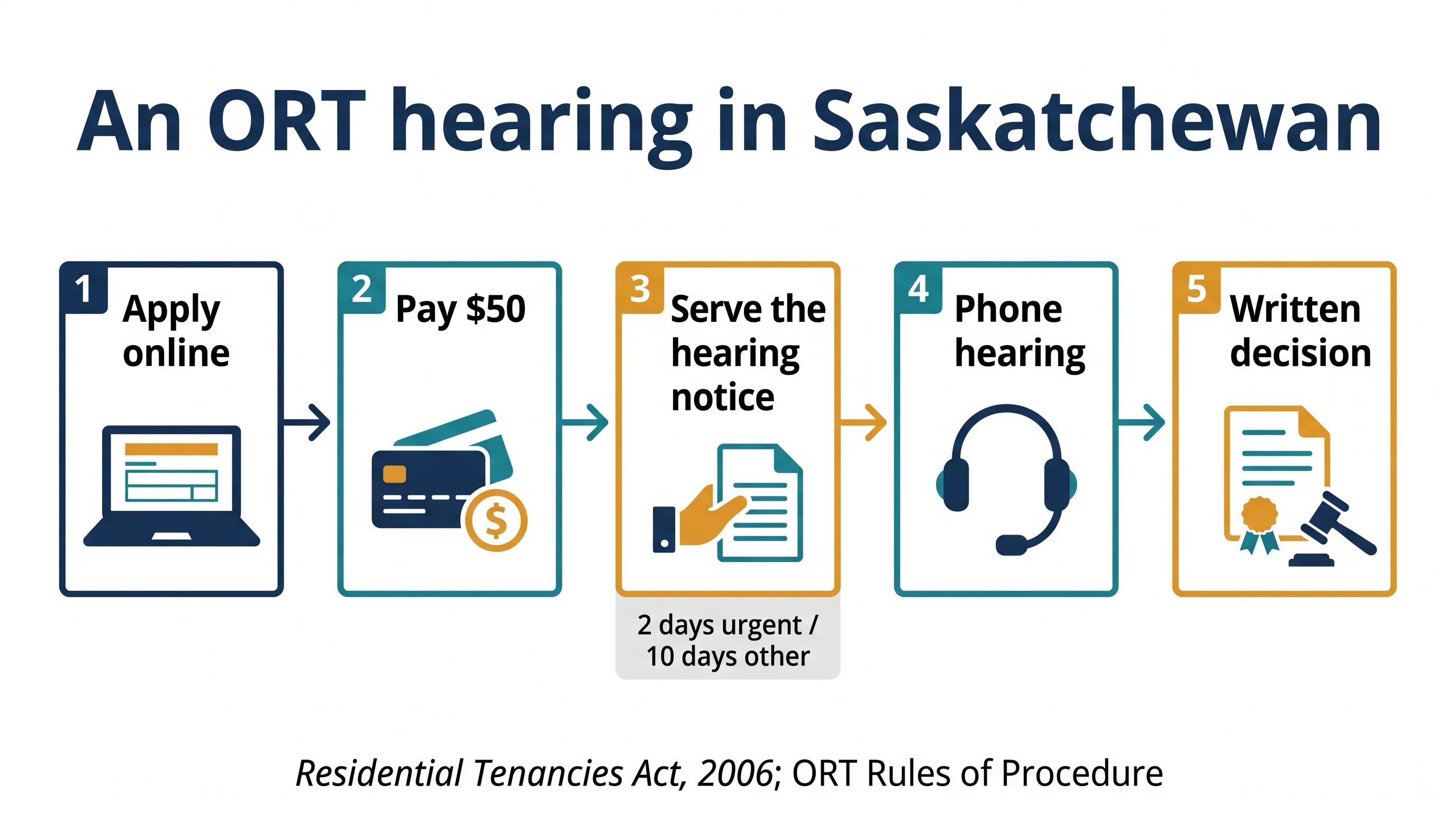
In Saskatchewan, landlord and tenant disputes go to the Office of Residential Tenancies (ORT), formerly the Rentalsman. You apply online, pay a non-refundable $50 fee, serve the hearing notice yourself, and attend a phone hearing. A hearing officer then issues a written decision on claims of up to $30,000 (Regs ss.11, 13; Act s.70).
Many people search for a Saskatchewan "landlord tenant board"; the ORT is that body. This guide walks through an Office of Residential Tenancies Saskatchewan hearing from start to finish: what the ORT can decide, the deadlines for applying, how to serve the other side, what happens on the call and what you can do after the decision. It is written for landlords and tenants alike, and every rule comes from The Residential Tenancies Act, 2006 (the Act), The Residential Tenancies Regulations, 2007 (the Regs), the ORT Rules of Procedure (the Rules) and the ORT's page on dispute resolution and the hearing process.
- Fee: $50 for every application, non-refundable; a fee waiver is available (Regs s.13; Act s.70(2.01)).
- Limit: $30,000 per monetary claim; you may abandon the excess (Regs s.11; Act s.71).
- Deadline: one year for most applications; 60 days after the tenancy ends for deposit disputes (ss.71.1, 33(2)).
- Hearing notice: served by the applicant at least 2 days before an urgent hearing, 10 days before others (Rules Part 4).
- Hearing: by phone; the decision is written and never given on the call (Rules Parts 5–6).
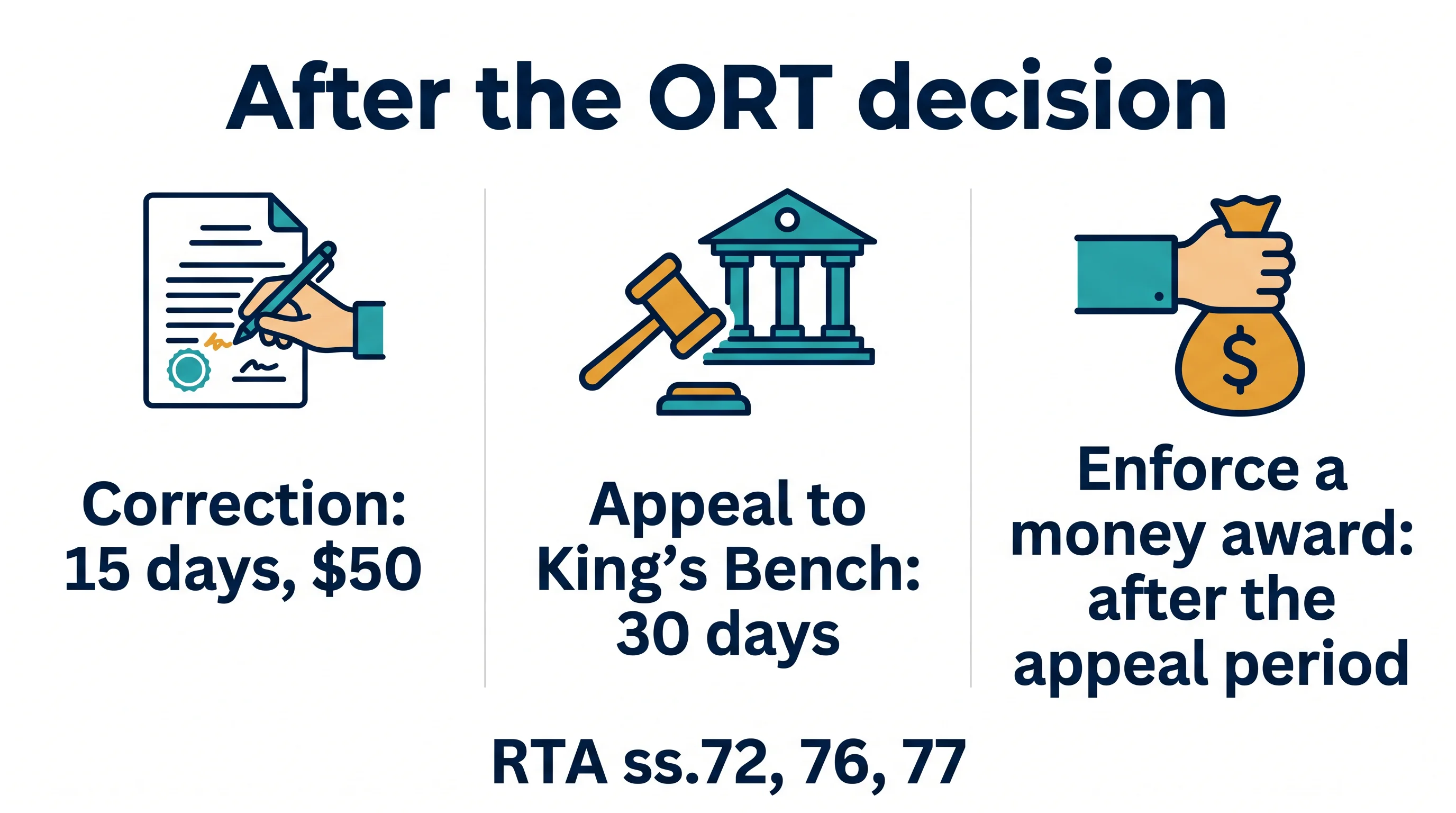
- After: 15 days to ask for a correction ($50); 30 days to appeal (ss.76(3), 72(1)).
Saskatchewan ORT Hearing Checklist
Get Free PDF →What does the Office of Residential Tenancies decide in Saskatchewan?
The Saskatchewan ORT decides most disputes between residential landlords and tenants, including possession, unpaid rent, damages, repairs, security deposits and rent-increase notices, for amounts up to $30,000 (Act s.70(6); Regs s.11). After a hearing, a hearing officer may make any order that is "just and equitable" (s.70(6)).
An order can also require a tenant to pay rent to the director instead of the landlord, and that money can be used to fix the landlord's breach (s.70(6)(b), (7)).
Some housing is outside the ORT's reach, including hotel-type stays under six consecutive months, crisis shelters, care facilities, tenancies for life or 20 years or more, and student housing run by an educational institution (s.5; ORT page). The ORT also has no jurisdiction over "pain, suffering, or discrimination" (Rules Part 2).
How do you apply for an ORT hearing in Saskatchewan?

In Saskatchewan you apply for an ORT hearing through the ORT online portal, signing in with a Saskatchewan Account: an organization account for a business landlord, an individual account for anyone else. The ORT's hearing page lists the steps:
- Sign in to the portal and select New Application.
- Choose landlord or tenant, and whether you are the applicant or filing for someone.
- Pick the application type, enter the tenancy details with every party's legal name, and upload your documents.
- Select Submit. ORT staff review it; when approved, the status shows Payment Required.
- Pay the non-refundable $50 fee in the portal. Staff then schedule the hearing and send the hearing notice by email or mail.
Watching the status is your job, not the ORT's. The page says it is "the responsibility of the party who submitted the application to monitor the status of their submission." Where there is an access-to-justice issue, the ORT may accept a paper application by email, mail or in person (Rules Part 2). Compare Alberta's tribunal, which charges its own fees: see RTDRS filing fees and claim limit.
What does an ORT application cost and when must you file?
Every Saskatchewan ORT application costs $50, including a request to correct or clarify a decision, and the fee is never refunded (Regs s.13(1); Act ss.70(2.01), 76(2.1)). A party who cannot pay can apply for a fee waiver certificate under The Fee Waiver Act (s.70(2)).
A successful applicant can ask to get the fee back: the hearing officer may order the respondent to reimburse it (Regs s.13(2)). The time limits depend on the claim:
| Application | Time limit | Source |
|---|---|---|
| Most applications (possession, damages, repairs, rent) | Within 1 year after the act or omission | Act s.71.1 |
| Tenant's security-deposit application or dispute of a landlord's claim | Within 60 days after the tenancy ends | Act s.33(2); Rules Part 2 |
| Landlord's claim on a deposit guaranteed by the Ministry of Social Services | Within 7 business days after the tenant vacates | Rules Part 2 |
| Property Disposition Order (property over $1,500) | After the tenancy ends, up to one year | Act s.85; ORT page |
A claim above $30,000 cannot go to the ORT unless you give up the excess, using the Abandonment of Claim in Excess of $30,000 form (Act s.71; Rules Part 2).
How do you serve the hearing notice and evidence?
In Saskatchewan, the person who applied must serve the ORT hearing notice on the other side: at least two days before an urgent hearing and at least ten days before any other (Rules Part 4). Urgent applications include possession and a current tenant's claim for breach of rights; money claims and deposit disputes are not urgent (Rules Part 3).
| Serving on | Allowed methods |
|---|---|
| A current tenant | Personal service; or posting on the front door plus ordinary mail; or posting plus an electronic copy (s.82(2)(a)) |
| A former tenant | Personal service or electronic form (s.82(2)(b)) |
| A landlord | Personal service (including the agent or attorney), ordinary mail to the landlord's service address, or electronic form (s.82(2)(c)) |
Ordinary mail is deemed received on the third business day after mailing and an electronic copy on the next business day (s.82(4)–(5)). Before the hearing, complete the Certificate of Service in the portal, upload the full hearing notice you served, and, if you served it electronically, add proof of earlier messages with the other party at that address (Rules Part 4). For deposit disputes the ORT sends the hearing notice to both sides itself.
Evidence has its own rule. Upload it to the application and give it to the other party by another method "well in advance" of the hearing; uploading alone "is not considered service" and undisclosed evidence may be refused (Rules Parts 4–5). The ORT does not apply the strict rules of evidence: a hearing officer may admit anything credible, trustworthy and relevant (s.75).
What happens at an ORT hearing in Saskatchewan?
Saskatchewan ORT hearings take place by phone: the hearing officer calls each party at the number they gave the ORT, hears both sides, and then reserves the decision (Act s.70(2.3); Rules Parts 5–6). An in-person hearing is possible only if a party asks in writing and the hearing officer agrees.
- Before the day: contact the ORT by email or the Hearing Hotline at least two business days before the hearing with the number to call (Rules Part 5). Do not block 1-800 numbers (ORT page).
- Order of the hearing: preliminary matters such as service first, then the applicant's evidence, questions from the other side, the respondent's evidence and closing summaries (Rules Part 5).
- Who can help: an agent, a lawyer, an advocate or an interpreter. Hearings are in English, and arranging interpretation is the party's job (Rules Part 5).
- If someone is missing: an absent applicant's claim may be dismissed; if the respondent was properly served and is not reachable, the hearing can go ahead without them (Rules Part 5; Act s.73(4)).
- Rules on the call: recording is prohibited, hearings are open to the public unless closed by the hearing officer, and contacting the hearing officer outside the hearing is not allowed (Rules Part 5).
The applicant carries the burden of proof on a balance of probabilities: if the hearing officer cannot tell which version is more likely, the claim fails (Rules Part 6). BC readers can compare what happens at an RTB hearing.
What can you do after the ORT decision?
After a Saskatchewan ORT decision you can ask for a correction or clarification within 15 days, ask for a rehearing if you never got notice, appeal to the Court of King's Bench within 30 days, or enforce a money award in court (Act ss.76, 73(5), 72, 77). The ORT emails or mails the written decision to both parties.
| Option | Deadline | Who decides |
|---|---|---|
| Correct or clarify an error ($50) | 15 days after the date on the decision (s.76(3)) | The same hearing officer |
| Rehearing (order made without hearing you, or no notice received) | No deadline stated; ask promptly (s.73(5)) | The hearing officer |
| Appeal on a question of law or jurisdiction | 30 days after the decision is signed and dated (s.72(1)) | Court of King's Bench |
| Enforce a money award | After the appeal period ends (s.77) | Court of King's Bench, as a judgment |
A tenant appealing a possession order for unpaid rent, utility arrears or repeated late rent must first pay one month's rent to the ORT for a certificate of payment of rent (s.72(1.3); Regs s.10.1). The ORT does not collect money for you, but after the 30-day appeal period you can ask it to place a party who has not paid on the non-compliance list (Rules Part 7). ORT decisions are published on CanLII. More guides are in the Canadian Landlord Resource Center and the Canadian Tenant Resource Center.
Frequently asked questions
Is the ORT the same as the Rentalsman?
Yes. The Office of Residential Tenancies is the body many people still call the Rentalsman. It runs Saskatchewan's dispute process under The Residential Tenancies Act, 2006 and is reached at 1-888-215-2222.
Can I get my $50 ORT fee back?
Not from the ORT: the fee is non-refundable (s.70(2.01)). If you win, the hearing officer may order the other party to reimburse you (Regs s.13(2)). If you cannot afford it, apply for a fee waiver.
Can I have an in-person ORT hearing?
Only if you ask in writing by email and the hearing officer agrees. Include the application number or rental address and your reason (Rules Part 5). Otherwise the hearing is by phone.
How long after the hearing will I get the decision?
No fixed time is set. The Rules say the hearing officer reserves the decision and issues it in writing "in a reasonable and timely manner" (Rules Part 6). Keep your email and mailing address current in the portal.
Before you file
An ORT hearing in Saskatchewan rewards preparation: the right application, served correctly, with evidence the other side has already seen. Try to settle in writing first; the ORT notes that written communication can later be used as evidence.
Saskatchewan ORT Hearing Checklist
Get Free PDF →Get your rental paperwork right
Browse free landlord and tenant resources.
Free • No signup required