In Saskatchewan, no law sets a total time for an eviction; it sets the minimum steps. For unpaid rent, a landlord may serve an immediate notice once rent is 15 days or more overdue, apply to the Office of Residential Tenancies (ORT), and enforce through the sheriff with a writ that lasts 30 days (Act ss.57, 70(13); Regs s.10).
So how long does it take to evict a tenant in Saskatchewan? It depends on the ground, on how fast the ORT can schedule a hearing, and on whether the tenant appeals. This guide lays out each step with its statutory clock, for landlords planning ahead and tenants who want to know where they stand. The rules come from The Residential Tenancies Act, 2006 (the Act), The Residential Tenancies Regulations, 2007 (the Regs) and the ORT Rules of Procedure (the Rules).
- Unpaid rent: immediate notice once rent is 15 days or more overdue (s.57(1)); serve on day 16 or later to be safe.
- Cause: one month's notice ending the day before a rent day; the tenant has 15 days to dispute (s.58(3), (5)).
- Hearing notice: served at least two days before an urgent hearing, such as possession (Rules Part 4).
- Decision: always written and issued after the hearing, never on the day (Rules Part 6).
- Writ of possession: lasts 30 days unless the hearing officer sets another date (Regs s.10(2)).
- Appeal: 30 days to the Court of King's Bench; filing it stays the writ (ss.72(1), 78(1)).
Saskatchewan Eviction Timeline Checklist
Get Free PDF →What are the steps in a Saskatchewan eviction?
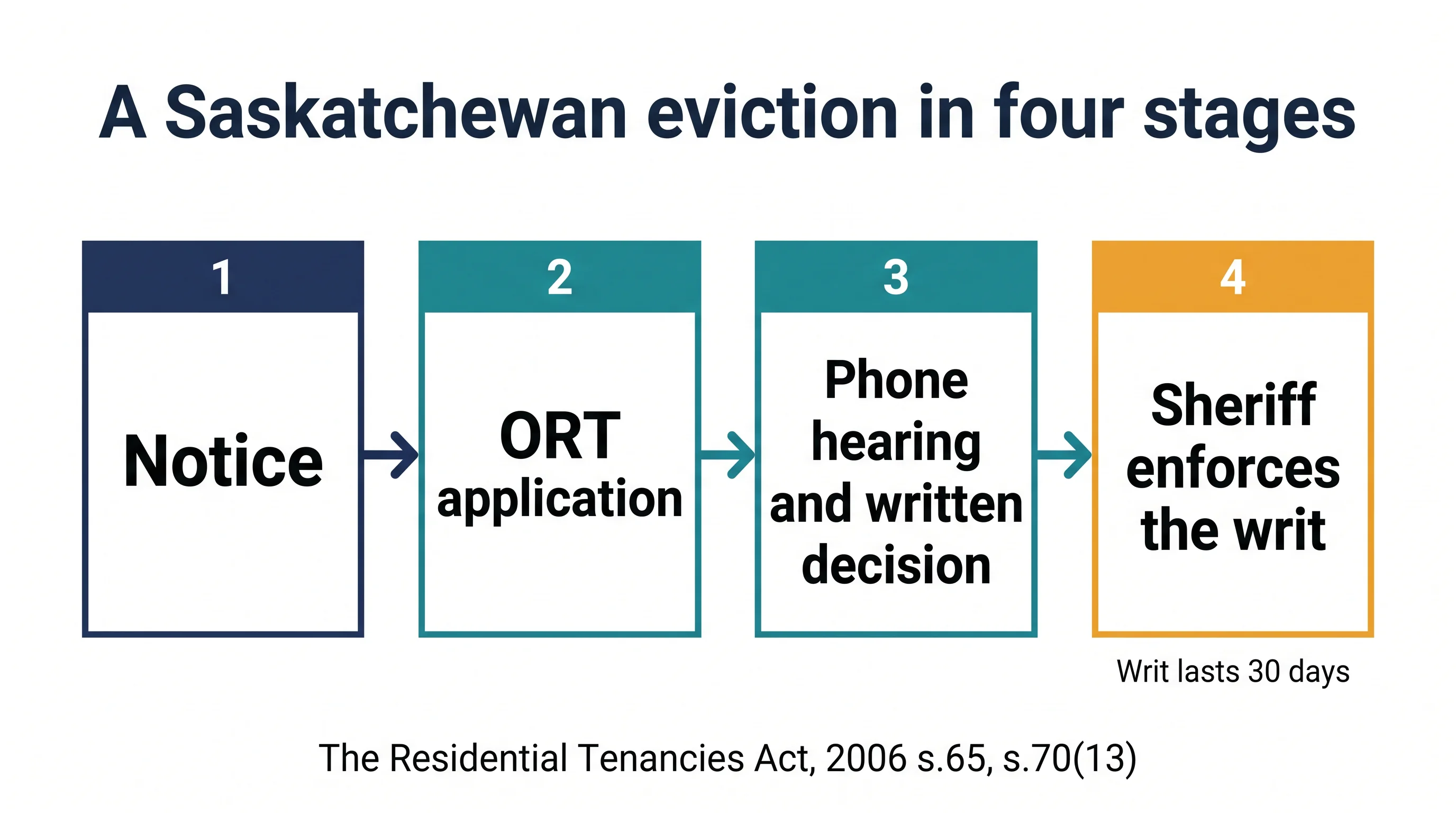
A Saskatchewan eviction has four stages: a written notice in the approved form, an ORT application if the tenant stays, a phone hearing and written decision, and enforcement by the sheriff under a writ of possession. A landlord cannot skip to the last stage; possession comes only when the tenant leaves or the sheriff acts (s.65).
| Stage | The clock the law sets | Source |
|---|---|---|
| Immediate Notice to Vacate and Notice of Arrears (formerly Form 7) | Rent unpaid 15 days or more after the due day; effective on service | s.57(1) |
| Notice to Vacate: Cause (formerly Form 8) | At least one month after receipt, ending the day before a rent day | s.58(3) |
| Landlord's-use notices (owner or purchaser occupy, specified uses, housing program) | Two months, or one month for purchaser and housing-program notices | s.60(3), (3.1) |
| Application for possession | After the tenant fails to vacate; within one year of the event | s.57(4), s.71.1 |
| Hearing notice served on the tenant | At least 2 days before an urgent hearing | Rules Part 4 |
| Written decision | Reserved, then issued "in a reasonable and timely manner" | Rules Part 6 |
| Writ of possession | Expires 30 days after it is ordered unless another date is set | Regs s.10(2) |
| Tenant's appeal | 30 days after the decision is signed and dated | s.72(1) |
The one stage with no fixed clock is the wait for a hearing date. The Rules say applications are scheduled first come, first served, and that the earliest date depends on urgency and on hearing officers' availability (Rules Part 3). Possession applications are classed as urgent.
How long does an eviction for unpaid rent take in Saskatchewan?

In Saskatchewan, the unpaid-rent route is the fastest notice: the immediate notice takes effect on service, and a landlord can apply for possession as soon as the tenant does not leave (s.57(1), (4)). After that, the timeline is the ORT's scheduling, the decision and the sheriff.
The Act allows the notice when rent is unpaid "for a period of 15 days or more after the day it is due" (s.57(1)), while the Standard Conditions say "more than 15 days" (Regs Schedule 1 s.17(1)). Serving on day 16 after the due date, or later, satisfies both. A worked example with rent due on the 1st:
| Event | Example date |
|---|---|
| Rent due | Sunday, November 1, 2026 |
| Earliest safe day to serve the immediate notice (day 16) | Tuesday, November 17, 2026 |
| Application for possession filed | Any day after the tenant fails to leave |
| Hearing notice served | At least 2 days before the hearing date the ORT sets |
| Writ of possession, if granted | Valid 30 days from the day it is ordered |
How the notice is served matters to the date. On a current tenant, service is personal, or by posting on the front door plus ordinary mail or an electronic copy (s.82(2)(a)). Mail is deemed received on the third business day after mailing and an electronic copy on the next business day (s.82(4)–(5)). Hand delivery is the quickest.
The arrears on the notice and the $50 filing fee can be claimed at the same possession hearing, so a separate money claim is not needed to recover them (Rules Part 2). Landlords who also own in other provinces can compare Alberta's 14-day notice and BC's five-day window after a 10 Day Notice.
How long does an eviction for cause take in Saskatchewan?
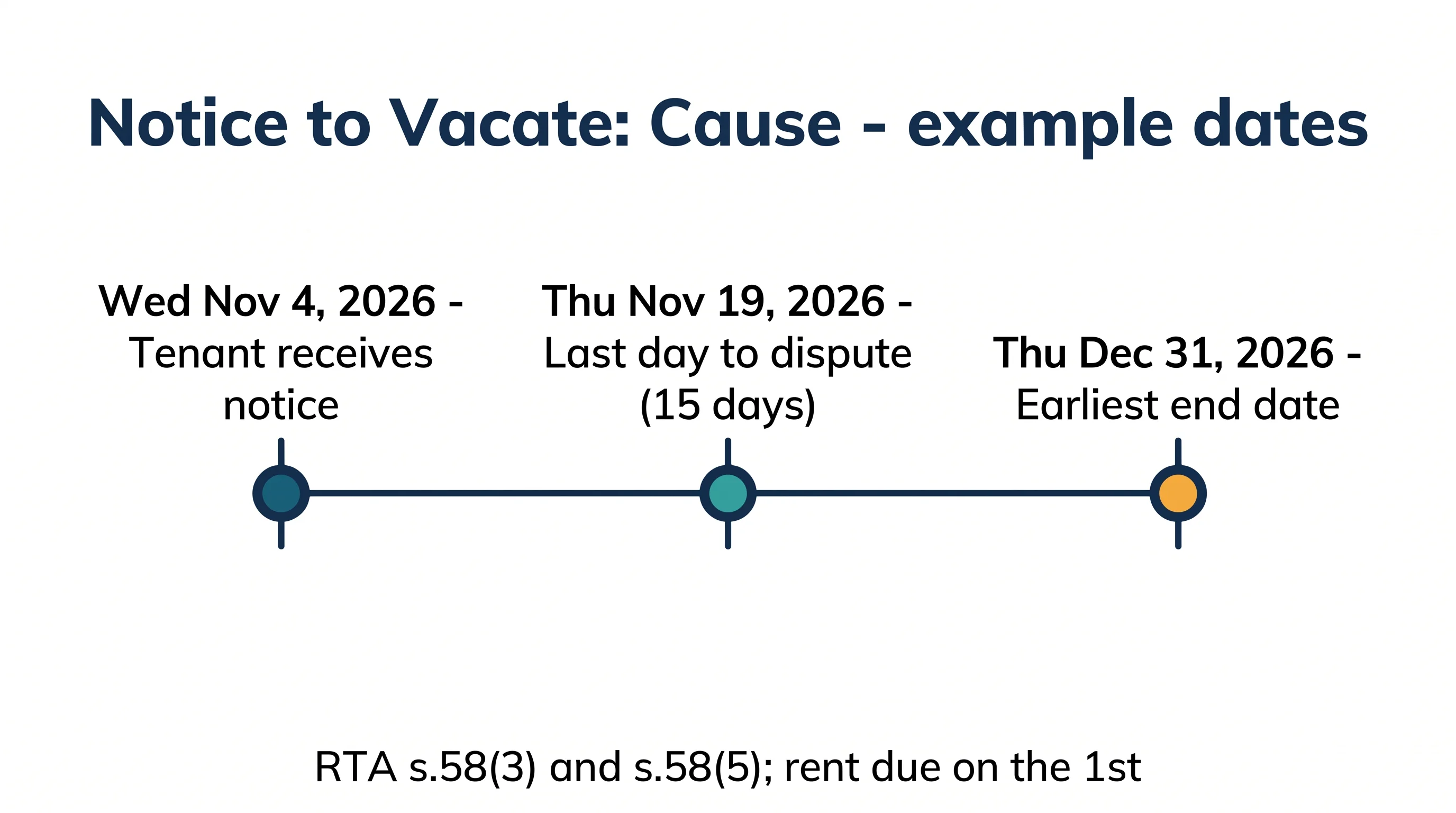
A Saskatchewan eviction for cause takes at least one month from the day the tenant receives the notice, because the end date must be no earlier than one month after receipt and must fall on the day before a rent day (s.58(3)). Where the problem can be fixed, the landlord must first give a reasonable time to remedy it (s.58(2)).
The tenant then has 15 days after receiving the notice to dispute it in writing (s.58(5)). A tenant who does not dispute is deemed to accept the end date and must leave by then (s.58(6)). If the tenant disputes, the landlord applies to the ORT for an order ending the tenancy and must prove the ground (s.67(1)–(2)).
| Event (rent due on the 1st) | Example date |
|---|---|
| Tenant receives the cause notice | Wednesday, November 4, 2026 |
| Last day for the tenant's written dispute | Thursday, November 19, 2026 |
| Earliest end date (one month after receipt, then the day before rent day) | Thursday, December 31, 2026 |
A notice with a date that is too early is not wasted. Section 64 moves it to the earliest date that complies. Notices for a landlord's own use under s.60 run two months, or one month for a purchaser or housing-program notice, and apply to periodic tenancies only (s.60(2)–(3.1)).
What can make a Saskatchewan eviction take longer?
In Saskatchewan, the usual causes of delay are a service problem, an adjournment, a tenant's request for relief at the hearing, and an appeal. Each adds time the landlord cannot fully control.
- Service problems. A hearing notice that was not properly served can stop the hearing going ahead, although a hearing officer may accept service where the notice came to the person's attention (s.82.1; Rules Part 4).
- Adjournments. A hearing officer may adjourn on request where both parties consent or it is just and equitable (Rules Part 5).
- Relief for the tenant. At a possession hearing, the tenant may ask for relief, for example where the notice followed a good-faith complaint or the landlord breached the agreement (s.70(11)).
- An appeal. Filing a notice of appeal at the Court of King's Bench stays proceedings, including the writ, unless the court orders otherwise (s.78(1)). For rent-based writs the tenant must first pay one month's rent to the ORT for a certificate of payment of rent (s.72(1.3); Regs s.10.1).
A request for a rehearing does not stop a landlord enforcing a writ of possession (Rules Part 7). Paying the arrears late does not automatically cancel the immediate notice either: the Act does not say so, the hearing officer decides possession, and any agreement to continue the tenancy should be in writing (s.60.1). Tenants can find more help in the Canadian Tenant Resource Center; landlords in the Canadian Landlord Resource Center.
How does the Saskatchewan timeline compare with other provinces?
Saskatchewan's unpaid-rent notice is immediate, but it cannot be served until rent is at least 15 days overdue, and every eviction still ends with a hearing and the sheriff. Ontario's process also runs through a tribunal and a sheriff; see the Ontario LTB process from notice to enforcement. The real difference between provinces is usually the wait for a hearing, which no statute fixes.
Frequently asked questions
What is the fastest a landlord can evict a tenant in Saskatchewan?
For unpaid rent, the notice can be served once rent is 15 days or more overdue and takes effect on service (s.57(1)). The rest depends on the ORT's hearing date, the written decision and the sheriff. In serious circumstances a landlord may apply without notice (s.68).
How long does a tenant have to leave after an ORT order?
The order of possession takes effect on the date the hearing officer sets (s.67(4)). If the tenant does not leave, the writ of possession lets the sheriff act; it expires 30 days after it is ordered unless another date is set (Regs s.10(2)).
Can a tenant stop an eviction by paying the rent?
The Act does not say that paying after an immediate notice cancels it, and accepting arrears is not a waiver unless agreed in writing (s.60.1). The hearing officer decides possession. Tenants should raise any payment at the hearing and get any agreement in writing.
Does the ORT give its decision at the hearing?
No. Hearing officers reserve their decision and issue it in writing afterwards, by email or mail (Rules Part 6). Keep your contact details current in the ORT portal so you receive it.
How long does a tenant have to appeal an eviction order?
Thirty days after the hearing officer signs and dates the decision, at the Court of King's Bench, on a question of law or jurisdiction (s.72(1)). Form A of the Regs adds that the appeal must be filed before the enforcement date the sheriff sets.
Saskatchewan Eviction Timeline Checklist
Get Free PDF →The bottom line
A Saskatchewan eviction is a sequence of short statutory clocks around one open-ended wait: the hearing date. Serve the right notice on the right day, prepare the application properly, and get the writ to the sheriff quickly, and the parts you control will not slow it down.
Get your rental paperwork right
Browse free landlord and tenant resources.
Free • No signup required