In Saskatchewan, a landlord may enter a rented unit with the tenant's permission, or after giving written notice at least 24 hours and no more than seven days ahead that states a reasonable purpose, the date and a window of up to four hours between 8 a.m. and 8 p.m. (Residential Tenancies Act, 2006, s.45). Emergencies are the main exception.
The Saskatchewan notice of entry is the ORT's approved Notice of Entry form (formerly Form 4), which the Office of Residential Tenancies says is available through its online portal under New Notice. This guide covers every situation in s.45: routine entry, emergencies, showings to new tenants and buyers, abandonment, and what each side can do when the rules are broken.
At a glance
- Routine entry: written notice 24 hours to seven days ahead, a reasonable purpose, the date and a four-hour window between 8 a.m. and 8 p.m. (s.45(1)(b), (2)).
- No notice needed: tenant's permission, emergency to protect life or property, apparent abandonment, agreed housekeeping, or an ORT order (s.45(1)).
- Showing to new tenants: two hours' notice once the tenant has given notice, or in the last two months of a fixed term (s.45(3)–(4)).
- Showing to buyers: 24 hours' notice or consent (s.45(5)).
- Showings never: before 8 a.m., after 8 p.m., on a Sunday or the tenant's day of religious worship (s.45(6)).
Saskatchewan Landlord Entry Checklist
Get Free PDF →How much notice does a Saskatchewan landlord need to enter?
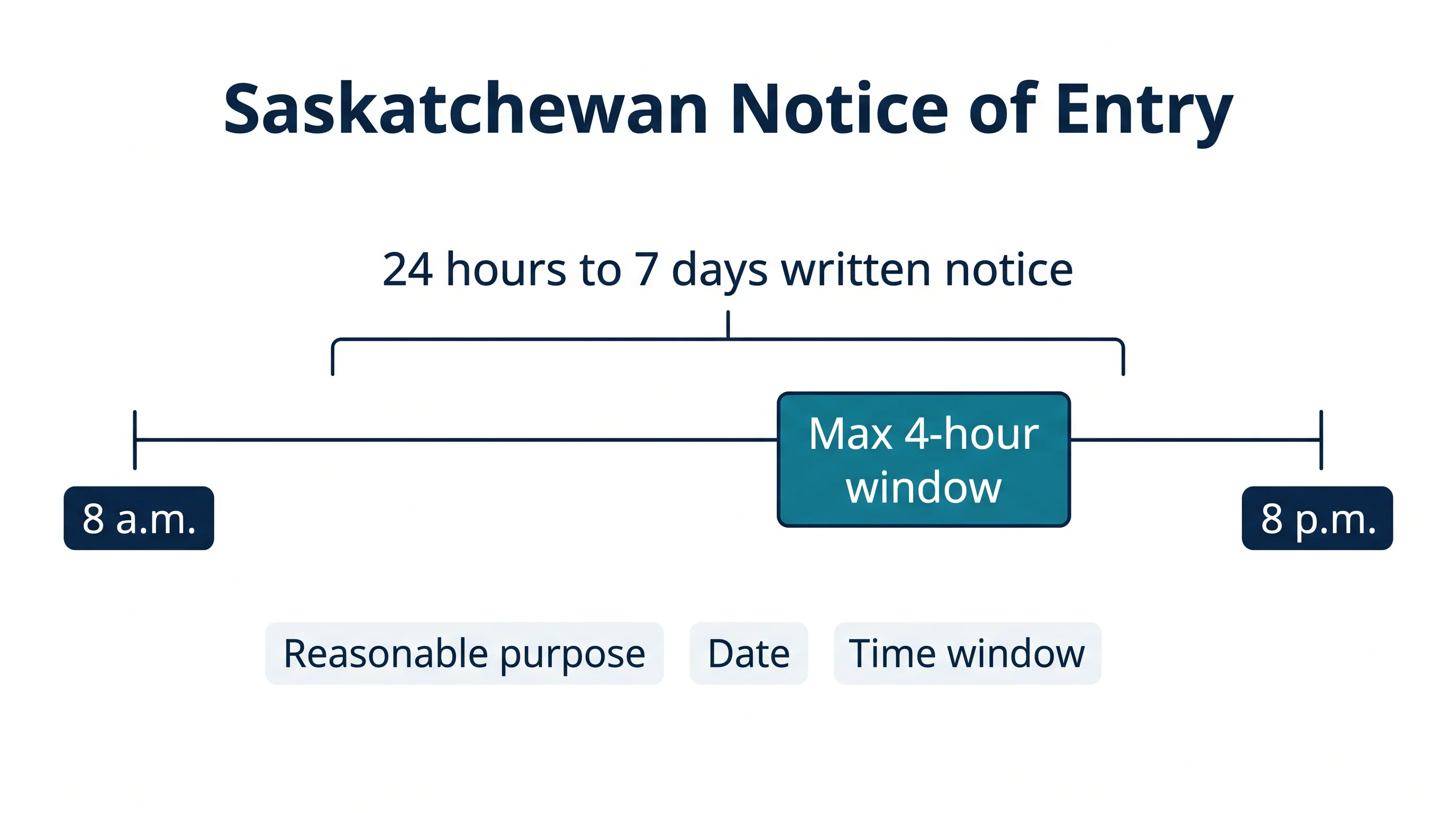
A Saskatchewan landlord needs to give written notice at least 24 hours and not more than seven days before entering, unless another exception applies (s.45(1)(b)). The notice must state a purpose for entering, which must be reasonable, and the date and time of entry (s.45(1)(b)(i)–(ii)).
The "time" must be a window of no more than four hours, and the window must fall between 8 a.m. and 8 p.m. unless the tenant agrees otherwise (s.45(2)). A notice that says "sometime Tuesday" or "between 9 a.m. and 5 p.m." does not meet that rule. The Standard Conditions printed in every tenancy agreement repeat the same requirements (Schedule 1, s.9(1)(b), (2)).
Typical reasonable purposes include repairs, maintenance, a scheduled inspection, a smoke alarm check or letting a contractor give a quote. The landlord's own duty to keep the property in good repair (s.49) is a common reason to come in, and it is also why tenants benefit from a predictable process.
When can a Saskatchewan landlord enter without notice?

A Saskatchewan landlord can enter without written notice in five situations listed in s.45(1). Outside them, entry without notice is not allowed.
| Situation | What is needed | Section |
|---|---|---|
| Tenant agrees | Permission at the time of entry or not more than seven days before | s.45(1)(a) |
| Routine entry | Written notice 24 hours to seven days ahead, purpose, date, four-hour window | s.45(1)(b), (2) |
| Housekeeping services | Provided under a written tenancy agreement and entry is for that purpose | s.45(1)(c) |
| ORT order | An order under s.70 authorizing the entry | s.45(1)(d) |
| Abandonment | The tenant reasonably appears to have abandoned the unit | s.45(1)(e) |
| Emergency | An emergency exists and entry is necessary to protect life or property | s.45(1)(f) |
| Showing to new tenants | Two hours' notice, or a posted notice after trying to reach the tenant | s.45(3)–(4); Regs s.7 |
| Showing to buyers | 24 hours' notice or consent | s.45(5) |
An emergency means a real risk to life or property, such as a burst pipe, a fire, a gas smell or water coming through the ceiling of the suite below. Routine repairs, even urgent-feeling ones like a dripping tap, are not emergencies and need notice. The Act does not define abandonment, so a landlord relying on s.45(1)(e) should record the signs and the attempts made to reach the tenant first.
What are the rules for showings to new tenants and buyers?
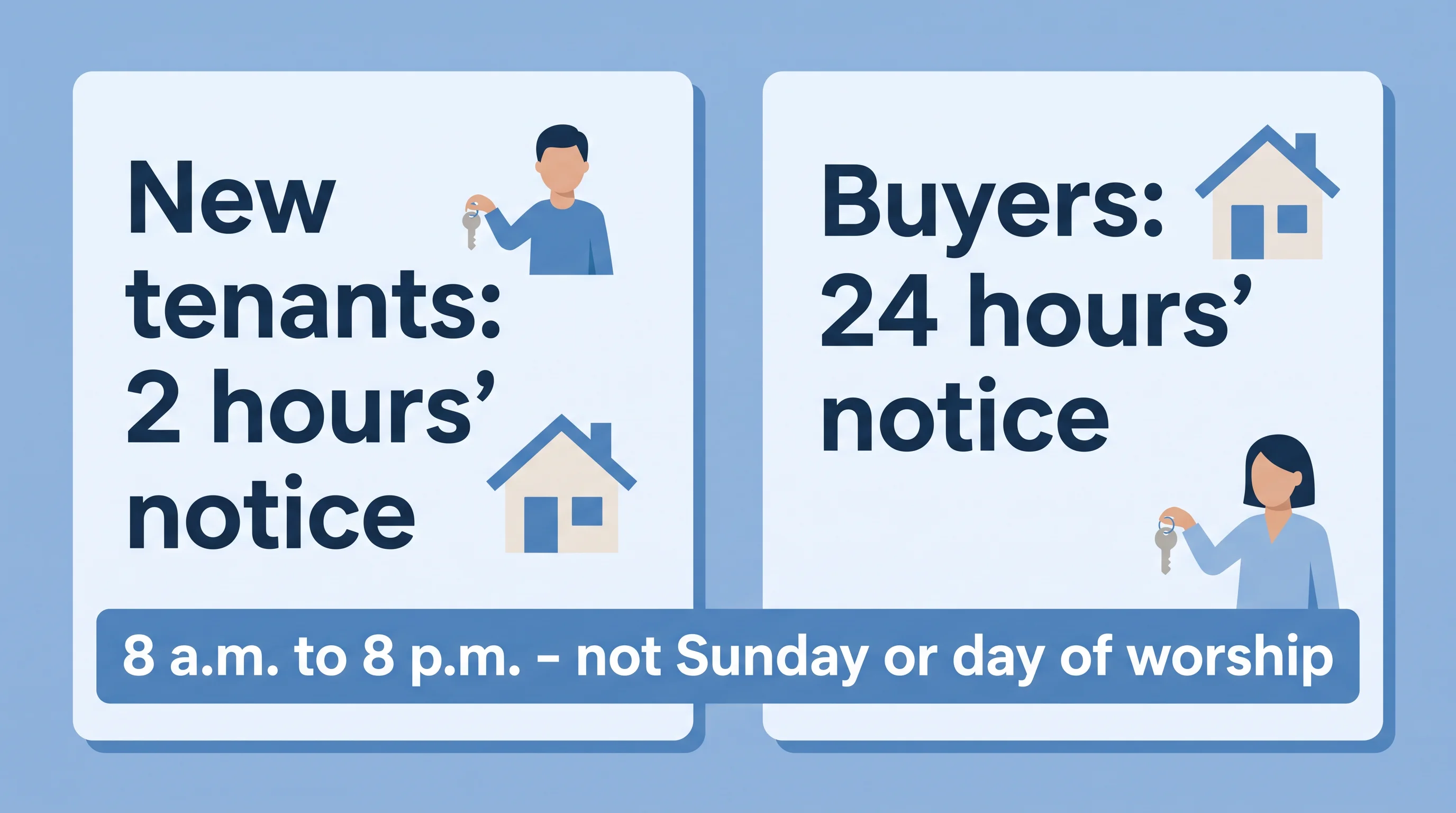
Once a Saskatchewan tenant has given notice to end a periodic tenancy, or in the two months before a fixed term ends, the landlord may show the unit to prospective tenants after giving notice and waiting at least two hours after the tenant receives it (s.45(3)–(4)(a)). The ORT's Notice of Entry page says that notice may be given by phone or email.
Regulations s.7 adds two other routes. The landlord and tenant may agree in writing, after the tenant gives notice, to reasonable terms for showings (Regs s.7(1)(c)). If the landlord cannot get in that way, it may post a notice of entry on the door setting out the date and time, no later than the time of entry, after a reasonable effort at least two hours before to reach the tenant at the phone number or email address the tenant gave for the purpose (Regs s.7(2), (4)). If the tenant gave no number or address, the door notice alone is allowed (Regs s.7(3)).
Showings to a prospective buyer need 24 hours' notice or the tenant's consent (s.45(5)). Showings of either kind may happen only between 8 a.m. and 8 p.m., and never on a Sunday or on the tenant's day of religious worship (s.45(6)). The Standard Conditions add "unless the tenant otherwise agrees" (Schedule 1, s.9(5)); the Act's own wording has no such exception for showings, so stick to the s.45(6) hours unless the tenant has clearly agreed in writing.
What rights does a Saskatchewan tenant have during entry?
A Saskatchewan tenant is entitled to quiet enjoyment, which includes reasonable privacy, freedom from unreasonable disturbance and exclusive possession of the unit subject only to the landlord's s.45 rights (s.44). Disturbance by the landlord, by other tenants and by people they let in all count (Regs s.6).
Neither side may change the unit's locks alone. A landlord may change them only with the tenant's agreement and by giving new keys (s.48(2)), and a tenant may change them only with the landlord's consent or an ORT order (s.48(4)). A landlord also must not restrict the tenant's or their guests' access to the property (s.46(1)).
Refusal cuts both ways. A tenant who improperly denies a landlord lawful entry under s.45 gives the landlord a cause ground for a one-month Notice to Vacate (s.58(1)(p)), with a reasonable chance to remedy first (s.58(2)). A landlord who enters without a lawful basis breaches the Act, and the tenant can apply to the ORT for an order to stop it and compensation for any loss (s.70(6); s.8). The application fee is $50 (Regs s.13(1)(a)), and most applications must be made within one year (s.71.1).
Compare the rules elsewhere: BC's 24-hour written notice, Ontario's 24-hour notice of entry rule and Alberta's entry notice for repairs. More guides are in the Canadian Tenant Resource Center and the Canadian Landlord Resource Center.
How should a Saskatchewan landlord serve a Notice of Entry?
A Notice of Entry to a current Saskatchewan tenant is served personally, or by posting it on the front door of the unit and also sending it by ordinary mail or electronically (s.82(2)(a)). An email alone does not serve a current tenant. Mail is deemed received on the third business day after mailing and electronic delivery on the next business day (s.82(4)–(5)), so count the 24 hours from when the notice is received, not when it is sent. The two-hour showing notice is a separate rule with its own methods (s.45(4); Regs s.7).
Frequently asked questions
Can my landlord enter without notice in Saskatchewan?
Only with your permission, in an emergency to protect life or property, if the unit appears abandoned, for housekeeping agreed in a written lease, or with an ORT order (s.45(1)). Otherwise the landlord needs 24 hours' to seven days' written notice.
What is a Notice of Entry in Saskatchewan?
It is the ORT's approved form for giving written notice of entry, formerly called Form 4. It states the purpose, the date and the four-hour window, and the ORT says it is available through its online portal under New Notice.
Can a landlord enter on a weekend in Saskatchewan?
For routine entry with notice, the Act sets the 8 a.m. to 8 p.m. window but does not exclude weekends (s.45(2)). Showings to new tenants or buyers cannot happen on a Sunday or the tenant's day of religious worship (s.45(6)).
Do I have to be home when the landlord enters?
No. Section 45 does not require the tenant to be present, so a valid notice allows entry in the stated window (s.45(1)(b)). Improperly refusing lawful entry can be a cause ground for ending the tenancy (s.58(1)(p)).
How much notice for a showing to new tenants?
Two hours after you receive the landlord's notice, once you have given notice to move or in the last two months of a fixed term (s.45(3)–(4)). A door notice is allowed only after the landlord tried to reach you at least two hours before (Regs s.7(2)).
Entry in Saskatchewan works best when both sides treat the notice as a booking: a clear purpose, a short window, a lawful method of service, and a written record of what happened.
Saskatchewan Landlord Entry Checklist
Get Free PDF →Get your rental paperwork right
Browse free landlord and tenant resources
Free • No signup required