In Saskatchewan, a writ of possession is the document a hearing officer at the Office of Residential Tenancies (ORT) directs to the sheriff to put a landlord back in possession of a rental unit. It expires 30 days after it is ordered unless the hearing officer sets another date, and only the sheriff enforces it (Act s.70(13); Regs s.10).
This guide is for landlords who have won, or expect to win, a possession hearing at the ORT (still called "the Rentalsman" by many people), and for tenants facing one. It answers the common writ of possession Saskatchewan questions: what it does, how long it lasts and what can still stop it. Every rule below comes from The Residential Tenancies Act, 2006 (the Act), The Residential Tenancies Regulations, 2007 (the Regs) and the ORT's own pages.
- Who orders it: an ORT hearing officer, after deciding the landlord is entitled to possession (s.70(13)).
- Who enforces it: the sheriff at the judicial centre nearest the rental unit.
- How long it lasts: 30 days after it is ordered, or another date the hearing officer sets (Regs s.10(2)).
- Landlord's deadline: deliver it to the sheriff at least 5 business days before it expires (Regs Form A).
- What stops it: a notice of appeal filed at the Court of King's Bench, unless the court orders otherwise (s.78(1)).
Saskatchewan Writ of Possession Checklist
Get Free PDF →What is a writ of possession in Saskatchewan?
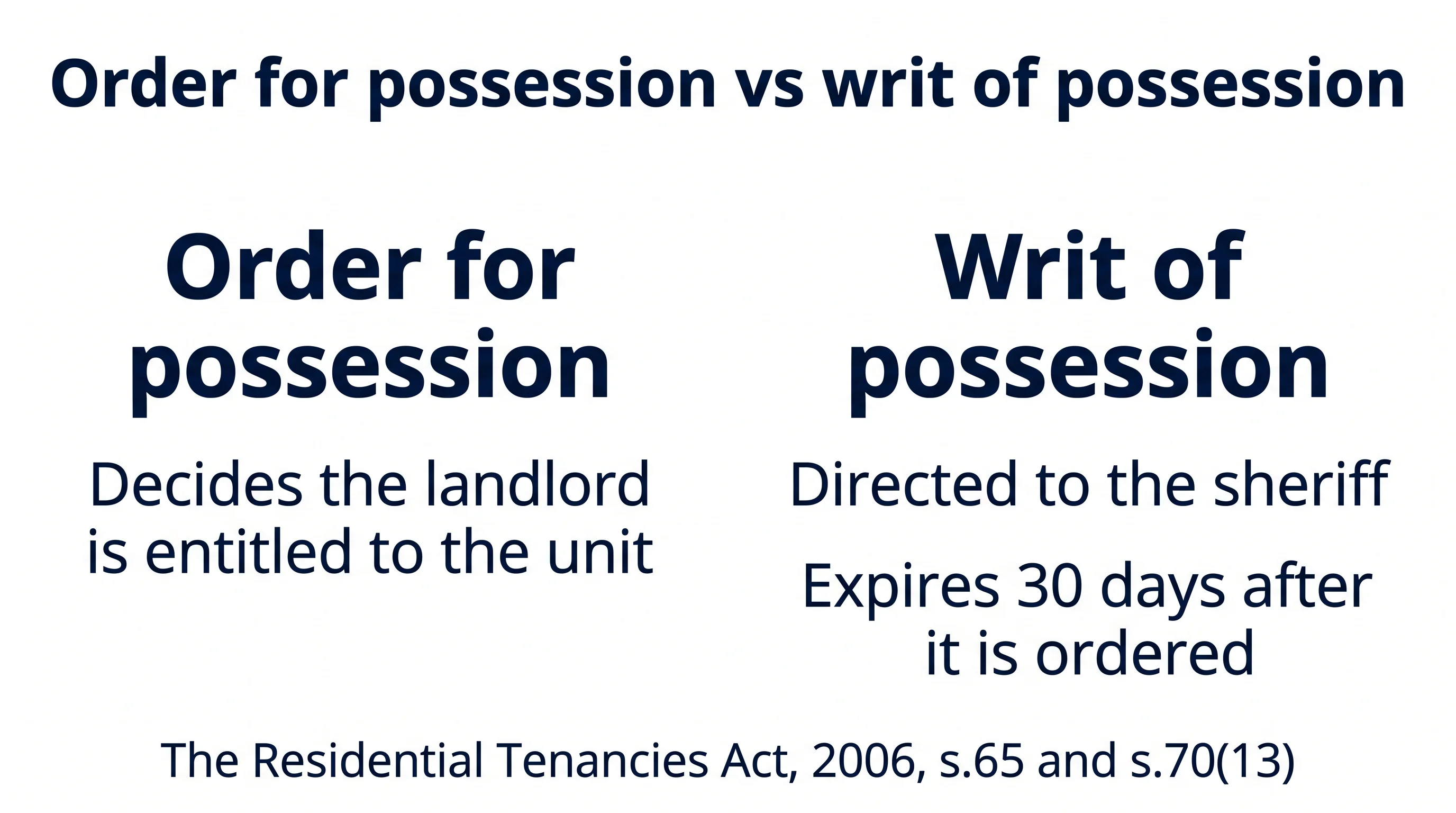
A Saskatchewan writ of possession is a written command, in the form set out as Form A of the Regs, telling the sheriff to place the landlord in possession of a rental unit "as soon as is reasonably possible" (Act s.70(13); Regs s.10(1)). The hearing officer makes it at the same time as an order for possession.
The order for possession decides the landlord is entitled to the unit; the writ is the enforcement step. Section 65 of the Act says no landlord may regain possession unless the tenant has vacated or abandoned the unit, or the landlord has an order for possession and a writ of possession directed to a sheriff. Section 69(2) repeats the rule for an overholding tenant, meaning a tenant who stays after the tenancy has ended.
Form A covers the fixtures, appliances and furnishings the landlord supplied, and reaches the named tenants "or any person claiming through or under" them. It can direct the sheriff to act as soon as reasonably possible or on a set date and time.
How does a landlord get a writ of possession from the ORT?

A Saskatchewan landlord gets a writ of possession by serving the right approved notice, applying to the ORT for possession, and winning the hearing. Every step runs through the ORT online portal, which you reach with a Saskatchewan Account.
- Serve the approved notice. For unpaid rent this is the Immediate Notice to Vacate and Notice of Arrears (formerly Form 7), available once rent is unpaid for 15 days or more after the due day (s.57(1)). Serve it on day 16 or later to be safe. Other grounds use the Notice to Vacate: Cause (formerly Form 8) and its siblings (ss.58–60).
- Apply for possession. The ORT Rules of Procedure (Part 2) require a true copy of the notice "exactly as it was served", a Certificate of Service for each tenant served personally or electronically, the $50 fee (or a fee waiver), the written agreement and, for arrears or repeated late payment, the rent ledger. Arrears on the immediate notice and the fee can be claimed at the same hearing.
- Serve the hearing notice. Possession applications are treated as urgent, so the hearing notice must reach the tenant at least two days before the hearing (Rules Part 4). On a current tenant, that means personal service, or posting on the front door plus ordinary mail or an electronic copy (s.82(2)(a)). Email alone is not enough.
- Attend the phone hearing. Hearings are by phone unless the hearing officer grants an in-person request (Rules Part 5). The decision is reserved and issued in writing, never at the hearing (Rules Part 6).
Alberta landlords follow a different path through the RTDRS or the courts; see RTDRS explained if you own in both provinces. More landlord guides sit in the Canadian Landlord Resource Center.
How long is a writ of possession good for in Saskatchewan?
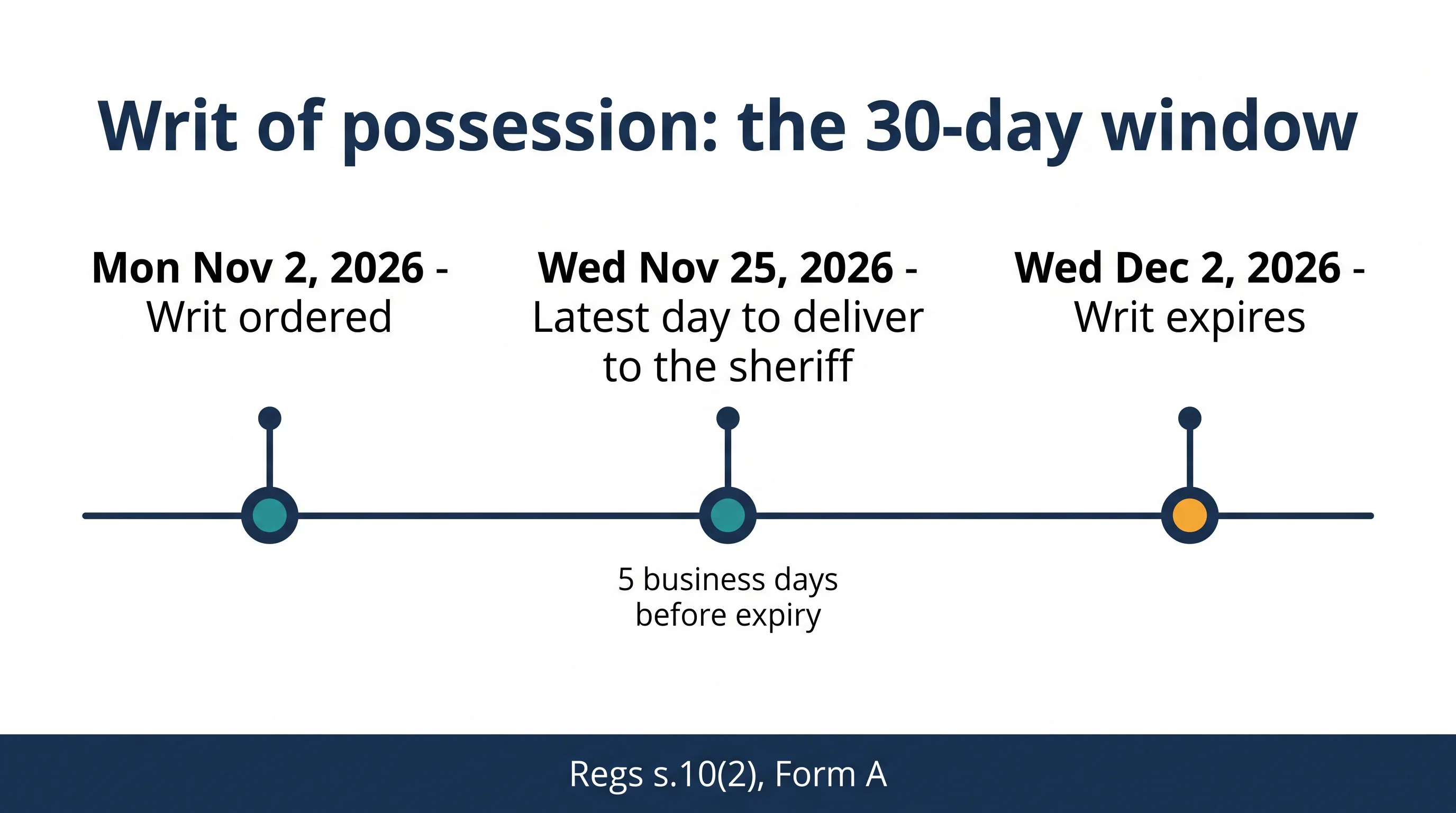
A Saskatchewan writ of possession expires 30 days after the date it is ordered, unless the hearing officer specifies a different expiry date (Regs s.10(2), s.8.3(2)). The expiry date is printed on the writ itself.
Form A carries a note for landlords: the sheriff needs time to enforce the writ, so deliver it to the sheriff at least 5 business days before it expires. A business day excludes Saturdays, Sundays and holidays (Act s.2(a.1)).
| Step | Example date |
|---|---|
| Writ ordered (30-day expiry) | Monday, November 2, 2026 |
| Writ expires | Wednesday, December 2, 2026 |
| Latest day to deliver it to the sheriff (5 business days before) | Wednesday, November 25, 2026 |
| Better: deliver it | The day you receive it |
The hearing officer can extend the expiry date in two cases: while the writ is under appeal, until 30 days after the appeal is decided or abandoned, or at the sheriff's request (Regs s.8.3(3)). Neither the Act nor the Regs sets a sheriff's fee or a waiting time, so ask the sheriff's office directly.
What does the sheriff do with a writ of possession?
In Saskatchewan the sheriff of the Court of King's Bench enforces a writ of possession by removing the occupants and putting the landlord in possession of the unit. The ORT's own page says writs "are enforced by the Sheriff" and tells landlords to contact the local Sheriff's Office at the nearest judicial centre with questions.
The ORT's Ending a Tenancy page is just as clear about everyone else: a sheriff "may remove a tenant from a rental unit by enforcing a Writ of Possession issued by the ORT", and "if any other person or entity attempts to remove a tenant, the tenant should call the police." Ontario and BC work the same way, through a sheriff or a court bailiff; compare what happens after an Ontario LTB order and enforcing a BC order of possession.
Can a tenant stop a writ of possession in Saskatchewan?
A Saskatchewan tenant can stop a writ of possession only by appealing to the Court of King's Bench, on a question of law or jurisdiction, within 30 days after the hearing officer signs and dates the decision (s.72(1)). Filing the notice of appeal with the local registrar stays everything under the order, including the writ, unless the court orders otherwise (s.78(1)).
The appeal is made at the judicial centre nearest the rental unit (s.72(1.2)). Where the writ followed an immediate notice for unpaid rent or utility arrears, or a cause notice for repeated late rent, the tenant must also file a certificate of payment of rent. The ORT issues it once the tenant deposits one month's rent, in the amount set out in the order (s.72(1.3); Regs s.10.1). Form A adds that an appeal must be filed before the enforcement date the sheriff sets.
| Step a tenant takes | Deadline | Effect on the writ |
|---|---|---|
| Appeal to the Court of King's Bench | 30 days after the decision is signed and dated (s.72(1)) | Stays the writ on filing, unless the court orders otherwise (s.78(1)) |
| Certificate of payment of rent (rent, utility or late-rent writs) | Filed with the appeal (s.72(1.3)) | Required before that appeal can go ahead |
| Request a rehearing | No deadline stated; ask promptly (s.73(5)) | Does not stop the landlord enforcing the writ (Rules Part 7) |
| Request to correct or clarify, $50 | 15 days after the date on the decision (s.76(3)) | Not listed as a stay in the Act |
Tenants looking for more help can start at the Canadian Tenant Resource Center, and the ORT answers questions at 1-888-215-2222.
What happens to belongings and unpaid rent after the sheriff acts?
After possession is recovered in Saskatchewan, property left behind and money still owed follow their own rules. Property the landlord reasonably estimates is worth $1,500 or less may be removed and sold or disposed of after reasonable efforts to find the tenant (s.85(4)–(6)). Anything worth more needs a Property Disposition Order, which a hearing officer can make without notice to the tenant (s.85(1)–(3)).
From any sale, the landlord may deduct only amounts owing under an ORT order; the rest goes to the director for the tenant (s.85(7)). A money award is not enforced by the ORT. Once the appeal period has passed, the landlord can file a certified copy in the Court of King's Bench, where it becomes enforceable as a court judgment (s.77). A landlord can also claim losses, including lost rent, from an overholding tenant (s.69(3)).
Frequently asked questions
How long does it take to get a writ of possession in Saskatchewan?
No provision sets a total time. The steps are the notice, the online application, a hearing notice served at least two days before an urgent hearing, and a written decision issued after the hearing. The writ then lasts 30 days unless the hearing officer sets another date (Regs s.10(2)).
Who enforces a writ of possession in Saskatchewan?
The sheriff at the judicial centre nearest the rental unit (s.70(13)). The ORT does not enforce writs itself. Contact the local Sheriff's Office with the writ as soon as you receive it.
Can a landlord change the locks once the ORT grants possession?
No, not while the tenant is still there. The landlord regains possession only when the tenant leaves or abandons the unit, or through the sheriff under the writ (s.65). A lockout without justification can lead to punitive damages (s.66(4)).
Is the writ still valid if the tenant appeals?
Proceedings under the writ are stayed once the notice of appeal is filed, unless the court orders otherwise (s.78(1)). The hearing officer may extend the writ's expiry until 30 days after the appeal is decided or abandoned (Regs s.8.3(3)(a)).
The short version
In Saskatchewan, the writ of possession is the last step in a lawful eviction and the only way to recover a unit the tenant will not leave. Get it to the sheriff quickly and keep your hands off the locks until the sheriff acts.
Saskatchewan Writ of Possession Checklist
Get Free PDF →Get your rental paperwork right
Browse free landlord and tenant resources.
Free • No signup required