You won at the Residential Tenancy Branch (RTB). The arbitrator granted you an order of possession, and you expected the tenant to pack up. The date in the order has come and gone, and the tenant is still there.
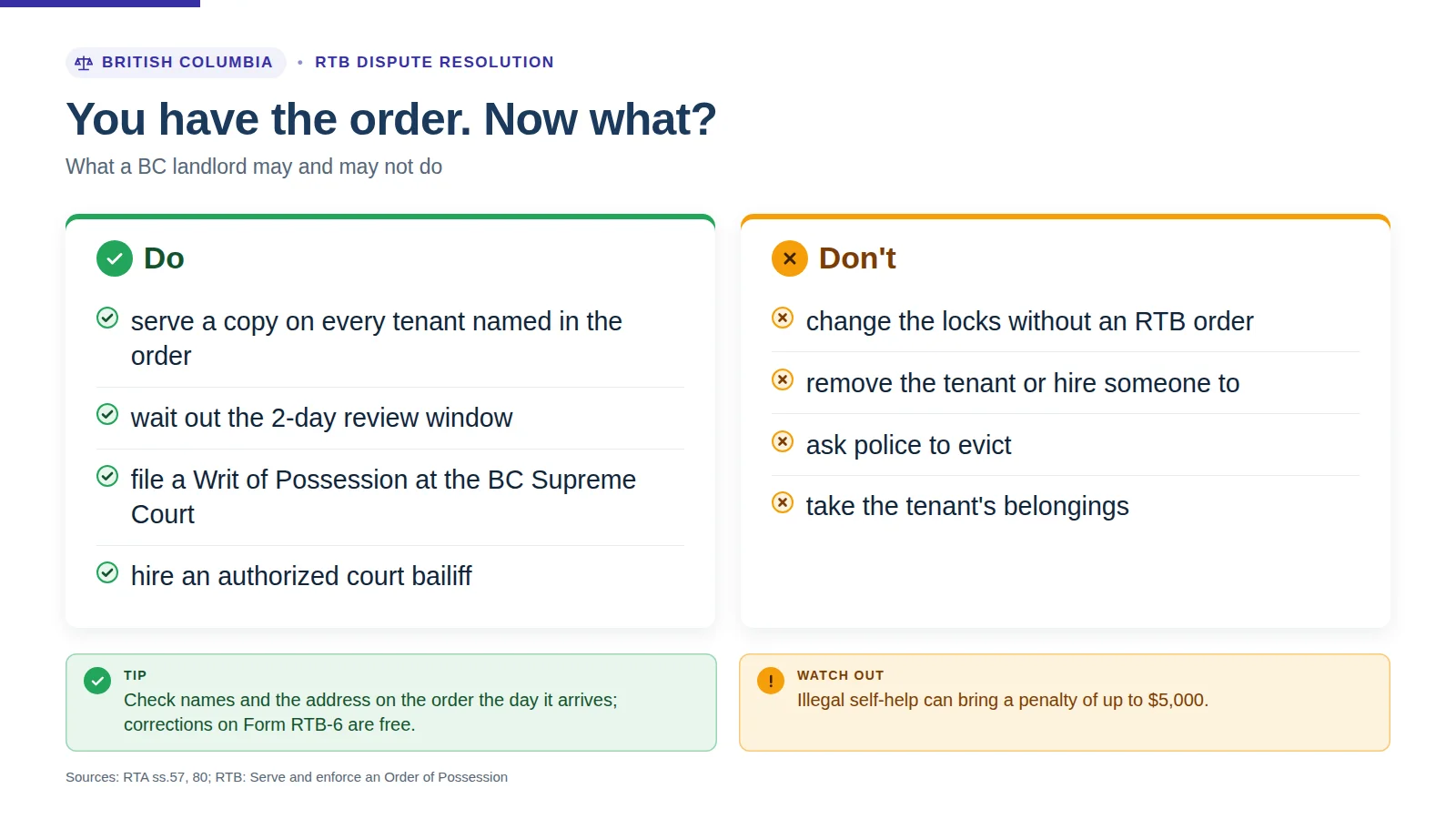
This is the point where many landlords make an expensive mistake. An order of possession gives you the right to the unit, but it does not let you remove anyone yourself. In British Columbia only the BC Supreme Court, through a Writ of Possession, and an authorized court bailiff can enforce it.
This guide walks through each step between the RTB order and a court bailiff at the door: serving the order, the review window, the Writ of Possession, and getting your costs back.
BC Order of Possession Enforcement Checklist
A landlord checklist for enforcing a BC order of possession: serving every tenant, the 2-day review window, the Writ of Possession package, the bailiff and recovering your costs.
Get Free PDF →What an order of possession does
An order of possession is an RTB order that gives the successful party possession of the rental unit. For a landlord, it means the tenant must move out by the date specified in it (section 55(3) of the Residential Tenancy Act, or RTA). The RTB's orders page describes it as final and binding.
Landlords usually get one after an arbitrator upholds their notice at a hearing, or, when the tenant did not dispute an eligible notice in time, through the RTB's Direct Request process. Our guide to Direct Request for an order of possession in BC covers getting the order. This guide starts once you have it.
From order to bailiff, step by step
Step 1: Serve the order on every tenant
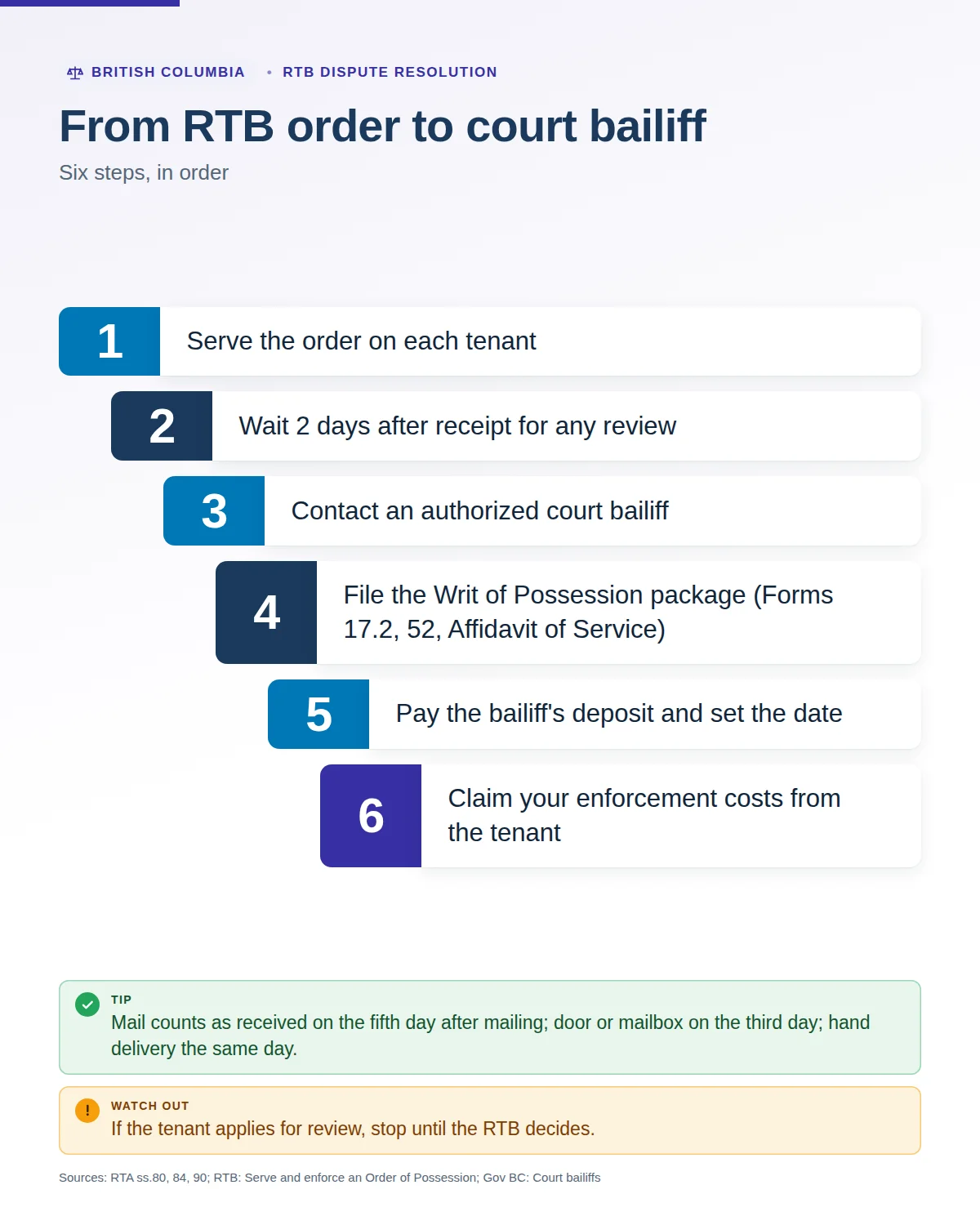
The RTB does not serve or enforce orders for you. You must serve a copy on each party named in the order for it to take effect. The method you choose affects when it counts as received. Under section 90 of the RTA, a copy sent by mail is deemed received on the fifth day after mailing, and a copy attached to the door or left in the mailbox is deemed received on the third day. Under section 44 of the Residential Tenancy Regulation, a copy emailed to an address the tenant gave for service is deemed received on the third day. A copy handed to the tenant is received that day.
Step 2: Wait out the 2-day review window
Section 80 of the RTA gives the other party 2 days after receiving a decision or order of possession to apply for a review. The RTB's review page confirms the 2-day deadline for orders of possession. The application (Form RTB-2) costs $50 under section 9 of the Regulation.
If the tenant applies and the RTB decides to review, you must wait until the review is complete before taking any further step. Section 84 of the RTA lets you file the order in the Supreme Court once the review period has expired, or once a review has been refused, dismissed or concluded.
Worked example
| Date | What happens |
|---|---|
| Tuesday, November 3, 2026 | You hand the order to the tenant in person. It is received that day. |
| Thursday, November 5, 2026 | Last day of the 2-day review window. |
| Friday, November 6, 2026 onward | No review filed, and the tenant is still in the unit past the date in the order. You can start court enforcement. |
If you had attached the same order to the door on November 3, it would be deemed received on November 6, and the 2-day window would run from then.
Step 3: Contact an authorized court bailiff
Only court bailiffs under contract with the Ministry of Attorney General can carry out the eviction. The province's court bailiffs page lists the authorized firms for each of its 12 service areas. The RTB suggests contacting one first to ask about availability, a fee estimate, a timeline estimate and anything else they need from you.
Step 4: File the Writ of Possession package
Take the order to a BC Supreme Court registry with the Writ of Possession package. The RTB's order of possession page lists three documents:
- Requisition (Form 17.2)
- Writ of Possession (Form 52)
- Affidavit of Service, sworn at the court registry
Pay the filing, affidavit and other court fees, then tell the registry which authorized bailiff you will hire. The registry forwards the writ to that bailiff.
Step 5: Pay the bailiff's deposit and set the date
The bailiff needs a deposit before starting work. The province's bailiffs page says costs can include an hourly rate, mileage, storage and services such as movers or locksmiths. A bailiff may ask police to attend to keep the peace, but the RTB is clear that police do not carry out evictions on their own.
Step 6: Recover your costs
You can ask the tenant to compensate you for enforcement costs, such as bailiff fees and the expenses of an incoming tenant who could not move in on time. The bailiff can seize and sell the tenant's possessions only to cover the cost of enforcing the order. If that is not enough, you can apply to the RTB for dispute resolution.
Separately, section 57(3) of the RTA lets you claim compensation from an overholding tenant for the time they stay after the tenancy ended. Policy Guideline 3 describes this as use and occupancy on a per-day basis until you get the unit back.
Common mistakes
- Self-help after winning. Winning the hearing does not let you change the locks. Only a court bailiff acting on a writ can remove the tenant.
- Serving only one tenant. The order must be served on each person named in it.
- Counting the review window from the wrong day. The 2 days start when the tenant receives the order, and a door or mailbox copy is not received until the third day.
- Hiring the wrong company. The RTB warns against using a bailiff company that does not have a contract with the Ministry of Attorney General.
- Accepting money without saying what it is for. The RTB says a landlord who accepts a payment from an overholding tenant should state in writing that it is for use and occupancy only and does not cancel the notice. Otherwise the tenant may argue the tenancy was reinstated.
- Losing the paperwork. The registry needs an affidavit of service, so you need clear proof of how and when you served the order.
Doing it at scale
If you manage many units, enforcement files are rare but costly when they go wrong. A short checklist keeps each one on track:
- Keep one file per order: the decision, the order, proof of service for each tenant and any review documents.
- Record the service method and the deemed receipt date for each tenant, then the review deadline.
- Keep the names of the authorized bailiff firms for each area where you own units.
- Keep a running ledger of rent, use-and-occupancy payments and enforcement costs, with receipts, for any later claim.
- Before court enforcement, consider the RTB's suggestion of negotiating a voluntary move (moving help, a rent reduction for the final month or more time) and put any deal in writing.
How Tenon10 helps
Most orders of possession start with a notice. Tenon10 generates the BC 10 Day Notice (RTB-30), the One Month Notice for Cause (RTB-33) and the Four Month Notice (RTB-29). Applications to the RTB and the Supreme Court are filed with those bodies, not through Tenon10.
Tenon10 keeps lease, notice and payment records together for each tenancy, which serves as your evidence record when you need to prove what was served and what is owed.
Frequently asked questions
Can the police enforce my order of possession?
No. The RTB says police do not have the authority to evict tenants on their own. A court-approved bailiff enforces a Writ of Possession, and may ask police to attend to keep the peace.
How long does the tenant have to ask for a review?
Two days after receiving an order of possession, under section 80 of the RTA. If the RTB agrees to review, you must wait for the outcome.
Who pays the bailiff?
You pay the deposit up front. You can then seek those costs from the tenant, and the bailiff can seize and sell the tenant's possessions to cover enforcement costs.
What if the tenant leaves some belongings behind after the bailiff's visit?
The Residential Tenancy Regulation has specific rules for abandoned personal property. Follow them rather than throwing items out, and check the RTB's guidance before you dispose of anything.
BC Order of Possession Enforcement Checklist
A landlord checklist for enforcing a BC order of possession: serving every tenant, the 2-day review window, the Writ of Possession package, the bailiff and recovering your costs.
Get Free PDF →Keep your evidence record ready
Tenon10 generates the BC RTB-30, RTB-33 and RTB-29 notices and keeps lease, notice and payment records together for every tenancy.
Built for Canadian landlords and property managers.
Related BC guides
- Direct Request for an Order of Possession in BC
- Serving Documents in BC: Every Method the RTA Allows
- Five Days to Pay or Dispute: What Happens After a BC 10 Day Notice
Sources: RTB: Serve and enforce an Order of Possession; RTB: Serve and enforce orders; RTB: Review, clarify or correct decisions and orders; RTB: Evictions; Government of B.C.: Court bailiffs; Residential Tenancy Act; Residential Tenancy Regulation. This article is a summary of British Columbia rules as of October 2026, not legal advice. Check the Residential Tenancy Branch for your situation.