Renting out a condo in Alberta starts with written notice to the condominium corporation of your intention to rent, giving an address for service and the rent (Condominium Property Act s.53(1)). You then give the tenant's name within 20 days of the tenancy starting (s.53(5)), and the corporation may require a rental deposit of up to $1,000 or one month's rent, whichever is greater.
This FAQ is for Alberta condo owners who rent out a unit and for the property managers who handle it. Your duties to the tenant still come from the Residential Tenancies Act, covered in the Alberta landlord guide. This page covers the second relationship: you and the corporation.
What notice must an Alberta condo owner give the corporation before renting?
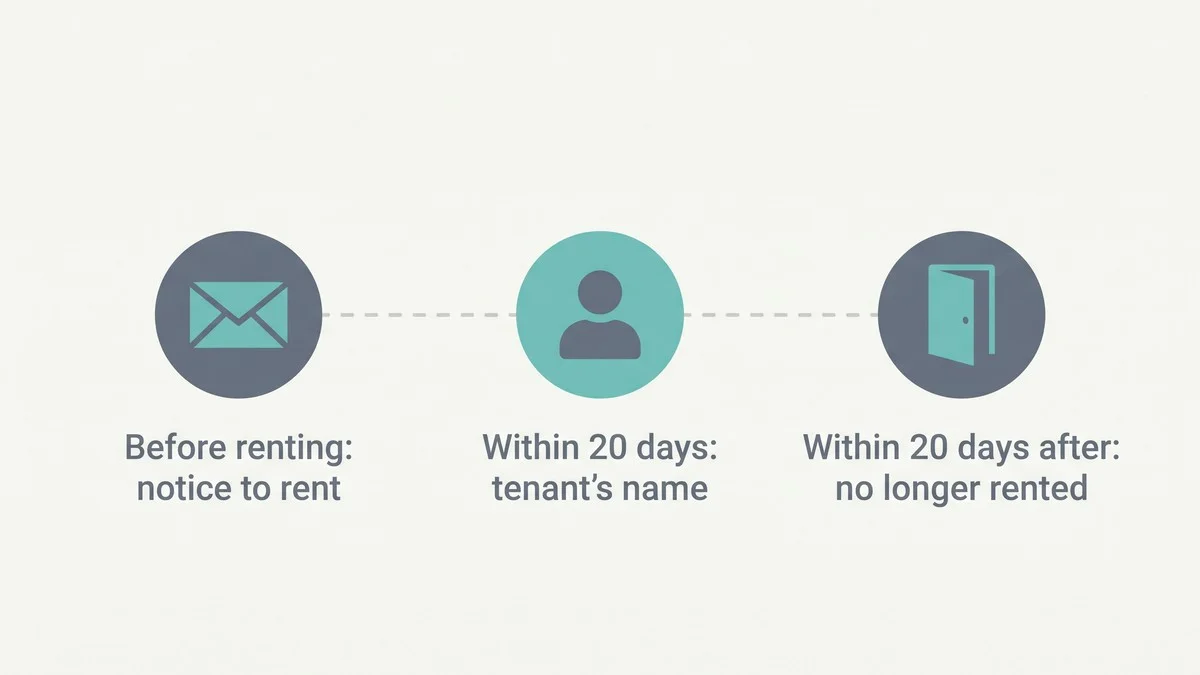
An Alberta condo owner cannot rent the unit until the corporation has written notice of the intention to rent, with the address where the owner can be served and the rent to be charged (CPA s.53(1)). Two more notices follow.
| When | What to tell the corporation, in writing | Section |
|---|---|---|
| Before renting | Intention to rent, an address for service, the rent | s.53(1) |
| Within 20 days of the tenancy starting | The tenant's name | s.53(5) |
| Within 20 days after you stop renting | The unit is no longer rented | s.53(6) |
The tenant's name matters for fines. When a corporation proposes a bylaw sanction without naming a person, the sanction falls on the owner unless the owner has given the tenant's name and has not yet reported that the tenancy ended (Condominium Property Regulation s.73.7(5)(b)).
How much rental deposit can an Alberta condo corporation charge?
An Alberta condo corporation can require a rental deposit of up to $1,000 or one month's rent, whichever is greater (Regulation s.74.2(1)). It can use the deposit only to repair or replace corporation property or common property, or to repair an exclusive-use area, damaged by anyone living in the rented unit (CPA s.53(3)).
- Return: within 20 days after you report that the unit is no longer rented, with interest earned, if any (s.53(7)).
- Deductions: a statement of account with an itemized list of each deduction and its purpose (s.53(7); Regulation s.74.3). If the amount is not yet known, an estimated statement first and a final one within 60 days.
- Older deposits: a larger deposit collected before January 1, 2020 may be kept until you report that the unit is no longer rented (Regulation s.74.2(2)).
This deposit is yours to pay. It is separate from the tenant's security deposit, which the Residential Tenancies Act caps at one month's rent (RTA s.43(1)). See Alberta security deposits.
Can condo bylaws ban rentals in Alberta?
No. Under the Alberta Condominium Property Act, no bylaw operates to prohibit or restrict any lease or other dealing with a unit (s.32(5)), and a bylaw sanction cannot have that effect either (s.35(6)). Bylaws do bind your tenant, though: it is a condition of every condo tenancy, whatever the lease says, that the people living in the unit will not damage the corporation's property or the common property and will not contravene the bylaws (s.53(2)).
Can an Alberta condo corporation evict my tenant?
Yes. An Alberta condo corporation can give a tenant notice to give up possession if anyone living in the unit damages corporation or common property beyond normal wear and tear, or contravenes a bylaw (CPA s.54(1)). The notice is served on both the tenant and you (s.54(3)). The tenancy then ends on the last day of the month after the month the notice is served, despite the Residential Tenancies Act or the lease (s.54(2)).
If the tenant does not leave, the corporation or the landlord can apply to the Court for an order (s.55). For excessive damage, or a danger to or intimidation of other residents, the corporation can apply for an order for immediate possession without giving that notice first (s.56).
Do the Residential Tenancies Act rules still apply to a condo rental?
Yes. Between you and your tenant, you are the landlord under the Residential Tenancies Act (s.1(1)(f)), so the usual rules on leases, inspection reports, entry and deposits apply. Start with what an Alberta lease must contain and the inspection report rules. For repairs to common property such as exterior windows, see who pays for condo windows in Alberta.
Frequently asked questions
Do I need the condo board's permission to rent my unit?
The Act requires written notice to the corporation before you rent, not its approval (CPA s.53(1)). A bylaw cannot prohibit or restrict a lease (s.32(5)). Your tenant must still follow the bylaws (s.53(2)).
Is the condo rental deposit the same as my tenant's security deposit?
No. The rental deposit is paid by the owner to the corporation for damage to its property or common property (s.53(3)). The tenant's security deposit is paid to you and is governed by the Residential Tenancies Act (RTA s.43).
Can the corporation fine my tenant?
Yes, under a sanction bylaw, after serving a notice of proposed sanction. The corporation may also serve that notice on you (Regulation s.73.7(1), (2)). Give the tenant a copy of the bylaws when the tenancy starts.
Does a corporation's notice to give up possession follow the RTA notice periods?
No. A notice under CPA s.54 ends the tenancy on the last day of the month following the month it was served, despite the Residential Tenancies Act and the lease (s.54(2)).
Start the condo tenancy on paper
Between you and the tenant it is an ordinary Alberta tenancy. Start with a free residential tenancy agreement that covers rent, the deposit and house rules.
Free • No signup required
Additional resources
- Condominium Property Act, RSA 2000, c C-22 (ss.32, 35, 53 to 56)
- Condominium Property Regulation, AR 168/2000 (ss.73.7, 74.2, 74.3)
- Edmonton landlord and tenant guide and Calgary landlord and tenant guide
- Canadian Landlord Resource Center