A Saskatchewan rental agreement can be written or oral, but a written one must include the Standard Conditions in Schedule 1 and the details listed in s.19(1) of The Residential Tenancies Act, 2006, and the landlord must give the tenant a signed copy within 20 days. A fixed term of three months or longer must be in writing (s.20).
At a glance
- Standard Conditions: part of every agreement, and cannot be changed or removed (ss.18, 22(1); Regs s.4).
- Required contents: names, address, dates, rent, utilities, services, deposit and contact numbers (s.19(1)).
- Copy: a signed copy to the tenant within 20 days, or rent can be suspended (s.19(2), (5)).
- Fixed terms: three months or longer must be in writing; no end date means month-to-month (ss.20-21).
- Fees: no application or processing fee (s.23).
- Templates: the ORT publishes free month-to-month, fixed-term and week-to-week agreements; using them is optional.
This guide is for Saskatchewan landlords drafting or checking a lease, and it answers the common searches for a "Saskatchewan rental agreement", template or PDF. It covers what the Act requires every written agreement to contain, the Standard Conditions, oral agreements, fixed terms, clauses that will not hold up, and the free agreements the Office of Residential Tenancies (ORT, formerly the Rentalsman) publishes.
Saskatchewan Lease Checklist
Get Free PDF →What must a Saskatchewan tenancy agreement include?
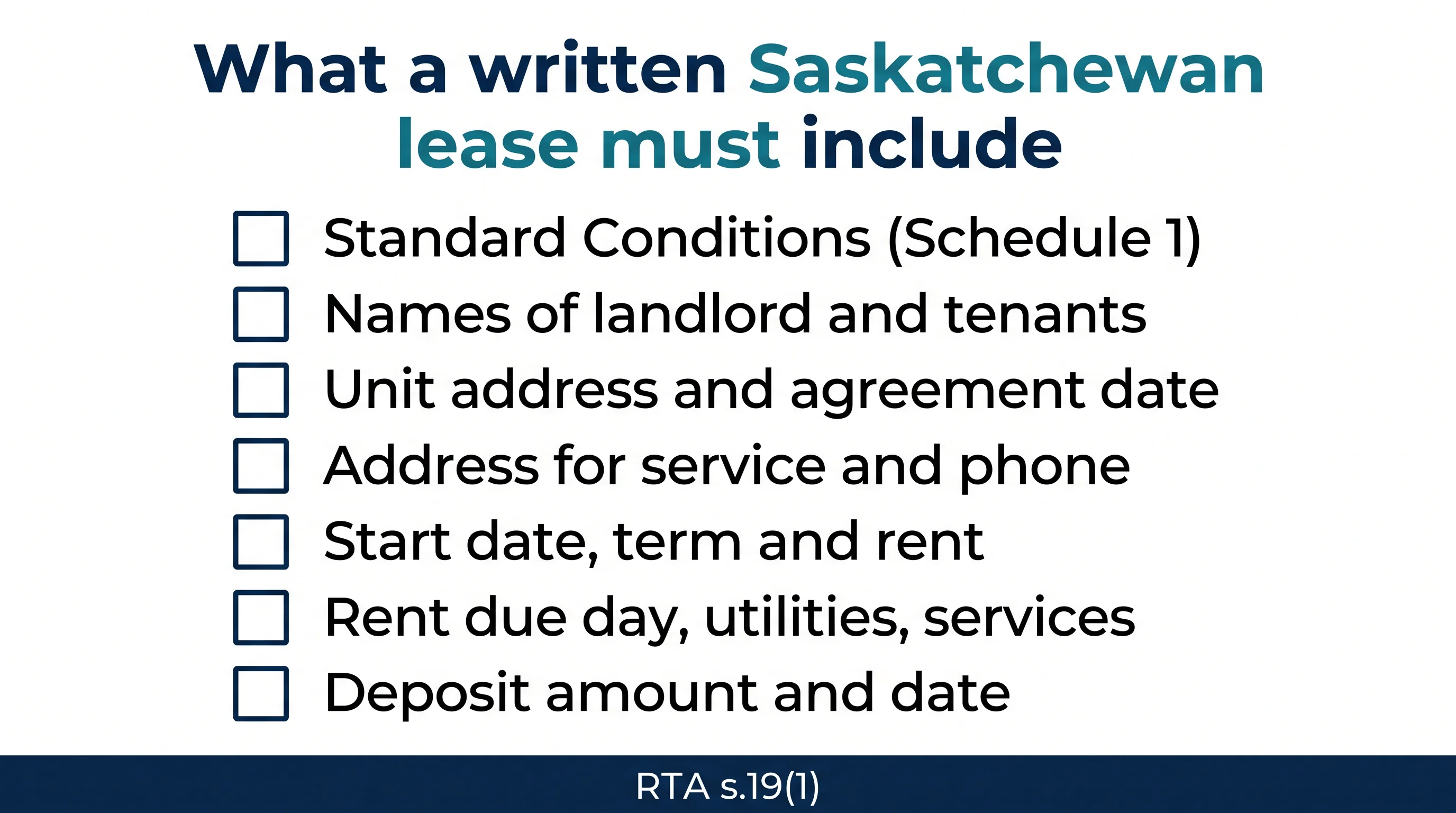
A written Saskatchewan tenancy agreement must comply with the regulations and contain every item in s.19(1) of the Act. Missing items do not void the agreement on their own, but they expose the landlord to orders and, in some cases, a suspension of rent.
| Required item | Section |
|---|---|
| The Standard Conditions (Schedule 1) | s.19(1)(a) |
| Correct legal names of the landlord and every tenant | s.19(1)(b) |
| Address of the rental unit | s.19(1)(c) |
| Date the agreement is entered into | s.19(1)(d) |
| Landlord's (or agent's) address for service and phone number | s.19(1)(e) |
| Emergency and emergency-repair phone number, if different | s.19(1)(f) |
| Start date; weekly, monthly or other periodic basis, or the fixed-term end date | s.19(1)(g)(i)-(iii) |
| Rent for a set period, and any change per extra occupant | s.19(1)(g)(iv) |
| The day rent is due | s.19(1)(g)(v) |
| Who pays which utilities | s.19(1)(g)(vi) |
| Services and facilities included in the rent | s.19(1)(g)(vii) |
| Security deposit amount and the date it was or must be paid | s.19(1)(g)(viii) |
In a building with more than one unit and common areas, the landlord must also post the landlord's legal name, address for service and phone number in a conspicuous place, at or near the main entrance (s.19(4)).
What are the Standard Conditions in Schedule 1?
The Standard Conditions are a plain-language summary of the Act's key rules that forms part of every Saskatchewan tenancy agreement, written or not (s.18; Regs s.4 and Schedule 1). They cover deposits, rent payment, rent increases, repairs, entry, locks, rules, ending a tenancy and property left behind.
A tenancy agreement cannot be amended to change or remove a Standard Condition (s.22(1)), and any term that contradicts one is void (Schedule 1, s.1(2)-(3)). Where the Standard Conditions and the Act differ, the Act and Regulations prevail (Schedule 1, note). The simplest approach is to attach the full Schedule 1 to every agreement; Publications Saskatchewan publishes it as a separate document.
Can a Saskatchewan tenancy agreement be oral?
Yes. Saskatchewan tenancy agreements do not have to be in writing (Schedule 1, s.2(1)), except a fixed term of three months or longer, which must be (s.20). Even with an oral agreement, the landlord must give the tenant, in writing and within 20 days, the address for service, phone number and any separate emergency number (s.19(3)). The ORT's page adds a copy of Schedule 1 to that list.
Schedule 1 words the fixed-term rule as "more than 3 months" (s.2(2)), while the Act says "three months or longer" (s.20). The Act prevails, so put any fixed term of three months or more in writing.
What happens if the landlord does not give the tenant a copy?
A Saskatchewan landlord must give the tenant a copy of the signed written agreement within 20 days after they enter into it (s.19(2)). If the landlord does not, or does not give an oral tenant the written contact details, the tenant's obligation to pay rent is suspended (s.19(5)).
A landlord can ask the ORT for an order that rent is not suspended where the agreement substantially complies with s.19(1) and the tenant is not prejudiced by the error (s.19(6)). An agreement is not invalid because information is missing unless a hearing officer finds the failure significant and the tenant prejudiced (s.19(7)). Tenants: do not stop paying without reading s.19(5)-(6) and asking the ORT first.
How do fixed-term and periodic agreements differ in Saskatchewan?
A Saskatchewan periodic tenancy (weekly, monthly or another period) runs until someone ends it with proper notice; a fixed term ends on its stated end date (s.55(2)). A written agreement that does not state an end date is deemed a monthly periodic tenancy (s.21). The ORT describes fixed terms as running from three months to less than 20 years.
| Point | Periodic | Fixed term |
|---|---|---|
| Must be in writing? | No | Yes, if three months or longer (s.20) |
| Rent increases | 12 months' notice; not before 18 months, then 12 months apart (s.54) | Only if amount and timing agreed at signing (s.53.1) |
| At the end | Ends only by notice or agreement (s.55(1)) | Landlord serves the Two Month Notice of Intention at least two months before the end (Regs s.8.2) |
| Free ORT template | Month-to-Month or Week-to-Week Tenancy Agreement | Fixed Term Tenancy Agreement |
For a fixed term, the landlord's notice of intention says whether a new agreement is offered and on what terms. The tenant accepts in writing within one month (Regs s.8.2(3)); the ORT's rent increase page says 30 days, so plan on 30 days to be safe. A tenant who does not answer is treated as refusing and leaves at the end of the term (Regs s.8.2(1)(d)).
What clauses can a Saskatchewan lease not include?
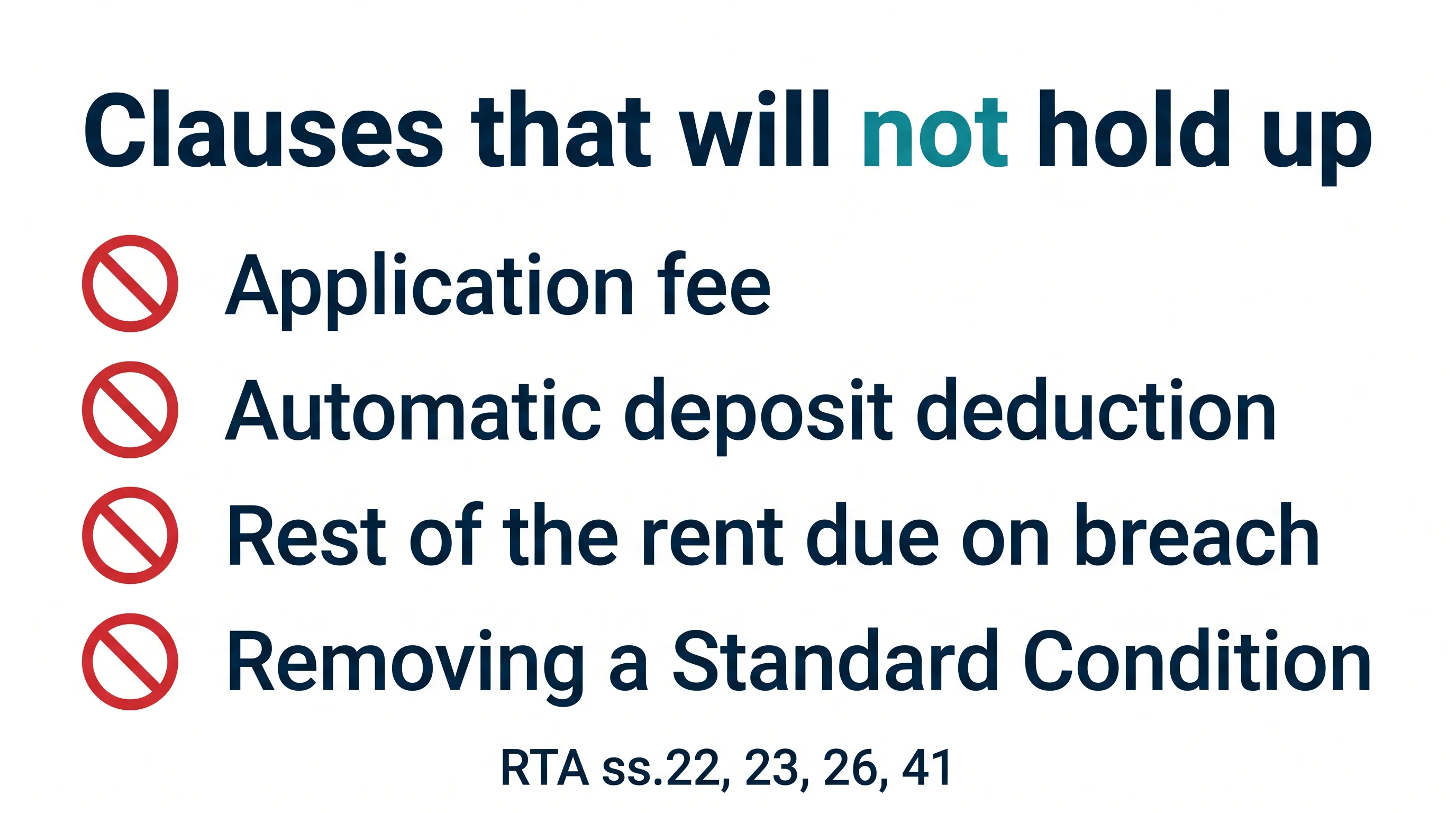
A Saskatchewan lease clause is unenforceable if it is inconsistent with the Act or Regulations, unconscionable, or not clear about the rights and obligations it creates (s.7(2)). Any agreement that the Act does not apply is void (s.6). Specific prohibitions include:
- Application or processing fees: no charge to accept or process an application, check a tenant's suitability or accept a tenant (s.23).
- Automatic deposit deductions: no clause that the landlord keeps part of the deposit at the end (s.26(1)(c)); the deposit is capped at one month's rent (s.25(1)).
- Acceleration clauses: no term making the rest of the rent due if the tenant breaches the lease (s.41).
- Rent in advance: a landlord must not demand money to pay rent that becomes due in the future (s.40).
- Removing a Standard Condition: not allowed (s.22(1)).
Late-payment and NSF fees are not mentioned anywhere in the Act or Regulations. Saskatchewan sets no amount and does not expressly allow one, so any such fee must be in the written agreement, must not work as a penalty, and can be challenged at the ORT as unenforceable (s.7(2)).
Landlords can add reasonable rules on top of the agreement, including a ban on cannabis use or growing, as long as the rules are in writing and made known to the tenant (s.22.1). Repeated breaches of those rules are a ground for a Notice to Vacate: Cause (s.58(1)(h.1)).
Where can I get a free Saskatchewan rental agreement template?
The ORT publishes three free agreements on Publications Saskatchewan: the Month-to-Month Tenancy Agreement, the Fixed Term Tenancy Agreement and the Week-to-Week Tenancy Agreement, along with Schedule 1 and the Condition of Premises Checklist. Using them is optional; any agreement that contains the s.19(1) items and the Standard Conditions complies.
A minor can sign as a tenant: a person under 18 can enter a tenancy agreement and it is enforceable by and against them (s.4). Neighbouring provinces handle leases differently; compare Alberta's lease rules and BC's RTB-1 tenancy agreement.
Frequently asked questions
Is there a standard lease in Saskatchewan?
There is no mandatory lease form, but the Standard Conditions in Schedule 1 are part of every agreement (s.18). The ORT's month-to-month, fixed-term and week-to-week templates are free and optional.
Does a Saskatchewan lease have to be signed by every tenant?
The Act requires the correct legal names of the landlord and tenant (s.19(1)(b)) and a copy of the signed agreement to the tenant (s.19(2)). Have every adult tenant sign and give each a copy, so each is clearly a party.
Can I charge an application fee in Saskatchewan?
No. A landlord must not charge for accepting or processing an application, investigating an applicant or accepting a tenant (s.23).
What if my written lease has no end date?
It is deemed a monthly periodic tenancy (s.21). It continues until it is ended by notice, agreement or ORT order (s.55(1)).
Can I change the lease after it is signed?
Only with both parties' agreement, and never to change or remove a Standard Condition (s.22(1)-(2)). A rent increase served under s.54, or a change the ORT orders, does not need the tenant's agreement (s.22(3)).
A compliant Saskatchewan lease is short to describe: every s.19(1) item, Schedule 1 attached, a signed copy within 20 days, and no clause the Act forbids. More landlord guides are in the Canadian Landlord Resource Center, and renter guides in the Canadian Tenant Resource Center.
Saskatchewan Lease Checklist
Get Free PDF →Get your rental paperwork right
Browse free landlord and tenant resources.
Free • No signup required