In British Columbia, a tenant must not sublet a rental unit or assign a tenancy agreement unless the landlord consents in writing (Residential Tenancy Act s.34(1)). If a fixed term has six months or more left, the landlord can't unreasonably refuse; the landlord can never charge for considering or giving consent; and an unauthorized sublet or assignment is cause for a One Month Notice.
This guide explains the difference between a sublet and an assignment, when a landlord can say no, what happens to each person's rights, and why a roommate or a short-term guest usually isn't a sublet at all. It is written for both landlords and tenants.
At a glance
- Written consent first, for either a sublet or an assignment (RTA s.34(1)).
- Six months or more left on a fixed term: the landlord must not unreasonably withhold consent (s.34(2)).
- No fee, no benefit for considering or consenting (s.34(3); standard term 7).
- A sublet is temporary, a transfer of the whole unit for a shorter period; an assignment is permanent (Policy Guideline 19).
- No consent? The landlord has cause for a One Month Notice under s.47(1)(i).
BC Sublet and Assignment Checklist
Handle a BC tenant's request to sublet or assign on the merits, in writing, without a fee.
Get Free PDF →What is the difference between a sublet and an assignment in BC?
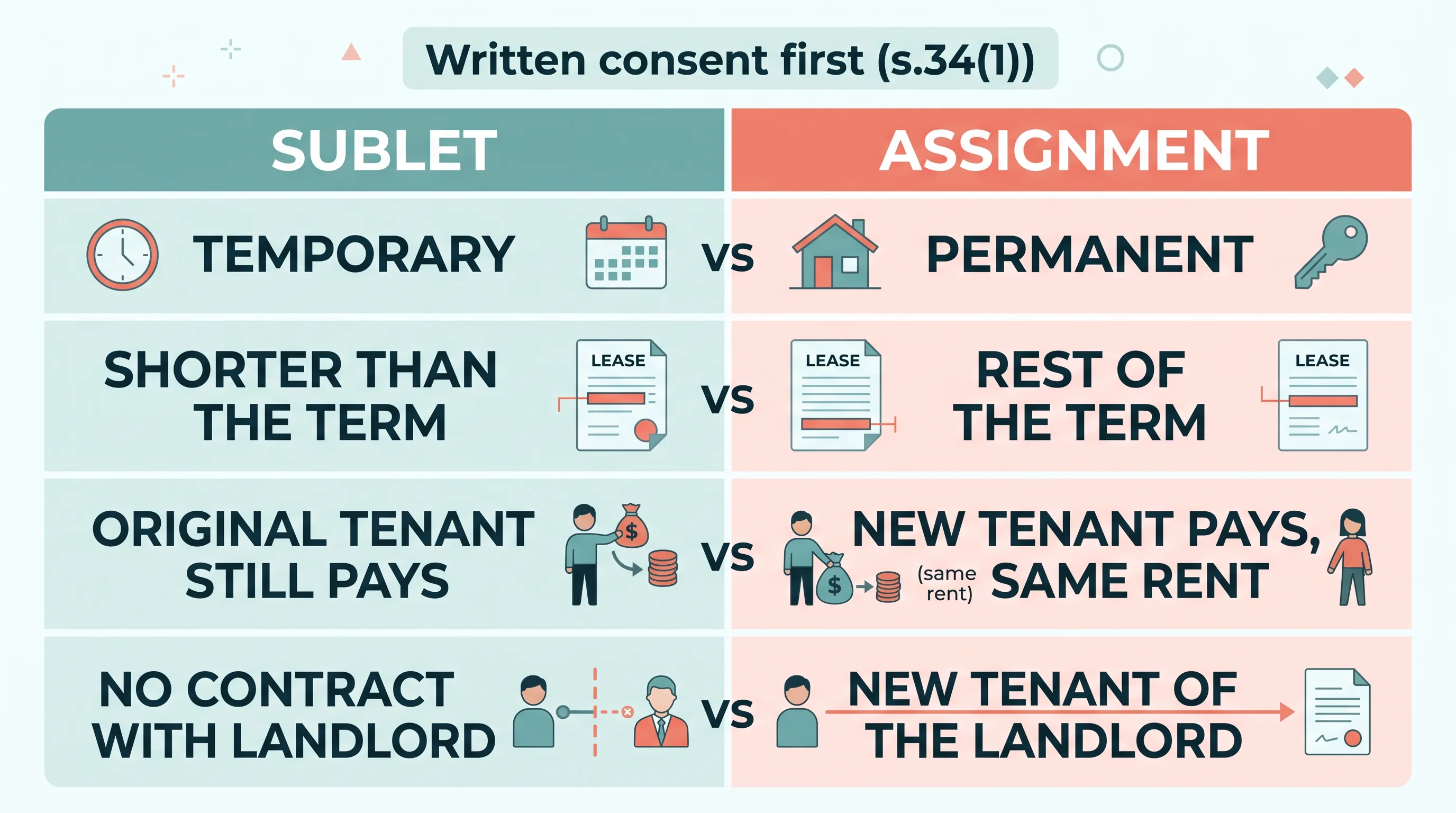
A sublet is temporary and an assignment is permanent. Under RTA s.1, a sublease agreement transfers the tenant's rights to a subtenant for a period shorter than the tenant's own term, with a set end date on which the subtenant agrees to leave. An assignment transfers the tenancy itself to a new tenant, who becomes the landlord's tenant for the rest of the term.
| Sublet | Assignment | |
|---|---|---|
| How long | Shorter than the original term, even by one day (Guideline 19) | The rest of the tenancy |
| Who is the landlord's tenant | Still the original tenant | The new tenant |
| Who pays the landlord | The original tenant, even if the subtenant doesn't pay them | The new tenant, at the same rent (standard term 7) |
| Contract between landlord and newcomer | None | Yes, on the existing terms |
| Original tenant's liability | Remains for the whole sublet | Usually ends, but may remain if done without consent or if the assignment doesn't address it (Guideline 19) |
A sublet with no gap may be an assignment
Policy Guideline 19 says that if a tenant sublets for the full remaining period and keeps no time at the end, the agreement likely amounts in law to an assignment. For a month-to-month tenancy, the guideline says the sublet would need to run month to month "less one day" to preserve the original tenant's interest. If you are subletting, write in a clear end date before your own tenancy ends.
When can a BC landlord refuse a sublet or assignment?
It depends on the tenancy. In BC, if a fixed-term agreement has six months or more remaining, the landlord must not unreasonably withhold consent (RTA s.34(2)). Guideline 19 says that by implication, with less than six months left, the landlord may refuse without regard to reasonableness, and for a month-to-month tenancy an arbitrator may find a refusal reasonable unless the tenant shows a compelling reason.
A reasonable refusal is one tied to the person, not the request. The RTB says a landlord may ask for credit or reference checks on the proposed new tenant and may refuse if it appears they won't be able to follow the terms of the tenancy agreement. The landlord must not charge anyone for considering, investigating or consenting (s.34(3)), and standard term 7 adds that the landlord must not receive a benefit, directly or indirectly, for consenting. Charging a fee is an offence under RTA s.95(1)(i).
What a tenant can do about an unreasonable refusal
Standard term 7(2) says a tenant may apply for dispute resolution if the landlord unreasonably withholds consent or charges a fee. Guideline 19 explains that an arbitrator can order that the tenancy be assigned or the unit sublet (RTA s.65(1)(g)), and can order compensation if the refusal was unreasonable. See How to File a Dispute Resolution Application with the BC RTB for the process.
What happens to everyone's rights during a BC sublet?
The original tenancy stays in place. In BC, the original tenant remains the landlord's tenant and becomes the subtenant's landlord; Policy Guideline 19 says there is no contract between the original landlord and the subtenant, and the original tenant stays responsible for the rent even if the subtenant doesn't pay.
Guideline 19 adds some practical consequences:
- If the landlord ends the original tenancy, it ends for the subtenant too, and only the original tenant can dispute the notice.
- Only the original landlord can make repairs. A subtenant asks the original tenant, who has to ask the landlord.
- A subtenant in a dispute generally applies against the original tenant, not the landlord.
An assignee is in a different position: the new tenant takes on all the rights and obligations of the existing agreement at the same rent (standard term 7). A no-pets clause, for example, binds the new tenant just as it bound the old one, the RTB says.
Is it a sublet if the tenant stays and rents out a room?
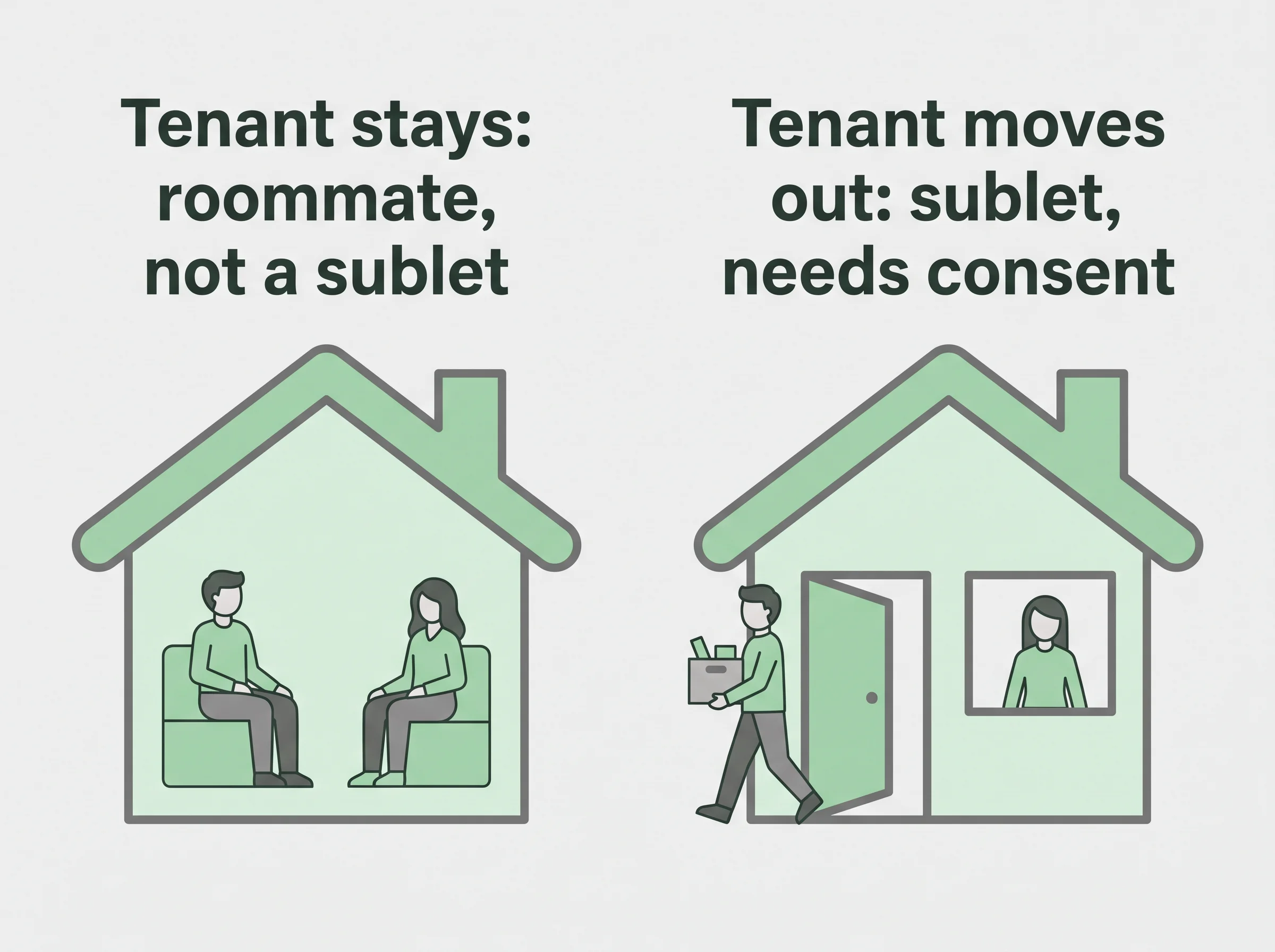
Usually not. Under the RTA, a sublet means the original tenant moves out and gives the subtenant exclusive occupancy. Policy Guideline 19 says that if the tenant stays in the unit and rents a room to someone, that person is an occupant or roommate with no rights under the RTA, and a One Month Notice for subletting without consent is likely to fail.
The same reasoning applies to short-term rentals while the tenant still lives there: Guideline 19 says this is not a true sublet, although it may breach other terms of the agreement, municipal bylaws or strata rules. A landlord who wants control over roommates or short-term rentals needs a clear added term in the agreement, such as requiring written consent before another occupant moves in. For how those terms work, see What You Can and Can't Add to a BC Tenancy Agreement.
Can a BC landlord evict for an unauthorized sublet?
Yes. In BC, a landlord may give a One Month Notice to End Tenancy for Cause if the tenant purports to assign the tenancy agreement or sublet the unit without first getting the landlord's written consent (RTA s.47(1)(i)). Guideline 19 notes that whether the notice holds up depends on whether an arbitrator finds a real sublet or assignment happened.
The tenant has 10 days after receiving the notice to dispute it (s.47(4)). Our guide to the One Month Notice to End Tenancy for Cause (RTB-33) walks through the form and the dispute window, and the RTB-33 form page has the notice itself. Breaking a fixed term without a valid assignment carries its own costs; see Ending a Tenancy in BC: Every Way It Can End.
Frequently asked questions
Can I sublet my apartment in BC?
Only with your landlord's written consent (RTA s.34(1)). If you have six months or more left on a fixed term, the landlord can't unreasonably refuse, and you can apply for dispute resolution if they do.
Can a landlord charge a fee to approve a sublet in BC?
No. The landlord must not charge anything for considering, investigating or consenting to an assignment or sublease (s.34(3)), and must not receive any benefit for consenting (standard term 7).
Is assigning my lease a way to leave a fixed term early?
Often, yes. The RTB says assignment usually happens when a tenant wants out of a fixed term early. With the landlord's written consent, the new tenant takes over the agreement at the same rent for the rest of the term.
Does a roommate count as a sublet?
Not if you still live there. Guideline 19 treats that person as an occupant or roommate, not a subtenant. Your agreement may still require the landlord's consent before adding occupants.
What if my subtenant stops paying me?
You still owe the landlord the full rent. Guideline 19 says the original tenant's responsibility to pay rent is unaffected, and the original tenant can be evicted if rent isn't paid.
BC Sublet and Assignment Checklist
Handle a BC tenant's request to sublet or assign on the merits, in writing, without a fee.
Get Free PDF →Conclusion
In BC, sublets and assignments turn on one piece of paper: the landlord's written consent. Tenants should ask first and keep the answer; landlords should screen the newcomer, decide on the merits and reply in writing, especially when six months or more remain on a fixed term.
Start the new tenancy on the right paperwork
Tenon10 creates the BC tenancy agreement and runs move-in and move-out inspection reports when one tenant hands over to the next.
Free BC form • Built for Canadian landlords