In British Columbia, everyone who signs the same tenancy agreement is a co-tenant, and each co-tenant is responsible for the whole rent and any damage, not just a share. A roommate who moves in later with only the tenant's say-so is an occupant, with no rights or obligations under the Residential Tenancy Act (RTA) unless the landlord adds them to the agreement.
That difference decides who you can collect rent from, whose notice ends the tenancy, who gets the deposit back and what happens when one person moves out. This guide explains the three statuses, using RTB Policy Guideline 13 and Guideline 19, and shows how to set each one up correctly on a BC tenancy agreement.
At a glance
- Co-tenants sign one agreement and are jointly and severally responsible for rent, utilities and damage (Guideline 13, sections E and F).
- Tenants sharing common space have separate agreements and are responsible only for their own (Guideline 13, section I).
- Occupants are people a tenant lets move in; they have no rights or obligations under the agreement (Guideline 13, section J).
- One co-tenant's notice ends the tenancy for everyone on the agreement (Guideline 13, section G).
- Guest fees are banned (Regulation s.5(1)) and you cannot restrict reasonable guests (standard term 9).
BC Co-Tenant and Occupant Checklist
Set up a shared BC tenancy so the paperwork matches who really lives there: co-tenants, separate tenants and occupants.
Get Free PDF →Who counts as a co-tenant in a BC tenancy?
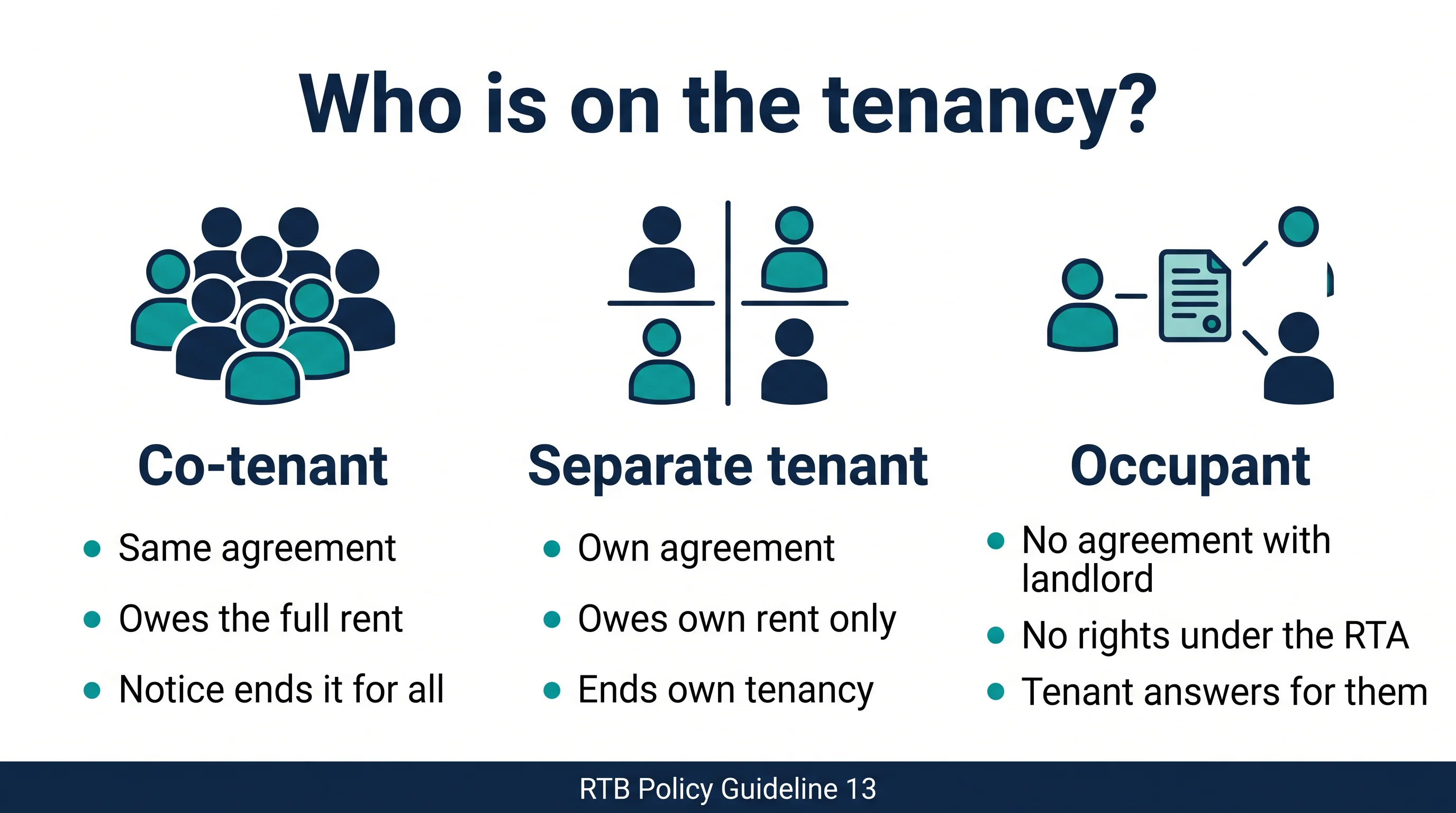
In BC, co-tenants are two or more people who rent the same unit under the same tenancy agreement. Guideline 13 says that, unless the agreement states otherwise, co-tenants have equal rights and are "jointly and severally" responsible for its terms, meaning responsible both as a group and as individuals.
The RTA itself does not define co-tenants (Guideline 13, section C), so the Branch looks at the paperwork and the facts. Where several people live in a unit and each pays part of the rent to the landlord, Guideline 13 says there is a presumption that they are co-tenants unless there is compelling evidence otherwise, such as separate agreements, separate rent receipts or separate deposits.
| Co-tenant | Tenant sharing common space | Occupant | |
|---|---|---|---|
| Agreement | Same agreement as the others | Own agreement with the landlord | None with the landlord |
| Owes the landlord | The full rent and any damage, jointly | Only their own rent and damage | Nothing directly; the tenant answers for them |
| Can end the tenancy | Yes, and it ends for all co-tenants | Only their own tenancy | No |
| Can apply to the RTB against the landlord | Yes | Yes | No, the RTB's authority covers the tenant and landlord only (Guideline 19) |
| Source | Guideline 13, D to H | Guideline 13, I | Guideline 13, J; Guideline 19, F |
Rent: one amount, owed by everyone
Guideline 13's example: two co-tenants agree to $1,800 a month. If one cannot pay a share, the other must pay the full amount. If only half arrives, the landlord can serve a 10 Day Notice to End Tenancy for Unpaid Rent or Utilities and end the tenancy for both. The same joint responsibility applies to unpaid utilities and damage, and co-tenants sort out who owes whom between themselves.
What happens when one co-tenant moves out in BC?
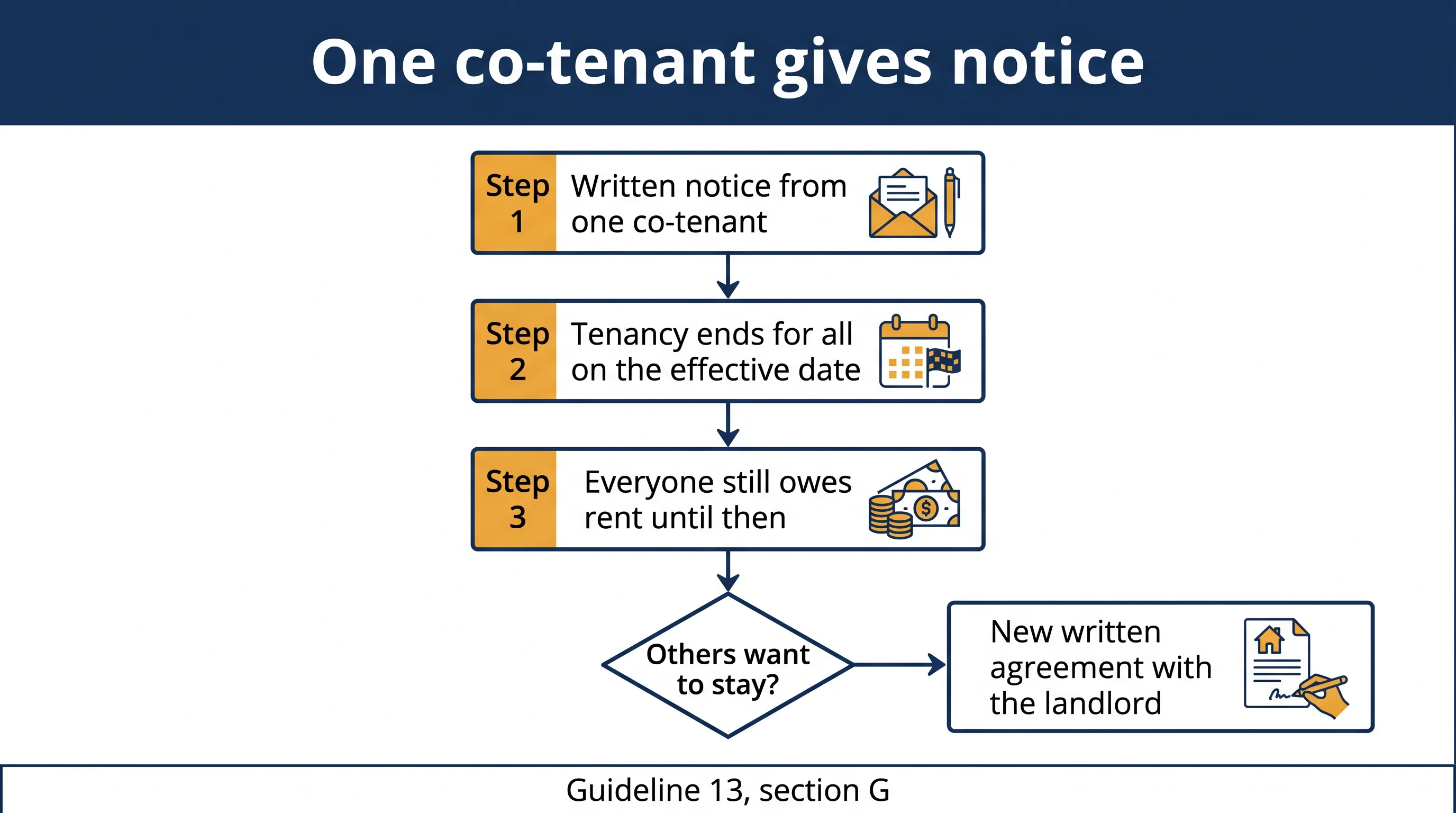
In BC, a proper written notice from one co-tenant ends the tenancy for all of them, even if the others did not sign it (Guideline 13, section G). Everyone on the agreement stays responsible for the rent and the unit until the notice's effective date.
Guideline 13 works through the common situations:
- One co-tenant gives notice and leaves early. The tenancy still ends on the notice's effective date, and the one who left still owes the final month's rent with the others.
- The others want to stay. They need a new written tenancy agreement with the landlord. If a remaining tenant keeps paying rent after the effective date, the landlord and that tenant may have implicitly made a new agreement, and the person who moved out is not responsible for it.
- One co-tenant leaves without giving notice. The original agreement stays in full effect. The person who left remains liable until the tenancy ends, whether or not they still live there.
Deposits follow the agreement, not the person who paid them. Under Guideline 13, section H, any tenant named on the agreement may agree in writing to let the landlord keep part of the deposit, and the landlord may return the deposit and interest to any named tenant. The RTB's moving-out page adds that a roommate on the agreement who leaves will not get their deposit back until everyone moves out and the inspection is done. For the 15-day return rule, see The 15-Day Rule: Returning a Deposit at the End of a BC Tenancy.
When is a roommate an occupant instead of a tenant?
In BC, a person the tenant lets move in, without the landlord adding them to the agreement, is an occupant. Guideline 13, section J, says an occupant has no rights or obligations under the tenancy agreement, and the tenant on the agreement is responsible for the actions or neglect of anyone they permit on the property.
This is also why a roommate is not a sublet. Guideline 19 explains that a sublet under the RTA happens only when the original tenant moves out and transfers their rights to a subtenant. If the tenant stays and rents a room to someone, that person is an occupant or roommate, not a subtenant, and a notice for "subletting without consent" is unlikely to hold. For the consent rules, see the RTB's subletting page and What You Can and Can't Add to a BC Tenancy Agreement.
Can you limit occupants?
Yes, within limits. Guideline 19 says terms restricting the number of occupants, or requiring the landlord's consent before someone moves in, are not standard terms but may be added. Guideline 13 adds that where the agreement has no such clause, it is implied that the tenant may have additional occupants. Any added term must be clear and not unconscionable to be enforceable (RTA s.6(3)).
- Rent that varies with occupants. The agreement may say the rent varies with the number of occupants and by how much (RTA s.13(2)(f)(iv)). Such an increase is not a "rent increase" under Part 3 (s.40), but the rent cannot go up because a child is added, or because a child who was an occupant turns 19 (s.22.1).
- Too many people. An unreasonable number of occupants is a cause for a One Month Notice (s.47(1)(c)), and standard term 9(3) says the landlord may discuss it with the tenant first.
Guests are not occupants
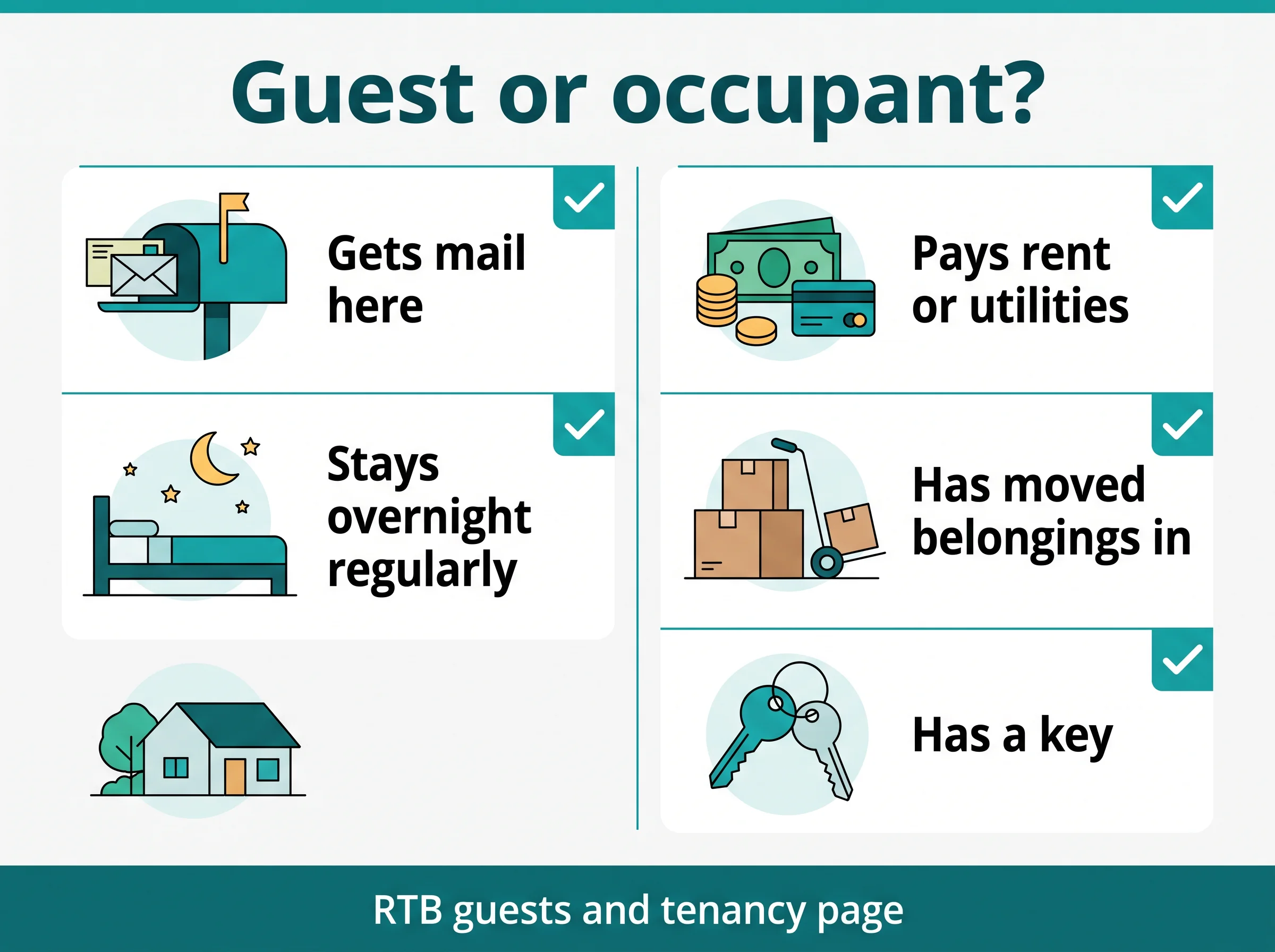
The standard terms say you must not stop a tenant having guests under reasonable circumstances, impose restrictions on guests, or charge for daytime or overnight guests (standard term 9). Regulation s.5(1) bans guest fees outright. The RTB's guests page lists signs that a guest has become an occupant: receiving mail at the address, paying rent or utilities, staying overnight regularly, moving in belongings, and having a key.
How should a BC landlord set this up in the tenancy agreement?
The safest setup in BC is the one the paperwork proves. Arbitrators look at the agreement, the rent receipts and the deposits to decide who is a co-tenant (Guideline 13, section I), so make them consistent from day one.
- Choose one agreement or several. One agreement for a household gives you joint liability. Separate agreements per room give each person their own tenancy, their own deposit and their own notice.
- Name every tenant. List every adult tenant on the agreement and give each a copy within 21 days (RTA s.13(3)).
- Write any occupant terms clearly. A maximum number of occupants, a consent requirement, or rent that varies with the number of occupants must be spelled out to be enforceable (s.6(3), s.13(2)(f)(iv)).
- Receipt the rent the way you want it read. Separate receipts and separate deposits suggest separate tenancies. One receipt for the full amount suggests co-tenants.
- Handle a change in writing. When someone leaves or joins, sign a new agreement or a written amendment, so nobody can argue a new tenancy was created by conduct.
Also check the tenancy is covered by the RTA at all. If the tenant shares a kitchen or bathroom with the owner, the Act does not apply (RTA s.4(c)); see Shared Accommodation in BC: When the RTA Doesn't Apply.
Frequently asked questions
Can I collect the full rent from just one co-tenant in BC?
Yes. Guideline 13 says co-tenants are jointly and severally responsible for rent, utilities and damage, so the landlord can recover the full amount from all of them or from any one of them. The co-tenants then divide it among themselves.
Does a BC tenancy end if one roommate gives notice?
If the roommate is a co-tenant on the agreement, yes. A proper written notice from one co-tenant ends the tenancy for all co-tenants on its effective date, and anyone who wants to stay needs a new agreement with the landlord (Guideline 13, section G).
Does a roommate who is not on the lease have rights under the RTA?
No. A person a tenant allows to move in is an occupant with no rights or obligations under the tenancy agreement, and the RTB cannot hear their dispute with the landlord (Guidelines 13 and 19). The landlord and tenant can add them as a tenant by amending the agreement.
Can a BC landlord charge more rent for an extra person?
Only if the agreement already says the rent varies with the number of occupants and by how much (RTA s.13(2)(f)(iv)). Even then, the rent cannot rise for adding a minor, or for a minor occupant who comes of age (s.22.1).
Who gets the deposit back when co-tenants split up?
The deposit belongs to the tenancy, not to whoever paid it. The landlord may return it, with interest, to any tenant named on the agreement (Guideline 13, section H), usually after the whole tenancy ends and the move-out inspection is done.
BC Co-Tenant and Occupant Checklist
Set up a shared BC tenancy so the paperwork matches who really lives there: co-tenants, separate tenants and occupants.
Get Free PDF →Conclusion
Most co-tenant disputes in BC come from paperwork that does not match reality. Decide whether each person is a co-tenant, a separate tenant or an occupant, write it into the agreement, and keep receipts and deposits consistent with that choice. When the household changes, put the change in writing.
Name every tenant on a BC tenancy agreement
Tenon10 creates the BC tenancy agreement with the standard terms, and runs the move-in and move-out inspection reports for each tenancy.
Free BC form • Built for Canadian landlords