Every BC rental property management brokerage runs the same monthly test: does the money in the trust account match what the brokerage owes each owner, to the cent? When it does, the reconciliation takes an hour. When it does not, someone spends week five hunting a missing deposit or an owner who was paid twice.
The test is set by the Real Estate Services Rules, and BCFSA audits against it. This guide explains what a compliant trust ledger has to show, walks through a reconciled month with two owners, sets out a routine for running ledgers across a portfolio, and shows which parts Tenon10 keeps for you and which stay your own monthly routine.
BC Trust Ledger Monthly Checklist
A month-end checklist for BC rental property managers: per-owner trust ledgers, no negative balances, bank and trust liability reconciliations and the managing broker's review within 5 weeks.
Get Free PDF →What a BC trust ledger has to show

Under the Real Estate Services Act, a brokerage must keep one or more interest-bearing trust accounts with savings institutions in BC, designated as trust accounts both in its records and the institution's (s.26), and must promptly pay money held for a principal into a trust account (s.27).
The Real Estate Services Rules then set the records:
- An account record of every amount received and disbursed, the reason, and the unexpended balance (s.80(b)).
- A separate trust ledger for each principal for money held in a pooled account for rental property management (s.81(a)(ii)). For a rental manager, the principal is usually the owner.
- A monthly bank reconciliation, done no later than 5 weeks after month-end (s.80(c)).
- A monthly trust liability and asset reconciliation listing each person you hold money for and the amount, and reconciling the trust account to the ledger balances, also within 5 weeks (s.81(b)).
- A managing broker's review: each reconciliation reviewed, dated and initialled by a related managing broker or a designate (s.72(2)).
- No negative ledgers: no payment that would take a ledger below zero, or from one already negative. If a negative balance arises, take immediate steps to fix it, and notify the superintendent within 10 days unless it is eliminated in that time, or immediately if it may lead to a compensable loss (s.73).
Tenants' deposits
A manager must also keep a record of each tenant's security, pet damage and other deposits (s.87(2)). BCFSA's trust account guidelines explain that interest on an account held under the Residential Tenancy Act, where the interest is to be paid to a tenant, is not held for the Real Estate Foundation, and pass on the Foundation's strong recommendation to keep a separate pooled trust account for security and pet deposits only. The guidelines also say bank service fees must not come out of a pooled trust account.
A worked month: two owners, one pooled account
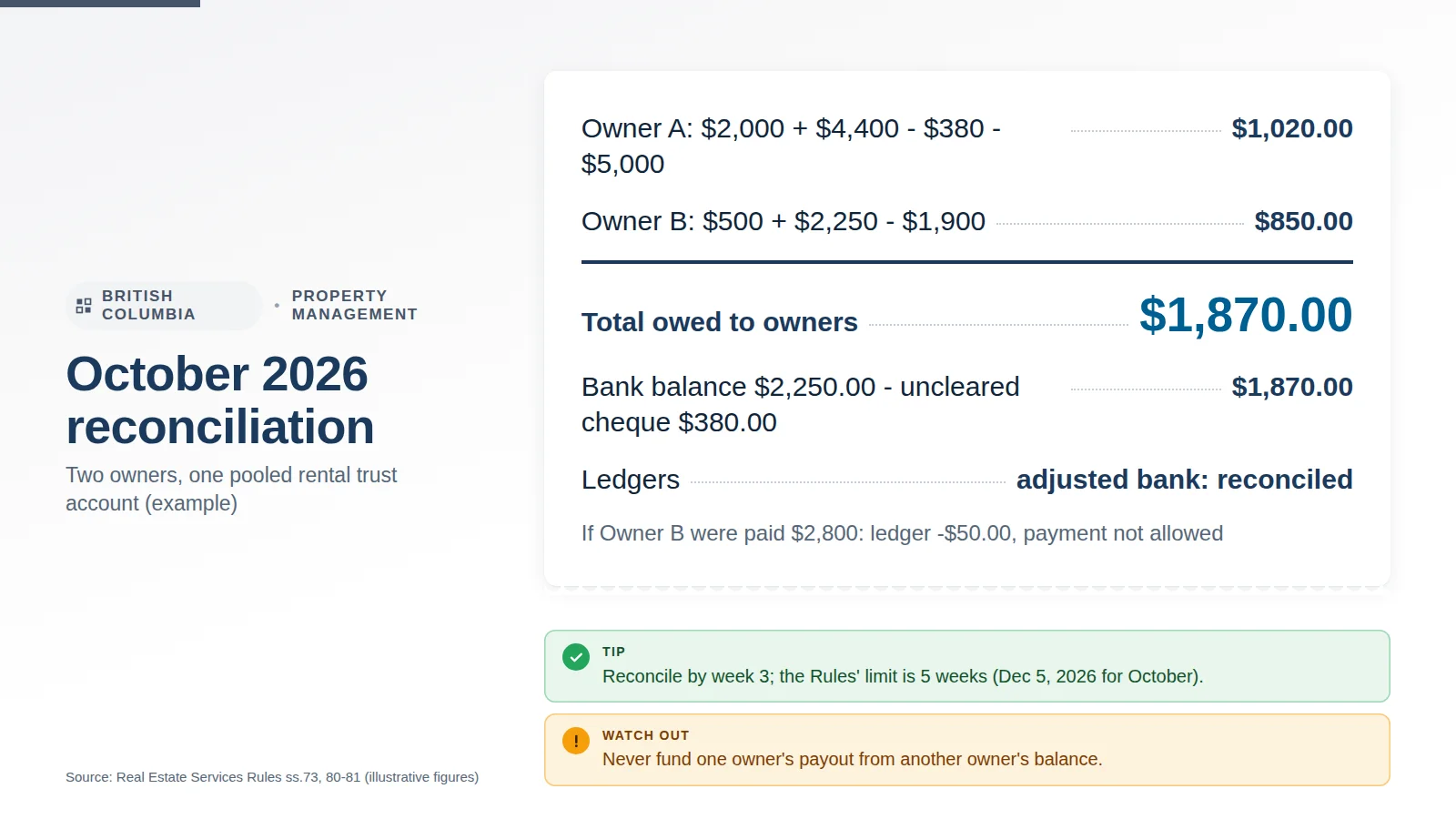
A brokerage manages for two owners from one pooled rental trust account. Tenants' deposits sit in a separate deposit trust account, as BCFSA's guidelines recommend. Here is October 2026.
| Ledger | Owner A | Owner B |
|---|---|---|
| Opening balance, Oct 1 | $2,000.00 | $500.00 |
| Rent received | +$4,400.00 | +$2,250.00 |
| Plumber, cheque issued Oct 28 | −$380.00 | - |
| Payout to owner | −$5,000.00 | −$1,900.00 |
| Closing balance, Oct 31 | $1,020.00 | $850.00 |
Total owed to owners: $1,870.00.
The reconciliation
- Bank statement balance, October 31: $2,250.00
- Less the plumber's cheque, issued but not yet cleared: −$380.00
- Adjusted bank balance: $1,870.00
- Total of owner ledgers: $1,870.00. They agree.
Now suppose Owner B had asked for a $2,800 payout. Owner B's ledger would have gone to −$50.00, funded in effect by Owner A's money. Section 73 prohibits that payment. The fix is to pay $2,750 or less, not to "borrow" from the pool.
Common mistakes
- Reconciling the bank but not the ledgers. The Rules require both reconciliations every month.
- Letting the 5-week deadline slide. October 2026 must be reconciled by December 5, 2026.
- Skipping the broker's initials. An unreviewed reconciliation is incomplete under s.72(2).
- Holding tenants' deposits in the operating pool, which mixes interest owed to tenants with other trust money.
- Paying bank fees from the pooled trust account. BCFSA says they belong in the brokerage's operating account.
- Unlabelled banking documents. Cheques, statements and deposit slips for a trust account must show it is a trust account (s.72(3)).
Running ledgers across a portfolio
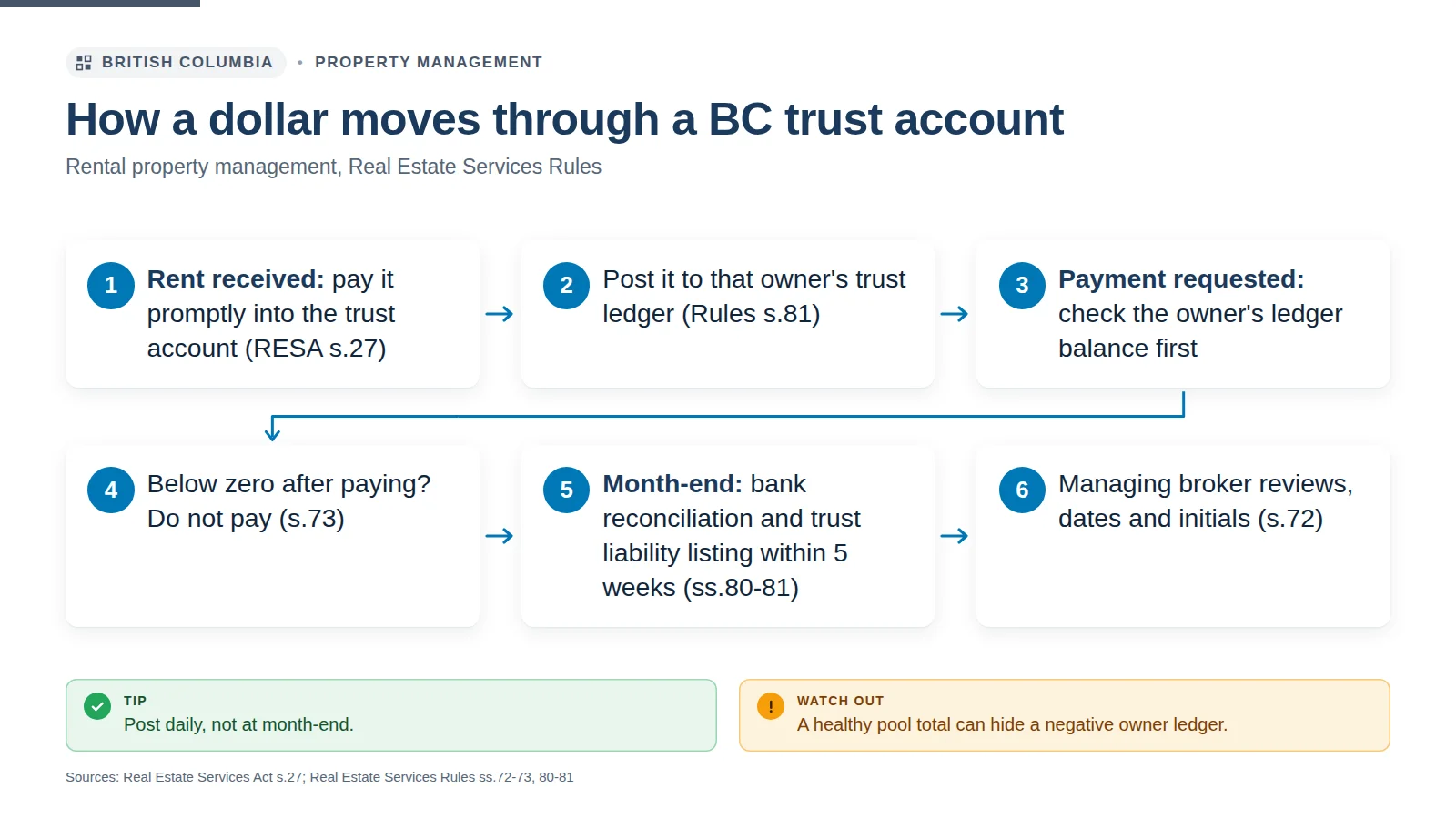
With 40 owners, the same rules become a monthly calendar:
| When | Task |
|---|---|
| Daily | Post receipts and disbursements to owner ledgers; check balances before paying |
| Month-end | Cut off, and download bank statements for each trust account |
| By week 2 | Bank reconciliation and trust liability listing for each account |
| By week 3 | Managing broker reviews, dates and initials |
| No later than 5 weeks after month-end | Both reconciliations complete, as the Rules require |
| Within 120 days of fiscal year-end | File financial statements, accountant's report and activity report (s.75) |
Taking on a new owner
Open the owner's ledger before the first dollar arrives. If you take over from another brokerage, the owner can ask the former brokerage to send its trust records, tenant list and deposit records to you, and the Rules require it to do so by the later of 2 weeks after the request or 4 weeks after its services end (s.87(3)-(4)). Use them to set the opening ledger balance and the deposit record, then confirm the money actually received into your trust account matches before you pay anything out.
Keep everything for at least 7 years (s.92). When an owner leaves, the same rule applies to you in reverse.
How Tenon10 helps
Property managers on the PM plan get a ledger for each owner, owner statements, and a check that stops an owner payout larger than that owner's balance. In the worked month above, that check is what would stop Owner B's $2,800 payout before it is made. Deposit tracking follows each deposit against the 15-day return clock at the end of a tenancy. See pricing for the PM plan.
The monthly bank reconciliation, the trust liability listing and the managing broker's review stay your own routine: work from your trust bank statements and the owner balances, and finish within the 5-week limit.
FAQ
Does every owner need a separate bank account?
Not for rental management. A pooled trust account is allowed, but each owner needs a separate trust ledger. Strata management has its own rules requiring separate accounts per strata corporation.
What if a ledger goes negative by mistake?
Take immediate steps to eliminate it. Notify the superintendent within 10 days if it is not eliminated in that time, or immediately if a managing broker thinks it may lead to a compensable loss.
Who can sign trust cheques?
At least one related managing broker must be a signing authority on each trust account (s.72(1)).
Where does deposit interest go?
Where interest on an account held under the Residential Tenancy Act is to be paid to a tenant, it is not held for the Real Estate Foundation. That is why BCFSA's guidelines recommend a separate pooled account for security and pet deposits only.
BC Trust Ledger Monthly Checklist
A month-end checklist for BC rental property managers: per-owner trust ledgers, no negative balances, bank and trust liability reconciliations and the managing broker's review within 5 weeks.
Get Free PDF →Keep owner ledgers that tie out
On the PM plan, Tenon10 keeps a ledger and statements for each owner, and stops a payout larger than that owner's balance.
Built for Canadian landlords and property managers.
Related BC guides
- BC Security and Pet Damage Deposits: The Complete Landlord Guide
- When a BC Landlord Must Pay Back Double the Deposit
Sources: Real Estate Services Act; Real Estate Services Rules; BCFSA: Trust Accounts Guidelines; Residential Tenancy Act. This article is a summary of British Columbia rules as of October 2026, not legal advice. Check the Residential Tenancy Branch for your situation.