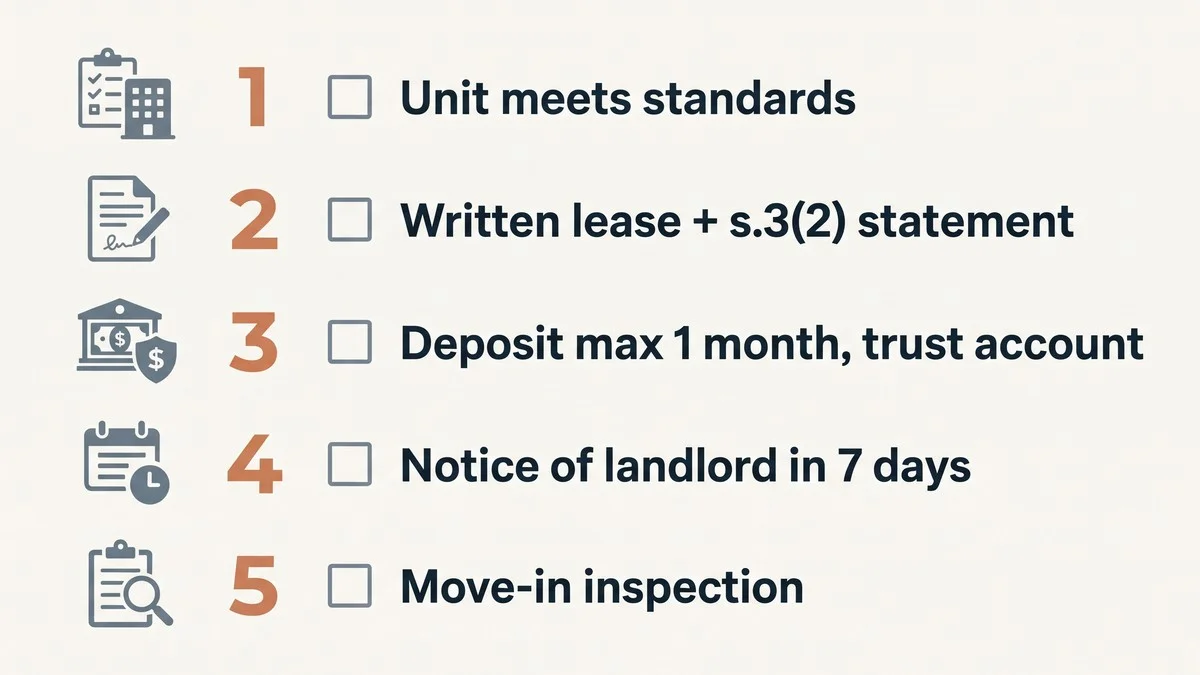
Before you rent out an Alberta property, set up five things: a written lease with the Residential Tenancies Act statement, a deposit plan capped at one month's rent with a trust account, a notice of landlord, move-in inspection paperwork, and a unit that meets the Minimum Housing and Health Standards. This Alberta landlord checklist puts them in order for anyone becoming a landlord.
The Alberta landlord guide explains every rule in depth. This page is the short version: what to have ready, in the order you will need it, with the section of the Residential Tenancies Act (RTA) behind each item.
What should the unit meet before an Alberta tenant moves in?
The unit must meet at least the minimum standards for housing under the Public Health Act, because the RTA makes that a covenant in every tenancy (s.16(c)). The Minimum Housing and Health Standards set the details.
- Heating that can keep habitable rooms at 22 °C or more (Standards, s.8).
- Hot water at the tap between 46 °C and 60 °C (s.9(a)).
- Working electrical service, outlets and fixtures (s.11).
- Smoke alarms in place and working: see smoke alarm rules for Alberta rentals.
- In Calgary, check whether a secondary suite needs to be on the city's registry: see the Calgary secondary suite registry.
What goes in an Alberta lease?
An Alberta lease can be oral, but a written one must carry the statement that the RTA governs and prevails, printed larger than the rest of the agreement (s.3(2)). Any clause that waives a tenant's rights under the Act is void (s.3(1)).
- Names of all parties and of everyone permitted to live there.
- The term (fixed or periodic) and the rent: amount, due date and how it is paid.
- Who pays utilities, and what furniture, appliances and parking are included.
- Deposit amount, interest, and what may be deducted at the end.
- Repair and maintenance duties, insurance requirements, and rules on fees, guests and pets.
That list is the Government of Alberta's own, from its Starting a tenancy page. More detail: what an Alberta lease must contain.
How should an Alberta landlord handle the security deposit?
An Alberta security deposit cannot exceed one month's rent and cannot be increased later (RTA s.43). Money deposits go into an interest-bearing trust account at a bank, treasury branch, credit union or trust corporation in Alberta within 2 banking days (s.44(1)), and only deposit money may sit in that account (s.44(3)).
- Open the trust account before the first deposit arrives.
- Keep a record per tenant of the date and amount received.
- Note the interest rate: the minimum is 0.0% for 2026 on the province's chart.
See Alberta security deposits for the return rules.
What paperwork is due at move-in?
| Item | Deadline | Section |
|---|---|---|
| Move-in inspection with the tenant, and the report given to them | Within one week before or after the tenant takes possession | RTA s.19(1) |
| Copy of the signed lease to the tenant | Within 21 days after the tenant returns it signed | s.17(1) |
| Notice of landlord (name, postal address and physical location in Canada) | Within 7 days after the tenant takes possession | s.18(2) |
A tenant may withhold rent until the signed copy of the lease is served (s.17(2)), so the 21-day deadline matters. The inspection report must contain the statements set out in the Ministerial Regulation (AR 211/2004, s.4); see inspection report rules.
What records should an Alberta landlord keep?
Keep inspection reports and security deposit records for at least 3 years after the tenancy ends (RTA s.19(6); s.44(5) and the RTA Handbook). For tax, the Canada Revenue Agency's rental income guide (T4036) explains reporting on Form T776 and says records generally must be kept for six years from the end of the tax year they relate to.
Frequently asked questions
Does Alberta have a standard lease form?
No. The forms in the schedule to the Ministerial Regulation (AR 211/2004) are notices, not a lease, so a landlord writes or chooses one. It must include the section 3(2) statement and cannot take away rights the Act gives.
Can I ask for first and last month's rent plus a deposit?
Be careful: the Act treats any money held as security for the tenant's obligations as a security deposit, whatever it is called (s.1(1)(n)), and the deposit is capped at one month's rent (s.43). Label each payment clearly in the lease so it is plain what is rent and what is security.
Do I have to do the move-in inspection with the tenant?
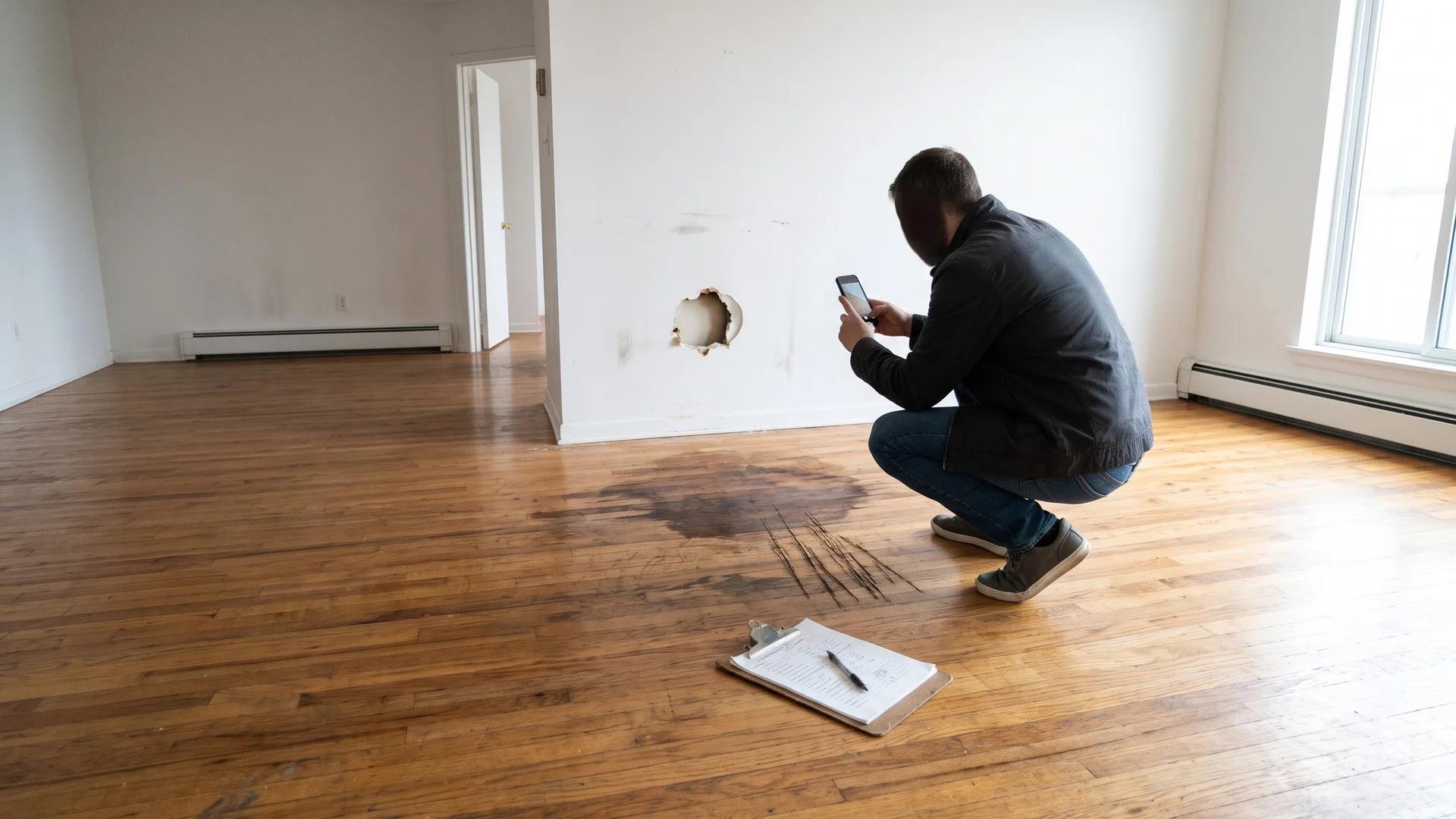
Yes, the landlord and tenant inspect together (s.19(1)). The landlord can complete it alone only after proposing two times on different days, not on holidays and between 8 a.m. and 8 p.m., and no tenant agrees to take part (s.19(3)).
What is the notice of landlord?
A written, dated and signed notice naming the landlord with a postal address and physical location in Canada (s.18(1)). In a building with common areas it can be posted in a conspicuous place there instead (s.18(3)).
Ready to write the lease?
Fill out an Alberta residential tenancy agreement online, with the content the Government of Alberta lists, and download the PDF.
Free • No signup required