Filing the wrong LTB application can cost an Ontario landlord months: the application is dismissed, the right notice has to be served, and the wait for a hearing starts again while any arrears keep growing. L1 and L2 applications sound similar, cost the same filing fee ($186 through the Tribunals Ontario Portal, $201 otherwise), and both end at the same administrative tribunal. But the rules governing when and how to file them are completely different, and one of the most common reasons tenancy cases get dismissed at the LTB is a landlord filing the wrong form.
The distinction between L1 and L2 is among the most confusing aspects of Ontario tenancy law for self-managing landlords, property managers handling their first LTB matter, and tenants trying to understand what they've just been served with. The names suggest they're closely related; the procedural rules suggest otherwise.
This guide walks through the L1/L2 distinction in practical, side-by-side terms — which notices feed which application, filing deadlines that catch landlords off guard, documentation requirements that differ in important ways, hearing dynamics that play out very differently in each application, and what happens in combo cases where a tenancy has both payment and non-payment issues. Tri-audience throughout: landlord filing, property manager filing on behalf of a client, and tenant receiving notice.
The L1 vs L2 Quick Reference Guide for Ontario Landlords, Property Managers, and Tenants
Confused about L1 vs L2 LTB applications in Ontario? This free quick-reference guide lays out the key differences, filing deadlines, and what each audience — landlord, PM, or tenant — should do at every stage.
Get Free PDF →The landscape: why this distinction matters
L1 and L2 are the two most common landlord applications at Ontario's Landlord and Tenant Board. Both ask the LTB to order an eviction or end a tenancy. Both come after an N-series notice to the tenant. Both cost $186 to file through the Tribunals Ontario Portal, or $201 by other filing methods. Both go to the same tribunal. The similarities end there.
- L1 = Application to Evict a Tenant for Non-payment of Rent and to Collect Rent the Tenant Owes. Used exclusively when the issue is rent not being paid.
- L2 = Application to End a Tenancy and Evict a Tenant or Collect Money. Used for every other ground.
Why the stakes are high for getting this right
Waits for an LTB hearing vary by application type and region; Tribunals Ontario publishes its current figures in the LTB's "Average Days to Hearing and Order" report. On an L1, every month of waiting can be another month of unpaid rent. Filing the wrong application means dismissal, restart, and more months of delay. A defective underlying notice (N4, N5, N12, etc.) means the application cannot succeed at all — a mistake often discovered only when the hearing finally happens.

Why each audience needs to understand this
- Landlords filing directly need to match the application to the notice they served, file within the correct window, and show up with the right documentation. Most first-time L1/L2 filers find the process confusing because the form names are similar and the official Tribunals Ontario instructions don't explain the distinction in plain language.
- Property managers filing on behalf of clients bear operational responsibility — the client's lost months fall on the PM's performance record. PM differentiation often comes down to documentation discipline.
- Tenants receiving notice need to understand what kind of application has been filed against them, what defences are available, and in the specific case of L1, what the void-payment rule allows.
The notice map: which notice leads to which application
The practical test is simple: if the tenancy issue is about rent not being paid, it's L1. Everything else is L2. The exceptions are combination cases with more than one issue — covered in the next section.
The full notice-to-application map
- N4 (non-payment of rent) → L1
- N5 (interference, damage, overcrowding) → L2
- N6 (illegal acts, misrepresentation in rent-geared-to-income) → L2
- N7 (serious impairment of safety, wilfully caused undue damage, substantial interference with a landlord who lives in a building of three units or fewer) → L2
- N8 (end of term, persistent late payment, subsidized housing issues) → L2
- N12 (landlord, family, or purchaser own-use) → L2
- N13 (demolition, major repairs, conversion) → L2
The confusing middle ground: persistent late payment
One of the most misunderstood scenarios: a tenant pays rent but consistently 7-14 days late over many months. The landlord's instinct is often to file L1 because the issue feels like non-payment. It isn't. Persistent late payment is a separate ground that requires an N8 notice (not N4) and an L2 application (not L1). Filing L1 on a persistent lateness pattern leads to dismissal — the tenant isn't currently in arrears, and current arrears are what L1 requires.
The void-payment rule that makes L1 unique
For L1 cases specifically, if a tenant pays all the arrears, the rent that has come due since, and the landlord's filing fee before the LTB issues the eviction order, the application is discontinued and the tenancy continues (RTA s. 74(2)). Even after an eviction order issues, paying the amount set out in it before it becomes enforceable voids the order (s. 74(4)). This rule is in the RTA and is intentionally a tenant protection — designed for tenants who can remedy the arrears but needed the pressure of the process to do so.
- From the landlord side: expect this as a possible outcome. It's not a loss; the tenancy simply continues with arrears caught up.
- From the tenant side: if you can pay arrears + filing fee before the hearing, your tenancy is preserved.
- From the PM side: advise clients to think of L1 as a payment-enforcement mechanism first, an eviction mechanism second.
L2 does not have a void-payment equivalent. L2 cases that proceed to hearing are contested on their substantive merits.

Filing deadlines and documentation
The procedural differences between L1 and L2 are most consequential at two points: when you file, and what you bring.
The deadline difference that costs landlords months
- L1: no filing deadline. The 30-day limit does not apply to an application based on non-payment of rent (RTA s. 69(3)). The only timing rule is that the L1 can't be filed before the day after the termination date on the N4 (s. 74(1)). Until the day you file, the tenant can still void the N4 by paying the arrears and any rent that has since come due (s. 59(3)).
- L2: 30-day window. The landlord must file L2 within 30 days of the termination date on the underlying notice. Miss the 30 days, and the LTB will not accept an L2 based on that notice. A new notice must be served, with the termination clock restarting from zero.
This is the single most consequential procedural difference between L1 and L2. The 30-day L2 window catches first-time landlords off guard — they assume they have time, and by the time they look up the rule, the notice has expired. A landlord who serves an N5 in March and decides to "wait and see" through April typically discovers in May that they need to start again.
L1 documentation checklist
What the landlord must bring to (or file with) an L1:
- Copy of the N4 notice served, properly dated and naming the correct parties
- Certificate of Service proving how and when the N4 was served
- Rent ledger showing every payment received, every payment missed, dates and amounts
- Copy of the current lease, confirming the rent amount on which arrears are calculated
- Any additional evidence of payment or non-payment, correspondence, bounced cheques
L2 documentation — varies by underlying notice
The L2 documentation burden is higher and varies by the ground:
- N5 damage or interference: photos, witness statements from neighbours, police reports if applicable, repair estimates
- N6 illegal acts: police reports, conviction records where applicable
- N7 serious impairment: inspection reports, photos, expert testimony
- N12 own-use: the sworn affidavit (or LTB declaration) of the person who personally requires the unit, filed with the L2 — on a landlord's own-use N12 it certifies a good-faith intent to occupy for at least one year; on a purchaser's N12 it certifies a good-faith requirement for their own personal use — plus evidence of the family relationship, supporting documents (employment, current residence)
- N13 demolition or repairs: permits, contractor statements, architectural drawings, scope of work
- N8 persistent late payment: rent ledger showing payment dates. Since September 21, 2026, rent paid more than 7 days late on at least three occasions in any six-month period counts as persistent late payment (O. Reg. 516/06, s. 8.1), though other patterns can also qualify
- In all cases: the underlying notice itself, Certificate of Service, and current lease
The combo case: non-payment AND another ground
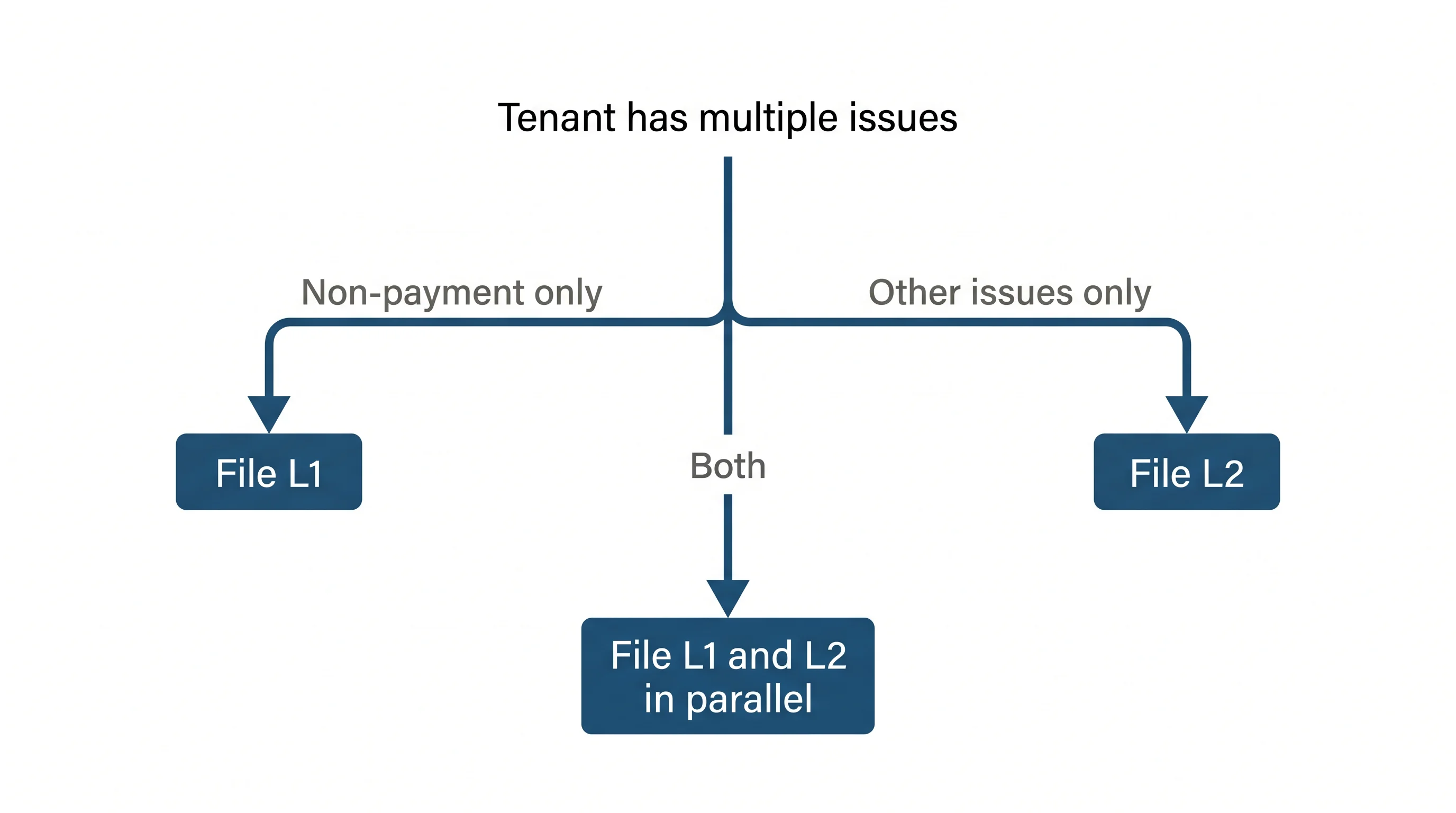
One of the most common real-world scenarios: a tenancy has both arrears AND damage, or arrears AND interference. The LTB's Interpretation Guideline 10 allows two routes. A landlord who has served two different notices (say, an N4 for the arrears and an N5 for the damage) may file a single application for eviction based on both notices, as long as it is filed within the deadline that applies to each notice. Or the landlord may file a separate application for each.
- Two correct approaches: one combined application that relies on both notices, filed within the 30-day L2 deadline; or two parallel applications, L1 for non-payment and L2 for the other ground, each with its own filing fee. Either way, each notice must be valid and properly served on its own. Be careful about serving a voidable and a non-voidable notice for the same conduct: the test is whether a reasonable tenant would be confused by the notices, not whether this tenant actually was, and where they would be, the LTB can find all the notices defective and dismiss the application (LTB Interpretation Guideline 10).
- Strategic consideration: If arrears are large and damage is small, many landlords file L1 only and address damage through tenant insurance claim or final settlement. If both are significant, both applications may be worth pursuing.
Hearing dynamics: what actually happens
The hearing experience differs substantially between L1 and L2 — different questions, different evidence, different outcomes.
L1 hearings: documentary and procedural
An L1 hearing is typically the most mechanical of LTB proceedings. The adjudicator focuses on three questions:
- Was the N4 valid and properly served?
- Was rent actually owed on the termination date?
- How much is owed now?
A well-prepared landlord with a clean rent ledger, proper N4, and filed Certificate of Service often gets an order on the day of the hearing. The three most common outcomes:
- Eviction order plus arrears order. The tenant has not paid; the adjudicator orders termination and the outstanding balance.
- Consent payment plan. Many L1 cases resolve with the tenant agreeing to a structured payment plan to pay off the arrears over time. Eviction is suspended as long as payments are made.
- Void by payment. The tenant pays the arrears, rent since come due and the filing fee before the eviction order issues; the application is discontinued.
L2 hearings: adjudicative and evidentiary
L2 hearings are more substantive. The adjudicator must evaluate whether the underlying allegation is substantiated — a legal and factual judgment, not a mathematical one. This means:
- More witness testimony (neighbours for interference cases, intended occupants for N12 cases, contractors for N13 cases)
- More documentary exhibits and photographs
- More back-and-forth between parties and the adjudicator
- Substantive tenant defences — challenging whether interference actually occurred, challenging whether an N12 is in bad faith
- Less predictable outcomes; the landlord needs strong, organized evidence
At an N12 hearing the landlord must prove, on a balance of probabilities, that the intended occupant genuinely intends to move in (for at least one year on a landlord's own-use N12) and will do so within a reasonable time, and the Board may consider the landlord's previous N12 and N13 notices (RTA s. 72(3); LTB Interpretation Guideline 12). Weak N12 cases can lose at hearing — and even when the landlord wins, the former tenant can file a T5 bad-faith application up to one year after moving out (s. 57(2)). On a landlord's own-use N12, advertising, re-renting or selling the unit at any time from the day the notice is given until one year after the tenant vacates is presumed to be bad faith (s. 57(5)–(6)). For the full N12 picture, see Ontario N12 Notices: A Complete Guide to Own-Use Tenancy Endings.
What each audience should prepare for
- Landlord. Plan to present, not just hand over documents. Be prepared to answer questions about service methods, rent collection patterns, and any prior correspondence with the tenant.
- Tenant. Attend the hearing. Not attending almost always means a default order against you. Low-income tenants can get legal help from Ontario's community legal clinics, which are funded by Legal Aid Ontario — use it. Bring evidence of any defence, including payment records, photos, or witness statements.
- Property manager. Represent or accompany the landlord per your agreement. Ensure the file is complete before the hearing — adjudicators are not sympathetic to missing certificates of service or incomplete ledgers.
How different situations play out
Five real-world scenarios that show how the L1/L2 distinction translates into actual cases:
Scenario A: Classic L1 with clean documentation
Mississauga condo, $2,400/month. Tenant misses October 1, 2026 rent. Landlord serves N4 on October 2 with a termination date of October 9 (the 7-day period that applies to N4s given on or after September 21, 2026), then files L1 on October 10 with complete documentation. Before the hearing, the tenant pays the full arrears, the rent that has come due since, and the landlord's filing fee. The L1 is discontinued and the tenancy continues with the arrears caught up. The landlord has spent months waiting and has been repaid the filing fee, and is no worse off financially.
Scenario B: L2 for damage with proper evidence
Toronto apartment, $2,200/month. Tenant causes significant damage. Landlord serves first N5 (damage notice) March 1, 2026. Tenant does not remedy within 7 days. N5 termination date is March 21. Landlord files L2 on March 22 — safely within the 30-day window — with photographs, repair estimates, and neighbour witness statements. At the hearing, the adjudicator finds the tenant responsible, orders eviction plus damages.
Scenario C: Combo case done right
Hamilton apartment, $1,900/month. Tenant has $5,700 in arrears AND has caused approximately $3,000 in damage. Landlord files L1 for the arrears and L2 for the damage as two parallel applications. Two filing fees ($372 if both are filed through the Tribunals Ontario Portal). Both hearings end up consolidated into one calendar date in November 2026. Adjudicator grants eviction and orders the tenant to pay both arrears and damages.
Scenario D: The wrong-application mistake
Waterloo apartment, $1,500/month. Landlord wants to end the tenancy because the unit is being sold to a buyer who will occupy. Landlord confuses herself by serving an N4 (non-payment notice) despite rent being paid, then filing L1. At hearing, the adjudicator dismisses the application — there's no non-payment. Landlord must start over with a properly drafted N12 and a later L2 filing. Months of unnecessary wait and a wasted filing fee.
Scenario E: Persistent lateness mistaken for non-payment
Toronto apartment, $2,000/month. Tenant pays every month but consistently 10-14 days late. Landlord serves N4s monthly for 8 months and tries to file L1 for the pattern. L1 is dismissed because the tenant is current on rent. Correct path: serve an N8 notice (persistent late payment) with a termination date at least 60 days away that falls on the last day of a rental period (RTA s. 58(2) and s. 44), then file L2 no later than 30 days after that termination date.
Practical takeaways
Before you file — the decision checklist:
- What ground am I relying on? Non-payment → L1. Anything else → L2.
- Did I serve the correct underlying notice (N4 for L1; N5/N6/N7/N8/N12/N13 for L2)?
- Is the underlying notice valid and properly served, with Certificate of Service filed?
- Am I within the filing window? L1 = no earlier than the day after the N4 termination date, with no outer deadline; L2 = no later than 30 days after the notice's termination date (and, on a first N5, not before its 7-day remedy period ends).
- Do I have the documentation the application type requires?
- For N12 specifically: do I have the sworn affidavit of the person who personally requires the unit, ready to file with the L2? Without it the Board must refuse to accept the application for filing (RTA s. 71.1).
- Am I prepared for the hearing — documents organized, potential witnesses ready, outcomes thought through?
Combo-case reminder: If the tenancy has multiple issues (arrears + damage, arrears + interference), you can file one application based on both notices, as long as it is filed within each notice's deadline, or two parallel applications: L1 for non-payment, L2 for the other ground.
Quick wins:
- Use the official Tribunals Ontario forms for both underlying notices and the L1/L2 applications. The N5, N6, N8, N12, N13, L1 and L2 were replaced on September 21, 2026, and previous versions will not be accepted from November 30, 2026
- File your Certificate of Service immediately after serving any notice
- Keep a clean, up-to-date rent ledger from day one
Longer term:
- Track the filing windows on every notice you serve — 30 days for L2 goes fast
- Build template documents (rent ledger, certificate of service, affidavits) so you're not drafting from scratch under time pressure
- For PM firms: consider software that validates notice-to-application matching and tracks filing deadlines automatically
Calculate notice termination dates accurately: Use the Ontario Termination Date Calculator to compute the correct termination date for any notice — preventing the most common defective-notice mistakes that derail L1 and L2 filings.
The L1 vs L2 Quick Reference Guide for Ontario Landlords, Property Managers, and Tenants
Confused about L1 vs L2 LTB applications in Ontario? This free quick-reference guide lays out the key differences, filing deadlines, and what each audience — landlord, PM, or tenant — should do at every stage.
Get Free PDF →Conclusion
The L1 vs L2 distinction isn't complicated at its core — L1 is for non-payment, L2 is for everything else — but the procedural rules around each application can easily cost a landlord months if misapplied. The 30-day L2 filing window, the different documentation requirements, the void-payment rule unique to L1, the proper matching of notice to application: these are the details that separate landlords who get an order on their first application from landlords who have to start over.
For landlords, the work of a successful L1 or L2 happens before the hearing — in the notice, the ledger, the certificate of service, and the documentation file. For property managers, that same work is the value proposition. For tenants, understanding the application type clarifies what defences are available and what outcomes are realistic.
If you're preparing to file an L1, see How to Use the N4 Notice in Ontario: A Landlord's Complete Guide for the prerequisite steps. If you've received an N4, see Got an N4 Notice? Here's What to Do.
File your L1 or L2 with the right documentation, the first time
Generate compliant LTB notices, calculate termination dates automatically, and track every filing deadline — free to start.
Free • Updated for the Bill 60 changes in force 21 Sep 2026 • Includes Certificate of Service templates
Frequently asked questions
What's the main difference between L1 and L2 applications?
L1 is filed when the issue is non-payment of rent — it follows an N4 notice. L2 is filed for every other ground for eviction, including damage, interference, illegal acts, own-use, and demolition — following the appropriate notice type (N5, N6, N7, N8, N12, or N13). Both cost $186 to file through the Tribunals Ontario Portal, or $201 by other filing methods.
Can I combine L1 and L2 in one application if my tenant has multiple issues?
Yes. The LTB's Interpretation Guideline 10 says a landlord who served two different notices may file a single application for eviction based on both, as long as it is filed by the deadline for each notice. Separate applications (an L1 and an L2) are also allowed, each with its own filing fee.
How long do I have to file an L1 or L2?
There is no deadline for an L1: the 30-day limit doesn't apply to non-payment applications, though you can't file before the day after the N4's termination date. L2 must be filed within 30 days of the termination date on the underlying notice. Miss the L2 window and you have to serve a new notice and start again.
What happens if my tenant pays before the L1 hearing?
For L1 cases, if the tenant pays all arrears, any rent that has come due since, and the landlord's filing fee before the LTB issues the eviction order, the application is discontinued and the tenancy continues. This is a statutory tenant protection in the RTA. From the landlord's perspective, the outcome is neutral — rent is caught up, but the tenancy remains in place.
What if I file the wrong application?
The LTB will dismiss the incorrect application. The landlord must serve the correct underlying notice and file the proper application — effectively starting over. This adds the time it takes to serve a new notice and wait for a new hearing, and in L1 cases arrears keep accumulating.