In Ontario, a lender that takes over a rental property after the landlord defaults on the mortgage cannot simply make the tenants leave. Under Part V of the Mortgages Act, a mortgagee in possession, or a buyer who takes title through power of sale or foreclosure, is deemed to be your landlord, is bound by your tenancy agreement, and can end your tenancy only through the Residential Tenancies Act, 2006 and the Landlord and Tenant Board (LTB).
This guide explains what changes for a tenant when a landlord's mortgage goes into default, who you pay rent to, what the lender can and cannot ask of you, and the one special notice that applies to single family homes. For more renter guides, see the Ontario Tenant Resource Center.
Ontario Power of Sale: Tenant Checklist
A one-page checklist for Ontario tenants whose landlord's mortgage is in default: who to pay, what the lender can ask for, and the 60-day single family home notice.
Get Free PDF →Can a bank evict a tenant after a power of sale in Ontario?
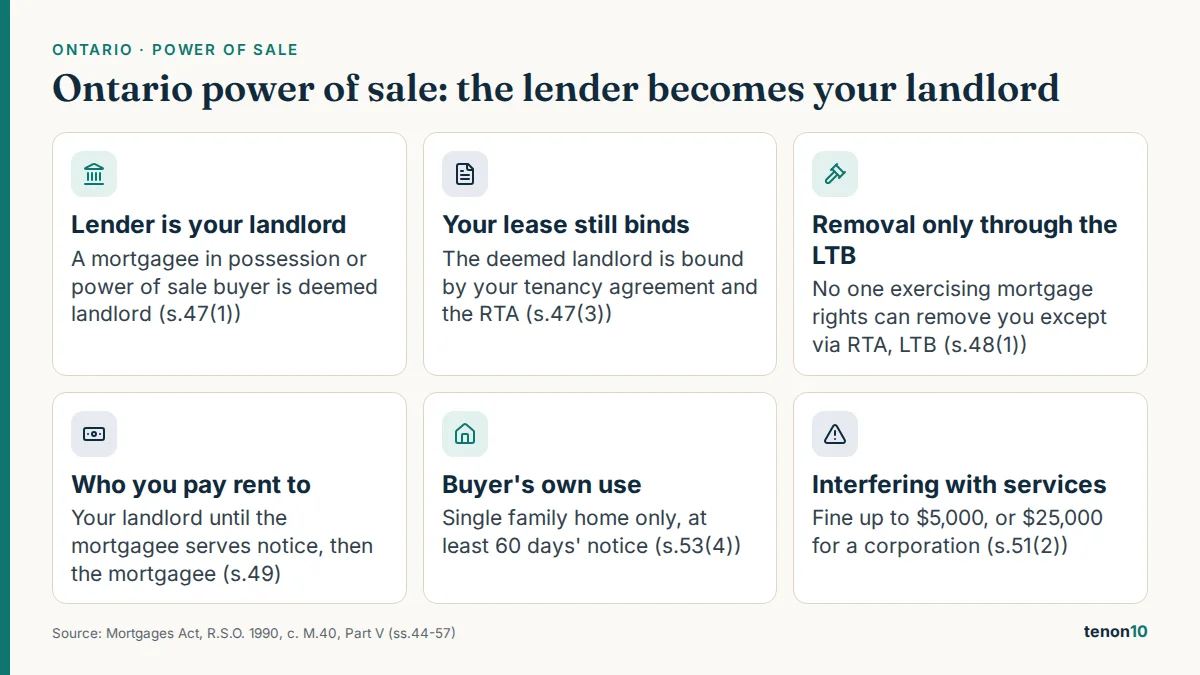
No, not on its own say-so. Section 48(1) of the Mortgages Act says no person exercising rights under a mortgage may obtain possession of a rental unit from the mortgagor's tenant except in accordance with the Residential Tenancies Act, 2006. The lender, a receiver acting for it, and the buyer at a power of sale all have to use the same notices, grounds and LTB process as any other landlord.
Part V of the Mortgages Act applies despite any agreement to the contrary (s.46(2)), it prevails over other provisions and statutes unless they say otherwise (s.46(1)), and it applies whether the mortgage was registered before or after your tenancy agreement was signed (s.46(3)). A clause in your lease that says you must leave if the property is sold or the mortgage goes into default does not override it.
Who becomes my landlord when the lender takes over?

A person who becomes the mortgagee in possession of a rented residential complex, or who obtains title by foreclosure or power of sale, is deemed to be the landlord under your tenancy agreement (Mortgages Act s.47(1)). While that person is your landlord, the original owner stops being your landlord (s.47(2)).
The deemed landlord is subject to your tenancy agreement and to the Residential Tenancies Act, 2006 (s.47(3)). That means your rent, your services, your repair rights and the rules on rent increases carry on. If the lender later stops being a mortgagee in possession, it stops being your landlord, but it stays liable for the landlord obligations it incurred while it was one (s.47(4)-(5)).
A lender that gives a notice of termination is also deemed to be a landlord (s.48(2)), so it takes on the landlord's obligations when it tries to end a tenancy.
The written notice of the change
The new deemed landlord must serve all tenants with a written notice of the change in landlord that gives its name and address (s.47(6)-(7)). Documents under this Part are served the same way as under the Residential Tenancies Act (Mortgages Act s.57, which points to RTA s.191): by hand, to an adult in the unit, in your mailbox or by mail, among other methods.
Who do I pay rent to after a mortgage default?

Keep paying your landlord until a mortgagee serves notice on you. On or after the default, a tenant who in good faith pays rent to a mortgagee that first serves notice on the tenant is released from the obligation to pay that rent to anyone else, unless the mortgagee tells you otherwise or a court orders otherwise (Mortgages Act s.49).
In practice:
- Pay the rent when it is due. A dispute between your landlord and its lender is not a reason to stop paying, and unpaid rent is still a ground for an N4 from whoever is your landlord.
- Once you receive a written notice from the mortgagee, pay the mortgagee as it directs and keep the notice with your rent records.
- If you get conflicting demands, pay the party that served the mortgagee's notice and keep proof. Section 49 protects a tenant who pays in good faith.
- Ask for receipts. Under RTA s.109, a landlord must give a tenant a receipt for any payment free of charge on request.
What can the lender ask a tenant for?
After a default, a mortgagee may enter the common areas of the residential complex to inspect them, and may demand a copy of a written tenancy agreement or the particulars of the tenancy from the owner or from you (Mortgages Act s.50(2)). You must provide the information and documents requested and let the mortgagee into the common areas (s.50(5)). If you do not, the mortgagee can apply to the Superior Court of Justice for an order requiring you to comply (s.50(6)).
Doing these things does not make the lender a mortgagee in possession (s.50(3)), so an inspection or a request for your lease does not by itself mean the lender has become your landlord.
The right to enter covers the common areas only. Entry into your unit still follows the Residential Tenancies Act's notice rules; see the 24-hour notice of entry rule in Ontario.
Can the lender cut services or pressure me to leave?
No. Section 51(1) of the Mortgages Act says no mortgagee, or person acting for it, may deliberately interfere with a reasonable supply of any service such as heat, fuel, electricity, gas, food or water to your unit or the building, whether or not the original owner was the one who had to supply it. Nor may it substantially interfere with your reasonable enjoyment of the unit with the intent of causing you to give up possession or stop asserting your rights.
A breach is an offence, with a fine of up to $5,000 for an individual and $25,000 for a corporation (s.51(2)). The Residential Tenancies Act's own protections still apply as well; see vital services in Ontario and the T2 application for how tenants enforce them.
Can the lender end my tenancy because a buyer wants to move in?
Only for a single family home, and only through a specific notice. Section 53 of the Mortgages Act lets a deemed landlord obtain possession of a single family home on behalf of a purchaser who, on closing, would be entitled to give notice under section 48 of the Residential Tenancies Act (the own-use notice, N12).
What counts as a single family home
For this Part, a single family home is a residential complex with a single dwelling unit, or a primary dwelling unit and not more than two subsidiary dwelling units, that was not subject to a tenancy agreement when the mortgage was registered (s.45(1)). A duplex or triplex is not a single family home (s.45(2)), and the number of units is counted as of the date of the default (s.45(3)).
The conditions on that notice
| Requirement | Mortgages Act |
|---|---|
| A binding agreement of purchase and sale for the home | s.53(2) |
| A written undertaking from the buyer that the buyer requires the home, or the part you occupy, for themselves, their spouse, or a child or parent of theirs or of their spouse | s.53(3) |
| Notice effective at least 60 days after it is given, regardless of any fixed term | s.53(4) |
| A copy of the buyer's undertaking attached to the notice | s.53(5) |
| The notice indicates the mortgagee is acting on behalf of a buyer who requires the home for that occupation | s.53(6) |
| To evict, an application to the LTB for an order under RTA s.69 | s.53(7) |
Even with a valid notice, you do not have to leave on the termination date unless you choose to. If you stay, the deemed landlord or buyer must apply to the LTB, and only an LTB order enforced by the Sheriff can remove you. See after the LTB order: the Sheriff and eviction day.
If the buyer never moves in
If the purchaser does not occupy the home for their own use for a reasonable period within 180 days of the termination date, the tenant who was served the notice may apply to the Superior Court of Justice for an order that the tenant can reoccupy on the same terms as before (s.54(1)). That application must be brought within 210 days after the termination date set out in the notice (s.54(2)). If the home is already occupied by another tenant, the original tenant may sue the purchaser for costs and damages caused by having to move (s.54(3)).
What about a building with more units?
If the property is a duplex, a triplex or any larger building, or if it was already rented when the mortgage was registered, section 53 does not apply. The lender or new owner is simply your landlord under the Residential Tenancies Act, and can end the tenancy only on the grounds and with the notices that Act allows, through the LTB. If a buyer of a rented building later wants a unit for their own use, the ordinary N12 rules apply; see Ontario N12 notices.
Can the lender undo my lease?
Only through a court, and only in narrow cases. The Superior Court of Justice may, on the mortgagee's application, vary or set aside a tenancy agreement that the owner entered into in contemplation of or after the default with the object of discouraging the mortgagee from taking possession or reducing the value of the mortgagee's interest (Mortgages Act s.52(1)). The judge must consider both the tenant's and the mortgagee's interests (s.52(2)). A genuine tenancy at market rent signed in the ordinary course is not the target of this section.
Can the lender show the home to buyers?
For a single family home, a deemed landlord may, on reasonable notice, show it to a prospective purchaser at reasonable times (Mortgages Act s.55). The Residential Tenancies Act also lets a landlord enter on 24 hours' written notice to allow a potential purchaser to view the unit (RTA s.27(2)). See your landlord is selling for showings in an ordinary sale.
Frequently asked questions
Does a power of sale end my lease in Ontario?
No. The buyer at a power of sale is deemed to be your landlord, is bound by your tenancy agreement and must follow the Residential Tenancies Act (Mortgages Act ss.47-48). Your tenancy continues unless it is ended through the Act and the LTB.
My landlord stopped paying the mortgage. Should I stop paying rent?
No. Keep paying your landlord until a mortgagee serves you with notice. After that, paying the mortgagee in good faith releases you from paying anyone else (s.49).
Can a receiver or the bank change the locks on my unit?
No. A person exercising rights under a mortgage can obtain possession only in accordance with the Residential Tenancies Act (s.48(1)), which requires an LTB order enforced by the Sheriff.
How much notice does a lender have to give for a buyer to move in?
For a single family home, the notice must be effective at least 60 days after it is given, regardless of any fixed term, and include the buyer's written undertaking (s.53(4)-(5)). In any other building, the ordinary Residential Tenancies Act rules apply.
What if the new owner never moves in after I leave?
Within 210 days of the termination date, you can apply to the Superior Court of Justice to reoccupy the home on your old terms if the buyer did not occupy it for a reasonable period within 180 days (s.54).
Ontario Power of Sale: Tenant Checklist
A one-page checklist for Ontario tenants whose landlord's mortgage is in default: who to pay, what the lender can ask for, and the 60-day single family home notice.
Get Free PDF →Key takeaways
- A lender in possession or a power of sale buyer is your landlord, bound by your lease and the RTA (Mortgages Act s.47).
- No one exercising mortgage rights can remove you except through the RTA and the LTB (s.48(1)).
- Pay your landlord until the mortgagee serves notice, then pay the mortgagee (s.49).
- Only a single family home can be ended for a buyer's own use, on at least 60 days' notice with the buyer's undertaking (s.53).
Know your notice before you move
Free Ontario tenancy forms with plain-language instructions.
Free • No signup required