

Ending a Saskatchewan lease early for safety is allowed: a tenant on a fixed-term lease who is at risk of interpersonal or sexual violence can leave on 28 days' written notice with a certificate from Victim Services, with no early-termination penalty (Residential Tenancies Act, 2006, s.64.2). In an emergency, call 911 first.
On a month-to-month tenancy you can always leave on one month's notice (s.56(1)); see Giving Notice to Move Out in Saskatchewan.
Who can use the 28-day notice?
A tenant with a fixed-term tenancy agreement may end it early if the tenant, the tenant's child, or an adult in the tenant's care is a victim of interpersonal violence, and the Victims Services Branch has certified that they are at risk of interpersonal violence from a cohabitant if the tenancy continues (saskatchewan.ca, Interpersonal Violence and Abuse Programs).
The Government of Saskatchewan describes interpersonal violence and abuse as violence and abuse between people who know each other, inside or outside a family. It can include physical, sexual, mental and emotional or financial abuse, intimidation and threats; a person does not need to have been hit for it to be abuse.
How do I get the Victim Services certificate?
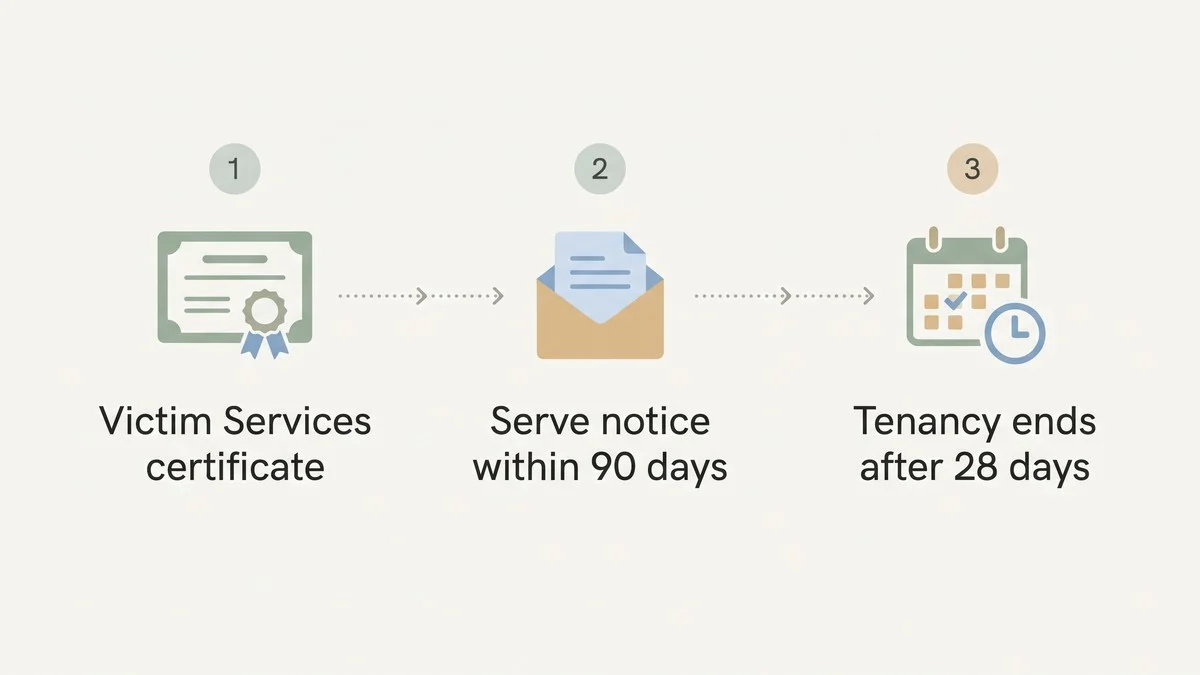
Apply to the Victims Services Branch of the Ministry of Justice for a Certificate Confirming Safety Risk. You provide either a court order or bond that keeps a cohabitant from contacting you, your child or an adult in your care, or a statement from a professional such as a police officer, nurse, doctor, social worker or shelter worker (saskatchewan.ca, Interpersonal Violence and Abuse Programs). Victims Services can help at 1-888-286-6664 on weekdays.
- With a court order or bond: send the Court Order Submission Form with a copy of the order or bond.
- Without one: send a Professional Person Statement. It can be completed by a social worker, psychologist, medical practitioner, registered nurse, registered psychiatric nurse, a member of the RCMP or a police service, or an employee of an emergency shelter or an agency that supports victims of interpersonal violence.
If the Branch is satisfied there is a risk if the tenancy continues, it issues the certificate. The toll-free line, 1-888-286-6664, is answered 8 a.m. to noon and 1 to 5 p.m., Monday to Friday, except statutory holidays. Your local Victim Services program can also help you complete the forms.
How do I give the 28 days' notice?

Serve the landlord with the Notice to Landlord to Terminate a Fixed Term Tenancy for Interpersonal Violence and the certificate.
- The notice must be written, dated, identify you as the sender, give the end date and state the ground (s.64.2(3)).
- The end date must be at least 28 days after service (s.64.2(2)(a)).
- Serve it within 90 days after the certificate is issued (s.64.2(3)(e)).
The Act lets a tenant serve a landlord in three ways (s.82(2)(c)):
- In person, to the landlord or the landlord's agent;
- By ordinary mail to the address the landlord gave in the tenancy agreement, deemed served on the third business day after mailing (s.82(4));
- Electronically, such as by email, deemed served on the next business day after sending (s.82(5)).
Count the 28 days from the day service is deemed to happen, not the day you send it. Email can be the simplest option if meeting the landlord in person is not safe.
An example timeline
These dates are illustrative only.
| Step | Date |
|---|---|
| Certificate issued | Monday, November 16, 2026 |
| Last day to serve the notice (90 days) | Sunday, February 14, 2027 |
| Notice and certificate emailed to the landlord | Tuesday, December 1, 2026 |
| Deemed served (next business day) | Wednesday, December 2, 2026 |
| Earliest end date (28 days later) | Wednesday, December 30, 2026 |
If you pay $1,200 on the 1st of each month, December's rent is owed and nothing after December 30. If instead the end date fell on January 6, January's rent would be prorated to those six days.
What do I owe after giving notice?
Rent only to the end of the 28 days, prorated if needed, and no penalty for ending early (s.64.2(4)). Ask in writing and the landlord must apply your security deposit to that rent.
A clause in the lease that charges a fee or liquidated damages only because the tenancy ended early cannot be enforced against a tenant who used this notice (s.64.2(4)(b)). Any part of the deposit not applied to rent is dealt with under the usual return rules; see Saskatchewan security deposits and moving out in Saskatchewan.
Where to find support in Saskatchewan
- Emergency: call 911.
- Victims Services: 1-888-286-6664 (toll free), weekdays during the hours above, or your local Victim Services program.
- Shelters: the province funds transition houses across Saskatchewan, listed with phone numbers on the Interpersonal Violence and Abuse Programs page. For a full list, contact the Provincial Association of Transition Houses and Services of Saskatchewan (PATHS) at 306-522-3515.
- Sexual assault services: the same page lists community centres, many with 24-hour support lines.
The government page also explains how to hide your browsing history and has a Quick Exit button, which may help if someone else uses your device.
Frequently asked questions
Does this end the lease for my co-tenants?
Yes. The tenancy ends for every tenant, the landlord must tell them, and they may sign a new agreement (s.64.2(5)–(7)).
Can the landlord challenge the notice?
No. Neither the landlord nor another tenant can ask the ORT or a court to set it aside (s.64.2(9)).
Will my landlord share what I disclose?
No. The landlord must keep it confidential (s.64.3).
What if the 90 days have passed?
The notice must be served within 90 days after the certificate is issued. If that time has passed, contact Victims Services about your situation before serving anything.
Do I need to say what happened in the notice?
No. The notice must state that the ground is interpersonal violence or sexual violence (s.64.2(3)(d)); the certificate is what supports it.
I rent month to month. Does the 28-day notice apply to me?
Section 64.2 covers fixed-term tenancies. A month-to-month tenant can end the tenancy with one month's written notice under section 56(1), without a certificate.
What should I keep a copy of?
The certificate, the notice, the date and method you served them (for email, the sent message), and your written request to apply the deposit. Store copies somewhere only you can reach.
Where else can I get help?
Call or text 211 Saskatchewan, or contact your local Victim Services program. More renter help is in the Canadian Tenant Resource Center and Saskatchewan Tenant Rights.
Your safety comes first
Plain-language guides for renters on leases, notices and tenant protections across Canada.
Free • No signup required


