
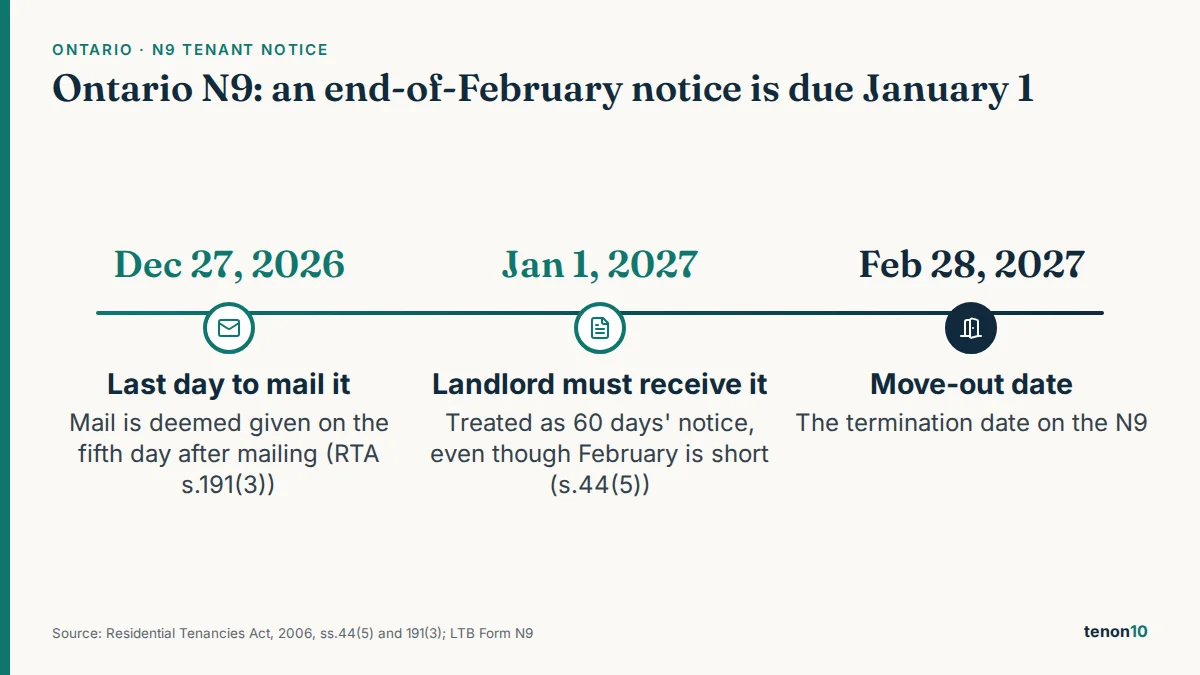
In Ontario, an N9 notice for the end of February is on time if your landlord gets it by January 1, and a notice for the end of March is on time if it arrives by February 1. Section 44(5) of the Residential Tenancies Act treats either one as 60 days' notice, even though February is short.
Most monthly tenants in Ontario must give at least 60 days' notice, and the move-out date has to be the last day of a rental period (RTA s.44(2)). February breaks the arithmetic: from January 1 to February 28, 2027 is only 58 days. The Residential Tenancies Act, 2006 fixes that with a special rule, and the instructions on the Landlord and Tenant Board's (LTB) N9 Tenant's Notice to End the Tenancy repeat it. This guide shows how to use it without losing a month's rent. For the general N9 rules, read how tenants give proper notice in Ontario; more renter guides are in the Ontario Tenant Resource Center.
What you'll need
- The LTB's N9 form, filled in with every tenant's name and the full unit address.
- Your lease, to confirm the rent is paid monthly (or yearly) and when any fixed term ends.
- A way to prove delivery: a witness or signed receipt for hand delivery, or a dated mailing record.
- Your landlord's written consent to email service, if you plan to email the notice.
How do you give an N9 for the end of February in Ontario?

You give the N9 so that the landlord receives it no later than January 1, with February 28 (or February 29 in a leap year) as the termination date. The same pattern moves one month later for March: deliver by February 1 for a March 31 move-out.
1. Check that the special rule covers your tenancy
Section 44(5) applies to a tenant's notice under section 44(2), (3) or (4): monthly tenancies, yearly tenancies and fixed-term tenancies. A fixed term that expires on February 28 qualifies, because s.44(4) makes the termination date the expiry date. Weekly and daily tenancies use a different rule (28 days, s.44(1)) and do not need it.
2. Set the termination date
Write the last day of February (or March) as the termination date. If your rent is due on the 1st, that is the last day of a rental period. If your rent is due on another day, your rental period ends on a different date and the February rule may not line up with it; count the full 60 days to the end of a period instead.
3. Deliver it early enough
Hand delivery counts on the day it happens. Mail is deemed given on the fifth day after mailing (RTA s.191(3)), so a notice mailed on December 27 is deemed given on January 1, and one mailed later is late for February. For an end-of-March move, mail by January 27. Email works only if your landlord agreed in writing to be served by email (LTB Rules 3.1 and 3.5).
4. Keep your proof and plan the move
Keep a copy of the signed N9 and your proof of delivery. Once you have given notice, your landlord may show the unit to prospective tenants without written notice between 8 a.m. and 8 p.m., after informing you or making a reasonable effort to (RTA s.26(3)). See Ontario's entry rules for the limits.
What are the key dates for a 2027 move-out?
| Move-out (termination) date | Landlord must receive the N9 by | If mailing, mail by |
|---|---|---|
| February 28, 2027 | January 1, 2027 | December 27, 2026 |
| March 31, 2027 | February 1, 2027 | January 27, 2027 |
| April 30, 2027 (ordinary 60-day rule) | March 1, 2027 | February 24, 2027 |
The April row uses the ordinary count: 60 days before April 30 is March 1, and mail is deemed given five days after mailing.
Tips
- Fill in every field. List each tenant's name and the full unit address as the form asks, and sign and date it.
- Move out completely. The N9 itself says you must remove your belongings by the termination date. Things left behind after you move out can be disposed of by the landlord (RTA s.41).
- Your last month's rent deposit is applied to the rent for the last rent period (RTA s.106(10)). Read how the LMR deposit works.
Troubleshooting
- "I missed January 1." A notice that arrives after January 1 cannot use the February rule. Your earliest date is then the end of March if the landlord gets it by February 1, or later under the ordinary 60-day count. You can also ask your landlord to sign an N11 agreement to end the tenancy on an earlier date.
- "My landlord says the notice is too short." Point to s.44(5) and the special rule printed on page 2 of the LTB's N9. The landlord may apply to the LTB as soon as you give notice, but an order cannot require you to leave before your termination date (N9 instructions). Read about the L3 application.
- "My rent is due on the 15th." The February rule is built around month-end dates. Count 60 days to the last day of a rental period instead.
Frequently asked questions
Is 58 days enough notice to end a tenancy in Ontario?
Only for the end of February. Section 44(5) deems a notice given by January 1 for a February termination to be 60 days' notice. For any other month, a monthly tenant needs at least 60 days.
Does the February rule apply to landlords?
No. Section 44(5) speaks only of a tenant who gives notice. A landlord's notice must meet the full notice period for that notice.
Can I email my N9 to my landlord?
Only if the landlord has consented in writing to service by email (LTB Rules 3.1 and 3.5). Otherwise hand it over, leave it in the landlord's mailbox, or mail it early.
What if February 29 falls in the year I move?
In a leap year the last day of February is February 29, and that is the termination date to write on the N9. The January 1 deadline is the same.
Give your notice on the right form
Fill in the Ontario N9 for free and keep a copy for your records.
Free • No signup required