TORONTO, Oct. 27, 2026: The Toronto election 2026 results show Olivia Chow leading the unofficial count in the October 26 municipal vote, with 532,201 votes (54.16%) to Brad Bradford's 404,013 (41.11%) and all 1,431 polls reporting. The results are unofficial until the City Clerk certifies them. Nothing in Toronto's rental rules changes because of the vote: city bylaws stay in force until Council amends them, and rent increases remain provincial.
What are the Toronto election 2026 results?
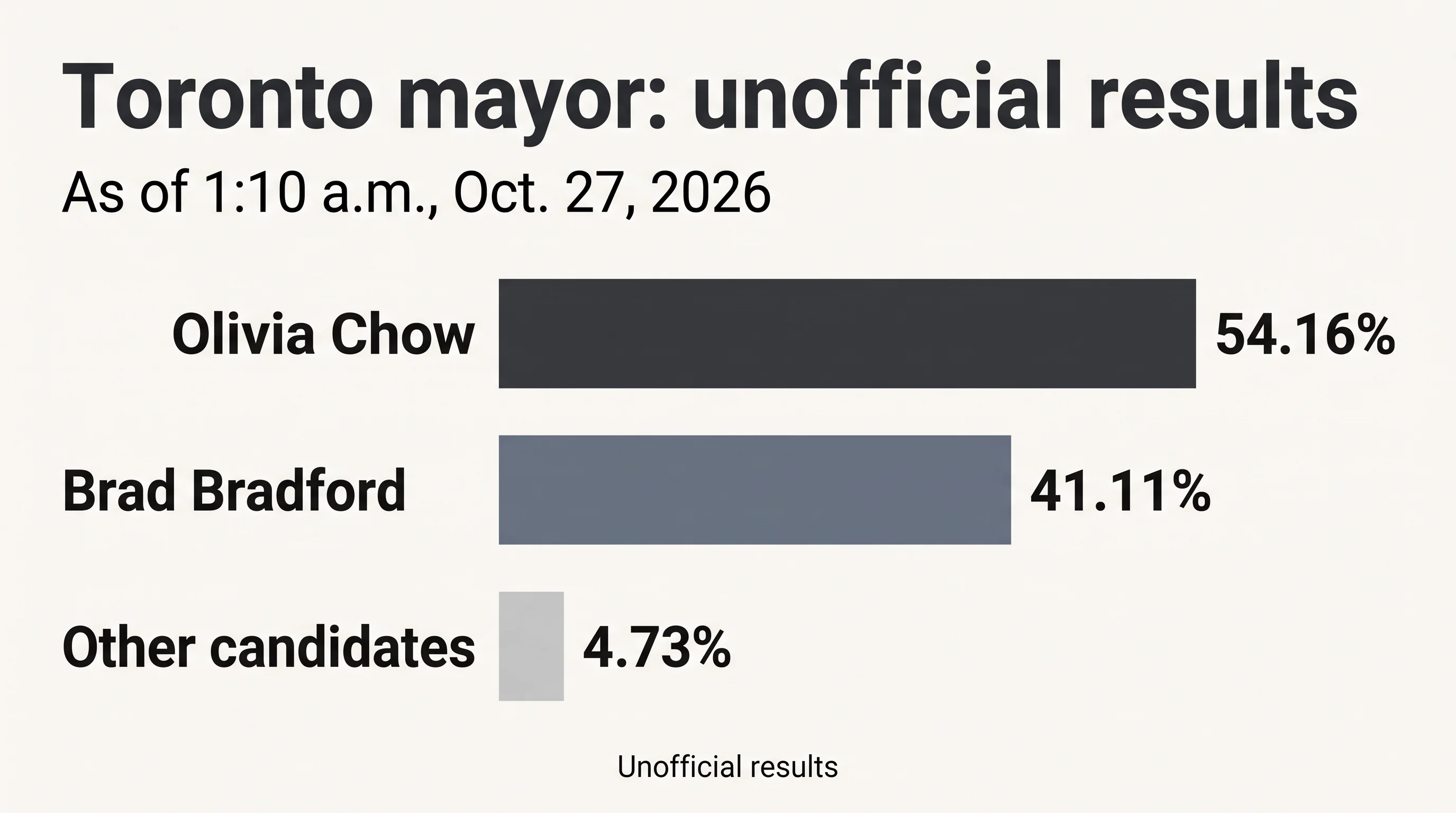
Olivia Chow leads Toronto's mayoral race in the City's unofficial results, which show "Olivia Chow Leading (1431 of 1431 polls reporting)" as of 1:10:35 a.m. on October 27 (City of Toronto election results).
| Mayoral candidate | Votes | Share |
|---|---|---|
| Olivia Chow | 532,201 | 54.16% |
| Brad Bradford | 404,013 | 41.11% |
| The other 51 candidates combined | 46,446 | 4.73% |
| Total votes counted for mayor | 982,660 | 100% |
No other candidate reached 1%. The same page posts unofficial results for all 25 ward councillor races.
When will Toronto's election results be official?
Toronto's election-night figures stay unofficial until the City Clerk certifies them, the City told media in its results briefing, and its September candidate bulletin says certified and poll-by-poll results "will be posted on the Elections Results web page at a later date." As of October 27, the City has not announced that date, and its general election results page lists no 2026 declaration of results yet.
What did Olivia Chow campaign on for rental housing?
Chow's rental commitments, each taken from her own campaign site (read October 27), were:
- A Bad Landlords Task Force: "More enforcement officers and lawyers to inspect units and take landlords to court," and, for landlords who refuse to repair, "the City will go in to make repairs and bill the landlord" (oliviachow.ca/plan).
- Supply: "shovels in the ground on 10,000 more next year," and a plan to "build 65,000 affordable and rent-controlled homes" (same page), through the Rental Housing Supply Program (campaign post).
- Renovictions, cooling and rent control: "Continuing to enforce Chow's Renovictions By-Law," "Passing a Maximum Temperature By-Law" (which the post says should not raise rents through above-guideline increases) and "Continuing to advocate for real rent control to the province" (campaign post).
Runner-up Brad Bradford's renters' plan proposed a public dashboard on renoviction licences, a maximum heat standard and more pre-development loans for non-profit builders. Our pre-election comparison sets the two platforms side by side.
A campaign commitment is not law. Each item needs a Council decision, and some depend on the Province.
What powers does Toronto's mayor have?
Toronto's mayor holds the special powers in Part VI.1 of the City of Toronto Act, 2006: proposing the City budget and vetoing Council's amendments to it, a veto Council can override with a two-thirds vote (s.226.14), and, where provincial priorities are prescribed, vetoing certain by-laws that could interfere with them (s.226.9). The 2027 budget can be adopted only in 2027, because a budget for the year after an election may only be adopted in that year (s.228(2)).
Which Toronto rental rules stay in force after the election?
Every Toronto rental bylaw stays in force after the vote unless the new Council amends it:
- RentSafeTO (Municipal Code Chapter 354): applies to apartment buildings with three or more storeys and ten or more units, which must register and renew every year (City RentSafeTO page).
- Rental Renovation Licence (Chapter 662): enforced since July 31, 2025, for N13 notices given on or after that date. The landlord applies within seven days of the N13, pays $728 per unit, and must provide temporary housing or rent-gap payments plus a moving allowance (City landlord page). See our renoviction licensing guide.
- Multi-tenant (rooming) houses (Chapter 575): a licence is required where four or more rooms are rented to separate people; the city-wide framework took effect March 31, 2024 (City framework page).
- Vacant Home Tax (Chapter 778): 3% of Current Value Assessment from the 2024 tax year. Every residential owner must declare occupancy each year by April 30, even if they live there, or the City assumes the property was vacant; false declarations can bring fines of up to $10,000 (City Vacant Home Tax page). Our vacant home tax guide compares Ontario cities.
Does a Toronto election change rent increase rules?
No. Rent increases in Ontario are set by the Province under the Residential Tenancies Act, and disputes go to the Landlord and Tenant Board (LTB), so a city election does not change them. The rent increase guideline is 2.1% for 2026 and 1.9% for 2027, and a landlord must give at least 90 days' written notice on the LTB's form (Ontario rent increase guideline). Units first occupied for residential purposes after November 15, 2018, are exempt from the guideline. Our N1 guide explains the notice.
What it means for landlords
For Toronto landlords, no obligation changes with the unofficial result. RentSafeTO registration, the renovation licence for any N13, multi-tenant house licensing and the annual Vacant Home Tax declaration all continue as before.
What it means for tenants
For Toronto tenants, your rights under the Residential Tenancies Act and the City bylaws are the same today as before the vote. Rent increases still follow the provincial guideline, and an N13 renovation notice still triggers the City licence and its tenant protections.
What to do now
- Treat the figures above as unofficial until the City Clerk certifies the results; no certification date has been announced.
- Note the dates: the 2026-2030 Council term starts November 15, 2026 (Municipal Elections Act, 1996, s.6(1)), and the first meeting is November 18 and 19, 2026 (City Clerk's 2026 schedule report).
- Watch the 2027 budget: under Part VI.1, the City Clerk's report notes the mayor must propose a budget by February 1 each year. The City has not yet published 2027 budget dates that we could find.
- Landlords: keep your Vacant Home Tax declaration and any renovation licence paperwork current.
The rules haven't changed, so keep your paperwork current
Fill Ontario N-forms, create leases, track deposits and send rent reminders in Tenon10.
Free • No signup required