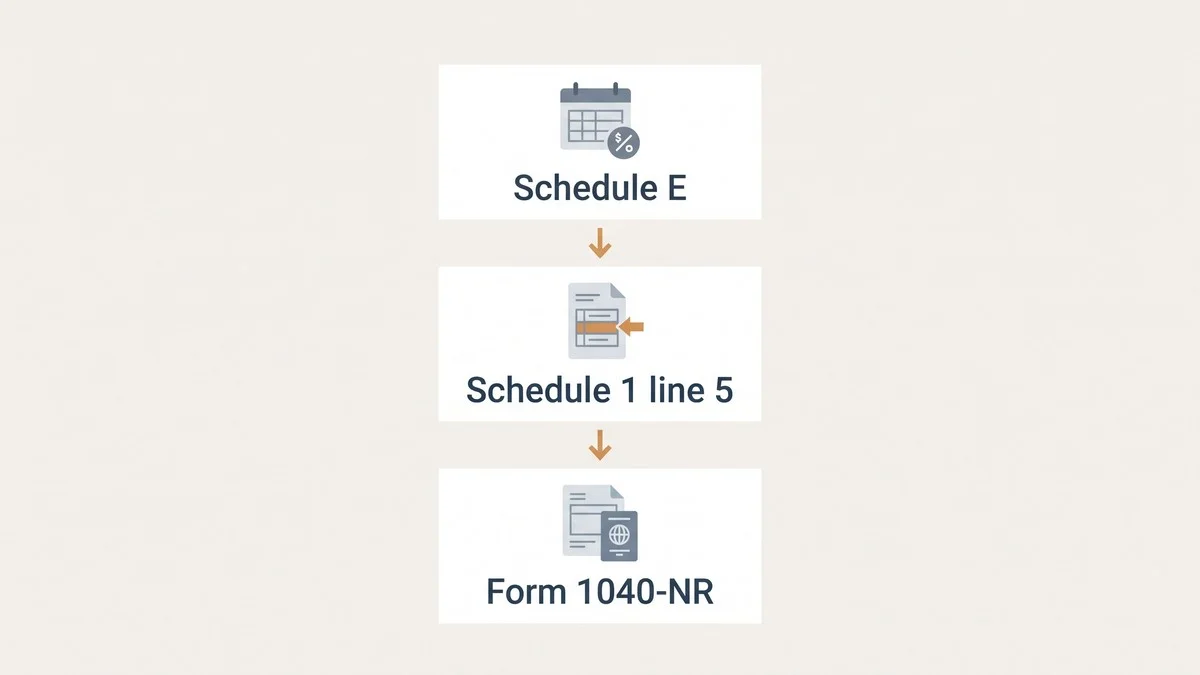
A Canadian landlord who elects to be taxed on net US rental income files Form 1040-NR with Schedule E each year: the rent, expenses and depreciation go on Schedule E, the net figure goes to Schedule 1 (Form 1040), line 5, and the return is due June 15 for an owner with no US wages.
This how-to follows the 2025 Instructions for Form 1040-NR and IRS Publication 519 (2025). It assumes you are a resident of Canada, a nonresident alien for US tax purposes, and that you have made, or are making, the net-basis election on your US real property income. Why the election matters, and how the US return links to your Canadian T776, is covered in the series pillar, Canadians Who Own a US Rental: The Complete Tax Guide.
What do you need before filing a 1040-NR?
- A US taxpayer identification number. If you have none, a Form W-7 ITIN application goes on the front of this return (W-7 instructions).
- Rent and expenses for the year in US dollars, with receipts.
- Your depreciation figures: cost of the building (not the land), date placed in service, and prior depreciation.
- Every Form 1042-S showing US tax withheld from your rent.
- In the first year of the election, the election statement.
How do you file a 1040-NR with Schedule E, step by step?

- Confirm you file as a nonresident alien. Your US status depends on the residency tests in Publication 519; a Canadian who spends long periods in the US should check them every year.
- Complete Schedule E (Form 1040). Report the rent and each expense category. Depreciation follows Publication 527: residential rental buildings over 27.5 years, and no depreciation on land.
- Carry the net result to Schedule 1 (Form 1040), line 5. The 1040-NR instructions say that if you elect to treat US real property income as effectively connected, you report the rental income or loss there and attach Schedule E.
- Attach the election statement in the first year. Per the 1040-NR instructions, it lists that you are making the election, your US real property, your share, any substantial improvements, your income from it, the dates you owned it, whether the election is under section 871(d) or a treaty, and any earlier elections or revocations.
- Skip the standard deduction. Publication 519 says nonresident aliens "cannot claim the standard deduction"; you can itemize allowable deductions.
- Claim the US tax already withheld. Enter the federal income tax withheld from your Forms 1042-S on line 25g and attach the 1042-S forms to the front of the return.
- Mail it. Without a payment, the 2025 instructions give Department of the Treasury, Internal Revenue Service, Austin, TX 73301-0215 USA; with a payment, Internal Revenue Service, P.O. Box 1303, Charlotte, NC 28201-1303 USA. A return with a new W-7 goes to the ITIN address in the W-7 instructions instead.
Example Schedule E figures (illustrative only)
| Line item | US$ |
|---|---|
| Rents received | 24,000 |
| Property taxes, insurance, HOA fee, management, repairs | (9,000) |
| Depreciation: 200,000 building ÷ 27.5 years (full year) | (7,273) |
| Net rental income to Schedule 1, line 5 | 7,727 |
When is the 1040-NR due for a Canadian landlord?
For the 2025 tax year, an owner with no US wages subject to withholding files by June 15, 2026, according to Publication 519. Form 4868 extends that to December 15, 2026, but does not extend the time to pay. An owner who also has US wages files by April 15, 2026. Your Canadian return is due April 30, 2026 for most people, so the US figure for your foreign tax credit may not be final when you file in Canada; our year-end tax prep checklist helps you gather both sets of records early.
What goes wrong on a first 1040-NR?
- Rent on the wrong schedule. Rent you did not elect to treat as effectively connected goes on Schedule NEC, line 6, at the flat rate; elected rent goes through Schedule E. The instructions say not to put the same income on both.
- Land depreciated. Split the purchase price between land and building first.
- No 1042-S attached, so the withholding credit is not matched.
- E-filing in the ITIN year. The W-7 instructions say you cannot e-file with a newly assigned ITIN until the following year.
- Canadian rules applied to the US return, or the reverse. The US uses Schedule E and 27.5-year depreciation; Canada uses the T776 and CCA. Keep one set of receipts and two sets of calculations; our landlord bookkeeping guide shows how to keep them organized.
Frequently asked questions
Do I file a separate 1040-NR for each US property?
No. You file one 1040-NR for the year; Schedule E has room for several properties. Publication 519 says the election covers all your US real property held for the production of income.
Can spouses file one joint 1040-NR?
Generally no. Publication 519 says a nonresident alien "generally cannot file as married filing jointly", and married nonresident aliens generally use the married-filing-separately rates. Each co-owning spouse files their own 1040-NR for their share.
What if my rental shows a loss?
Report it on Schedule E and Schedule 1 like a profit. The election lets you deduct expenses against the rent, which is why a timely return matters even in a loss year.
Is a state return also required?
The state where the property sits may have its own filing rules. This article covers the federal 1040-NR only.
For the Canadian half, see our T776 form guide.
Track your rental income in one place
Free guides, tools and checklists for Canadian landlords
Free • No signup required