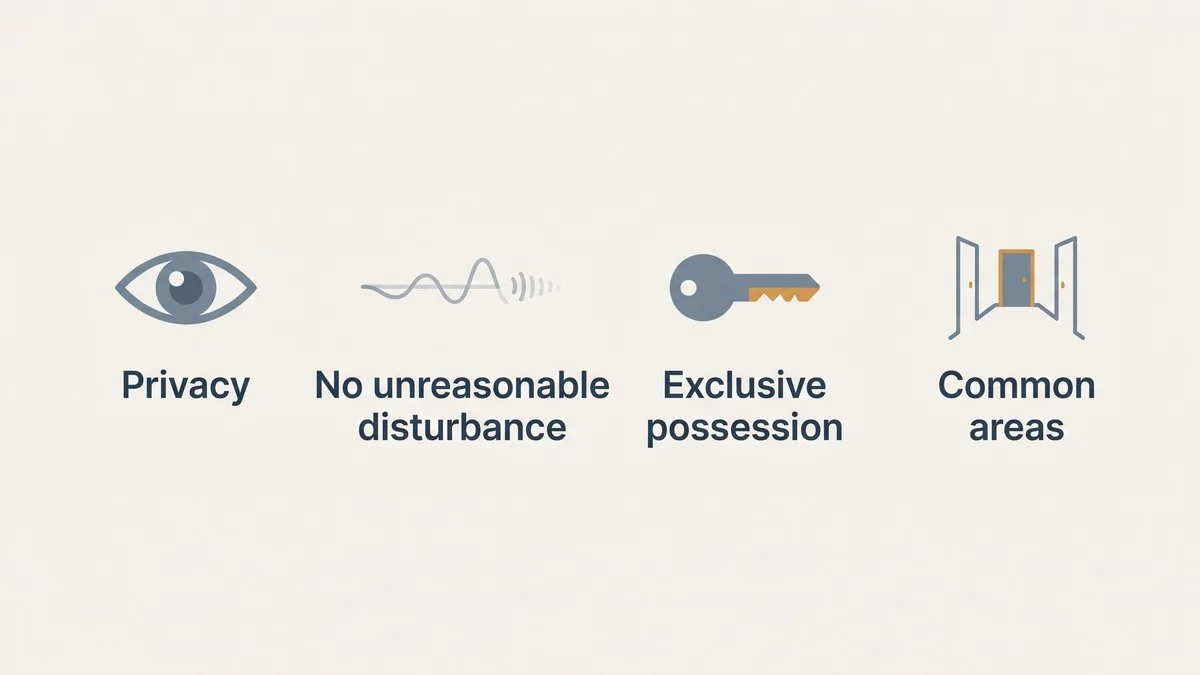
Landlord harassment in Saskatchewan is dealt with through the tenant's right to quiet enjoyment. The Residential Tenancies Act, 2006 does not use the word "harassment", but s.44 entitles every tenant to reasonable privacy, freedom from unreasonable disturbance, exclusive possession subject to lawful entry, and use of common areas. A tenant whose rights are breached can apply to the Office of Residential Tenancies (ORT).
What counts as harassment under Saskatchewan tenancy law?
In Saskatchewan, conduct that breaks the quiet enjoyment rights in s.44 or the rules that protect them is what a hearing officer will look at. Freedom from unreasonable disturbance expressly includes disturbance created by the landlord (Regulations s.6(a)).
| Conduct | The rule it breaks |
|---|---|
| Entering without notice, permission or an emergency | s.45(1)–(2): 24 hours to 7 days' written notice, a reasonable purpose and a four-hour window between 8 a.m. and 8 p.m. |
| Changing the unit's locks without agreement | s.48(2) |
| Cutting off a service or facility, such as heat or laundry | s.43(1): needs the tenant's agreement or an ORT order |
| Keeping the tenant from their belongings | s.12(1) |
| Blocking the tenant or their guests from the property | s.46(1) |
| Repeated, unreasonable contact or disturbance | s.44(b); Regulations s.6 |
Lawful acts are not harassment: serving a proper notice, entering on valid notice, or asking in writing for overdue rent. The detail on entry is in our guide to Saskatchewan's 24-hour notice and four-hour window.
What can a Saskatchewan tenant do about it?

- Put it in writing. Tell the landlord what must stop and which rule applies. The ORT asks parties to try to resolve a matter directly before applying.
- Apply to the ORT. A Breach of Tenant's Rights application through the online portal costs $50 (or a fee waiver), needs the tenancy agreement and your evidence, and is treated as urgent while you still live in the unit (ORT Rules of Procedure, Parts 2 and 3).
- Ask for the right order. A hearing officer may order the landlord to stop and comply, award damages, or direct rent to be paid to the director (s.70(6)). Compensation covers loss caused by the breach (s.8(1)).
- Call the police if anyone other than a sheriff tries to remove you from your home, as the ORT advises.
Is a notice to vacate after a complaint retaliation?

It can be. If a Saskatchewan landlord applies for possession, the tenant can ask for relief where the notice was given because of a good-faith complaint about health or housing standards, or because the tenant tried to enforce their rights under the Act (s.70(11)(a), (b)). A landlord who locks a tenant out without justification can be ordered to pay punitive damages (s.66(4)).
A tenant facing a serious breach that the landlord will not fix in a reasonable time can also give short written notice to end the tenancy, stating the reason (Schedule 1, s.16(3)–(4)).
Relief from a retaliatory notice is asked for inside the landlord's own possession application, so do not ignore a hearing notice: attend and raise it there. If you have already received a notice, our guide to what tenants can do after an immediate notice to vacate walks through the next steps.
Showings, sales and locks: the rules most often broken
Many complaints start with an entry the landlord thought was routine. The Act sets different rules depending on why the landlord wants in:
- Showing the unit to new tenants. Allowed only after the tenant has given notice to end the tenancy, or in the last two months of a fixed term (s.45(3)). The landlord must give notice and let at least two hours pass after the tenant receives it, or use the method set out in the Regulations (s.45(4)). After giving notice, a tenant can also agree in writing to reasonable terms for showings (Regulations s.7(1)(c)).
- If the landlord cannot reach you. The Regulations allow a notice of entry posted on the door, plus a reasonable effort at least two hours beforehand to contact you at the phone number or email you gave for that purpose (Regulations s.7(2)).
- Showing the property to a buyer. 24 hours' notice or the tenant's consent (s.45(5)).
- Timing. Showings to prospective tenants or buyers may happen only between 8 a.m. and 8 p.m., and not on a Sunday or the tenant's day of religious worship (s.45(6)).
- Locks. A landlord who changes the locks on the building must give every tenant new keys (s.48(1)). The rule cuts both ways: a tenant must not change the lock on their own unit unless the landlord consents or the director has ordered it (s.48(4)).
Building an evidence file the ORT can use
A hearing officer decides on the evidence in front of them. The Government of Saskatchewan's dispute page says every piece of evidence a party wants reviewed must be uploaded to the ORT's online portal and provided to the other party, and should be clear, unaltered and limited to the claim. The usual evidence is the tenancy agreement, written communications, receipts, photos and videos.
- A dated incident log, kept as things happen rather than rebuilt from memory.
- Every notice of entry you received, or a note of each entry with none, so the officer can compare it with the 24-hour, seven-day and four-hour rules.
- The texts or emails in which you asked the landlord to stop.
- Receipts for any money the conduct cost you, such as food spoiled during a cut-off service or a night away after a lockout.
The applicant serves the hearing notice. For an urgent application it must be served at least two days before the hearing, and ten days for other applications; hearings are held by phone unless the hearing officer decides an in-person hearing is needed (ORT Rules of Procedure, Part 3). After serving, the applicant completes a Certificate of Service in the portal.
A worked example
A tenant on a month-to-month tenancy gives notice to move out. Over the following week the landlord enters three times without notice to show the suite, once at 9 p.m. on a Sunday.
- Day 1. The tenant emails the landlord, cites s.45(3)–(6), and asks for proper notice before any further showing.
- Day 3. The landlord enters again unannounced. The tenant logs the time and keeps the email thread.
- Day 4. The tenant files a Breach of Tenant's Rights application online with the $50 fee, the tenancy agreement, the log and the emails. Because the tenant still lives in the unit, it is classed as urgent.
- Before the hearing. The tenant serves the hearing notice at least two days ahead and completes the Certificate of Service.
- At the hearing. The tenant asks for an order that the landlord comply with s.45, and for compensation for any loss the evidence shows.
Common mistakes that weaken a tenant's case
- Changing the lock yourself. It breaches s.48(4) and gives the landlord a complaint of their own. Ask the ORT for an order instead.
- Not limiting the loss. A party claiming compensation must do whatever is reasonable to minimize the damage or loss (s.8(2)).
- Relying on phone calls. A call leaves nothing to upload. Follow every conversation with a short email or text.
- Serving the hearing notice late. The ORT puts the duty of proper and timely service on the applicant, and a hearing may not go ahead without it.
Disrepair that the landlord ignores is a separate problem with its own rules; see who fixes what in a Saskatchewan rental.
Frequently asked questions
Can the ORT deal with discrimination by a landlord?
No. The ORT's Rules of Procedure say it has no jurisdiction over pain, suffering or discrimination, so those claims go elsewhere.
Is harassment by a landlord an offence?
Breaking the Act is an offence: an individual can be fined up to $500, imprisoned for up to six months, or both, and a corporation fined up to $1,000 (s.79(1)–(2)). Prosecution is separate from your ORT claim.
What if the landlord ignores an ORT order?
Failing to comply with an order made under the Act is itself an offence (s.79(1)(a)), and the director may refuse to schedule a hearing for a landlord who is in contravention of an order (s.70(14)(a)).
Can my landlord show the suite on a Sunday?
Not to prospective tenants or buyers. Those showings are limited to 8 a.m. to 8 p.m. on a day that is not a Sunday or your day of religious worship (s.45(6)).
Can my landlord ban election signs?
Not in or on your own unit during a federal, provincial or local election campaign. The landlord may set reasonable conditions on the type and size of posters and keep them off common areas, and posters must come down within seven days after the election (s.47).
What if another tenant is the problem?
Disturbance by another tenant of the landlord also falls under quiet enjoyment (Regulations s.6(b)). Tell the landlord in writing, who can act on it.
How long do I have to apply?
Generally within one year of the act or omission (s.71.1).
Quiet enjoyment is enforceable in Saskatchewan, and records win hearings. For every other right, see Saskatchewan tenant rights and how to apply for an ORT hearing.
Know your rights as a renter
Plain-language guides for tenants in Saskatchewan and across Canada.
Free • No signup required