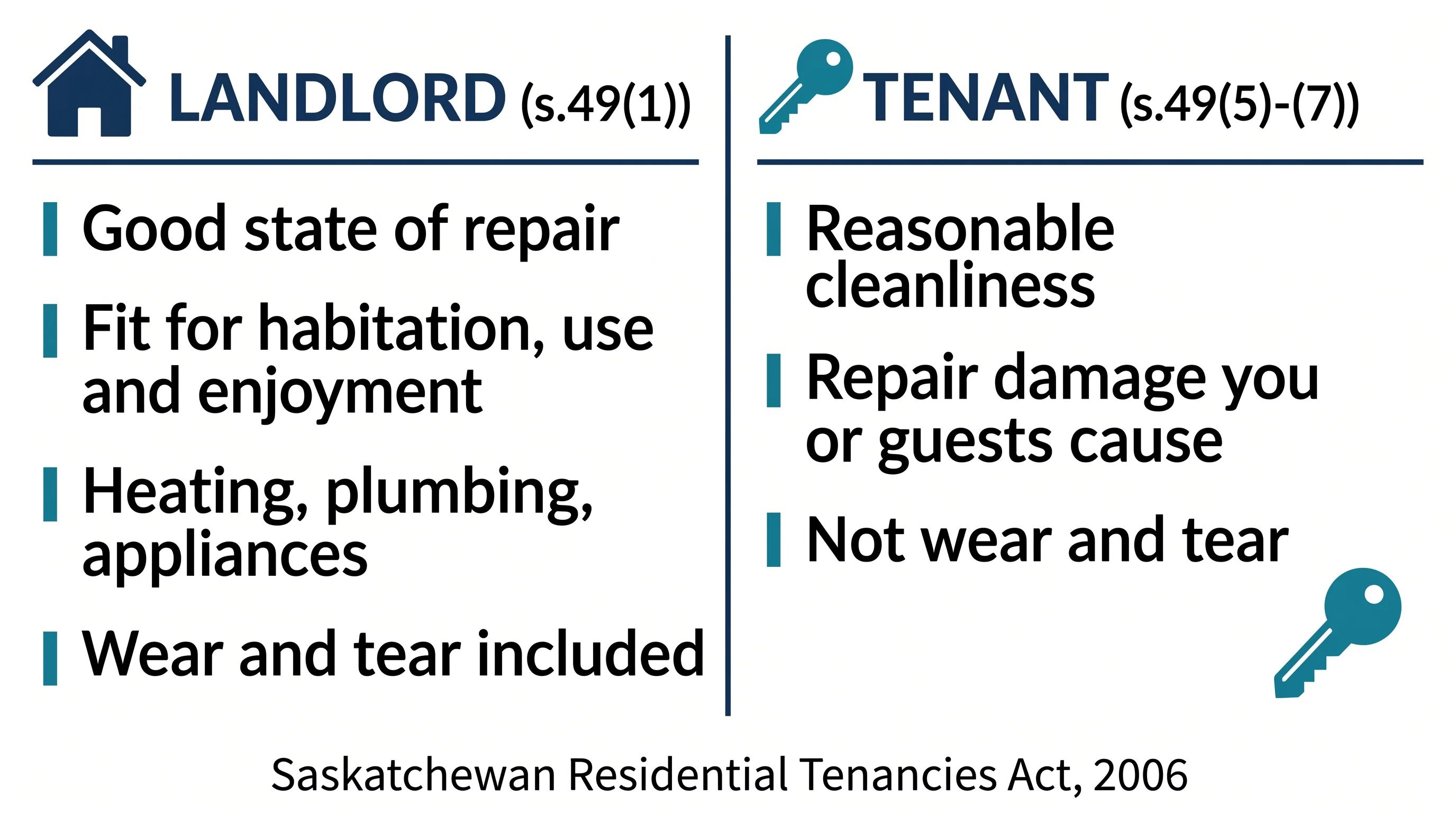
In Saskatchewan, the landlord must keep a rental in a good state of repair and fit for habitation, use and enjoyment, and must keep supplied services such as heating, plumbing and appliances working, whatever the cause of the wear (Residential Tenancies Act, 2006, s.49). Tenants keep the unit reasonably clean and fix damage they or their guests cause.
If you searched "tenant rights Saskatchewan repairs", this is the short version: the duty to repair sits with the landlord, the duty not to damage sits with the tenant, and disagreements go to the Office of Residential Tenancies (ORT), the body many people still call the Rentalsman. Rent is not withheld while you wait. This guide covers who fixes what, how to ask for a repair, what the ORT can order and when a public health inspector can step in.
At a glance
- Landlord: good repair and fit for habitation, use and enjoyment, even if the tenant knew of the problem when signing (s.49(1)(a)).
- Services and facilities: the landlord repairs them whether the cause is reasonable wear and tear or anything else, except damage the tenant must repair (s.49(1)(b), (4), (6)).
- Tenant: reasonable health, cleanliness and sanitary standards; repair damage caused by the tenant or their guests; no duty to fix reasonable wear and tear (s.49(5)–(7)).
- Rent: keep paying; apply to the ORT instead (s.42(1); Standard Conditions s.4(1)).
- ORT: $50 application fee, claims up to $30,000, apply within one year (Regs s.13(1)(a), s.11; Act s.71.1).
Saskatchewan Rental Repairs Checklist
Get Free PDF →Who is responsible for repairs in a Saskatchewan rental?
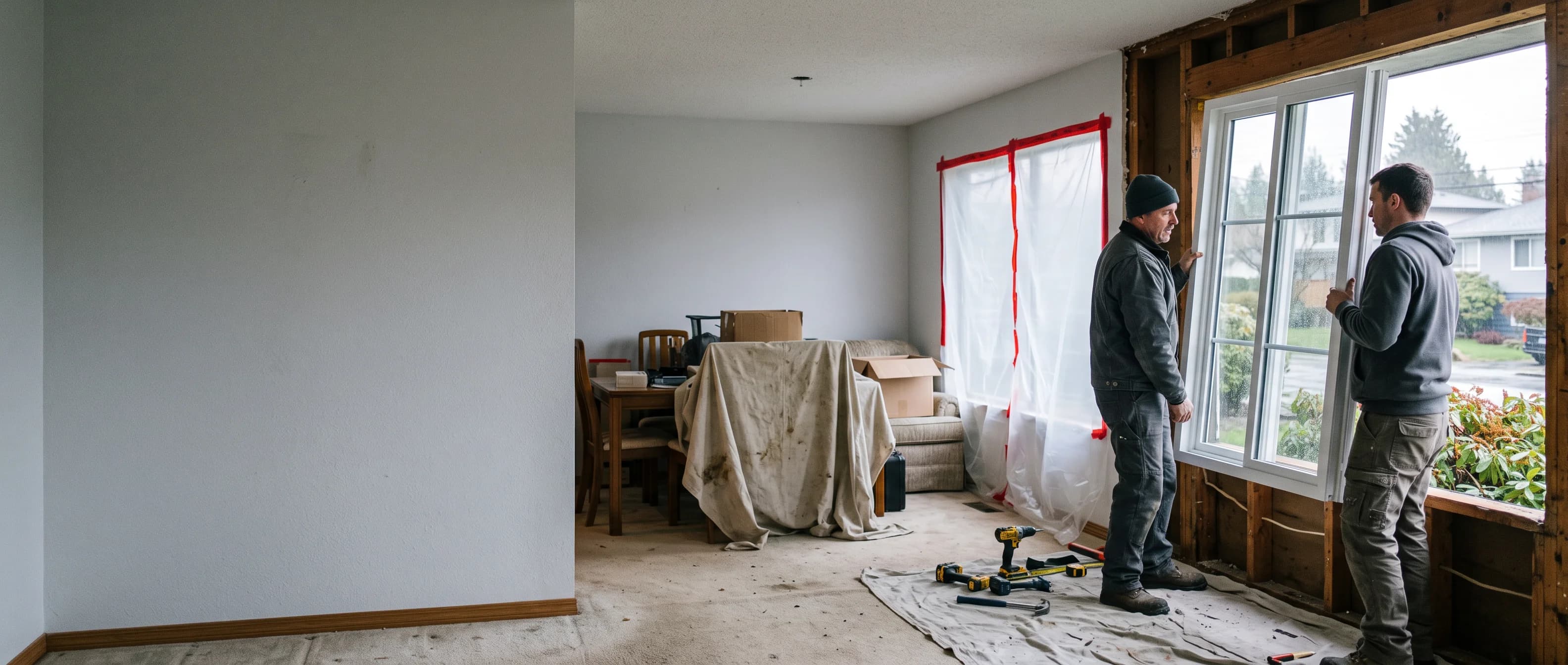
In Saskatchewan the landlord is responsible for keeping the residential property in a good state of repair and fit for habitation, use and enjoyment for the whole tenancy (s.49(1)(a)). That duty applies even when the problem existed before the lease was signed and the tenant knew about it, so a "rented as is" clause does not remove it. A lease term that conflicts with the Act is not enforceable (s.7(2)), and the Standard Conditions say a term that changes a statutory right is void (Schedule 1, s.1(3)).
The landlord must also keep in good repair every service and facility it supplies under the tenancy agreement, or adds or substitutes later (s.49(1)(b)). The Standard Conditions give examples: appliances, heating systems and plumbing systems (Schedule 1, s.8(1)). Under s.49(4) the landlord is not excused because the repair comes from reasonable wear and tear "or any other cause", subject to the tenant's own duty to repair damage they caused (s.49(6)).
The one exception in the section is a property so destroyed that it is uninhabitable: the repair duty in s.49(1) does not apply to it (s.49(3)). The Standard Conditions list that situation, for example a fire, as one way a tenancy ends (Schedule 1, s.15(1)(d)).
What repairs does a Saskatchewan tenant have to do?
A Saskatchewan tenant must maintain reasonable health, cleanliness and sanitary standards throughout the unit (s.49(5)) and must repair damage to the property, services or facilities caused by their own actions or neglect, or by anyone they let onto the property (s.49(6)). A tenant does not have to repair reasonable wear and tear (s.49(7)).
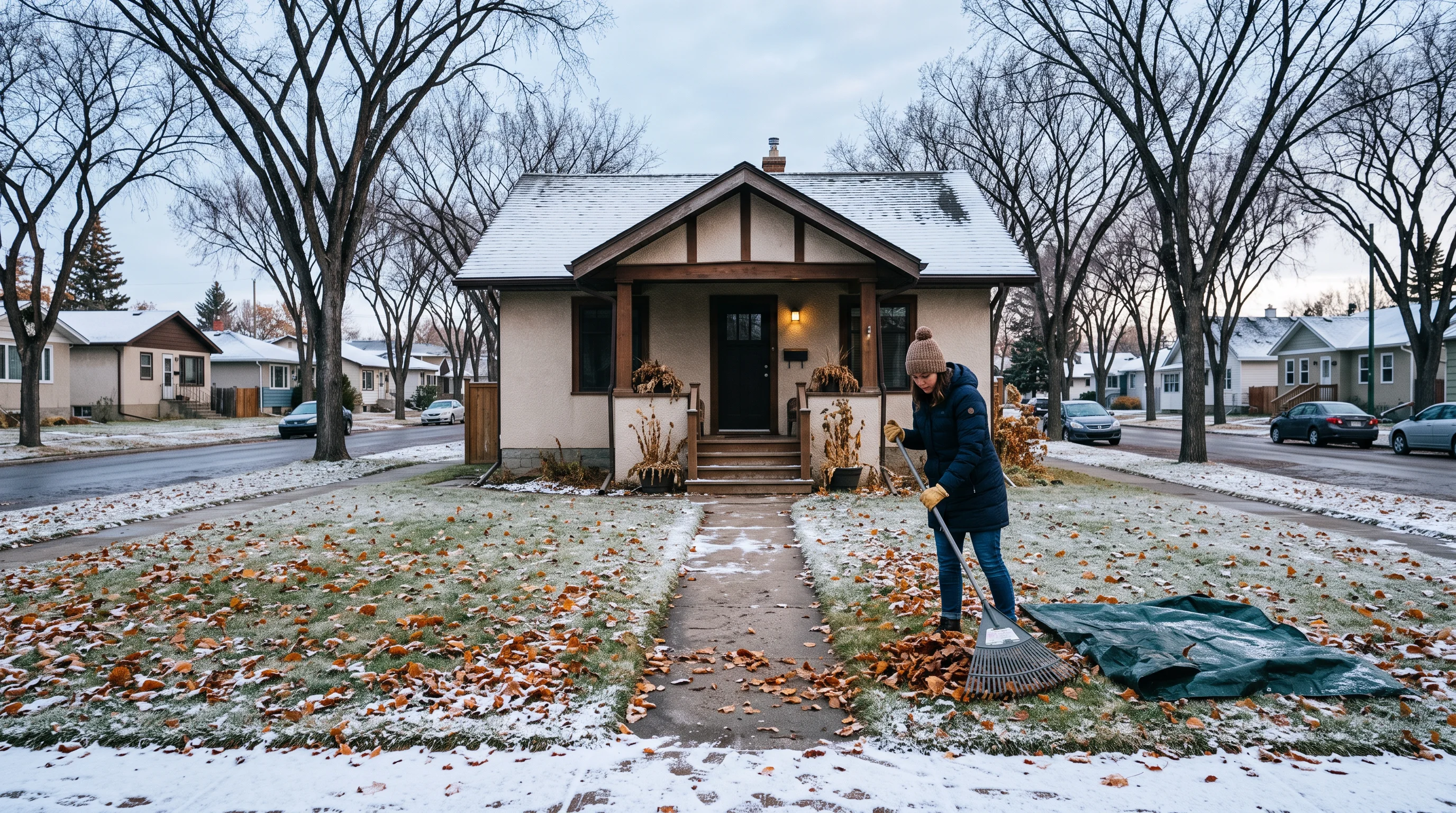
When a tenant rents a whole property with exclusive use, such as a house, the tenant is responsible for the ordinary cleanliness of the exterior of the unit and the property unless the two sides agree otherwise (s.49(2)). The Standard Conditions add that this includes the yard or surrounding land (Schedule 1, s.8(3)). The Act does not mention snow clearing or lawn mowing by name, so write who does them into the lease rather than relying on the general rule.
If a tenant does not repair damage they are responsible for within a reasonable time, the landlord may give a Notice to Vacate for cause (s.58(1)(g)), after first allowing a reasonable period to fix it (s.58(2)). Extraordinary damage is a separate cause ground (s.58(1)(f)).
Who fixes what? A quick comparison
This table sets the Saskatchewan rules side by side. Where the Act is silent, the safe course is to put the answer in the written agreement.
| Item | Usually the landlord | Usually the tenant | Source |
|---|---|---|---|
| Structure, roof, windows, doors | Keep in good repair and fit for habitation | Damage they or guests cause | s.49(1)(a), (6) |
| Heating, plumbing, supplied appliances | Repair, including wear and tear | Damage from misuse or neglect | s.49(1)(b), (4), (6); Sch.1 s.8(1) |
| Everyday cleanliness inside | — | Reasonable health, cleanliness and sanitary standards | s.49(5) |
| Yard and exterior of a house rented with exclusive use | Unless agreed otherwise | Ordinary cleanliness | s.49(2); Sch.1 s.8(3) |
| Bed bugs and other pests | Generally pays for treatment | Report right away, cooperate; pays if at fault | ORT Repairs and Maintenance page |
| Cleaning at move-out | Cannot automatically charge a cleaning fee | Leave the unit reasonably clean | s.51(a); ORT Repairs and Maintenance page |
The ORT's Repairs and Maintenance page says the cost of treating an infestation is generally the landlord's because of the duty to keep the unit fit for habitation, that a landlord may claim the cost from a tenant who caused it, and that tenants must cooperate with the landlord and pest control. Smoke and carbon monoxide alarm rules come from building and fire codes rather than this Act, and we cover the carbon monoxide changes in a separate guide.
How should a tenant ask for a repair in Saskatchewan?
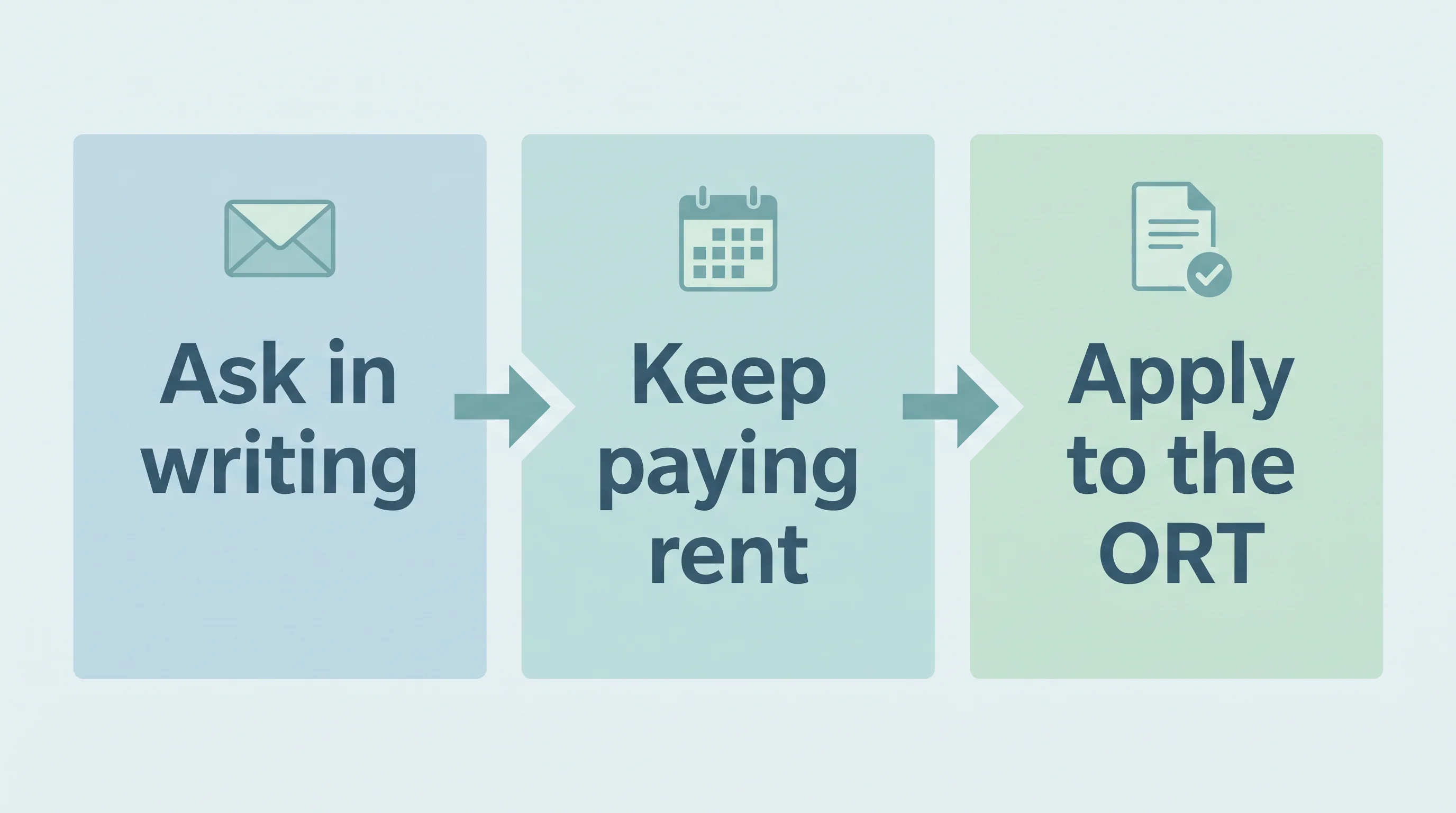
A Saskatchewan tenant should ask for the repair in writing, keep a copy, and give the landlord a reasonable time to fix it. Every written tenancy agreement must list a phone number for emergencies, including emergency repairs, if it differs from the landlord's main number (s.19(1)(f)); with an oral agreement the landlord must give that number in writing within 20 days (s.19(3)).
- Report it. Describe the problem, when it started and any risk to health or property. Send photos.
- Allow access. The landlord can enter with 24 hours' to seven days' written notice that states the purpose and a four-hour window between 8 a.m. and 8 p.m., or without notice in an emergency to protect life or property (s.45(1)(b), (f), (2)).
- Keep paying rent. Rent is payable "whether or not the landlord complies" with the Act, unless the Act itself allows a deduction (s.42(1)). The Standard Conditions tell tenants to apply to the ORT instead of withholding (Schedule 1, s.4(1)).
- Follow up in writing. Keep a dated record of every message and visit.
- Apply to the ORT through its online portal if the repair is not done.
A landlord must not cut off or restrict a service or facility, such as heat, water or laundry, without the tenant's agreement or an ORT order (s.43(1)). Taking a service away is a different issue from a breakdown, and a tenant can apply to the ORT over either.
What can the ORT order if a landlord won't fix things?
After a hearing, an ORT hearing officer may make any order that is just and equitable, including an order to comply with the Act or the agreement, an order for damages, and an order that the tenant pay all or part of the rent to the director instead of the landlord (s.70(6)(a)–(c)). The hearing officer may direct that the money paid to the director be used to remedy the landlord's failure (s.70(7)).
Either side who breaks the Act or the agreement must compensate the other for the resulting loss, and the person claiming must take reasonable steps to keep that loss down (s.8). The application fee is $50 (Regs s.13(1)(a)), the ORT hears monetary claims up to $30,000 (Regs s.11), and most applications must be made within one year of the act or omission (s.71.1).
Tenants are also protected from retaliation. If a landlord applies for possession, a tenant can ask for relief where the notice was given because of a good-faith complaint about health or safety standards, including housing standards, to a government agency or municipality, or because the tenant tried to enforce their rights (s.70(11)(a)–(b)). For a serious breach that the landlord does not fix after a reasonable chance, a tenant may also end the tenancy on notice (s.56(2)–(3)).
Compare the other prairie and western rules: Alberta sets numeric minimum standards under its public health law (see repairs and minimum housing standards for Alberta rentals), while BC's duty is explained in repairs and maintenance in BC and Ontario's in maintenance standards in Ontario.
When can a public health inspector help with a Saskatchewan rental?
A Saskatchewan Health Authority public health inspector may investigate certain rental housing conditions on a complaint basis: lack of plumbing, lack of a drinking water supply, lack of water heating, sewer back-ups, rodent or insect infestation, lack of heating and extensive mould, according to the Safe Rental Housing page. Inspectors do not handle cosmetic updates, noise or appliance repairs; those and rent or deposit disputes go to the ORT.
Saskatchewan's Act and Regulations do not set a minimum indoor temperature. Heat is a service the landlord must keep in good repair (s.49(1)(b); Schedule 1, s.8(1)), and lack of heating is on the inspectors' list. Mould is not named in the Act either; it falls under the general duty to keep the unit fit for habitation, and extensive mould is an inspector issue.
Frequently asked questions
Can I withhold rent until my landlord makes repairs in Saskatchewan?
No. Section 42(1) says rent must be paid when due whether or not the landlord complies, unless the Act gives a right to deduct. Apply to the ORT instead; a hearing officer can order rent paid to the director and used for the repair (s.70(6)(b), (7)).
Does my landlord have to fix something that was broken when I moved in?
Yes. The duty to keep the property in good repair and fit for habitation applies even if the tenant knew of the problem before the agreement was made (s.49(1)(a)).
Who pays for bed bug treatment in Saskatchewan?
Generally the landlord, according to the ORT's Repairs and Maintenance page, because of the duty to keep the unit fit for habitation. A landlord may claim the cost from a tenant who caused the infestation, and the tenant must report it right away and cooperate with treatment.
Is there a minimum temperature for Saskatchewan rentals?
No figure appears in The Residential Tenancies Act, 2006 or its Regulations. Heating systems the landlord supplies must be kept in good repair, and a public health inspector takes complaints about lack of heating.
Who shovels snow at a rented house in Saskatchewan?
The Act does not name snow. A tenant with exclusive use of a property is responsible for the ordinary cleanliness of the exterior, including the yard, unless agreed otherwise (s.49(2); Schedule 1, s.8(3)). Settle snow and lawn care in the written agreement.
How long does a tenant have to apply to the ORT about repairs?
Most applications must be made within one year after the act or omission giving rise to the claim (s.71.1). The fee is $50 (Regs s.13(1)(a)).
Repairs in Saskatchewan are simple in principle: the landlord maintains, the tenant takes care, and the ORT settles what the two cannot. Put requests and answers in writing, keep paying rent, and use the ORT portal when talks stall. More guides for both sides are in the Canadian Tenant Resource Center and the Canadian Landlord Resource Center.
Saskatchewan Rental Repairs Checklist
Get Free PDF →Get your rental paperwork right
Browse free landlord and tenant resources
Free • No signup required