Replacing windows in a tenanted BC rental is allowed without ending the tenancy, but each entry needs the tenant's permission or written notice given at least 24 hours and not more than 30 days ahead, for a time between 8 a.m. and 9 p.m. (Residential Tenancy Act s.29). The tenant also keeps the right to quiet enjoyment (s.28).
Window replacement with the tenant living in the unit is one of the most common capital projects in BC rentals, and one of the easiest to get wrong. The work is noisy and cold, and a badly handled project can end with a rent reduction order. This guide covers the notice to enter, timing, noise and disruption, and when a tenant may be compensated.
Can a BC landlord replace windows while the tenant lives in the unit?

Yes. A BC landlord can replace windows during a tenancy without ending it, provided every entry follows section 29 of the Residential Tenancy Act and the work does not substantially interfere with the tenant's quiet enjoyment under section 28. Temporary inconvenience is not a breach, but substantial interference can be compensated, even when the landlord was careful.
Window replacement almost never justifies ending a tenancy: a renovation order under section 49.2 needs work that requires the unit to be vacant.
How much notice does a BC landlord need to enter for window replacement?
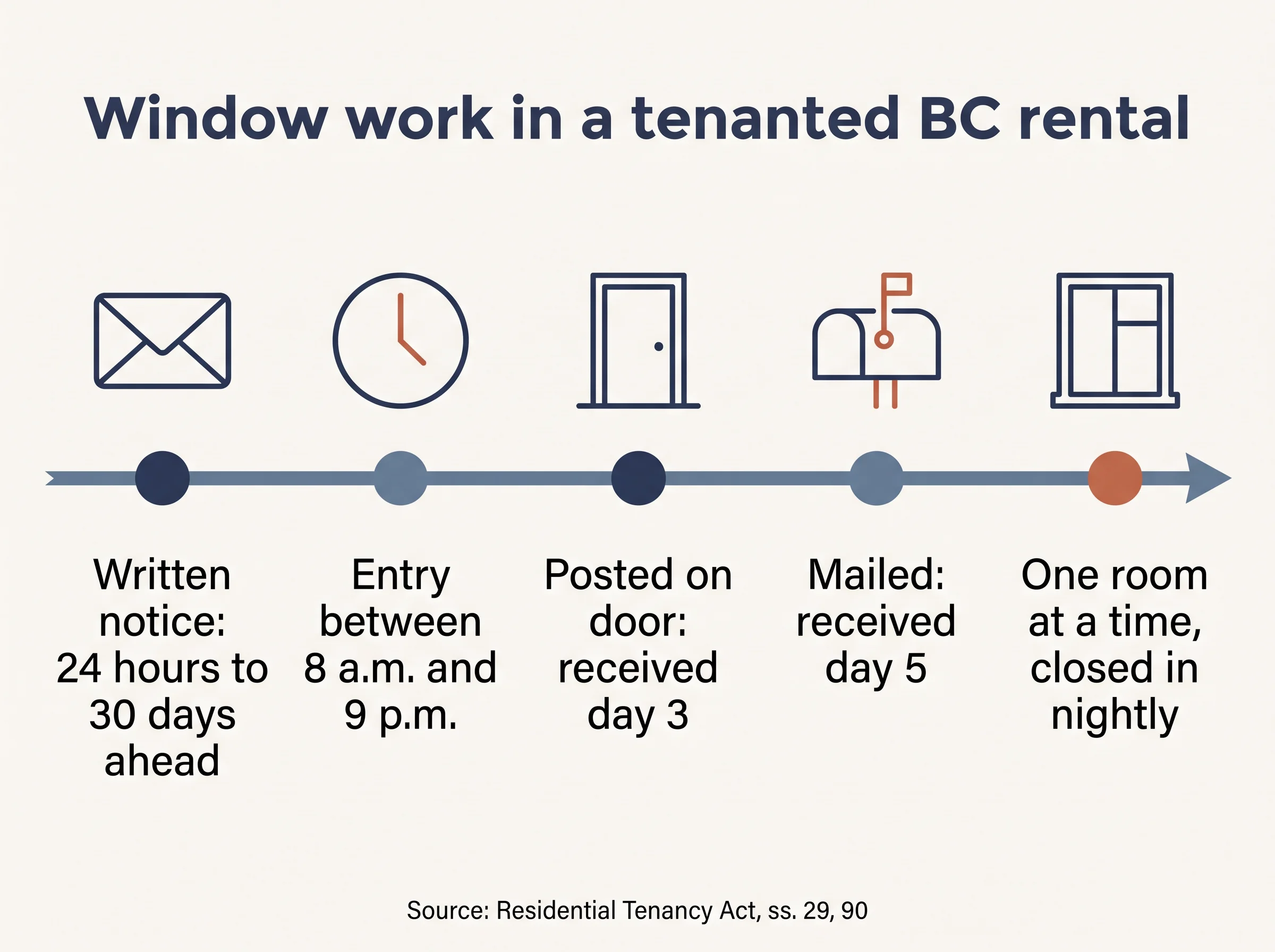
A BC landlord needs either the tenant's permission or written notice given at least 24 hours and not more than 30 days before each entry. Under section 29(1), a landlord may enter a rental unit only if one of the listed conditions applies, and for a planned project the two that matter are:
- Permission at the time of entry, or given not more than 30 days before it. A tenant's written agreement to a schedule is the cleanest way to run a multi-day job.
- Written notice at least 24 hours and not more than 30 days before the entry, stating the purpose (which must be reasonable) and the date and time, which must be between 8 a.m. and 9 p.m. unless the tenant agrees otherwise.
Two details catch landlords out. The first is deemed receipt under section 90: unless the notice is actually received earlier, the 24 hours run from the day the Act treats it as received.
| How the entry notice is delivered in BC | When it is deemed received (RTA s.90) |
|---|---|
| Attached to the door | On the third day after it is attached |
| Mailed | On the fifth day after it is mailed |
So a notice taped up on Monday does not support an entry on Tuesday. Hand delivery avoids that delay; our guide to serving documents in BC covers each method. The second detail is scope: a notice should name each day the crew needs to be in the unit. If the job runs over, give a fresh notice or get the tenant's agreement for the extra day.
How should window work be scheduled to keep a BC rental livable?
BC's Residential Tenancy Act does not set a season for window work, but the landlord's repair duty and the tenant's quiet enjoyment both point the same way: plan the job so the unit is habitable each night. In practice that means:
- One room at a time, with each opening closed in before the crew leaves for the day.
- Weather: avoid cold snaps and heavy rain where you can, and have a plan for temporary covers.
- Noise and dust: limit cutting to working hours, protect floors and belongings, and clean up daily.
- Access: tell the tenant how much clear space is needed in front of each window and help move heavy furniture if they cannot.
- Security: never leave a ground-floor opening unsecured overnight. RTB Policy Guideline 1 makes the landlord responsible for adequate locks on exterior windows.
Is a BC tenant entitled to compensation while windows are replaced?
Sometimes. A BC tenant may be compensated for substantial, ongoing loss of use of part of the unit during window work, even if the landlord made reasonable efforts to minimize the disruption, according to the Residential Tenancy Branch's Policy Guideline 6. Section 28 gives every tenant the right to quiet enjoyment, including reasonable privacy and freedom from unreasonable disturbance, and Policy Guideline 6 explains how it applies to repairs:
- A breach means substantial interference with ordinary and lawful enjoyment of the premises. Temporary discomfort or inconvenience is not enough; frequent and ongoing interference may be.
- An arbitrator balances the tenant's right to quiet enjoyment against the landlord's right and responsibility to maintain the premises.
- A tenant may be entitled to compensation for loss of use of part of the property even if the landlord made reasonable efforts to minimize disruption while making repairs or renovations.
- The amount reflects how seriously and for how long the tenant was deprived of the use of the unit.
Compensation is ordered under section 67, and Policy Guideline 16 notes that damages for lost quiet enjoyment may be calculated as a percentage of the rent. Section 65 also lets the director reduce past or future rent to reflect a reduction in the value of the tenancy. Policy Guideline 6 is clear that a tenant must not deduct rent as compensation for lost quiet enjoyment unless a director's order allows it.
Can a BC landlord and tenant agree on a rent credit for window work?
Yes. Nothing in BC's Residential Tenancy Act stops a landlord and tenant from agreeing on a credit for a disruptive project. Put it in writing: the dates, what the tenant will lose the use of, and the amount.
A clear agreement reduces the chance of a later claim and is good evidence that the landlord acted reasonably. It does not bind the Residential Tenancy Branch if the project turns out worse than either side expected.
Can a BC landlord end a tenancy to replace windows?
Almost never. Section 49.2 of BC's Residential Tenancy Act lets a landlord apply to the RTB for an order ending a tenancy for renovations or repairs only where the landlord has all necessary permits and approvals, the work requires the unit to be vacant, the work is necessary to prolong or sustain the use of the unit or building, and ending the tenancy is the only reasonable way to get the vacancy.
Window replacement is usually done room by room with the tenant in place, so the "requires the unit to be vacant" condition is hard to meet. Our guides to renovictions in BC and what a renovation order application needs explain the test.
Do you need a permit to replace windows in a BC rental?
Ask your local building department before the work is booked, especially if any opening changes size: the BC Building Code regulates building alterations and repairs as well as new construction, according to the province's BC Codes page. The province notes that BC Codes do not apply in the City of Vancouver, which has its own building bylaw.
Replacement windows in bedrooms and upper floors also bring the code's egress and window-fall rules into play; see our guide to window safety in rentals.
Can a BC landlord recover the cost of new windows?
Possibly, in two ways that both need paperwork: some provincial and utility rebates may cover part of the cost, and a BC landlord may be able to apply for an additional rent increase for eligible capital expenditures. Two things to know before the invoice is paid:
- Some rebates have strict pre-conditions (registered contractors, product labels, pre-approval for larger buildings). Check them before you buy.
- For an additional rent increase, any rebate received or available must come off the eligible amount, and the work must meet the Residential Tenancy Regulation's tests. See the general BC rent increase limit for the starting point.
How do you choose a licensed window contractor for an occupied BC rental?
In an occupied unit, the contractor's planning matters as much as the product. Before you sign, ask for:
- A room-by-room schedule showing how many openings are done each day and how each is closed in at night.
- A named site lead the tenant can reach during working hours.
- Dust and floor protection written into the quote, along with daily clean-up and removal of the old units.
- Confirmation of who obtains any permit and who books the inspection.
- Proof of a valid business licence and liability insurance, since the crew is working among the tenant's belongings.
Frequently asked questions
When is an entry notice taped to the door received in BC?
On the third day after it is attached, under section 90 of BC's Residential Tenancy Act, unless the tenant actually receives it earlier. A mailed notice is deemed received on the fifth day. The 24-hour minimum notice for entry runs from that point, so posted notices need extra lead time.
Does a BC landlord need a new notice if the window job runs over?
Yes, for each extra day the crew needs to enter. A BC entry notice should name the days and times of entry, so if the job runs over, give a fresh written notice at least 24 hours ahead or get the tenant's agreement for the extra day.
Can a BC tenant deduct rent because window replacement disrupted the unit?
Not on their own. RTB Policy Guideline 6 says a tenant must not deduct rent as compensation for lost quiet enjoyment unless a director's order allows it. The tenant can instead apply to the Residential Tenancy Branch for compensation, or agree a rent credit with the landlord in writing.
Is replacing windows a valid reason for a renoviction in BC?
Rarely. Section 49.2 of BC's Residential Tenancy Act requires, among other things, that the work needs the unit to be vacant and that ending the tenancy is the only reasonable way to get that vacancy. Window replacement is normally done room by room with the tenant in place.
Does the BC Building Code apply to window replacement in Vancouver?
No. The province notes that BC Codes do not apply in the City of Vancouver, which has its own building bylaw, so Vancouver landlords should check the city's rules and permit requirements before replacing windows.
Plan the job, then keep the record
Use Tenon10 to log the window project as maintenance requests and work orders, schedule each visit, and keep your vendors in one list, so every entry and every invoice is easy to find later.
Built for Canadian landlords and property managers.