
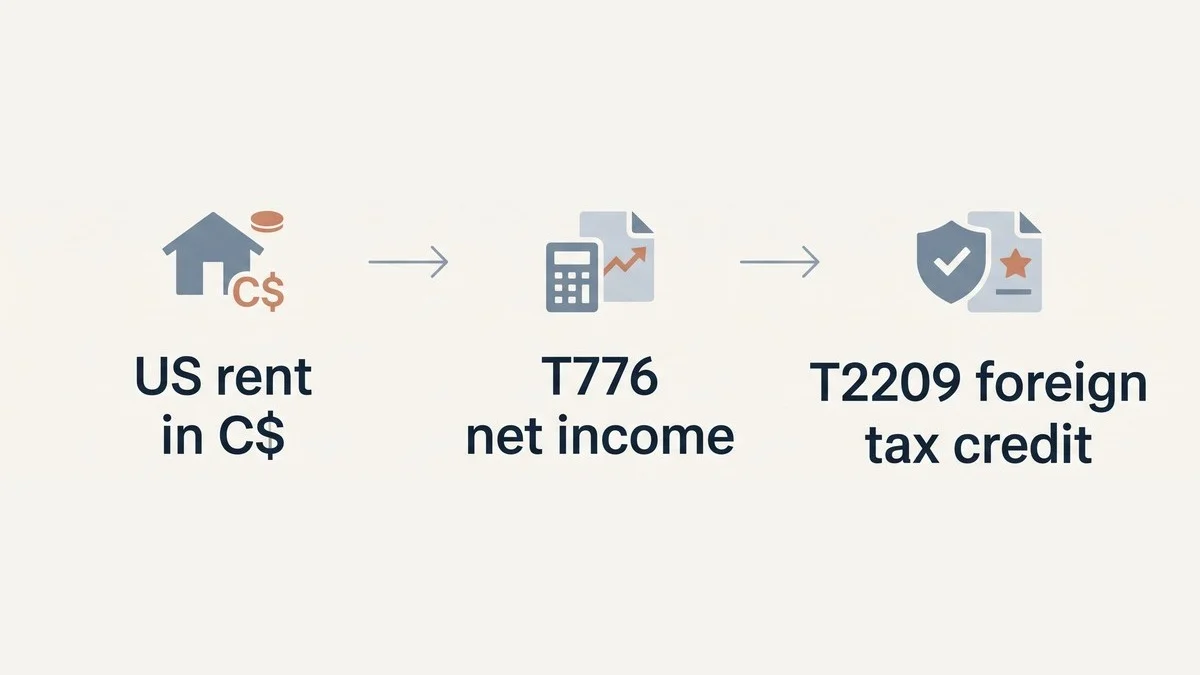
You report US rental income on your T776 in Canadian dollars, under Canadian expense and capital cost allowance rules, then claim the US income tax on that rent as a federal foreign tax credit on Form T2209 (and a provincial one on Form T2036), limited to the Canadian tax on the same income.
This how-to covers the Canadian return only, for the 2025 tax year. For how the US side works and how the two returns fit together, see the pillar guide in this series, Canadians Who Own a US Rental: The Complete Tax Guide.
What do you need before you start?
- A US-dollar ledger of rent and expenses for the property, with the date of each amount.
- Your filed or final US figures: Form 1040-NR (if you made the net-basis election) or the Form 1042-S showing 30% withheld.
- The Bank of Canada exchange rates you will use (see step 1).
- Your capital cost allowance (CCA) schedule for the building, kept in Canadian dollars.
How do you report US rent on the T776, step by step?

- Convert every amount to Canadian dollars. The CRA's line 40500 page says to use the Bank of Canada rate in effect on the day an amount arose, or the average annual rate for amounts paid at different times in the year.
- Fill in the T776 as you would for a Canadian property. Gross rent, then the expenses the CRA allows. A deduction allowed on the US Schedule E is not automatically allowed in Canada; our T776 expense deep-dive covers the CRA list.
- Use CCA, not US depreciation. The 27.5-year US schedule in IRS Publication 527 has no role on the T776. The CRA's T4036 Rental Income guide sets out the CCA classes and the limits on using CCA to create a rental loss; our CCA explainer covers when not to claim it.
- Carry the net figure to line 12600. T4036 says to enter the amount from line 9946 of the T776 on line 12600 of your return.
- Complete Form T2209 for the federal foreign tax credit, then Form T2036 for the provincial or territorial credit, and enter the results where the line 40500 page directs.
How much foreign tax credit can you claim?
The federal credit for the US is the lesser of the US tax you paid on the income and the Canadian tax on that income. Income Tax Folio S5-F2-C1 (¶1.74) writes the Canadian-tax side as foreign non-business income ÷ worldwide income × Canadian tax otherwise payable, calculated country by country (¶1.91).
Worked example (illustrative figures only)
| Item | Amount |
|---|---|
| US tax on the rent per filed 1040-NR | US$1,100 × 1.3978 = C$1,538 |
| Net US rental income on the T776 | C$10,000 |
| Net income for the year | C$100,000 |
| Canadian federal tax otherwise payable (assumed) | C$15,000 |
| Limit: 10,000 ÷ 100,000 × 15,000 | C$1,500 |
| Federal credit (lesser of C$1,538 and C$1,500) | C$1,500 |
Form T2036 then works out any provincial or territorial credit. The rate 1.3978 is the Bank of Canada's 2025 annual average US dollar rate; the other figures are invented for the example.
What US tax does not count for the credit?
Only tax you actually owe the US counts. Folio S5-F2-C1 says a portion that is refunded, or will be, is not foreign tax paid (¶1.33), and neither is a voluntary payment (¶1.34). If 30% was withheld on gross rent and filing a 1040-NR would get part of it back, claim only the tax actually owed. Real property rental income is not subject to the 15% cap on an individual's other property income (¶1.22), and an unused credit on non-business income cannot be carried to another year (¶1.24).
What goes wrong most often?
- US depreciation copied to the T776. Replace it with CCA.
- Two exchange rates for one property. Rent at the average, tax at a year-end rate: the folio asks for the same rate.
- The Canadian return filed before the US figure is final. The T1 is due April 30, 2026 for most people (CRA) and the 1040-NR June 15, 2026. If the US tax changes, the credit may need to be adjusted.
- No proof on file. Paper filers who paid US tax attach the US return and a US tax account transcript, per the line 40500 page. Our guide to CRA rental audits covers the records to keep.
Frequently asked questions
Which exchange rate do I use for monthly US rent?
The CRA's line 40500 page says that for amounts received at different times in the year you can use the average annual exchange rate. A one-off amount uses the Bank of Canada rate for the day it arose.
Is the 30% withheld from my rent creditable?
Only the part that is your actual US tax. Folio S5-F2-C1 excludes amounts that are or will be refunded, so if a 1040-NR would recover part of the 30%, that part is not creditable.
Do I also need to file Form T1135?
If the total cost of your specified foreign property passed C$100,000 at any time in the year, yes; a rental outside Canada counts, according to the CRA's T1135 questions and answers.
Can I claim the credit if I had a rental loss?
The credit is limited by the Canadian tax on the US income, so with no net US income there is no Canadian tax on it for the credit to offset.
Need the basics first? Our step-by-step T776 form guide covers every line.
Get your rental return organized
Tax guides and checklists for Canadian landlords
Free • No signup required