Breaking a fixed-term lease in Alberta has no notice that ends it early. A tenant who leaves can owe rent until the term ends, minus what the landlord recovers by re-renting, because the landlord must try to mitigate. The clean exits are a written agreement to end, an approved assignment or sublet, or the domestic violence notice.
A fixed term ends on its stated date with no notice from either side; see ending a tenancy in Alberta.
What happens if you just move out?
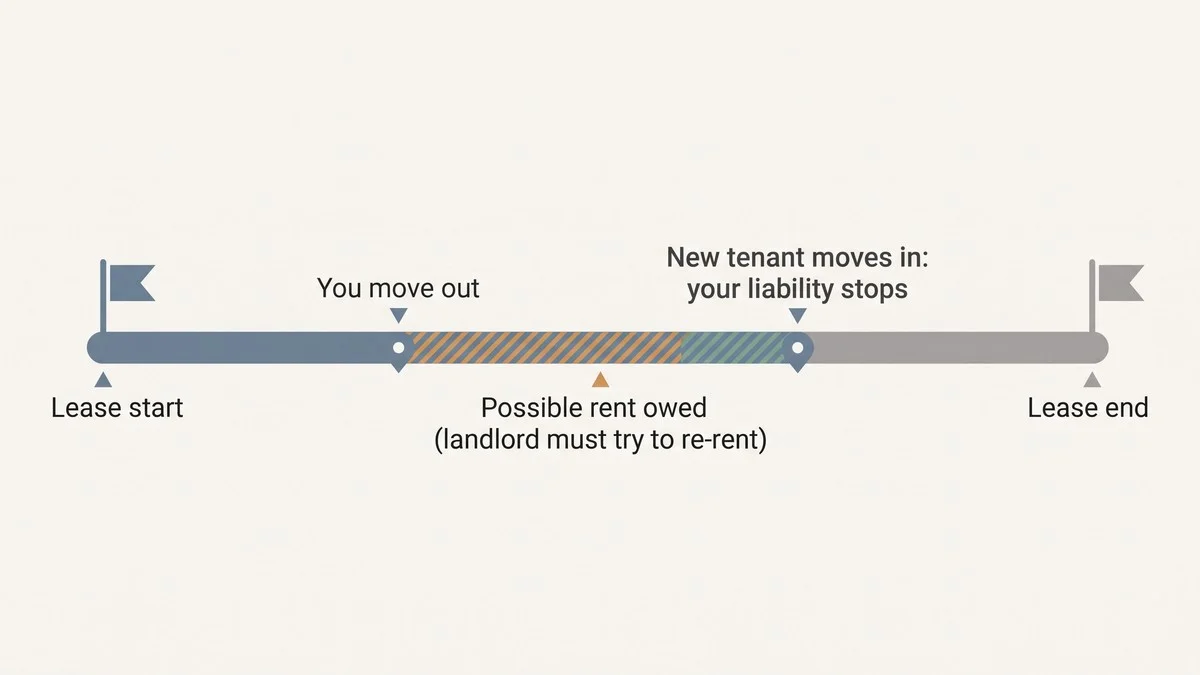
Under RTA s.27, the landlord may accept that you have repudiated the lease or keep the tenancy going. Either way they must make reasonable efforts to mitigate, and once they re-rent, your liability stops when the new tenancy starts. You may still owe rent for the gap.
The two choices lead to slightly different claims:
| Landlord's choice | What the landlord may recover | Duty |
|---|---|---|
| Accepts the repudiation as ending the tenancy (s.27(1)(a)) | Damages for any breach before you left, plus damages for the loss of the benefit of the lease until the fixed term would have expired (s.27(3)) | Reasonable efforts to mitigate those damages (s.27(4)) |
| Refuses it and keeps the tenancy going (s.27(1)(b)) | Rent as it falls due until the term expires, as long as the unit has not been re-rented (s.27(7)) | Reasonable efforts to mitigate your liability for rent (s.27(5)) |
Either way, renting to a new tenant is treated as accepting your repudiation as of the day the new tenancy starts (s.27(6)). That date is where your rent liability ends.
A worked example: leaving five months early
A tenant signs a one-year lease from February 1, 2027 to January 31, 2028 at $1,800 a month, and moves out on June 30, 2027 with seven months left. The landlord advertises at once and a new tenant starts August 1.
- July: the unit sits empty, so the landlord can claim the $1,800 for that month.
- August to January: the new tenancy started August 1, so the first tenant's liability for rent stopped that day (s.27(6)).
- If the new rent is lower, say $1,700, the landlord may argue that the $100 a month difference for the six remaining months ($600) is part of the "loss of the benefit" of the lease under s.27(3)(b). Whether that is owed, and whether the landlord's mitigation was reasonable, is for the RTDRS or the court to decide if you cannot agree.
Had the landlord waited months before advertising, the tenant could argue that the landlord did not make reasonable efforts to mitigate, and that the claim should be reduced.
Can the landlord show the unit before you leave?
Only with your consent, in most cases. The Act lets a landlord enter on 24 hours' written notice to show the premises to prospective tenants only after a notice ending a periodic tenancy has been served, or during the last month of a fixed term (s.23(3)(e)). Mid-term, showings to new tenants depend on your agreement, which is one more reason to offer it in writing: it speeds up re-renting and lowers what you may owe.
How can a tenant end a fixed-term lease early?
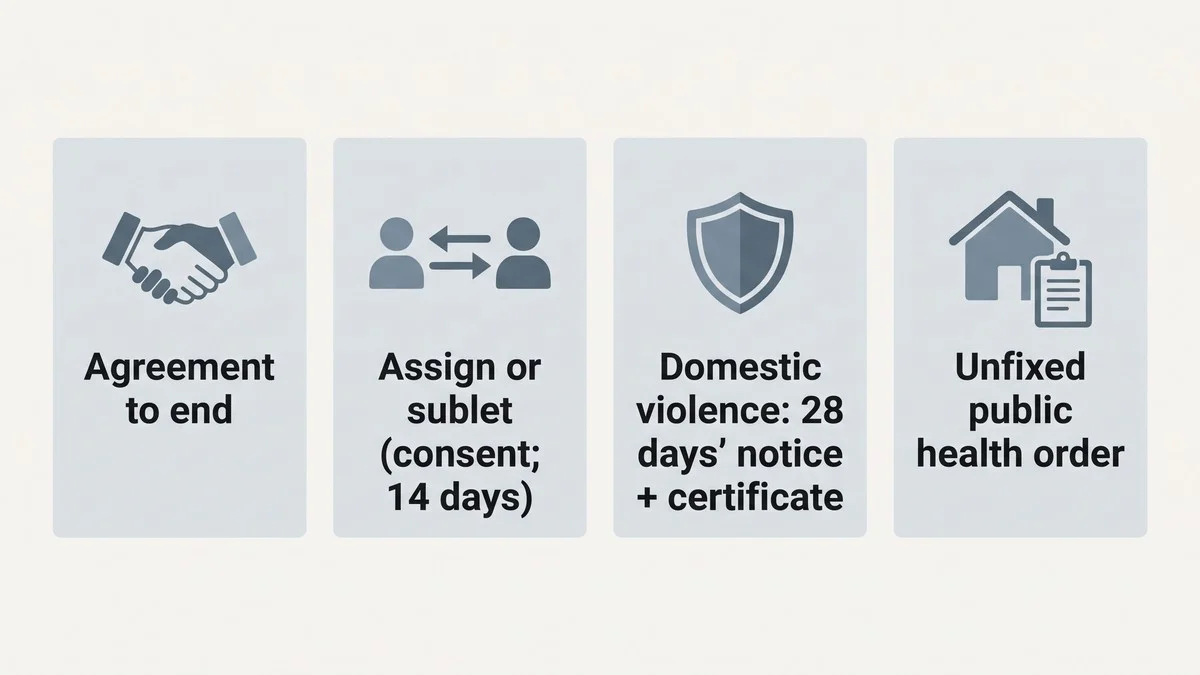
- Agreement to end. You and the landlord sign an end date.
- Assignment or sublet (s.22). Needs the landlord's written consent, which cannot be refused without reasonable grounds. A refusal must give written reasons; no reply within 14 days is deemed consent; no fee may be charged.
- Domestic violence (s.47.3). 28 days' notice with a certificate from the designated authority, served within 90 days of its issue. Rent is owed only for the notice period, with no early-termination penalty.
- Landlord's breach of health standards under a public health order (s.28); see repairs and minimum housing standards.
Each route has its own detail. For the consent request and the difference between assigning and subletting, see Subletting in Alberta; for the certificate and how to apply for it, see the Safer Spaces certificate guide.
The health-standards route is narrow. It needs both a substantial breach by the landlord and an order from an executive officer under section 62 of the Public Health Act that the tenant reasonably believes the landlord has not obeyed. The tenant's notice must be in writing, signed, give the reasons and the termination date, and be served at least 14 days before that date. It does not take effect if, within 7 days of receiving it, the landlord serves a written objection and has by then complied with the order or obtained a stay (s.28(3)).
Steps to leave early and owe as little as possible
- Read your lease for the end date and any clause about assignment or subletting.
- Ask the landlord in writing whether they will agree to end the tenancy on a set date. If they agree, put it on a signed agreement to end.
- If not, find a replacement and ask in writing for consent to assign or sublet. Note the date the landlord received the request.
- Give a written move-out date and offer access for showings.
- Leave the unit clean and empty. Goods left behind are dealt with under the abandoned-goods rules (s.31); see belongings left in an Alberta rental.
- Do the move-out inspection and give a forwarding address for the deposit.
- Keep copies of every message, listing and receipt in case the amount owed goes to a hearing.
What about the security deposit?

The usual rules apply: a move-out inspection, then the deposit or a statement within 10 days. See Alberta security deposits.
Under a domestic violence notice, the tenant can ask the landlord to apply the security deposit to the rent for the 28-day notice period, and the landlord must do so (s.47.3(4)(c)).
Frequently asked questions
Can a lease charge a lease-break fee?
The Act does not set one. A landlord's recovery under s.27 is damages, subject to mitigation; a domestic violence notice bars such penalties.
Can the landlord refuse a sublet?
Only on reasonable grounds, given in writing.
Does a fixed term renew automatically?
If you both agree to continue without a new fixed term, it becomes periodic.
I bought a house or got a job in another city. Is that a legal way out?
The Act has no early-exit ground for a home purchase or a job move. The options are the ones above: an agreement with the landlord, or an assignment or sublet with consent.
Does a domestic violence notice end the lease for my roommates too?
Yes. It ends the tenancy for all tenants of the premises, although the others and the landlord can agree to a new tenancy (s.47.3(5)).
Who decides what I owe?
The RTDRS or court, if you cannot agree. How the service works: RTDRS explained.
Agreed to end early?
Put the date in writing with the free Alberta Agreement to End the Tenancy. Fill it out online and download the PDF.
Free • No signup required