

A clogged toilet or drain in an Ontario rental is the landlord's to fix and usually to pay for, because O. Reg. 517/06, s. 9(1), requires drains to be kept free from obstructions. The tenant pays only where they, an occupant or a guest caused undue damage wilfully or negligently (RTA s. 34), and the landlord must prove it.
A clogged toilet or drain is the most common plumbing call in any rental, and the one most likely to end in an argument about the bill. This guide sets out where the line falls, how a landlord can recover the cost, and what neither side should do.
Who pays for a clogged toilet or drain in an Ontario rental?

In Ontario, the landlord arranges the repair promptly whatever caused the blockage, and pays for it unless the tenant's own wilful or negligent conduct caused it.
| Question | Answer |
|---|---|
| Who arranges the repair? | The landlord, promptly, whatever caused the blockage |
| When does the landlord pay? | Blockages from age, wear, tree roots, building design or the building's main lines |
| When does the tenant pay? | Only where the tenant, an occupant or a guest caused undue damage wilfully or negligently, for example by flushing items that do not belong in a toilet |
What does an Ontario landlord have to do about blocked drains?
An Ontario landlord must keep drains clear and fix a blocked toilet or drain within a reasonable time, because the maintenance standards require plumbing and drainage to be free from obstructions. Section 20(1) of the Residential Tenancies Act, 2006 makes the landlord responsible for keeping the unit in a good state of repair and complying with maintenance standards. The provincial standard in O. Reg. 517/06 is direct: plumbing and drainage systems must be maintained free from leaks, defects and obstructions (section 9(1)), every unit must have a toilet, kitchen sink, washbasin and bathtub or shower (section 10(1)), and those fixtures must be kept in a good state of repair and a safely operable condition (section 10(5)). Section 9(3) adds that the means of sewage disposal must be kept in a good state of repair.
Toronto's Chapter 629, Property Standards adds that basements with concrete floors need trapped floor drains kept in good repair and connected to the sewage system. Toronto's new chapter, coming into force on May 1, 2027, spells out that plumbing must be capable of draining sinks and basins under normal conditions of use (By-law 1512-2025).
So a tenant with one bathroom and a toilet that will not flush has a repair the landlord must deal with within a reasonable time, not a problem to solve on their own.
Is a blocked drain in an Ontario rental tenant-caused or wear and tear?
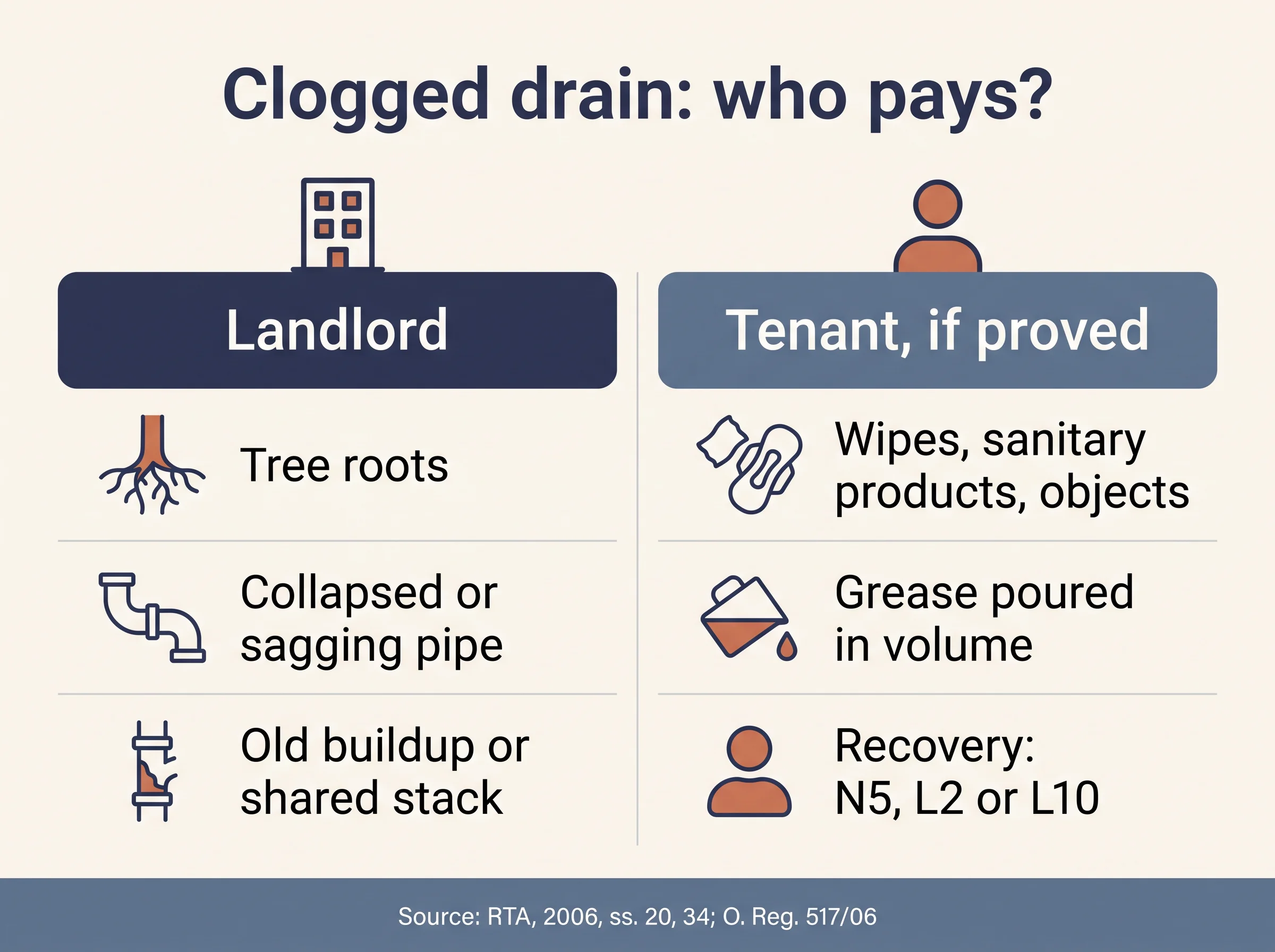
In Ontario, a blockage is the tenant's cost only if it is undue damage caused by the wilful or negligent conduct of the tenant, another occupant or a guest (RTA s. 34), and the LTB's L2 instructions add that normal wear and tear is not undue damage. In drain terms, the conservative reading is:
| What the plumber finds | Usually whose cost |
|---|---|
| Tree roots in the sewer line | Landlord |
| A collapsed, sagging or corroded pipe | Landlord |
| Grease and scale that built up over years in an old line | Landlord |
| A blockage in a shared stack or main | Landlord |
| A toilet or trap worn out with age | Landlord |
| A recurring backup that points to the building's system | Landlord |
| Wipes, diapers, sanitary products, a toy, cooking fat poured in volume, or construction debris from the tenant's own work, in a line that serves only that unit | Possibly the tenant |
The tenant does not have to prove innocence; the landlord has to prove the cause. That is why the plumber's findings matter more than anyone's opinion.
What do repeat blockages mean in an Ontario rental?
In an Ontario rental, a drain that blocks every few months is often a sign of a problem in the line itself (roots, a belly in the pipe, poor slope) rather than tenant behaviour. Charging a tenant for each visit without checking the line risks an LTB finding that the landlord never fixed the real problem. A camera inspection of the line is the usual way to tell which it is before anyone is billed.
How does an Ontario landlord recover the cost of a clogged drain?
An Ontario landlord fixes the drain first, asks in writing, and then recovers the cost through the Landlord and Tenant Board on an N5, an L2 or an L10, never through rent or the rent deposit.
- Fix it first. Do not leave a unit without a working toilet while arguing about fault.
- Ask in writing, attaching the invoice and the plumber's findings.
- Form N5, if the damage was undue and wilful or negligent. Section 62 lets the landlord serve a notice of termination that gives the tenant seven days to repair or pay the reasonable cost; the notice is void if the tenant pays or makes satisfactory arrangements. See our N5 guide and Form N5.
- Form L2, to claim the money. The L2 lets a landlord claim compensation for damage from a sitting tenant, with or without ending the tenancy.
- Form L10, after move-out. A former tenant can be pursued within one year of leaving on the L10 (section 89(1.1)).
The LTB filing fee for an L2 or L10 is $201, or $186 through the Tribunals Ontario Portal, which is worth weighing against a single plumbing invoice.
What should an Ontario tenant do about a clogged toilet or drain?
An Ontario tenant should report the blockage to the landlord in writing, try only a plunger, and never hire a plumber and deduct the bill from rent without the landlord's agreement or an LTB order.
- Report it in writing, with photos and the date it started. Note if more than one fixture is affected; that often points to a main line.
- Try only the basics. A plunger is ordinary use. Avoid chemical drain cleaners or taking apart fixtures; damage from your own repair attempt can become your cost.
- Do not hire a plumber and deduct it from rent without the landlord's agreement or an LTB order. The LTB can authorize a repair the tenant paid for and order the landlord to reimburse it (section 30(1), paragraph 3), but that is the LTB's call, after the fact.
- If nothing happens, see our guide to what to do when a plumbing repair is not done.
Who handles a sewage backup in an Ontario rental?
The Ontario landlord: a backup of sewage into a unit is a health hazard and, in practice, an emergency, so the landlord may enter without written notice (section 26(1)(a)) to stop it and make the unit safe. Cleanup and repair of the building fall to the landlord; damage to the tenant's belongings follows the same rules as any water damage claim. Toronto's permit page lists installing a backwater valve as work that needs a building permit.
Choosing a licensed plumber: what should you check for drain work in Ontario?
In Ontario, check the plumber's certificate and, in some cities, a separate drain licence, because drain work has its own licensing wrinkle:
- Plumber's certificate. Plumbing is a compulsory trade in Ontario; a worker needs a registered training agreement or a provisional or full certificate of qualification, and the Skilled Trades Ontario public register lists certified people.
- Drain licence where the city requires one. Toronto, for example, requires a Drain Layer licence for anyone who repairs drains or removes tree roots or other obstructions from them. Check your own municipality's licensing rules.
- A camera report for repeat blockages. When a drain clogs again and again, ask for an inspection that records what was found and where. Roots or a collapsed section point to the building; a wad of wipes points to use.
- Insurance and warranty. Confirm coverage before anyone works in an occupied unit and keep the guarantee on the clearing or repair.
What are the key points about a clogged toilet or drain in an Ontario rental?
- Ontario's maintenance standards require drains to be kept free from obstructions, and the landlord arranges the repair.
- The tenant pays only for undue damage they, an occupant or a guest caused wilfully or negligently; wear and tear is not undue damage.
- The plumber's written findings decide most disputes.
- Recovery runs through an N5, an L2 or an L10, never through rent or the rent deposit.
- Repeat blockages usually mean a line problem the landlord has to fix.
Frequently asked questions
Who pays for a clogged toilet in an Ontario rental?
The landlord arranges and pays for the repair unless the tenant, an occupant or a guest caused undue damage wilfully or negligently, for example by flushing items that should not be flushed. The landlord has to prove the cause.
Can my Ontario landlord add the plumber's bill to my rent?
No. A landlord who believes the tenant caused the damage can ask for payment, serve an N5, or apply to the LTB on Form L2 (or L10 after move-out).
Is a blocked drain an emergency in Ontario?
A single slow drain usually is not. A sewage backup or an overflowing toilet that is damaging the unit or another unit can be, and allows entry without written notice.
Can an Ontario landlord keep my last month's rent deposit for drain damage?
No. Ontario allows only a rent deposit, which must be applied to the last rent period (sections 105 and 106 of the Act).
Can an Ontario tenant hire a plumber and deduct the bill from rent?
Not without the landlord's agreement or an LTB order. The LTB can authorize a repair the tenant paid for and order the landlord to reimburse it (section 30(1), paragraph 3), but that is the Board's decision, after the fact.
Keep every plumbing repair on the record
In Tenon10, a tenant with an active lease submits a maintenance request from their account and the landlord tracks it to completion, so the dates the Landlord and Tenant Board asks about are already written down.
Built for Canadian landlords and property managers.


