Frozen pipes in an Ontario rental are usually the landlord's responsibility: O. Reg. 517/06, s. 9(1), requires plumbing to be "adequately protected from freezing", and the landlord must thaw, repair and restore water quickly. A tenant pays only if they, an occupant or a guest caused the freeze wilfully or negligently (RTA s. 34), which the landlord must prove.
Every Ontario winter brings the same calls: no water in the morning, a bulge in a pipe along an outside wall, or water pouring from a ceiling after a thaw. This guide covers who has to fix frozen pipes right now and who pays for the damage afterwards, and sets out the practical prevention steps for landlords and tenants, including the vacant-unit risk that catches many landlords out.
What does Ontario law say about protecting rental pipes from freezing?
Ontario's maintenance standards require plumbing and drainage systems to be maintained free from leaks, defects and obstructions and "adequately protected from freezing" (O. Reg. 517/06, s. 9(1)), and section 2(2) of the regulation puts compliance on the landlord unless the regulation says otherwise. O. Reg. 517/06 is made under the Residential Tenancies Act, 2006, and these provincial standards apply where no municipal property standards by-law covers the building (section 224 of the Act).
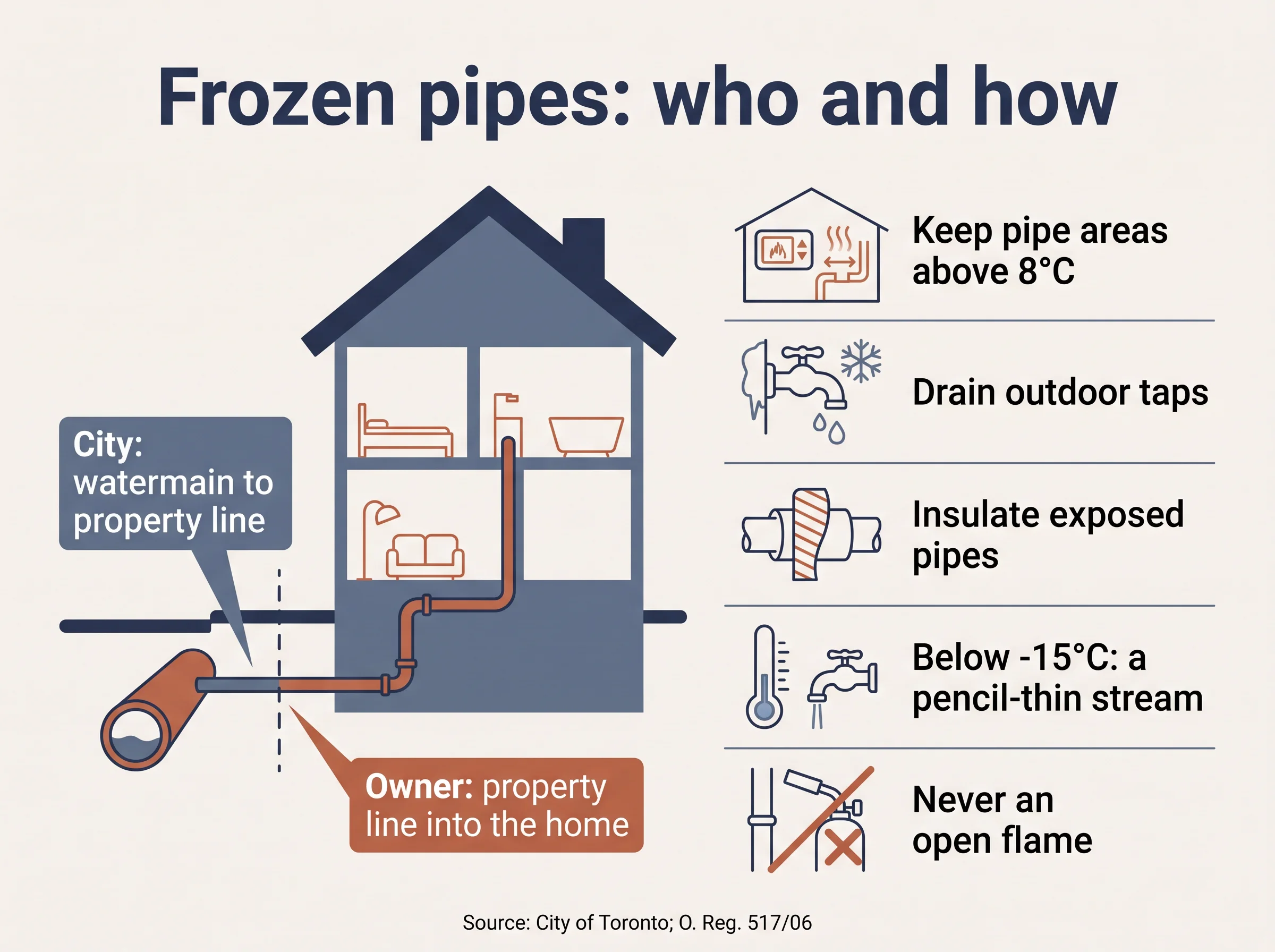
Municipal by-laws say much the same. Toronto's Chapter 629, Property Standards requires the plumbing system to be kept in good working order, free from leaks or defects and protected from freezing. Toronto's water by-law, Chapter 851, goes further for the pipe that brings water in from the street: the property owner must make sure private water service pipes are protected from freezing, is responsible for damage and water loss caused when they freeze, and is responsible for thawing them. The City's frozen pipes page explains the split: the City is responsible for the water service pipe from the watermain to the property line, and property owners and landlords for the part from the property line into the home.
Chapter 851 decides the City's position against the owner. It does not decide whether a landlord can recover from a tenant; that is a question for the Residential Tenancies Act.
How does heat affect frozen pipes in an Ontario rental?
Where an Ontario landlord supplies heat, O. Reg. 516/06 makes heat a vital service from September 1 to June 15 and requires at least 20°C in habitable space (section 4), and most frozen pipes start with a cold space. That provincial floor does not apply to a unit where the tenant controls the temperature and the primary heat source can maintain 20°C (section 4(3)). Many cities set higher or longer rules; see our guide to heat by-laws in Toronto, Hamilton and Ottawa.
Two practical consequences follow. A landlord who controls the boiler or furnace must keep it running and keep unheated spaces with pipes (crawl spaces, garages, utility rooms) from freezing. And a tenant who controls the thermostat has a real role in prevention, which is where most disputes about who pays begin.
When can an Ontario tenant be charged for a frozen pipe?
An Ontario tenant can be charged only for undue damage caused by the wilful or negligent conduct of the tenant, another occupant or a guest (RTA s. 34), and the landlord has to prove it. Applied to frozen pipes, the conservative reading is:
| Usually the landlord's cost | Possibly the tenant's cost |
|---|---|
| Pipes in uninsulated exterior walls | A tenant who controls the heat switches it off during a deep freeze while away, and a pipe bursts as a result |
| A failed furnace or boiler | A tenant ignores a written request to keep a heater running |
| Drafts the landlord was told about | A tenant leaves a window open in extreme cold |
| An outdoor tap never drained; a building-wide heating failure | Even then, the landlord must show negligence, and an LTB member will weigh what the tenant was told |
Our companion guide on water damage: who pays explains how the cost is claimed through an N5, an L2 or an L10.
How do you prevent frozen pipes in an Ontario rental?
Seal drafts, drain outdoor taps, insulate exposed pipes and keep areas with water pipes above 8°C: that is the City of Toronto's advice, and it applies anywhere in Ontario. The City of Toronto checklist:
- Seal drafts around windows, doors, vents, wiring and pipes.
- Disconnect outdoor hoses, turn off the outdoor supply if there is a separate shut-off, and open outdoor taps to drain them.
- Insulate exposed pipes in basements, crawl spaces, garages and attics.
- Find the main water shut-off valve and make sure it works.
- Keep areas with water pipes above 8°C, especially near the water meter, and keep garage doors closed if pipes run through them.
- Open kitchen, bathroom and laundry cabinet doors so warm air reaches the plumbing.
- When night-time temperatures drop below -15°C, you may run a pencil-thin stream of water from vulnerable taps (you pay for the water).
For tenants, the City adds: report drafts to the landlord, ask who is responsible for outdoor taps, plumbing and shut-off valves, and find out who to contact during and after business hours.
Who protects a vacant Ontario rental unit from frozen pipes?
The Ontario landlord alone: a unit between tenants has no one to notice a cold room or a dripping fitting, so nobody else carries the prevention duty. For a vacant unit:
- Keep the heat on at a safe level and check it regularly in cold weather.
- If the unit will sit empty in deep winter, consider having a plumber shut off and drain the supply lines.
- Check your property insurance for conditions about vacant or unheated buildings, and follow them in writing.
- Schedule move-ins and turnovers so the unit is not left cold for days.
What should you do if a pipe freezes or bursts in an Ontario rental?
In an Ontario rental, turn off the main water supply if a pipe has burst, call the landlord's emergency contact, thaw gently without an open flame, and expect water to be restored quickly because cold water is a vital service (RTA s. 2). Step by step:
- Burst or about to burst: turn off the main water supply if you can, then call the landlord or their emergency contact. A burst pipe is an emergency, and section 26(1) lets a landlord enter without written notice in an emergency. Our guide to plumbing emergencies and entry covers the details.
- No water but no leak: report it to the landlord. Toronto's advice is to check pipes along exterior walls and where the service pipe enters the foundation, open the lowest cold tap so water can flow as the ice melts, and thaw gently with a hair dryer, heating pad or warm towels.
- Never use an open flame. The City warns against blowtorches, propane heaters or any open flame because of fire and carbon monoxide risk.
- Restore water quickly. Cold water is a vital service under section 2 of the Act; a landlord must restore the supply and not leave the tenant waiting without a plan.
Choosing a licensed plumber: who should thaw or repair frozen pipes in Ontario?
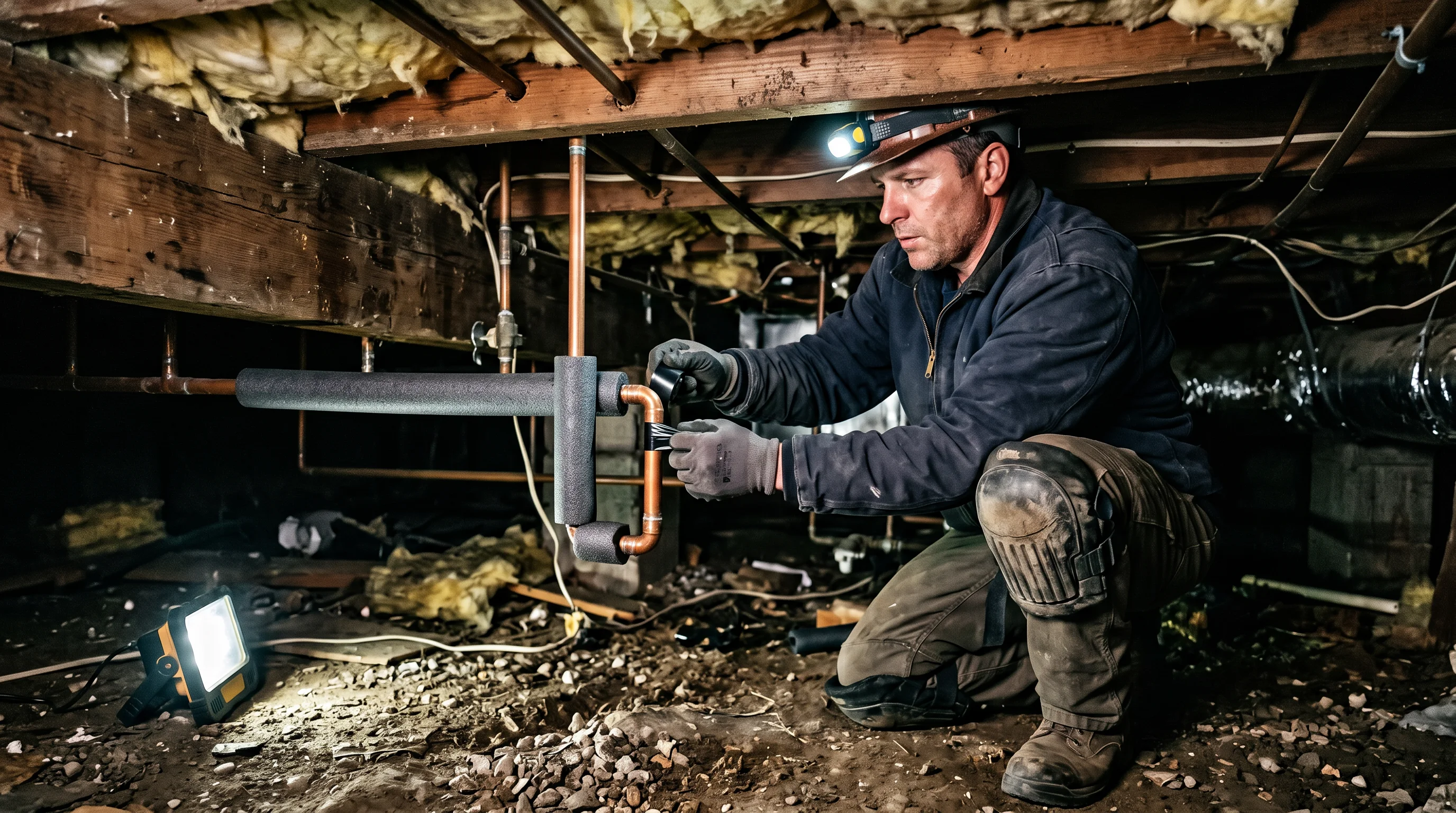
In Ontario, thawing a line or replacing a split section is work for a certified plumber, because plumbing is a compulsory trade. Before the job starts:
- Look the person up. Ontario treats plumbing as a compulsory trade, so anyone doing it must be an apprentice on a registered training agreement or hold a provisional or full certificate of qualification. The Skilled Trades Ontario public register shows who is certified.
- Know when a permit applies. In Toronto, installing or modifying a plumbing system (rerouting pipe, for example) needs a building permit; swapping a fixture does not. Moving a line away from a cold exterior wall may cross that line, so ask your own municipality.
- Ask for the reason on paper. "Froze where the line runs through an uninsulated wall" points to the building; "heat was off in the unit" points elsewhere. Either way, write it down while it is fresh.
- Check coverage and warranty for the repair before work starts in an occupied home.
What are the key points about frozen pipes in an Ontario rental?
- Ontario's maintenance standards and municipal by-laws require plumbing to be protected from freezing, and that duty sits with the landlord.
- Where the landlord supplies heat, 20°C is the provincial floor from September 1 to June 15; many cities require more.
- A tenant pays only if their own wilful or negligent conduct caused the freeze, and the landlord must prove it.
- Vacant units are the landlord's responsibility alone: keep them heated, checked or drained.
- In Toronto, the City is responsible for the service pipe up to the property line; the owner is responsible from there into the building.
For the wider winter checklist (heat by-laws, snow and ice, and pipes), see winter-proofing Ontario rentals.
Frequently asked questions
Who pays for frozen pipes in an Ontario rental?
Usually the landlord, because Ontario's maintenance standards require plumbing to be protected from freezing (O. Reg. 517/06, s. 9(1)). A tenant pays only where they, an occupant or a guest caused undue damage wilfully or negligently, for example by turning off the heat they control during a deep freeze.
Can an Ontario landlord make a tenant pay if the tenant was away and the pipes froze?
Not automatically. The landlord would have to show the tenant's conduct was negligent under RTA s. 34, and what the tenant was told about keeping the heat on matters. Being away is not, on its own, negligence.
Who is responsible for the water pipe between the street and the house in Toronto?
The City of Toronto is responsible from the watermain to the property line. The property owner or landlord is responsible from the property line into the home.
Can an Ontario landlord enter without notice to deal with a frozen pipe?
Yes if it is an emergency, such as a burst or leaking pipe (RTA s. 26(1)). To inspect pipes as a precaution, the landlord needs the tenant's consent at the time or 24 hours' written notice.
How warm should an Ontario rental be kept to stop pipes freezing?
The City of Toronto advises keeping areas with water pipes above 8°C, especially near the water meter. Separately, where the landlord supplies heat, O. Reg. 516/06 requires at least 20°C in habitable space from September 1 to June 15.
Keep every plumbing repair on the record
In Tenon10, a tenant with an active lease submits a maintenance request from their account and the landlord tracks it to completion, so the dates the Landlord and Tenant Board asks about are already written down.
Built for Canadian landlords and property managers.