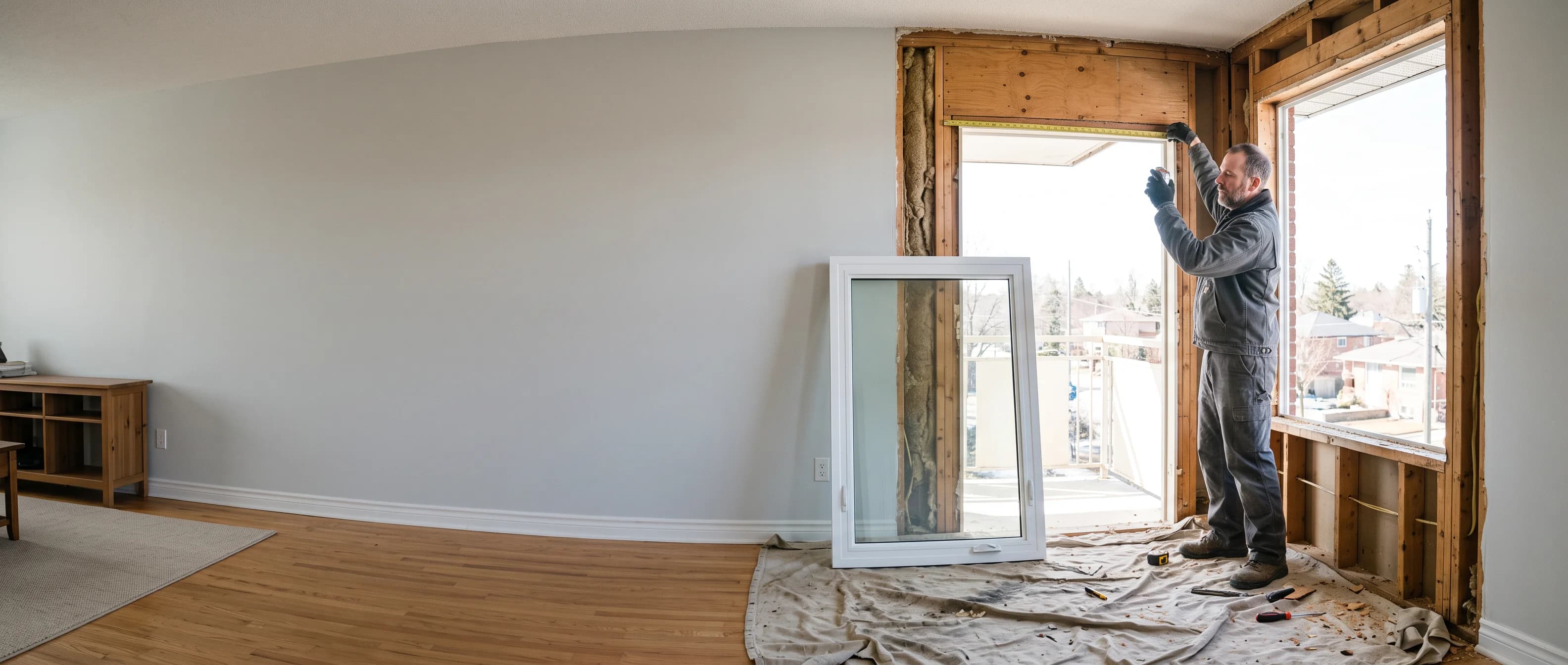
If there is no heat in an Ontario apartment between September 1 and June 15, the landlord is breaking the law: heat is a vital service then, and rooms must reach 20°C (O. Reg. 516/06, s. 4). Report it in writing today, call the city if it is not fixed fast, then apply to the LTB. Keep paying rent.
This article is the tenant's action plan, in the order to follow it. For the legal background on vital services generally, see vital services in Ontario; for city temperature rules, see heat by-laws in Toronto, Hamilton and Ottawa.
Is no heat in an Ontario rental a safety emergency?
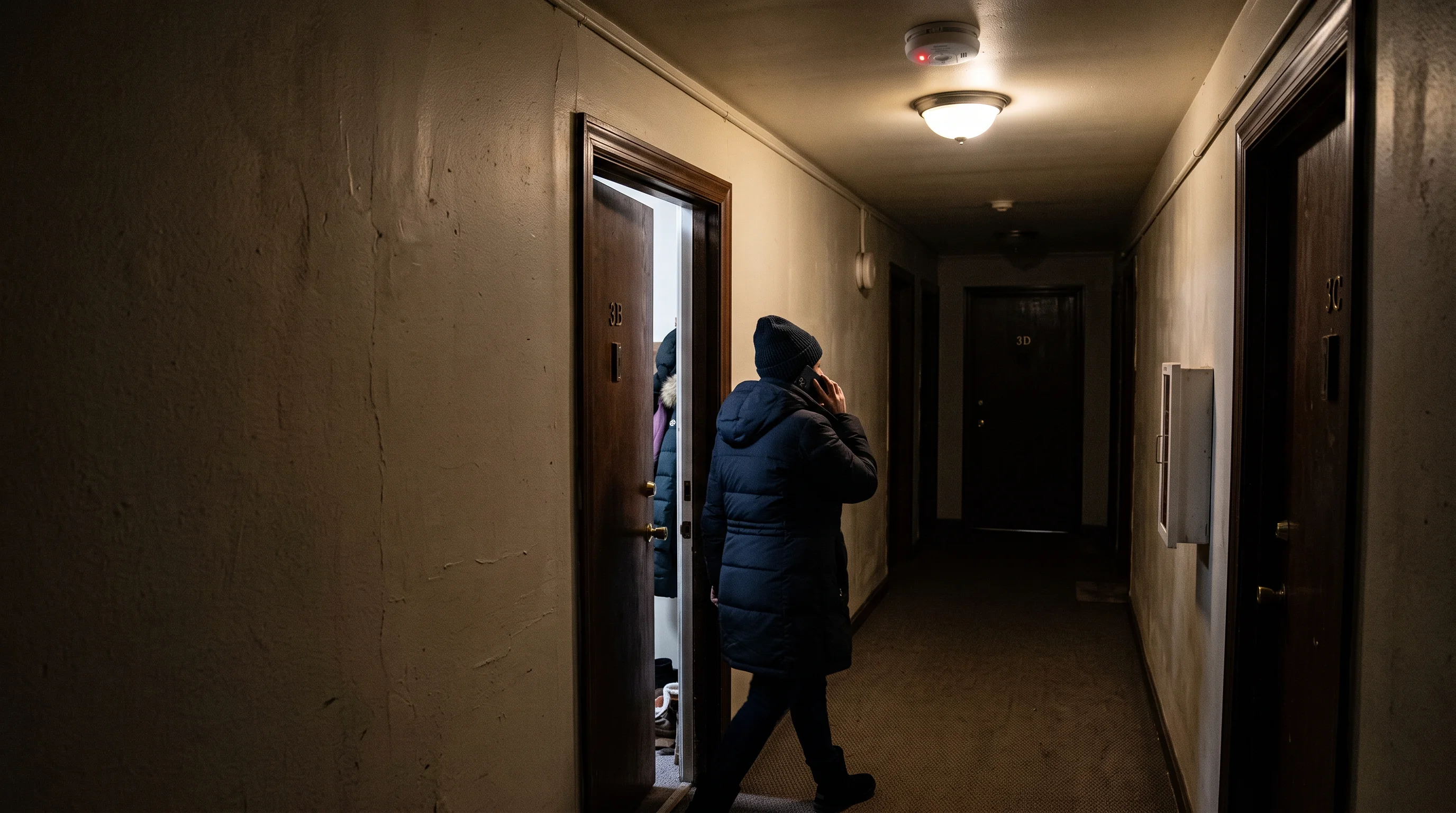
A gas smell, a sounding carbon monoxide alarm, or a furnace that is smoking or smells of burning is a safety emergency in any Ontario rental: leave the unit and call 911 or your gas utility's emergency line, then deal with the landlord. Everything below is for a furnace, boiler or heat pump that has simply stopped heating, or is not heating enough.
What heat does Ontario law guarantee a tenant?
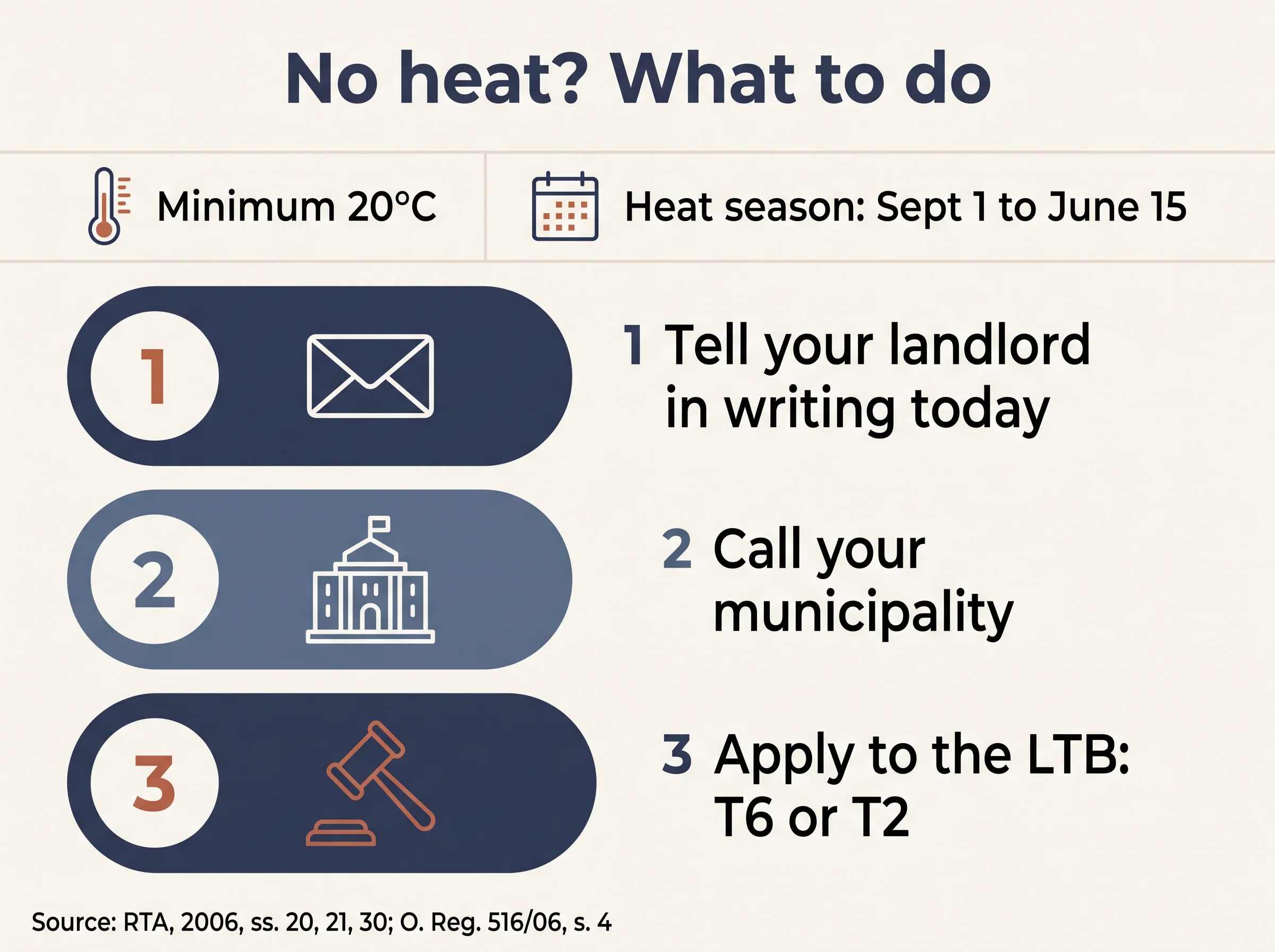
In Ontario, heat is a vital service from September 1 to June 15, and habitable rooms must be kept at a minimum of 20°C during that period (O. Reg. 516/06, s. 4(1) and (2)). The landlord must keep the heating system working and cannot withhold it.
- The season. The Residential Tenancies Act, 2006 (RTA) lists heat as a vital service for the part of the year set by regulation, and O. Reg. 516/06, s. 4(1), sets that as September 1 to June 15.
- The temperature. O. Reg. 516/06, s. 4(2), requires at least 20°C, measured 1.5 metres above the floor and one metre from exterior walls. Ontario's maintenance standards (O. Reg. 517/06, s. 15(1)) set the same minimum, and your city's by-law may set a higher one.
- The repair duty. RTA s. 20(1) makes an Ontario landlord responsible for repair and for meeting maintenance standards; O. Reg. 517/06, s. 17, says heating systems must be kept in a good state of repair and safely operable.
- No withholding. An Ontario landlord cannot withhold or deliberately interfere with heat it is supposed to supply (RTA s. 21(1)). If the landlord is supposed to pay the gas or fuel bill and does not, so the supply is cut, the law treats the landlord as having withheld it (s. 21(2)).
One exception: if you control your own thermostat and the main heat source can reach 20°C, the 20°C rule in O. Reg. 516/06 s. 4(2) does not apply (s. 4(3)). The landlord must still keep that equipment working.
What should an Ontario tenant do first when the heat goes out?
An Ontario tenant with no heat should report it to the landlord in writing the same day, because RTA s. 30(2) requires the LTB to consider whether the tenant told the landlord before applying. Phone or text if that is how you usually reach your landlord, then follow up by email or the landlord's maintenance portal. Say:
- the date and time the heat stopped or became inadequate;
- the temperature in the main rooms (a cheap thermometer, photographed, is good evidence);
- who in the home is affected (young children, older adults, anyone unwell);
- when you are available for a technician, and that you consent to entry for the repair.
When should an Ontario tenant call the city about no heat?
If the Ontario landlord does not respond, or the heat is not restored quickly, call your city or town within a day or two; you do not need an LTB case first. Municipal officers can inspect and order the work.
- Where the city has a property standards or heat by-law, its officers can inspect and order the work.
- Where no municipal by-law applies, the provincial standards do, and RTA s. 224.1 requires the municipality to receive a current tenant's written complaint and send an inspector.
- Some Ontario cities have a vital services by-law. Under RTA ss. 216 to 221, such a by-law can require landlords to supply heat, and if the landlord does not, the city may arrange the service itself and direct tenants to pay rent to the city instead. Paying the city as directed is not a default in rent (s. 221(2)).
Our guide to property standards officers explains what an inspection and work order involve.
Which LTB application fits a heating problem in Ontario?
An Ontario tenant whose furnace is not repaired files a T6 (maintenance); a tenant whose landlord is withholding or interfering with heat files a T2 (tenant rights). Both cost $53, or $48 through the LTB portal (October 2026).
| Form | Use it when | Fee (Oct 2026) |
|---|---|---|
| T6: Tenant Application about Maintenance | The furnace is broken or inadequate and the landlord has not repaired it (s. 20) | $53, or $48 through the LTB portal |
| T2: Application about Tenant Rights | The landlord is withholding heat or deliberately interfering with it (s. 21), or the problem substantially interferes with your reasonable enjoyment (s. 22) | $53, or $48 through the LTB portal |
On a T6, RTA s. 30(1) lets the Board, among other things, order the repair by a set date, order a rent abatement, order the landlord to pay your reasonable out-of-pocket costs (space heaters, damaged belongings, other expenses caused by the breach), and in serious cases stop the landlord raising the rent until the work is done. On a T2 about a vital service, s. 31(1) adds powers such as an administrative fine payable to the Board. You must apply within one year of the problem (s. 29(2)). See our guides to the T6 and T2.
What should an Ontario tenant not do when there is no heat?
An Ontario tenant with no heat should not stop paying rent, should not hire a repair and deduct it, and should not heat the unit with an oven or barbecue. Here is why.
- Don't hire your own furnace repair and deduct it from rent. The Board can authorize a repair and order the landlord to pay for it (s. 30(1), para. 3), but that is an order you ask for, not a step to take on your own. Gas work also needs a certified technician under Ontario's fuel-safety rules.
- Don't use an oven or a barbecue for heat. Use only portable heaters certified for indoor use, kept away from bedding and curtains.
- Don't refuse reasonable access for the repair. If you consent at the time, the landlord can enter without written notice (s. 26(1)(b)); otherwise 24 hours' written notice applies (s. 27).
Does an Ontario tenant who pays the heating bill have to fix the furnace?
No. An Ontario tenant who pays for gas or electricity is not responsible for fixing the furnace: equipment that came with the unit is still the landlord's to repair under RTA s. 20(1). The difference is the fuel supply: the provincial rule that fuel be supplied continuously does not apply if your lease makes you responsible for the fuel and it was cut off because your account was in arrears (O. Reg. 517/06, s. 16(4)). See who pays the heating bill in an Ontario rental.
Frequently asked questions
How cold does it have to be before an Ontario tenant can complain?
Below 20°C in habitable rooms between September 1 and June 15 breaches Ontario's provincial minimum under O. Reg. 516/06, s. 4(2). The exception is a unit where you control the heat yourself and the system can reach 20°C. Your city may set a higher minimum or a longer season.
How long does an Ontario landlord have to fix the heat?
Ontario's RTA sets no fixed number of days for a heating repair. We explain how "reasonable time" is read in how long a landlord has to fix a broken furnace.
Can an Ontario tenant end the lease because there is no heat?
Terminating the tenancy is one of the remedies the LTB can order on a T6 (RTA s. 30(1), para. 1). Don't simply move out without notice. Apply and let the Board decide.
Can an Ontario landlord evict a tenant for complaining to the city about heat?
No. RTA s. 83(3)(b) requires the LTB to refuse an eviction where the reason for it is that the tenant complained to a government authority about a health, safety, housing or maintenance standard. A complaint to the city about no heat is that kind of complaint.
Can an Ontario tenant pay rent to the city instead of the landlord?
Only where the city has a vital services by-law and has directed tenants to do so under RTA ss. 216 to 221. Rent paid to the city as directed is not a default in rent (s. 221(2)). Without that direction, keep paying the landlord.
Report a repair with a record that sticks
Tenon10 tenants can submit maintenance requests from their account, so every report is dated and on file.
For Ontario tenants and landlords.