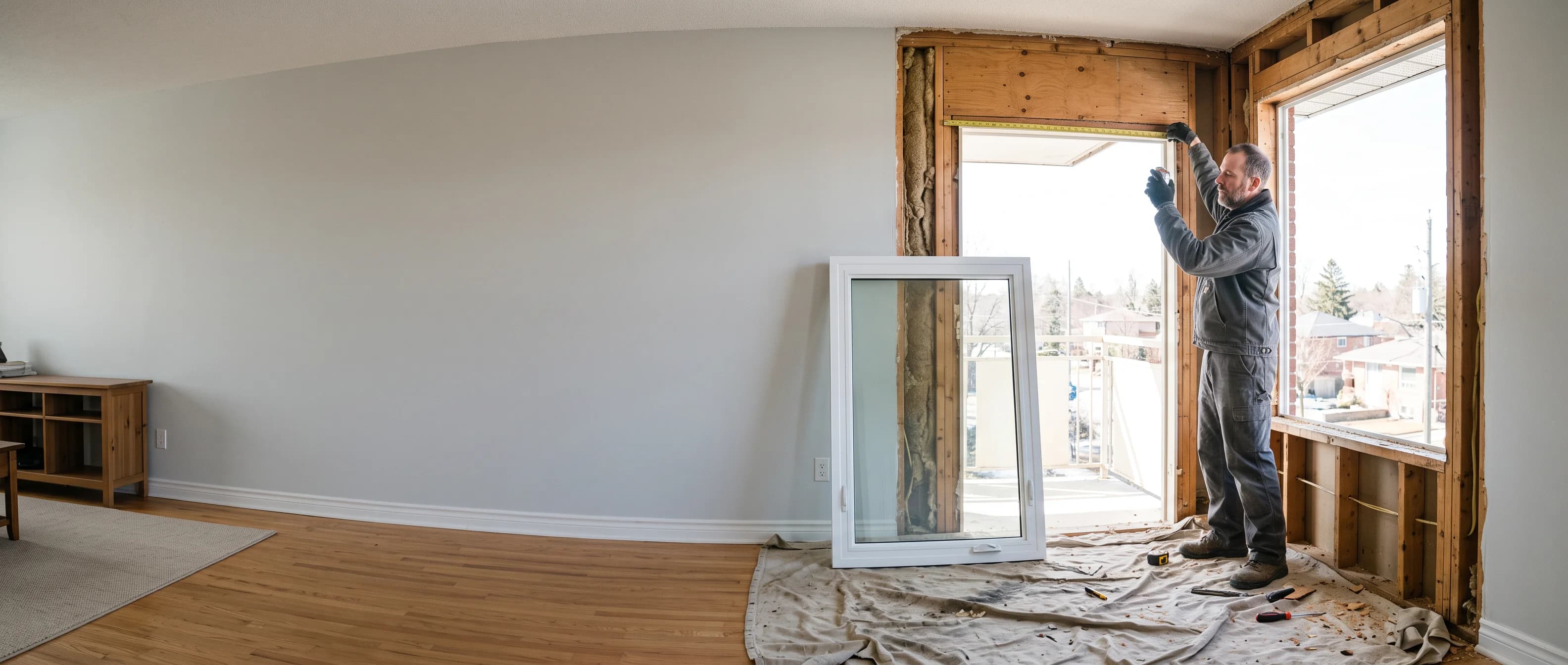
No law sets a number of days for a landlord to fix a broken furnace in Ontario. But heat is a vital service from September 1 to June 15 (O. Reg. 516/06, s. 4(1)) and must be kept in good repair (RTA s. 20(1)), so a winter breakdown should get a same-day response.
This guide explains what the law says, how to tell an emergency from a routine repair, and what happens if the fix drags on.
What does Ontario law require of a landlord when the furnace breaks?
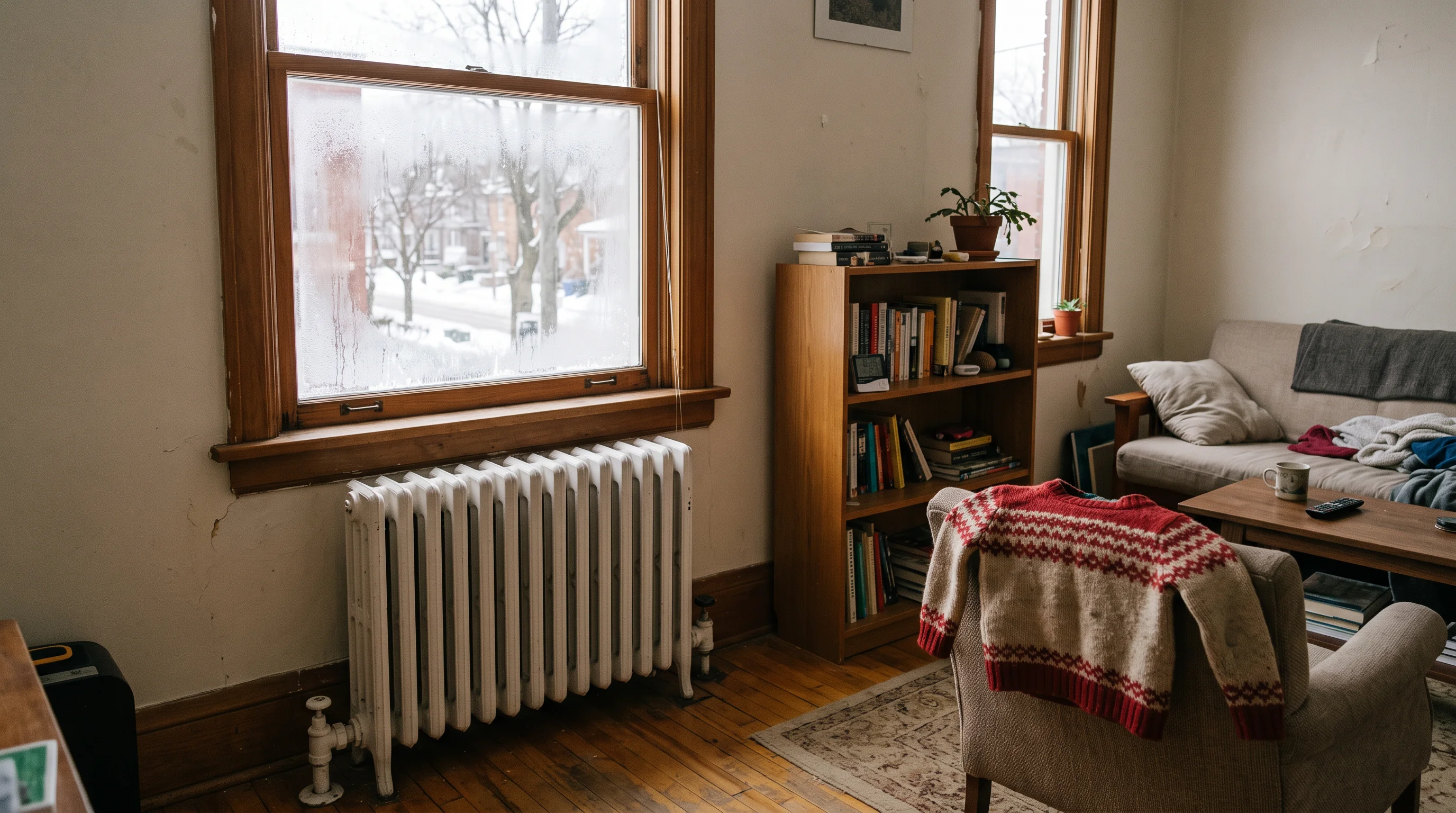
An Ontario landlord must keep the heating system in good repair and able to keep habitable rooms at 20°C from September 1 to June 15. Three sources set that duty:
- The duty to repair. Section 20(1) of the Residential Tenancies Act, 2006 (RTA) makes the Ontario landlord responsible for keeping the residential complex and each unit "in a good state of repair and fit for habitation" and for complying with health, safety, housing and maintenance standards. Section 20(2) says this applies even if the tenant knew about the problem before signing.
- Heat as a vital service. The RTA defines "vital service" to include heat during the part of the year set by regulation. Ontario Regulation 516/06, s. 4(1), sets that period as September 1 to June 15, and s. 4(2) requires heat that keeps habitable rooms at at least 20 degrees Celsius, measured 1.5 metres above the floor and one metre from exterior walls.
- The provincial maintenance standards. Ontario Regulation 517/06 requires heating equipment capable of keeping that temperature (s. 15(3)) and says heating systems, "including stoves, heating appliances, fireplaces intended for use, chimneys, fans, pumps and filtration equipment", must be kept "in a good state of repair and in a safely operable condition" (s. 17).
Many Ontario cities have their own heat by-laws, sometimes with a higher temperature or a longer heating season. If your rental is in Toronto, Hamilton or Ottawa, see our heat by-law comparison by city. Where a by-law and the provincial rule differ, the conservative course is to meet whichever is stricter.
Why is there no fixed furnace repair deadline in Ontario?
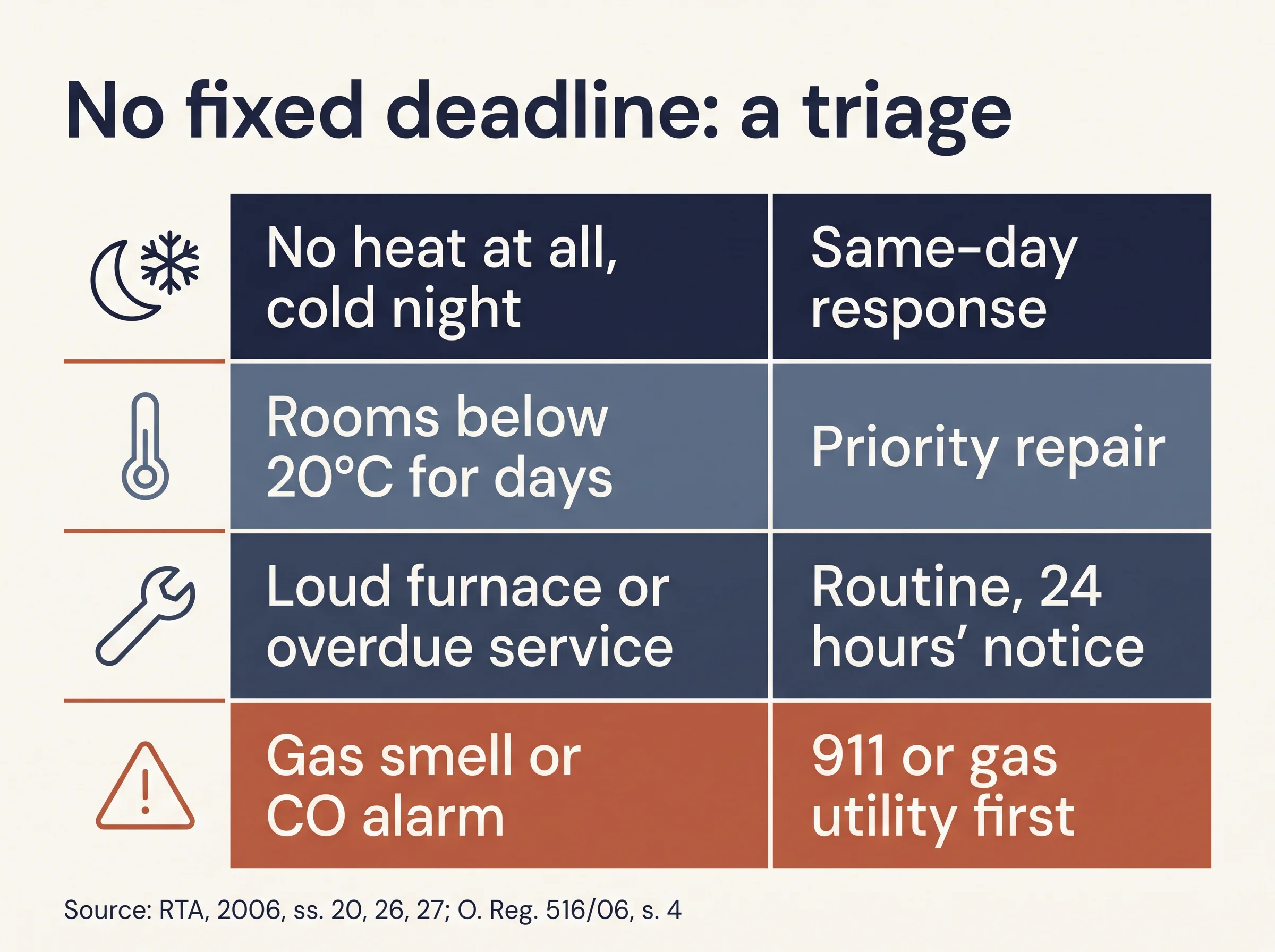
The Ontario RTA does not say "within 24 hours" or "within a week" for any repair; instead, the Landlord and Tenant Board (LTB) decides case by case whether the landlord breached s. 20(1). Under s. 30(2) the Board must consider whether the tenant told the landlord about the problem before applying, so how quickly the landlord responded after being told is central to the case.
Our conservative reading, which we would follow ourselves:
| Situation | How to treat it |
|---|---|
| Total loss of heat between September 1 and June 15 | Urgent repair. Respond the same day, get a qualified technician booked as soon as one is available, and provide safe temporary heat while you wait. |
| Partial heat (some rooms below 20°C, the system short-cycling, a heat pump that cannot keep up in deep cold) | Still a breach of the standard if the rooms fall below the minimum. Treat it as a priority repair, not a "next month" item. |
| Noise, a dirty filter or an overdue service, with the home still warm | Routine. Schedule it with proper notice (see below). |
Is a broken furnace an emergency or a routine repair in Ontario?
The Ontario RTA does not define "emergency"; we read a total loss of heat in cold weather, or a safety hazard from the equipment, as one, and a routine service visit as not. The answer decides whether the landlord may enter without written notice (RTA s. 26(1)(a)) or must give 24 hours' written notice (s. 27(1)).
| What the tenant reports | How to treat it | Entry rule |
|---|---|---|
| No heat at all, December night | Urgent: same-day response | Emergency entry is allowed without written notice (RTA s. 26(1)(a)); a reading, see above |
| Some rooms well below 20°C for days | Priority repair | 24 hours' written notice, or the tenant's consent at the time |
| Furnace works but is loud or needs a filter | Routine | 24 hours' written notice (s. 27(1)) |
| Annual furnace service or inspection | Routine, scheduled | 24 hours' written notice (s. 27(1)) |
| Gas smell or CO alarm | Safety emergency: 911 / gas utility first | Emergency |
Our guide to entry to service heating equipment covers the notice rules in detail.
What should an Ontario landlord do in the first 24 hours after a furnace fails?
An Ontario landlord should acknowledge the report in writing, book a qualified technician, arrange lawful access and provide safe temporary heat on day one. In order:
- Acknowledge in writing. Reply to the tenant's report with the time you received it and what happens next. That record matters later.
- Book a qualified technician. For gas or oil equipment, use a registered fuels contractor (more below).
- Arrange access properly. If it is an emergency, enter as needed. If not, get the tenant's consent at the time of entry or give 24 hours' written notice with the reason, the day and a time between 8 a.m. and 8 p.m. (s. 27(3)).
- Provide safe temporary heat. Portable heaters can bridge a short outage, but O. Reg. 517/06 s. 15(4) says a unit cannot use portable heating equipment as its primary source of heat, and s. 15(5) allows only heating equipment approved by a recognized standards testing authority in a room used for sleeping. They are a stopgap, not the fix.
- Keep the tenant informed about parts on order and the expected date. Silence is what turns a repair into an LTB application.
Choosing a licensed heating contractor: who may repair a gas furnace in Ontario?
In Ontario, only a certified gas technician working for a TSSA-registered fuels contractor should repair a rental's gas or oil furnace, boiler or water heater; Ontario's fuel-safety rules decide who may do the work, not just who is cheapest:
- Ontario Regulation 215/01 (Fuel Industry Certificates), made under the Technical Standards and Safety Act, 2000, says no person may perform the functions of a certificate holder without the right certificate, such as a gas technician 1, 2 or 3 certificate (s. 3(1)).
- The regulation's exemption for doing your own gas work covers a detached dwelling that is owned and occupied by the person (s. 55(1)). A rental unit the owner does not live in falls outside that wording, so a landlord should not plan to repair a tenant's gas furnace personally.
- The Technical Standards and Safety Authority (TSSA) says registered fuels contractors "are the only businesses that are legally authorized to do fuels related work in Ontario", and it publishes a search tool to find or verify a contractor's registration on tssa.org.
Before you hire, check the registration, ask for the technician's certificate, get the price and the scope in writing, and keep the invoice. Electric baseboards and heat pumps involve other trades; the same principle applies: hire someone qualified for that equipment.
What can an Ontario tenant do if the furnace repair drags on?
An Ontario tenant whose heat is not fixed can call the municipality, file a T6 maintenance application at the LTB, or file a T2 if heat is being withheld, and can use these routes together:
- Call the municipality. Where a city property standards or heat by-law applies, its officers can inspect and order work. Where none applies, RTA s. 224.1 requires the municipality to receive written complaints about the provincial maintenance standards and to have an inspector check. See how municipal enforcement works.
- Apply to the LTB with a T6 (Tenant Application about Maintenance). Under s. 30(1) the Board can order the repair by a set date, a rent abatement, payment of the tenant's reasonable out-of-pocket costs, and in serious cases can block rent increases until the work is done. See the T6 form and our T6 guide.
- Apply with a T2 (Application about Tenant Rights) where heat is being withheld or deliberately interfered with, which breaches s. 21. See the T2 form.
Our companion article, no heat in your Ontario apartment, walks through the tenant's side step by step. Applications must be made within one year of the conduct (s. 29(2)).
How does Tenon10 help Ontario landlords track a furnace repair?
In Tenon10, tenants can submit a maintenance request from their account, and landlords can track requests and work orders, schedule a maintenance visit and send the tenant a written notice of entry from the same place. Every step is time-stamped, which is the record you need if a heating complaint ever goes further.
Frequently asked questions
Is there a 24-hour rule for fixing heat in Ontario?
Not in Ontario's RTA. There is a 24-hour rule for notice of entry (s. 27), which people often confuse with a repair deadline. Some municipal by-laws set their own timelines, so check your city's by-law.
Can an Ontario tenant stop paying rent until the furnace is fixed?
No. The province's guide to the standard lease says the tenant must pay rent even when there are maintenance problems, and should tell the landlord and, if needed, apply to the LTB. Since September 21, 2026, a tenant who wants to raise repair issues at a hearing about unpaid rent generally has to pay half of the arrears claimed first (RTA s. 82(2)).
Does an Ontario landlord have to pay for a hotel while the heat is off?
Ontario's RTA has no automatic hotel rule. On a T6, the Board can order the landlord to pay a tenant's reasonable out-of-pocket expenses caused by the breach (s. 30(1), para. 5). Tenants should keep receipts.
Does the 20°C rule apply if the Ontario tenant controls the thermostat?
Not always. O. Reg. 516/06 s. 4(3) says the 20°C rule in s. 4(2) does not apply where the tenant can regulate the temperature and the primary heat source can maintain 20°C. The landlord still has to keep the equipment able to do that.
Can an Ontario landlord fix a tenant's gas furnace personally?
A landlord should not plan to. O. Reg. 215/01 s. 3(1) requires a certificate such as a gas technician certificate, and the self-work exemption in s. 55(1) covers only a detached dwelling the person owns and lives in. Hire a TSSA-registered fuels contractor instead.
Track every heating repair in one place
Maintenance requests, work orders and written notices of entry, with a dated record of each step.
For Ontario landlords and property managers.