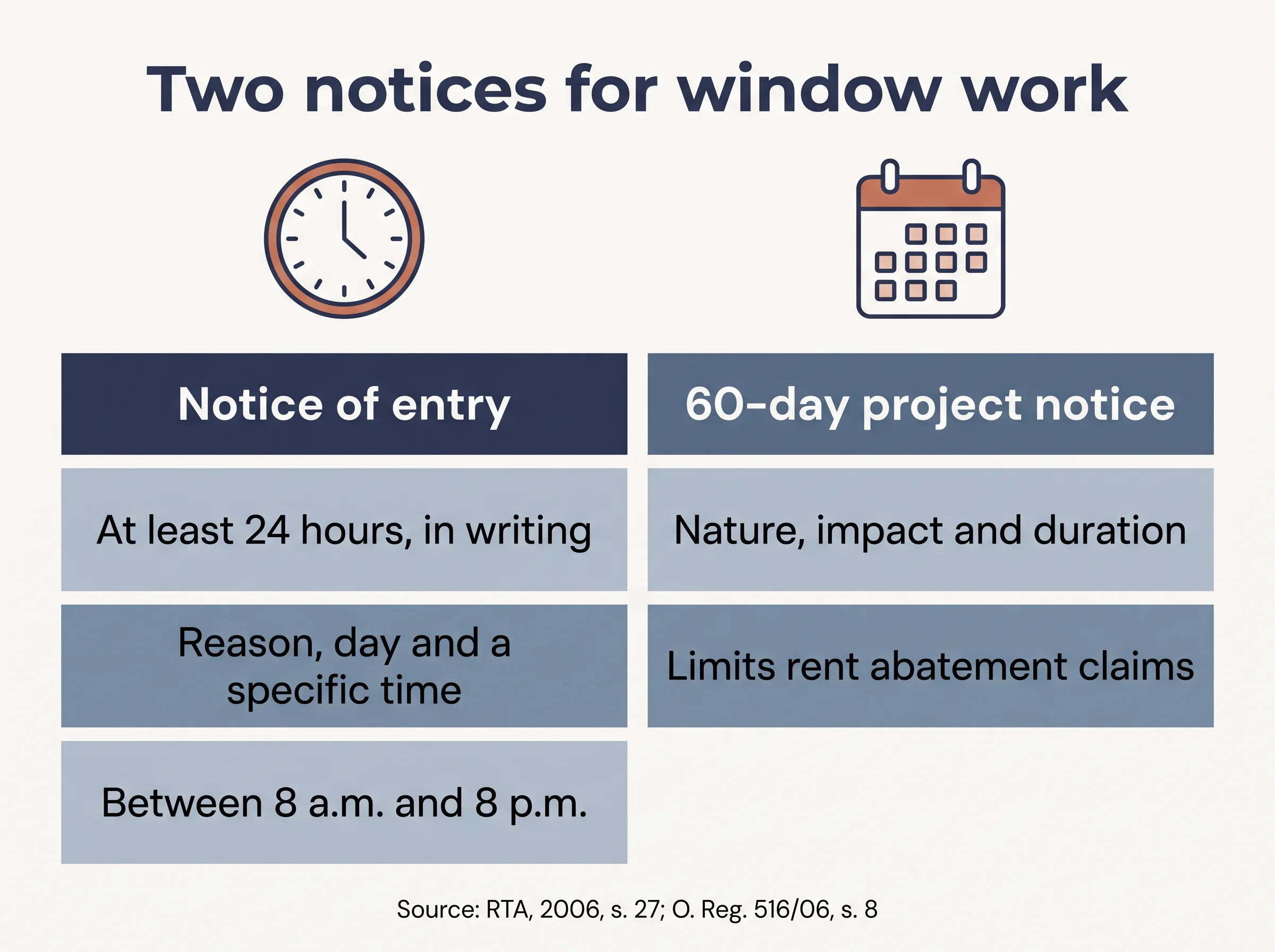
In Ontario, a landlord's notice to enter for window replacement must be in writing and given at least 24 hours before entry, stating the reason, the day and a time between 8 a.m. and 8 p.m. (RTA s.27). For a large project, a separate 60-day notice under O. Reg. 516/06 s.8 limits rent abatement claims.
Window replacement is one of the few jobs that touches every room of a unit at once. Installers need to get inside, remove the old frames, and often leave openings covered for a few hours. This guide explains how the Ontario 24-hour notice rule applies to window work, what the notice must say, how to serve it, and the separate 60-day project notice.
How much notice does an Ontario landlord need to replace windows?

An Ontario landlord needs to give at least 24 hours' written notice to enter a unit to replace windows. Section 27(1) of the Residential Tenancies Act, 2006 (RTA) lets a landlord enter with written notice given at least 24 hours before entry "to carry out a repair or replacement or do work in the rental unit." Replacing windows fits squarely in that paragraph.
RTA section 27(3) sets what the notice must contain:
- the reason for entry;
- the day of entry; and
- a time of entry between 8 a.m. and 8 p.m.
RTA section 25 makes this exclusive: a landlord may enter only under section 26 (no notice) or section 27 (with notice). Contractors working for the landlord are covered by the same rules, and the landlord answers for their entry.
"A time" means a time, not an all-day window
The LTB's Interpretation Guideline 6 cites the Divisional Court's decision in Wrona v. Toronto Community Housing Corporation, which held that a notice must specify an actual time of entry; a six-hour window was not enough, and the tenant received a $1,000 abatement. Installers rarely know their arrival time to the minute, so the conservative approach is to name a specific start time and plan the crew's schedule around it.
When can an Ontario landlord enter for window work without notice?
An Ontario landlord can enter without written notice only in an emergency or if the tenant consents at the time of entry (RTA s.26(1)). For windows, that looks like this:
- Emergency. A pane shattered in a storm or break-in, with the unit open to the weather or to intruders, is the kind of situation where a landlord may enter at once to board it up.
- Consent at the time of entry. If the tenant agrees when the installer arrives, entry is allowed. The consent has to be given at the time; a general "come in any time" in a lease clause is not the same thing.
A planned replacement is not an emergency. Even if the old windows are badly drafty, scheduled work needs the 24-hour notice unless the tenant agrees on the day.
How should an Ontario landlord serve a notice of entry?
An Ontario landlord can serve a notice of entry by handing it over, posting it on the unit door, leaving it in the mail slot or mailbox, or by email where the tenant consented in writing, under RTA section 191 and the LTB's Rules of Procedure:
| Method | When it counts as given | Watch for |
|---|---|---|
| Handing it to the tenant or an apparent adult in the unit | The day it is handed over | Note who received it and when |
| Posting on the unit door (Rule 3.2, notices of entry only) | When posted | Photograph the posted notice with a timestamp |
| Mail slot, under the door, or the tenant's mailbox | When left | Allow more than 24 hours in practice |
| The day it is sent | Only if the tenant consented in writing to service by email | |
| Fifth day after mailing | Mail is rarely practical for a 24-hour notice |
The 24 hours runs to the stated time of entry. A notice given at 10 a.m. Monday supports entry at 10 a.m. Tuesday or later, not 9 a.m. Tuesday.
What is the 60-day notice for a large window project in Ontario?
The 60-day notice is a project notice under O. Reg. 516/06 section 8 that, with the other listed conditions, stops the Ontario LTB from ordering a rent abatement for interference caused by the work. A building-wide window replacement can take weeks of scaffolding, noise, dust and rooms emptied of furniture, and a tenant can apply on a T2 claiming that the work substantially interfered with their reasonable enjoyment.
The LTB must not order a rent abatement for that interference if all of the following are met:
- The landlord gave tenants notice of the work at least 60 days before it began (or as soon as reasonable in an emergency), and told prospective tenants before signing them.
- The notice described the nature of the work, the expected impact on tenants and their households, and how long it would take, and was reasonably accurate.
- The landlord updated tenants in a timely way if that information changed significantly.
- The work falls in a listed category. Two fit window projects directly: work necessary to protect or restore the physical integrity of the building, and work that promotes energy conservation.
- Any required building permit was issued.
- The work was done at reasonable times, or within the hours allowed by the municipal noise bylaw.
- The duration was reasonable, and the landlord took reasonable steps to reduce noise.
If the conditions are not all met and the LTB finds substantial interference, it weighs factors such as the duration and degree of the interference and the steps the landlord took. Section 8(6) generally caps an abatement at 25% of monthly rent for each month or part month of interference, with limited exceptions in section 8(7).
The 24-hour notice and the 60-day notice compared
| 24-hour notice of entry | 60-day project notice | |
|---|---|---|
| Source | RTA s.27 | O. Reg. 516/06 s.8 |
| Purpose | Lets the landlord or contractor enter the unit | Tells tenants about the project and protects against abatement claims |
| Timing | At least 24 hours before the stated time of entry | At least 60 days before the work begins |
| Contents | Reason, day, a time between 8 a.m. and 8 p.m. | Nature of the work, expected impact, expected duration |
| Needed for | Every entry into each unit | Larger projects where abatement claims are a risk |
How should an Ontario landlord time a window install?
An Ontario landlord should time window installs around heat, noise bylaw hours and a fresh notice for every rescheduled entry. The practical points:
- Season. Replacing windows in winter means rooms open to the cold. Ontario's vital-services rules require heat to be maintained, and many bylaws set minimum indoor temperatures. Plan one opening at a time in cold weather, and close each before the crew moves on.
- Prep instructions. Tell tenants in the notice what to move away from windows (furniture, plants, blinds), whether blinds will be removed and reinstalled, and whether pets should be secured.
- Noise. Check your municipality's noise bylaw hours. They may be narrower than the 8 a.m. to 8 p.m. entry window.
- Delays. If the crew cannot come, do not let them enter a day later on the old notice. Serve a new notice with the new day and time.
- Tenant refuses entry. Entry under section 27 does not depend on the tenant agreeing to it. If a tenant blocks the entry, document it and do not force the issue. The LTB's Guideline 5 notes that a tenant who unreasonably prevented the landlord from entering to make repairs may see that reflected in any remedy the tenant later seeks.
What should an Ontario notice of entry for window work say?
An Ontario notice of entry for window work should name the tenant and unit, the reason, the day and a time between 8 a.m. and 8 p.m.; the LTB publishes no mandatory form for it. A clear notice includes:
- Tenant name(s) and unit address
- Reason: "Replacement of the windows in the living room and both bedrooms"
- Date and time of entry (between 8 a.m. and 8 p.m.)
- Who will enter (the landlord, a named contractor)
- Expected duration and what the tenant should prepare
- Landlord's name, contact details and the date the notice is given
Choosing a window contractor in Ontario: what helps with notices?
In Ontario, notice problems often start with scheduling, so choose an installer who can give unit-by-unit start times. When you choose one:
- Ask for a unit-by-unit schedule with start times, so each notice can name a real time.
- Confirm whether a building permit is needed. In Toronto, window replacement in any building other than a single-unit detached, semi-detached or row house requires a permit (City of Toronto). A missing permit removes one of the protections in section 8.
- Ask how many openings they close per day and how they protect units in cold weather.
- Confirm liability insurance and how they handle damage to tenant belongings.
How can Tenon10 help plan window work?
Tenon10 keeps each unit's tenants, contact details and maintenance requests together, so a landlord planning a window project can see who lives where and what has already been reported. Notices of entry are written by the landlord; Tenon10 does not replace the landlord's own notice.
Frequently asked questions
Can my Ontario landlord replace windows without notice?
Only in an emergency or if you consent at the time of entry (RTA s.26). Planned window replacement in Ontario requires 24 hours' written notice stating the reason, the day and a time between 8 a.m. and 8 p.m.
Is a text message enough notice of entry in Ontario?
Email is allowed if the tenant has consented in writing to receive documents by email. A text message is not listed as a method in the RTA or the LTB Rules, so the conservative approach in Ontario is to use a listed method.
Can an Ontario notice of entry say "between 9 a.m. and 5 p.m."?
The Divisional Court in Wrona held that a broad window of time was not sufficient, and the tenant received a $1,000 abatement. Name a specific time of entry.
Do Ontario tenants get a rent reduction during window work?
Possibly, if the work substantially interfered with the tenant's use of the unit and the landlord did not meet all the conditions in section 8 of O. Reg. 516/06. The claim is made on a T2 application, and an abatement is generally capped at 25% of monthly rent per month of interference.
Does an Ontario landlord need a new notice if the installers are delayed?
Yes. A notice of entry covers the day and time it names, so a crew that comes a day later needs a new written notice with the new day and time.
Which Ontario guides cover entry and repairs?
- The 24-Hour Notice of Entry Rule in Ontario
- The "Substantial Interference" Standard, Explained
- Drafty Windows in an Ontario Rental: Does the Landlord Have to Fix Them?
- The T2 Application: How Ontario Tenants Enforce Their Rights
Plan unit-by-unit work with the records in one place
Tenon10 keeps tenants, contact details and maintenance requests together for every unit you manage.
Built for Canadian landlords and property managers.