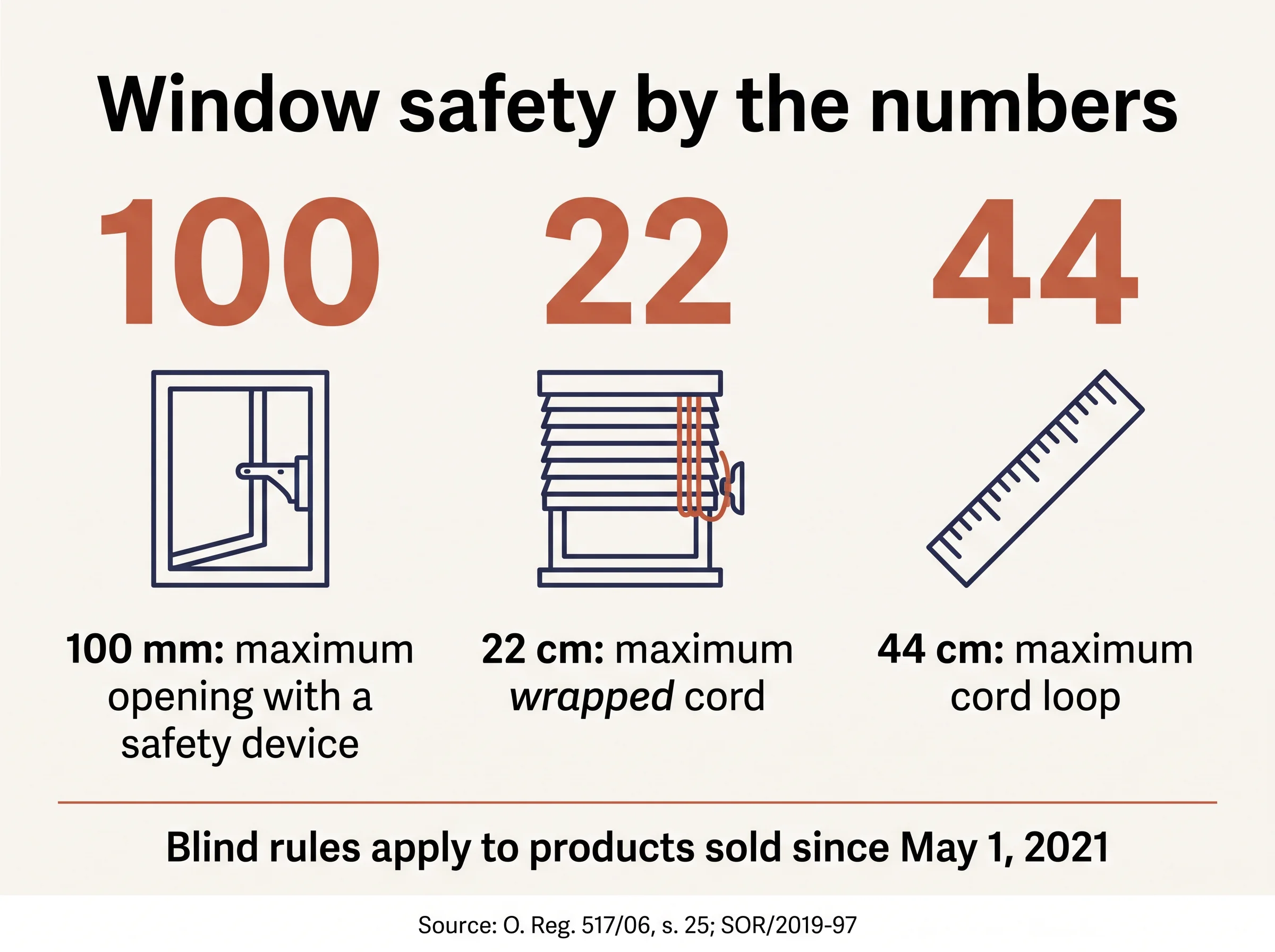
In Ontario, a landlord must fit window safety devices on upper-floor rental windows when the tenant asks, limiting the opening to 100 mm while letting an adult open the window without tools (O. Reg. 517/06 s.25). Toronto's bylaw requires protection in larger apartment buildings regardless of a request, and federal rules cap reachable blind cords at 22 cm.
Two window hazards come up again and again in family rentals: a child falling from an open upper-floor window, and a child caught in a blind cord. Ontario's rules on both sit in different places: municipal property standards bylaws, the provincial maintenance standards, and federal product-safety law. This guide pulls them together for landlords and tenants, sticking to what the official texts say.
Do Ontario landlords have to install window safety devices?
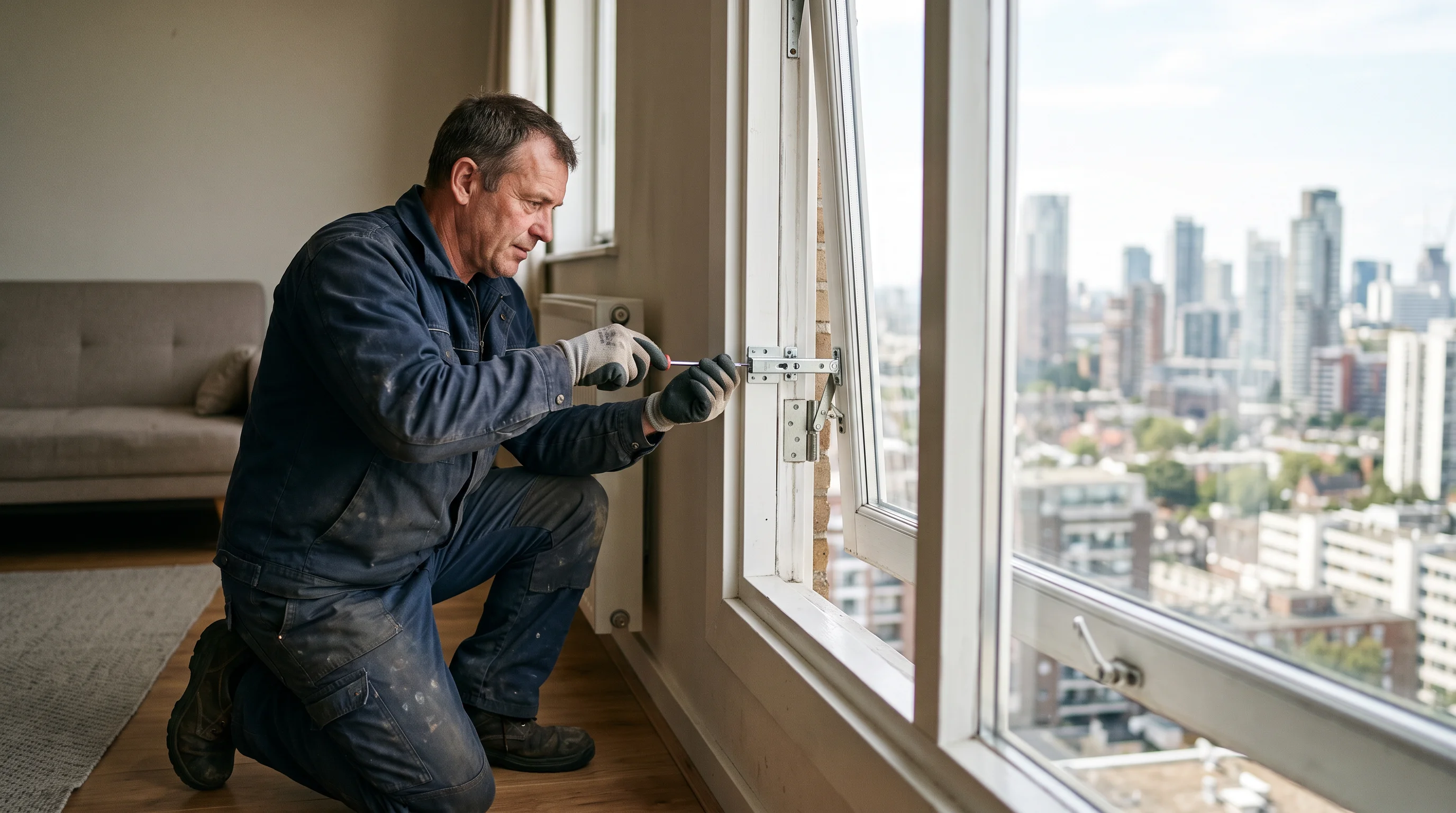
Yes, where Ontario's provincial maintenance standards apply, a landlord must install window safety devices on upper-floor windows at the tenant's request (O. Reg. 517/06 s.25). Some cities, including Toronto for larger apartment buildings, require window protection whether or not a tenant asks.
Where the provincial maintenance standards apply
Ontario's Maintenance Standards regulation, O. Reg. 517/06, applies to rental buildings in areas with no municipal property standards bylaw (RTA s.224). Section 25 covers window safety devices:
- It applies to every window in a rental unit that is in a storey above the storey whose floor is closest to ground level and whose ceiling is more than 1.8 metres above average ground level. In plain terms: windows above the lowest main floor.
- At the tenant's request, each of those windows must be fitted with a safety device that stops any part of the window opening wide enough to admit a sphere more than 100 millimetres in diameter.
- The device must not stop an adult from opening the window without a key or tools.
Note the trigger: under the provincial rule, the duty arises when the tenant asks. A landlord who receives the request has to act on it.
Toronto's bylaw: an example of stricter local rules
Toronto's Municipal Code Chapter 629, s.629-19 D(4), applies to apartment building occupancies in buildings over three storeys or above a set floor area. It requires protection at windows "to minimize the hazards to children":
- A window in a dwelling unit located more than 2,000 mm above grade that opens within 1,500 mm of the floor must be protected by a guard, or by a controlled sash that limits the opening to no more than 100 mm combined with a heavy-duty screen meeting CAN/CSA A440, or by an equivalent device.
- Fixed windows that come within 1,000 mm of the floor must be guarded to at least 1,000 mm or be built to withstand guard loads.
- No protection is needed where a balcony runs the full length of the window.
The Toronto rule does not depend on a tenant's request. Other municipalities have their own bylaws, which may be stricter or looser; check your city's property standards bylaw on its website.
The provincial rule and Toronto's rule compared
| O. Reg. 517/06 s.25 (no municipal bylaw) | Toronto s.629-19 D(4) | |
|---|---|---|
| Applies to | Windows above the lowest storey whose ceiling is more than 1.8 m above grade | Apartment building occupancies over three storeys or above a set floor area; windows more than 2,000 mm above grade opening within 1,500 mm of the floor |
| Trigger | The tenant's request | Required regardless of a request |
| Opening limit | No opening that admits a 100 mm sphere | Guard, or a sash limited to 100 mm with a CAN/CSA A440 heavy-duty screen, or an equivalent device |
Screens are not fall protection
Many bylaws require insect screens on openable windows, Toronto's s.629-21 B among them. A standard insect screen is there to keep pests out, not children in. The Toronto rule above calls for a heavy-duty screen meeting a specific standard and only in combination with a sash limiter.
Must rental windows in Ontario lock from the inside?
Yes. In Ontario, every openable window that can be reached from outside the unit or building must be securable from the inside (O. Reg. 517/06 s.29(1)). Toronto's s.629-21 C requires openable windows to be free from defective hardware and capable of being locked or secured from inside. A broken window latch on a ground-floor or balcony-accessible window is a priority repair.
What are the blind cord rules for Ontario rentals?
Blind cords in Ontario rentals fall under federal product-safety law, not the RTA: Health Canada's Corded Window Coverings Regulations (SOR/2019-97), in force since May 1, 2021. For corded window coverings sold in Canada, they limit:
- any reachable cord with one free end to 22 cm when pulled;
- any reachable cord between two contact points to 22 cm; and
- any loop that a reachable cord can form to a perimeter of 44 cm.
The regulations govern products as manufactured, imported and sold. They do not, by their own terms, order landlords to remove older blinds already installed. But Health Canada's announcement of the rules strongly encouraged replacing existing corded window coverings with cordless options, and reported 39 deaths in Canada linked to corded window coverings since 1989.
Can an Ontario tenant install a window air conditioner?
In most cases, yes: since July 1, 2026, RTA section 36.1 lets an Ontario tenant whose landlord does not supply air conditioning install a window or portable unit, subject to conditions (as the LTB's Guideline 6 notes). Two of those conditions are safety rules: the unit must be installed "safely and securely", and the installation must not be prohibited by the municipal property standards bylaw or other law. Section 36.1(4) confirms a landlord may enter on 24 hours' written notice for a reasonable inspection of the installation. See our guide to Ontario's air conditioner rules.
What should an Ontario landlord's window safety checklist include?
An Ontario landlord's window safety checklist should cover opening limiters on upper floors, the local bylaw, latches and locks, corded blinds, tenant air conditioners and proper entry notice:
- List every window above the lowest main floor and note which have opening limiters.
- Check your municipality's property standards bylaw for window protection rules; do not assume the provincial "on request" rule is the one that applies.
- Respond to any tenant request for a window safety device promptly and in writing.
- Test latches and locks on every reachable window at turnover.
- Replace older corded blinds with cordless or compliant coverings.
- Inspect tenant-installed window air conditioners, with proper notice, for secure installation.
- Give 24 hours' written notice for any entry to install devices. See notice rules for window work.
What can Ontario tenants with young children do?
Ontario tenants with young children can ask the landlord in writing for window safety devices, move climbable furniture away from windows, and report a window that cannot be secured as a repair:
- Ask your landlord in writing for window safety devices on upper-floor windows. Where O. Reg. 517/06 applies, the landlord must provide them on request; in Toronto apartment buildings, protection is required anyway.
- Move furniture that a child can climb away from windows.
- If a window cannot be secured, report it in writing as a repair. If nothing happens, contact your municipality's property standards office or apply to the LTB on a T6.
Choosing a window contractor in Ontario: what should you ask about safety devices?
When safety devices are part of an Ontario replacement project, ask the contractor about opening controls, the local bylaw and permits:
- Ask which opening-control options the window supports and whether an adult can release them without a key or tools, as the provincial rule requires.
- In Toronto apartment buildings, ask the contractor to confirm the product meets s.629-19 D(4), including the CAN/CSA A440 heavy-duty screen where a limiter is used.
- Confirm whether a building permit is needed; in Toronto, window replacement in buildings other than single-unit houses requires one (City of Toronto).
- Get written quotes and confirm insurance.
How can Tenon10 help with window safety requests?
Tenants can send a request for window safety devices or a broken-latch repair through Tenon10's maintenance requests, and landlords track each request with its date and replies on the unit's record.
Frequently asked questions
Do Ontario landlords have to install window stoppers?
Where the provincial maintenance standards apply, yes, on the tenant's request, for windows above the lowest main floor (O. Reg. 517/06 s.25). Some Ontario cities, including Toronto for apartment buildings, require protection regardless of a request.
How far can a window open with a limiter in Ontario?
Both O. Reg. 517/06 and Toronto's bylaw use 100 millimetres as the limit. The provincial rule also requires that an adult can open the window without a key or tools.
Do Ontario landlords have to replace old corded blinds?
The federal regulations apply to products sold since May 1, 2021, and do not themselves order removal of older installed blinds. Health Canada recommends replacing them with cordless options, which is the conservative choice for an Ontario landlord.
Can an Ontario tenant install a window air conditioner?
In most cases, yes, if the landlord does not supply air conditioning, the tenant gives written notice first and installs it safely and securely, as RTA s.36.1 requires. The landlord may inspect the installation on 24 hours' written notice.
Is an insect screen enough to stop a child falling in Ontario?
No. A standard insect screen keeps pests out, not children in, and Toronto's bylaw calls for a CAN/CSA A440 heavy-duty screen only in combination with a 100 mm sash limiter.
Which Ontario guides cover window and repair rules?
- Drafty Windows in an Ontario Rental: Does the Landlord Have to Fix Them?
- Maintenance Standards in Ontario
- Property Standards Officers: How Municipal Enforcement Works
- Can Your Landlord Ban Your Air Conditioner?
Track every safety request
Tenon10 keeps tenant requests and your replies on each unit's record, so nothing gets lost.
Built for Canadian landlords and property managers.