After a water leak in an Ontario rental, the landlord pays to stop the leak and repair the building (RTA s. 20(1)). The tenant pays only for undue damage caused wilfully or negligently by the tenant, an occupant or a guest (s. 34). A tenant's damaged belongings fall to contents insurance unless the landlord ignored a known leak (s. 30(1)).
The answer depends on three things: what caused the leak, whose property was damaged, and what insurance each side carries. The Residential Tenancies Act answers the first two. Insurance answers the third, and the Act says less about it than most people expect. This guide covers Ontario only.
Who pays for what after a water leak in an Ontario rental?
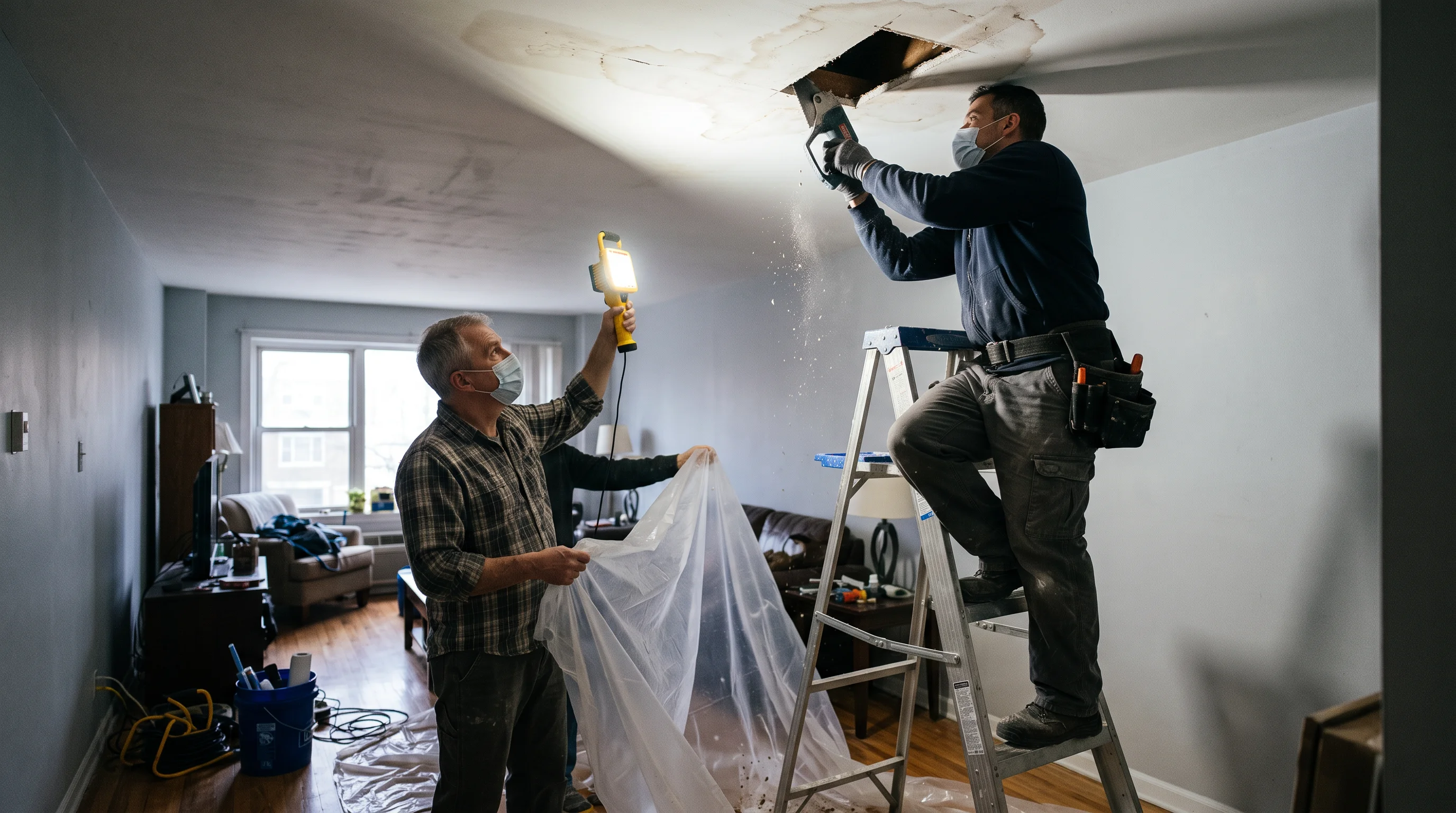
In Ontario, the landlord pays to fix the leak and the building, the tenant or their insurer usually pays for the tenant's own belongings, and a tenant who caused undue damage wilfully or negligently pays the reasonable repair cost.
| What was damaged | Who usually pays | Exception |
|---|---|---|
| The leak itself and the building | The landlord (RTA s. 20(1)) | The tenant (or their guest) caused it wilfully or negligently (s. 34) |
| The tenant's own belongings | The tenant or their contents insurance | The landlord failed to repair something they knew about; the LTB can order the landlord to pay (s. 30(1)) |
| Tenant-caused damage | The tenant pays the reasonable cost of repair | The landlord can ask the LTB to order it (s. 89) |
Does an Ontario landlord have to fix a leak even if the tenant caused it?
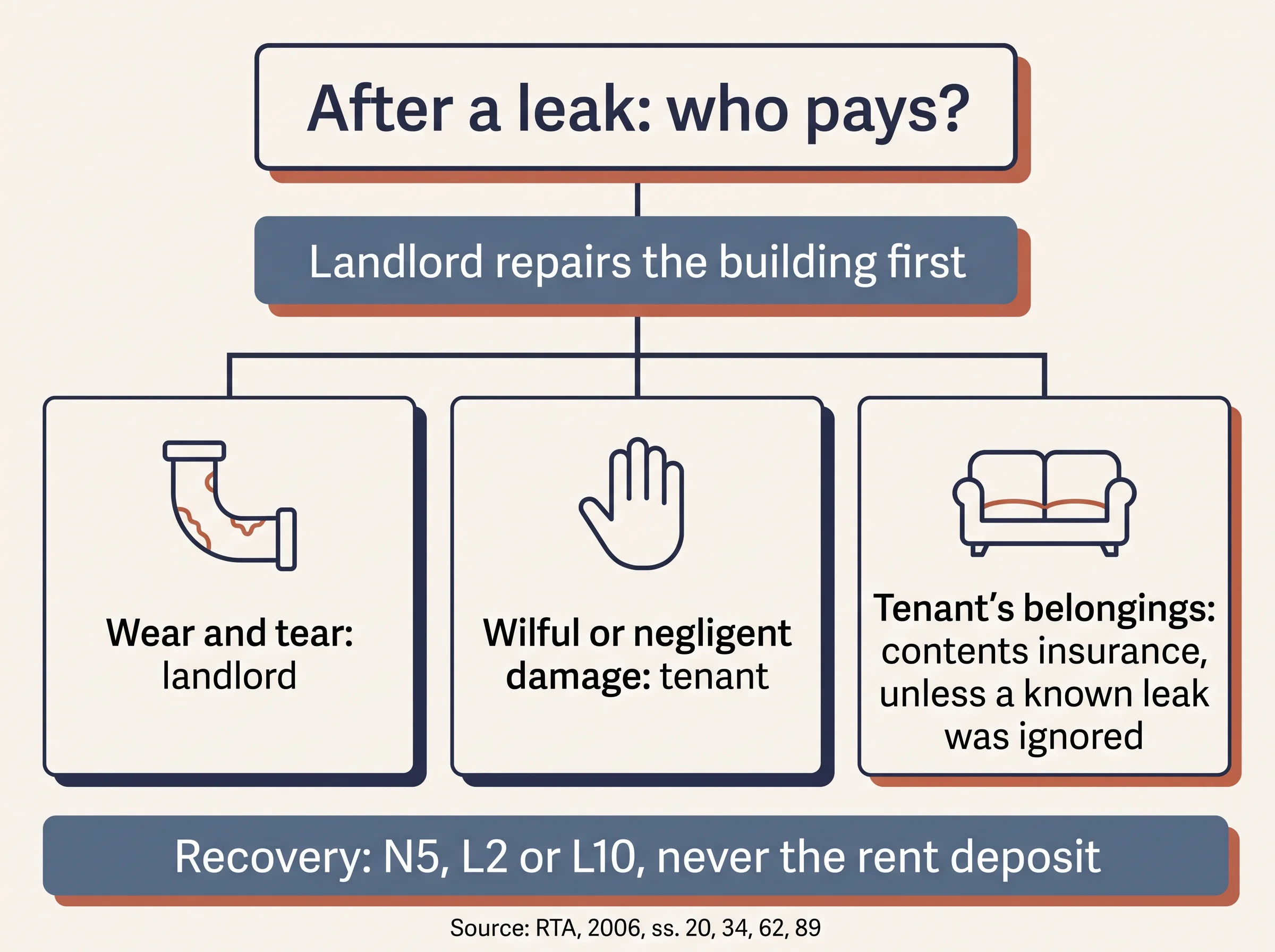
Yes. An Ontario landlord stops the leak and repairs the building first, whatever the cause, and settles who ultimately pays afterwards. Section 20(1) of the Residential Tenancies Act, 2006 makes the landlord responsible for keeping the residential complex and every rental unit in a good state of repair and fit for habitation, and for complying with health, safety, housing and maintenance standards. For plumbing, O. Reg. 517/06 is specific: plumbing and drainage systems must be maintained free from leaks, defects and obstructions and adequately protected from freezing (section 9(1)), and interior walls and ceilings must be kept free from holes, leaks, deteriorating materials, mould and mildew (section 39(1)). Toronto's property standards by-law similarly requires the plumbing system to be kept in good working order, free from leaks or defects.
Leaving a leak because "it's the tenant's fault" risks mould, more damage and an LTB finding against the landlord. Our guide to mould in an Ontario rental explains how a slow leak becomes a bigger problem.
When does an Ontario tenant pay for leak damage?
An Ontario tenant pays only for undue damage to the unit or the building caused by the wilful or negligent conduct of the tenant, another occupant, or a person the tenant let in (RTA s. 34). Two words carry the weight:
- Undue. The LTB's L2 instructions say normal wear and tear is not undue damage. A supply hose that perishes with age or a corroded pipe is wear and tear.
- Wilful or negligent. An accident is not automatically negligence. A bathtub left running and forgotten, a washing machine the tenant installed badly, or a toilet blocked with things that should never be flushed are the kinds of facts landlords point to. The landlord has to prove it.
Is an Ontario landlord responsible for a tenant's belongings damaged by a leak?
Only when the damage happened because the Ontario landlord breached the repair duty, for example a dripping pipe reported in writing and left for weeks; then section 30(1) lets the LTB order the landlord to pay the reasonable cost of repairing or replacing the tenant's property and other reasonable out-of-pocket expenses. The Act does not make a landlord an insurer of the tenant's furniture. The T6 instructions list this as Remedy 2 and note that the most the LTB can order on a claim is $50,000.
Timing and knowledge matter. The LTB's Interpretation Guideline 5 says that where the landlord responded within a reasonable time and the response was appropriate, the cases generally support ordering no abatement or other remedy. A sudden burst the landlord fixed promptly is usually treated very differently from a known leak that was ignored.
Who pays when the leak comes from the unit above in Ontario?
The Ontario landlord still repairs the building and the affected unit; if another tenant caused the leak wilfully or negligently, section 89 lets the landlord apply to the LTB for the reasonable costs of repair against that tenant (or a former tenant, within one year of them moving out). In apartments, duplexes and houses with a basement unit, the water often comes from someone else's space. In a condominium, the source may be the condo corporation's common elements or another owner's unit; the landlord still deals with their own tenant and pursues the source separately.
Where does insurance fit after a leak in an Ontario rental?
Ontario's Residential Tenancies Act does not require tenants to carry insurance, but a lease can require liability insurance, and contents insurance is up to the tenant. The Ontario government's guide to the standard lease explains that a landlord and tenant can agree whether the tenant must have liability insurance, that the tenant must provide proof if the landlord asks, and that contents insurance is up to the tenant. So:
- Contents insurance is the tenant's way to cover their own belongings when no one is at fault.
- Liability insurance (often part of a tenant policy) is what responds if the tenant is found responsible for damage to the building or a neighbour's unit, but only if the tenant has it.
- The landlord's own policy covers the building according to its terms. Deductibles, exclusions and whether an insurer pursues the tenant afterward are contract questions, not RTA questions.
We cover the details in what a landlord can require for tenant insurance and landlord insurance in Ontario.
How does an Ontario landlord recover leak damage costs from a tenant?
An Ontario landlord asks in writing first, then can use an N5 notice, an L2 application for a sitting tenant, or an L10 within one year after the tenant moves out (RTA s. 89(1.1)). In order:
- Ask first, in writing, with the invoice and the cause. Many cases end here.
- Form N5. Section 62 lets a landlord give notice of termination where a tenant wilfully or negligently causes undue damage. The notice must give the tenant seven days to repair or pay the reasonable cost, and it is void if they do. Our N5 guide explains the mechanics, and the form is at Form N5.
- Form L2. For a sitting tenant, the landlord can apply on the L2 for compensation for damage, with or without asking to end the tenancy. The L1 vs L2 guide explains the difference.
- Form L10. If the tenant has already moved out, the L10 claims money a former tenant owes, within one year of them leaving (section 89(1.1)). See our L10 guide.
Can an Ontario landlord raise rent to recover major plumbing work?
Only for a major capital project, through an above-guideline rent increase under RTA s. 126; ordinary repairs are part of running an Ontario rental and cannot be passed on through rent. Under O. Reg. 516/06, a capital expenditure is an extraordinary or significant renovation, repair or replacement whose benefit lasts at least five years, and it excludes routine or ordinary work and appliance repairs. Replacing a building's failing supply risers might qualify; fixing one leaking trap will not. Units that are exempt from the rent increase guideline do not need this route. Our guide to the AGI process covers the application.
Choosing a licensed plumber: what should you check in Ontario?
In Ontario, plumber is a compulsory trade, so check the plumber's certificate on the Skilled Trades Ontario register, ask about permits, and get the cause of the leak in writing. Whoever books the work, these checks protect the landlord, the tenant and the building:
- Check the certificate. Plumber is a compulsory trade in Ontario: to work in it legally a person must hold a registered training agreement, a provisional certificate of qualification or a certificate of qualification, and appear on the Skilled Trades Ontario public register.
- Ask about permits. Toronto, for example, says installing or modifying plumbing systems needs a building permit, while repairing and replacing plumbing fixtures does not. Other municipalities set their own rules, so ask the building department when work goes beyond a like-for-like repair.
- Get the cause in writing. An invoice that says what failed and why (worn part, root intrusion, an object in the line) is the evidence both sides use if cost is ever disputed.
- Confirm insurance before anyone works in an occupied unit, and keep the warranty terms for parts and labour.
What are the key points about leak damage in an Ontario rental?
- The landlord fixes the leak and the building first, whatever the cause.
- A tenant pays only for undue damage caused wilfully or negligently by them, an occupant or a guest; wear and tear is not undue damage.
- A landlord who ignored a known leak can be ordered to pay for the tenant's damaged belongings.
- Insurance is not required by the RTA, but a lease can require liability insurance; contents insurance is the tenant's choice.
- Recovery runs through an N5, an L2 or, after move-out, an L10, never through the rent deposit.
Frequently asked questions
Is an Ontario landlord responsible for water damage to a tenant's belongings?
Only when the damage resulted from the landlord's failure to repair or maintain, for example a leak you reported that was not fixed within a reasonable time (RTA s. 30(1)). Otherwise your own contents insurance is the usual cover.
Can an Ontario landlord charge a tenant for a burst pipe?
Only if the tenant, an occupant or a guest caused undue damage wilfully or negligently (RTA s. 34). A pipe that fails from age or wear is the landlord's cost.
Does an Ontario tenant have to have insurance?
Not under the Residential Tenancies Act. A lease can require liability insurance, and the tenant must show proof if asked; contents insurance is up to the tenant.
How long does an Ontario landlord have to claim leak damage from a former tenant?
One year after the tenant moved out, using Form L10. The limit is in section 89(1.1) of the Residential Tenancies Act.
Can an Ontario landlord keep the last month's rent deposit to pay for a leak?
No. The only security deposit allowed in Ontario is a rent deposit (RTA s. 105), and s. 106(10) says it must be applied to the last rent period. Damage is recovered from the tenant directly or through the LTB.
Keep every plumbing repair on the record
In Tenon10, a tenant with an active lease submits a maintenance request from their account and the landlord tracks it to completion, so the dates the Landlord and Tenant Board asks about are already written down.
Built for Canadian landlords and property managers.