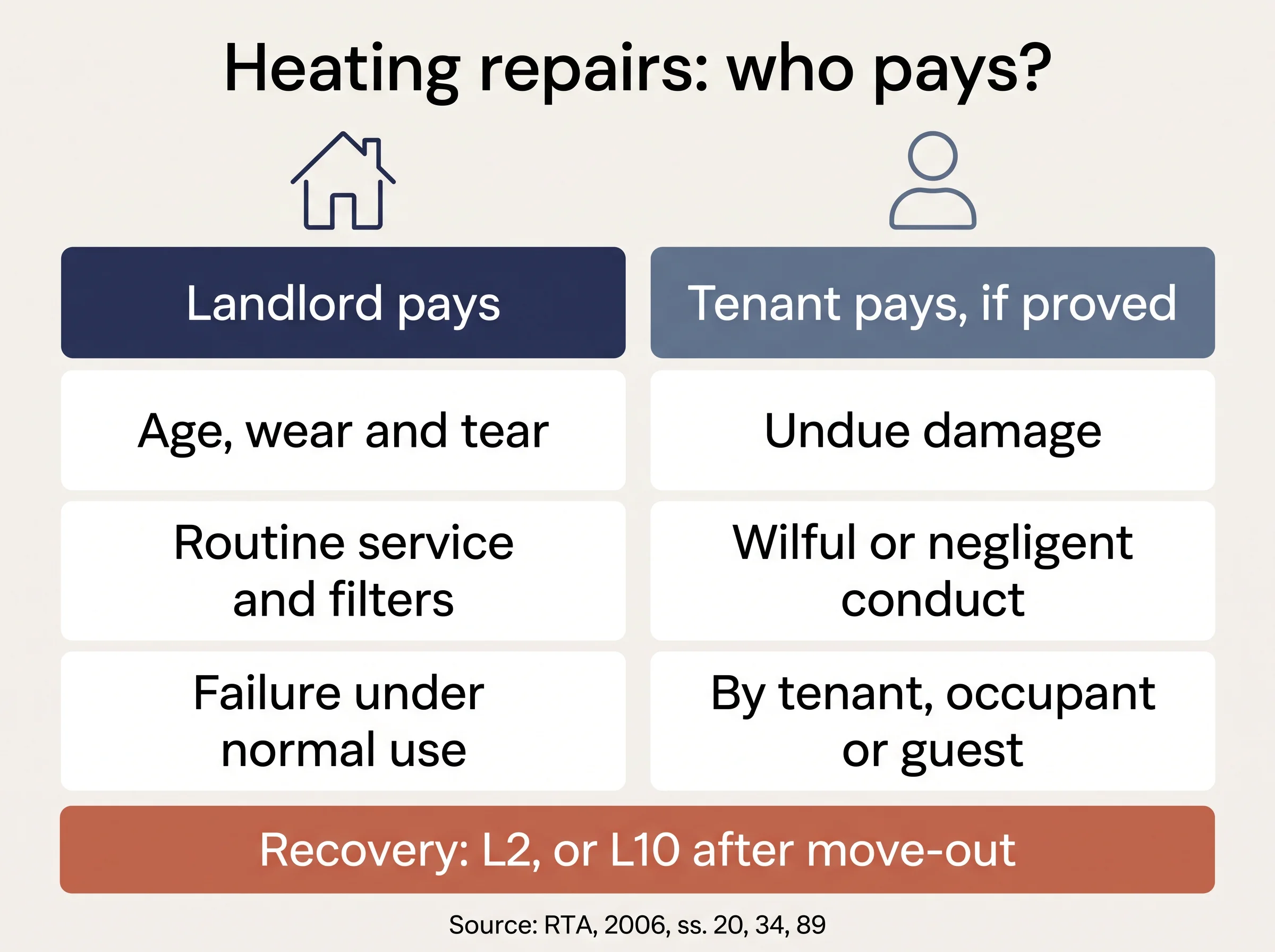
The landlord pays for furnace repairs in an Ontario rental, and for boiler and heat pump repairs, if the equipment fails from age or normal wear (RTA s. 20(1)). The tenant pays only for undue damage caused wilfully or negligently by the tenant, an occupant or a guest (RTA s. 34). A lease clause saying otherwise is void.
This guide explains where the line falls, how a landlord recovers the cost of real tenant damage, and the grey areas in between.
Who pays for a furnace or heat pump repair in an Ontario rental by default?
In Ontario, the landlord pays by default: RTA s. 20(1) makes the landlord responsible for keeping the rental unit and building "in a good state of repair and fit for habitation" and for complying with maintenance standards. For heating, Ontario Regulation 517/06 adds that heating systems, including "stoves, heating appliances, fireplaces intended for use, chimneys, fans, pumps and filtration equipment", must be "maintained in a good state of repair and in a safely operable condition" (s. 17), and that every building must have heating equipment able to keep habitable rooms at 20°C (s. 15).
So when a 15-year-old furnace's heat exchanger cracks, an igniter wears out, a boiler pump seizes or a heat pump's compressor fails, the cost is the landlord's. It does not matter that the tenant pays the gas or electricity bill: who pays for fuel and who pays to repair the equipment are separate questions. (We cover the bill itself in who pays the heating bill.)
When does an Ontario tenant have to pay for furnace damage?
An Ontario tenant pays only for "undue damage" caused by the "wilful or negligent conduct of the tenant, another occupant of the rental unit or a person permitted in the residential complex by the tenant" (RTA s. 34). Three things have to line up:
- Undue damage, not ordinary wear. The standard lease guide puts it plainly: tenant responsibility "does not include damage that results from normal use of the rental unit over time ('wear and tear')."
- Wilful or negligent conduct. Deliberate damage, or carelessness a reasonable person would avoid.
- Caused by the tenant, another occupant, or someone the tenant let in.
Some heating examples, read conservatively:
| Situation | Likely who pays | Why |
|---|---|---|
| Furnace fails at end of its life | Landlord | Wear and tear; s. 20(1) |
| Tenant's contractor or friend tampers with the furnace and breaks the control board | Tenant, if proved | Negligent conduct by a person the tenant let in; s. 34 |
| Supply vents blocked with furniture and the system overheats | Disputed: the landlord would have to prove the blocking caused the damage | Causation is the hard part |
| Tenant leaves for a month in January, turns the heat off, and pipes and a boiler freeze | Arguably tenant | Possible negligence, but expect a contest over what the tenant was told |
| Filter never changed and the lease says nothing about it | Landlord | Routine maintenance is part of keeping the system in repair (517/06 s. 17) |
| Heat pump outdoor unit damaged by the tenant's vehicle | Tenant | Negligent conduct; s. 34 |
The landlord carries the burden of showing the damage was undue and caused by the tenant's side. Where the cause is unclear, our conservative reading is that the landlord should repair first and pursue the tenant only with evidence.
How does an Ontario landlord recover the cost of tenant damage to heating equipment?
An Ontario landlord fixes the heat first, then asks the tenant to pay and, if the tenant refuses, applies to the Landlord and Tenant Board (LTB) under RTA s. 89(1). A dispute over who pays is not a reason to leave a unit cold between September 1 and June 15, when heat is a vital service. Then:
- Ask the tenant to pay, in writing, with the invoice and the technician's note on cause.
- Apply to the LTB with an L2 if the tenant still lives there. RTA s. 89(1) lets the Board order a tenant or former tenant to pay reasonable repair or replacement costs for undue damage caused wilfully or negligently. The L2 fee is $201, or $186 through the LTB portal (October 2026). See the L2 form.
- After the tenant has moved out, s. 89(1.1) allows the application up to one year after the tenant left; landlords usually use the L10 for money a former tenant owes. See our L10 guide.
- Serious damage can also ground an N5 notice to end the tenancy (RTA s. 62), but that is a separate step with its own rules.
An Ontario landlord cannot take a damage deposit; only a rent deposit (last month's rent) is allowed (RTA s. 105(1)), and it cannot be used for damage. Recovery goes through the tenant directly or the LTB.
Who pays to replace a furnace in an Ontario rental?
The Ontario landlord pays to replace a furnace or heat pump that cannot reasonably be repaired; replacing it is part of the same s. 20(1) duty. A landlord who replaces a furnace or installs a heat pump may, in some buildings, apply to recover part of that capital cost through an above-guideline rent increase over time, but not by billing the tenant directly. We explain the limits in rent increases after a furnace or heat-pump replacement.
Who pays for rented equipment, filters and space heaters in an Ontario rental?
In Ontario, the landlord stays responsible for rented heating equipment and, on our reading, for routine upkeep such as filters; only tenant-owned heaters are the tenant's to repair. In detail:
- Equipment the landlord rents from a third party (some water heaters and furnaces are leased): the landlord's repair duty to the tenant is the same, whatever the landlord's contract with the equipment company says.
- Filters and simple upkeep. Some leases ask tenants to change furnace filters. A tenant may agree to help, but because s. 20(1) cannot be contracted away, we read the landlord as still responsible for making sure it happens and for damage from neglected maintenance unless the tenant was clearly negligent.
- Tenant-owned space heaters or portable units are the tenant's property and the tenant's to repair. They cannot be the unit's primary heat source in any event (O. Reg. 517/06, s. 15(4)).
Choosing a licensed heating contractor: who should do the repair in Ontario?
Whoever ends up paying, a gas or oil furnace repair in Ontario must be done by a properly certified technician. Ontario Regulation 215/01 requires the person doing certificate-holder work to hold the right certificate (for gas, a G.1, G.2 or G.3; s. 3(1)), and the Technical Standards and Safety Authority (TSSA) publishes a search tool to verify registered fuels contractors on tssa.org. A cheaper unlicensed repair that later fails can turn a simple wear-and-tear bill into a safety problem and a dispute about cause.
How does Tenon10 help settle who pays for a heating repair?
Tenon10 keeps each maintenance request, work order and visit for a unit in one dated record, so the tenant's original report and what was done about it are in one place. That timeline is what you need either way: to show the tenant you fixed it promptly, or to show the LTB why the tenant should pay. Keep the technician's invoice with it.
Frequently asked questions
Can an Ontario landlord charge a tenant for a furnace service call?
Not for routine service or a breakdown from normal use; that is the landlord's cost under RTA s. 20(1). Only a call caused by the tenant's wilful or negligent conduct can be passed on, and only if the tenant agrees or the LTB orders it.
The tenant turned the thermostat way up and the furnace broke. Who pays in Ontario?
Using the thermostat as intended is normal use, not undue damage under RTA s. 34. A furnace that fails under normal settings is the Ontario landlord's to fix.
Can an Ontario landlord deduct furnace damage from the last month's rent deposit?
No. In Ontario the only deposit allowed is a rent deposit (RTA s. 105(1)), limited to the lesser of one rent period's rent and one month's rent (s. 106(2)), and it is applied to rent, not damage. See the last month's rent deposit rules.
Is a lease clause making an Ontario tenant pay for furnace repairs valid?
Not for repairs that are the landlord's responsibility. RTA s. 4(1) voids lease terms inconsistent with the Act, and Ontario's standard lease guide gives this exact kind of clause as an example of a void additional term.
How long does an Ontario landlord have to claim for tenant damage after move-out?
Up to one year after the tenant left (RTA s. 89(1.1)). Landlords usually file an L10 for money a former tenant owes.
Keep the paper trail that settles repair disputes
Requests, work orders and visits in one dated record per unit.
For Ontario landlords and property managers.