Do exterminators need a licence in BC? Yes: any business that applies pesticides for a fee needs a pesticide user service licence (IPM Regulation s.44(3)) unless the product is an excluded pesticide (s.6(1)(a)), and a certified applicator must perform or supervise the work (s.50(4)). In BC buildings with four or more units, most pesticide use in units and shared areas needs a licence even for the owner (s.5(1)(e)).
This guide explains what the British Columbia licence and certificate mean, when a landlord who does the work personally needs one, and what to check before hiring.
What does BC law say about pest control licences?

BC law requires a pest control licence for almost every pesticide service a landlord will meet. Section 4(1) of the Integrated Pest Management Act says that, except as provided in the regulations, a person must not:
- sell or offer to sell a pesticide;
- use a pesticide for a prescribed use;
- provide or offer to provide any service respecting pesticides; or
- buy a pesticide to resell it or to provide a service to others,
unless the person holds the licence required by the regulations and complies with its terms and conditions. Section 5 adds a personal layer: individuals using certain classes of pesticide, or doing certain uses, must hold a certificate, and a licensee providing a service with a prescribed class of pesticide must ensure a certified individual performs the duties the regulations assign to one.
The Act defines "pesticide" broadly as anything represented, sold, used or intended to prevent, destroy, repel or mitigate a pest, and "use" includes mixing, preparing, applying and possessing for the purpose of applying.
Which licence does a BC pest-control business need?
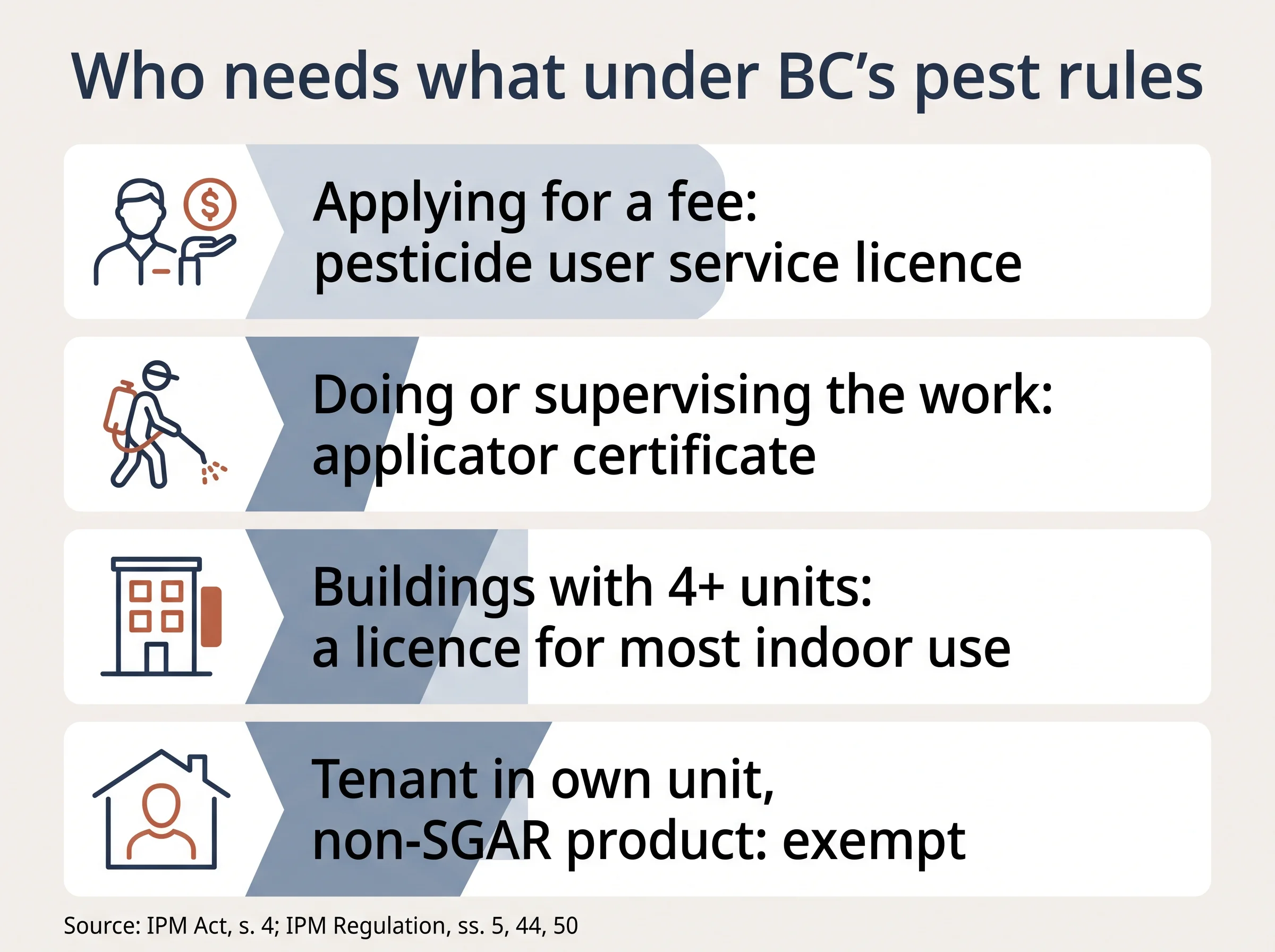
A BC pest-control business needs a pesticide user service licence, because it provides a service respecting pesticides for a fee (IPM Regulation s.44(3)). Section 44 of the Integrated Pest Management Regulation sets three licence categories:
| Licence category | Who needs it | Source |
|---|---|---|
| Pesticide vendor | A person selling pesticides | IPM Act s.4(1); Regulation s.44(1) |
| Pesticide user service | A person who provides, or offers to provide, a service respecting pesticides for a fee, such as an exterminator hired by a landlord | Regulation s.44(3) |
| Pesticide user non-service | An owner using pesticides on their own property where a licence is required, for example a landlord treating a building of four or more units | Regulation s.44(4) |
Section 4 of the regulation defines a "service" as pesticide use under a contract for service with the owner or manager of the land being treated, which is exactly what a landlord hiring an exterminator creates.
The certificate side sits in s.50: an individual who performs or supervises a pesticide use for a licence holder must hold a pesticide applicator certificate endorsed for that use, unless the pesticide is an "excluded" one. The province's licensing page confirms that to apply for a licence, a business needs someone on staff with a valid pesticide certificate in the appropriate category.
What must a licensed exterminator do on a BC rental job?
A BC licensee must follow integrated pest management steps, give treatment notices, safeguard rodenticide bait and keep use records. The regulation attaches these duties to the licence, and they protect tenants and landlords:
- Integrated pest management first. Section 68 says a licensee may use a pesticide only after identifying prevention measures (and doing them or advising the owner, occupant or manager of them), identifying the pest, monitoring its numbers and location, applying an injury threshold, and choosing methods that consider practical alternatives and protect health and the environment. It must evaluate effectiveness after each use.
- Treatment notices. Section 10 requires notice before use: at least 72 hours before treating occupied living accommodation, to the occupant and owner or manager; at least 48 hours before treating multi-residence common areas; and written notice to the owner or manager right after any use that needed a treatment notice. Section 63 sets the notice's contents, including the pest, the product's registration number and active ingredient, the licence number and re-entry precautions.
- Rodenticide safeguards. Section 81 requires bait in fastened, rigid containers or out of reach of people and pets, labelled with a contact and the active ingredient, and, in places children can reach, bait with a bitter agent that is removed when the program ends.
- Records. Section 35 requires a licensee to keep a use record for each treatment location and day of use, including the certified applicator's certificate number and each product used, and s.83 requires those records to be kept for 3 years.
Can a BC landlord apply pesticides personally?
It depends on the building and the product: in a BC building with four or more units, a landlord applying most pesticides in units or shared areas needs a licence and a certified applicator, while in smaller buildings the IPM Regulation s.5(1)(e) licence rule does not apply.
| Situation | Licence needed? | Source |
|---|---|---|
| Landlord treating units or shared areas in a building with four or more units | Yes: a pesticide user non-service licence and a certified applicator, unless the product is an "excluded" pesticide | Regulation s.5(1)(e), (f); s.44(4); s.6(1)(a) |
| Landlord treating a building with fewer than four units | Not under s.5(1)(e), though other s.5(1) uses may apply (for example, landscape pests or an SGAR rodenticide), and a restricted-class product needs a certificate (s.14(1)); every user must follow the label | Regulation s.5(1), s.14(1); IPM Act s.3(1)(c) |
| Tenant treating only their own unit with a non-SGAR product | No, for that use | Regulation s.5(2) |
| Anyone using SGAR rodenticides | Only at essential service locations, by those services or licensed companies they hire; a licence is needed to buy them | Province SGAR page |
The province's SGAR page explains the rodenticide limits. A typical rental is not an essential service location.
Does a BC pest-control licence give a right to enter a rental unit?
No. In BC, entry is governed by s.29 of the Residential Tenancy Act: the landlord must give the tenant written notice at least 24 hours and not more than 30 days ahead, with a reasonable purpose and a time between 8 a.m. and 9 p.m. The Residential Tenancy Branch (RTB) says the landlord must give that notice when a third party enters on the landlord's behalf too. So a licensed treatment in an occupied unit typically involves both the provider's 72-hour treatment notice and the landlord's entry notice. Our guide on notice before pest control in a BC rental explains how to time them, and BC landlord entry rules covers entry generally.
Choosing a licensed pest-control provider: what should a BC landlord check?
- Licence number for a pesticide user service licence, current.
- Name of the certified applicator for your job.
- Will they inspect and monitor before treating, as s.68 requires?
- Which methods will they try first, and which products might they use?
- Will they prepare and deliver each treatment notice, and send you the post-treatment notice?
- What preparation will tenants need, and what re-entry period applies?
- How many visits do they expect, and what follow-up is included?
- Proof of liability insurance (a business practice to ask about, not a requirement we found in the Act).
If you are unsure whether a business is licensed, the province's Integrated Pest Management Program can be reached through the contact details on its licensing page.
Frequently asked questions
What licence does an exterminator need in BC?
A pesticide user service licence, which IPM Regulation s.44(3) requires of anyone who provides or offers a pesticide service for a fee. The licensee must also have a certified applicator performing or supervising the work under s.50.
Can a BC landlord spray for pests without a licence?
In a building with four or more units, generally no: IPM Regulation s.5(1)(e) and (f) make most pesticide use in units and shared areas a licensed use, so the landlord would need a pesticide user non-service licence (s.44(4)) and a certified applicator, unless the product is an excluded pesticide. In smaller buildings s.5(1)(e) does not apply, but the label must still be followed.
Can a BC tenant use bug spray in their own apartment?
Yes, for a non-SGAR product used only within their own living accommodation: IPM Regulation s.5(2) takes that use out of the licensing requirement. The product label still has to be followed.
How can a BC landlord check an exterminator's licence?
Ask the business for its licence number and the name of its certified applicator; the licence number must appear on the treatment notice under IPM Regulation s.63. If in doubt, contact the province's Integrated Pest Management Program through its licensing page.
Does a BC exterminator need liability insurance?
We found no insurance requirement in the Integrated Pest Management Act. Asking for proof of liability insurance is a sensible business practice, not a legal requirement under that Act.
For specific pests, see bed bugs, mice and rats and cockroaches in apartment buildings. More guides are in the landlord hub.
Keep your tenancy records complete
Find the British Columbia landlord and tenant forms we cover, each with a plain-language guide.