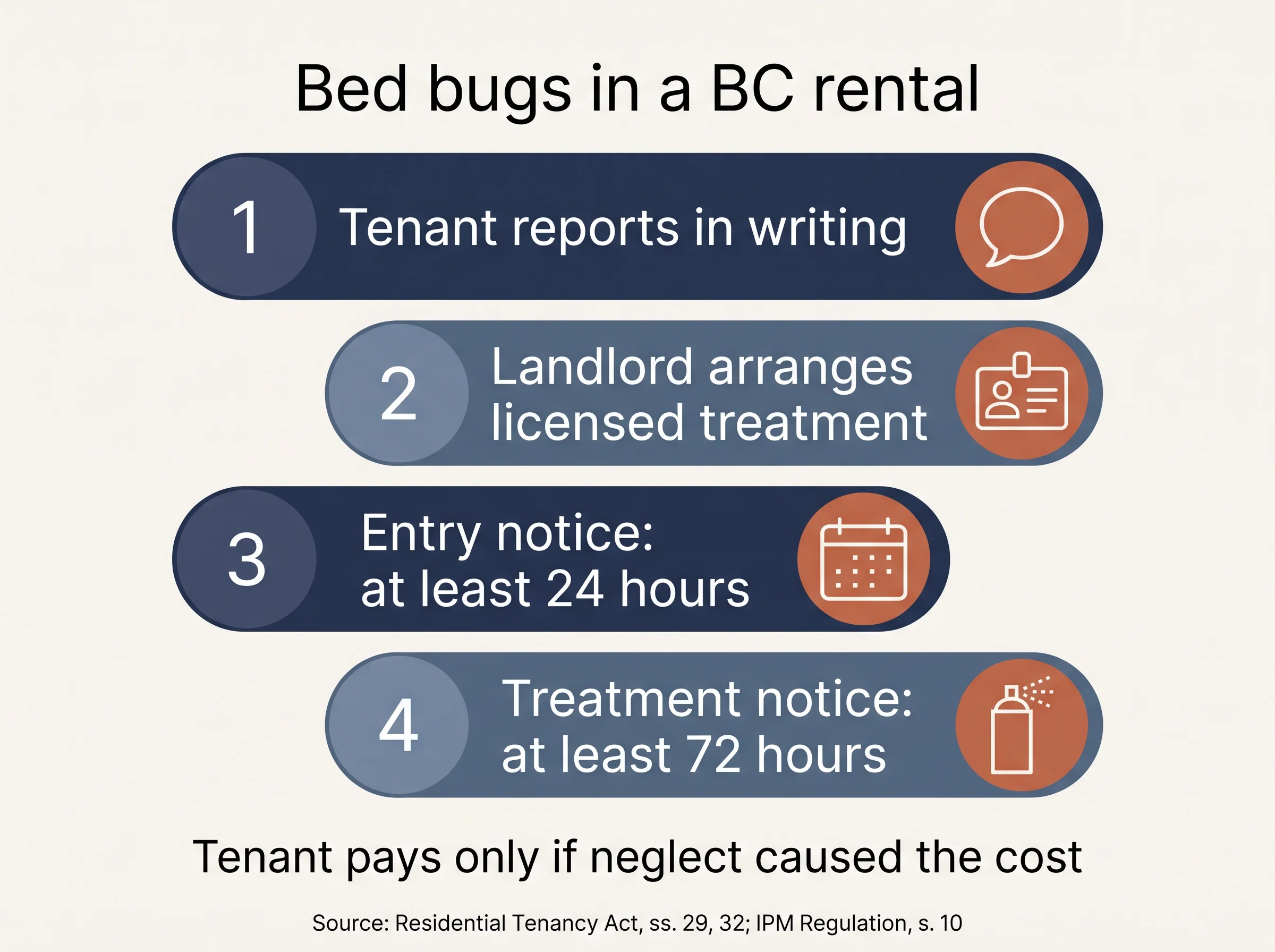
With bed bugs in a BC rental, the landlord generally treats the unit and pays for it: the Residential Tenancy Branch says landlords are generally responsible for controlling insect infestations, in line with the repair duty in RTA s.32(1). A BC tenant pays only where an arbitrator finds the tenant's actions or neglect caused the cost (RTA s.32(3), s.7, s.67).
This guide sets out who treats bed bugs in British Columbia under Residential Tenancy Branch (RTB) rules, who pays, how the landlord gets into the unit, and what both sides should keep on file.
Who pays for bed bug treatment in a BC rental?
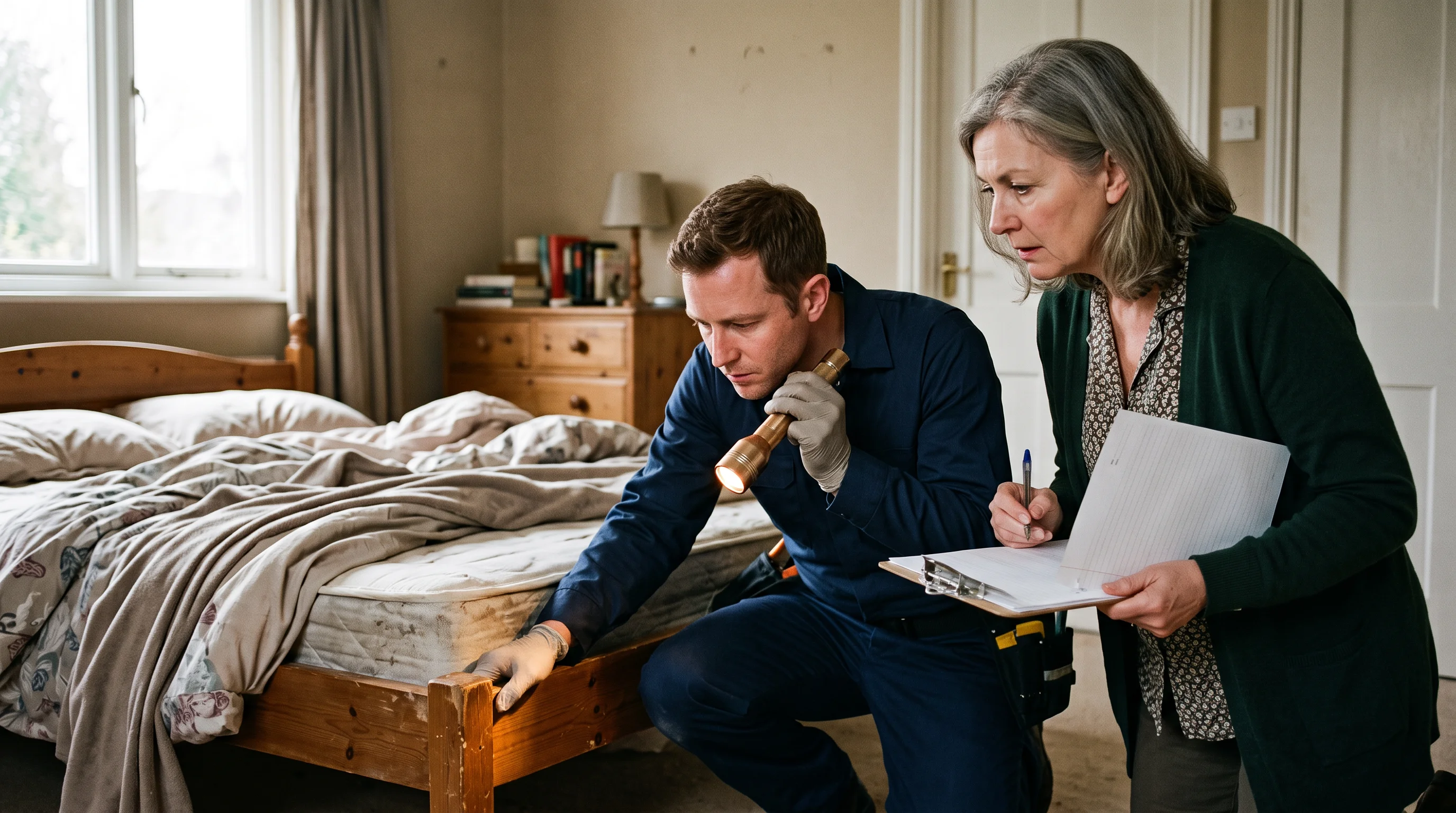
In British Columbia, the landlord arranges and pays for bed bug treatment in almost every case. Two provisions of the Residential Tenancy Act set the starting point:
- RTA s.32(1) requires a BC landlord to provide and maintain residential property in a state of decoration and repair that complies with the health, safety and housing standards required by law and makes it suitable for occupation, having regard to its age, character and location.
- RTA s.32(2) requires a BC tenant to maintain reasonable health, cleanliness and sanitary standards throughout the unit and the other parts of the property the tenant can use.
The RTB's repairs and maintenance page applies those duties to pests directly: "Landlords are generally responsible for controlling insect infestations, such as bedbugs." The same page says municipal standards of maintenance bylaws decide whether a BC landlord must manage other pests, such as rodents. For bed bugs, the landlord arranges the treatment.
The RTB's advice for repair disputes fits bed bugs well: make the repair first, then work out who should pay. A BC landlord who believes the tenant caused the infestation still treats the unit promptly and raises the cost question afterwards. Waiting while the two sides argue lets bed bugs spread, often into neighbouring units, and makes the bill bigger for everyone.
| Question | BC landlord | BC tenant |
|---|---|---|
| Duty | Maintain the unit to health, safety and housing standards (RTA s.32(1)) | Keep reasonable health, cleanliness and sanitary standards (RTA s.32(2)) |
| Bed bug treatment | Arranges and pays, as the RTB says landlords are generally responsible for insect infestations | Reports in writing and prepares the unit as instructed |
| When they pay | By default, for treatment | Only if an arbitrator finds the tenant's actions or neglect caused the cost (RTA s.32(3), s.7, s.67) |
| What they cannot do | Deduct the cost from a deposit without written agreement or an RTB order | Withhold rent (RTA s.26(1)) or bill the landlord for their own exterminator without written agreement |
When can a BC landlord charge a tenant for bed bug treatment?
A BC landlord can recover bed bug treatment costs from a tenant only by proving to an RTB arbitrator that the tenant breached a duty and that the breach caused the cost. RTA s.32(3) makes a tenant repair damage to the unit or common areas caused by the actions or neglect of the tenant, an occupant, or a person the tenant let onto the property; RTA s.7(1) lets one party claim compensation from the other for loss caused by non-compliance with the Act or the tenancy agreement; and RTA s.67 lets an arbitrator order that compensation.
In practice the landlord has to show two things:
- that the tenant breached a duty (for example, the s.32(2) cleanliness standard, or a refusal to prepare the unit that made a treatment fail), and
- that the breach caused the cost being claimed.
Proving where bed bugs came from is hard. HealthLinkBC notes that bed bugs hitch rides on clothing, backpacks, luggage and books, and are commonly found in homes, hotels, student residences and shelters. Bringing home a bed bug on a coat is not, on its own, neglect. The conservative reading, and the one we would rely on, is that a BC landlord should expect to pay for a first treatment and consider a claim against the tenant only with clear evidence, such as a tenant who refused entry or ignored written preparation instructions so that a treatment had to be repeated.
What should a BC tenant do after finding bed bugs?
A BC tenant who sees signs of bed bugs should tell the landlord in writing straight away. The RTB says tenants must request repairs in writing, by email, letter or text message, describe the problem, allow a reasonable time, and keep a copy. HealthLinkBC lists the signs to look for:
- bite marks, often on the face, neck, arms and hands;
- dark spotting or staining on sheets, mattresses, bed frames and carpets;
- live or dead bugs, or their shed skins.
Photos, dates and a copy of the written request matter if the problem drags on. If the landlord does not act within a reasonable time, the tenant can apply to the RTB for an order that the repair be made and for compensation. Our guide on what BC tenants can do when a landlord will not make repairs walks through that route.
A BC tenant can hire an exterminator and bill the landlord only in narrow cases. RTA s.33 lets a tenant arrange "emergency repairs" and be reimbursed, but the list of emergencies in s.33(1) covers things like major leaks, blocked sewer pipes, the primary heating system, locks and electrical systems, and bed bugs are not on it. The RTB also says tenants must have the landlord's written agreement before making repairs themselves and charging the landlord. Our article on emergency repairs in BC explains the s.33 process in full.
A BC tenant also cannot hold back rent because of an infestation: RTA s.26(1) says rent is payable when due whether or not the landlord complies with the Act, unless the Act gives the tenant a specific right to deduct.
How much notice does a BC landlord need to enter for bed bug treatment?
A BC landlord must give written notice at least 24 hours and not more than 30 days before entering for bed bug inspection or treatment (RTA s.29), and a licensed pest-control business must also give the occupant a treatment notice at least 72 hours before using a pesticide. Unless the tenant agrees at the time (or within the 30 days before), or there is an emergency, the s.29 notice must state a reasonable purpose and the date and time, which must fall between 8 a.m. and 9 p.m. unless the tenant agrees otherwise. The RTB confirms that the same notice is needed when the landlord sends someone else, such as a contractor, in on the landlord's behalf.
| Notice | Who gives it | Timing | Source |
|---|---|---|---|
| Entry notice | BC landlord (also when a contractor enters for the landlord) | At least 24 hours and not more than 30 days before entry; entry between 8 a.m. and 9 p.m. | RTA s.29 |
| Treatment notice | Licensed pest-control business | At least 72 hours before pesticide use in occupied living accommodation | IPM Regulation s.10(2) |
The treatment notice comes from section 10(2) of the Integrated Pest Management Regulation. It is separate from the landlord's 24-hour entry notice, and the longer period governs the schedule. Our companion piece on how much notice to give before a pest treatment in BC covers both notices and how to time them, and the general rules are in BC landlord entry rules.
Who pays for a BC tenant's damaged belongings or a hotel stay?
Nothing in BC's Residential Tenancy Act says a landlord must pay for a tenant's mattress or hotel stay just because bed bugs appeared. A BC tenant can claim compensation under RTA s.7 and s.67 if the landlord's failure to comply caused the loss, for example by ignoring a written report for weeks. RTB Policy Guideline 6 also notes that a tenant may be compensated for loss of use of part of the property even where the landlord made reasonable efforts to minimize disruption. Each claim turns on its facts, and an arbitrator decides.
Most treatments only work if the unit is prepared: laundry washed and bagged, clutter reduced, furniture pulled from walls. HealthLinkBC recommends washing bedding and clothing in hot water and drying on the hottest setting, steaming items that cannot be washed, and storing clean items in sealed bags or bins. The preparation sheet itself comes from whoever does the treatment; give the tenant a copy with the entry notice.
Choosing a licensed pest-control provider: what should a BC landlord check?
Any business that applies a pesticide for a fee needs a pesticide user service licence, whatever the size of the building, unless the product is an excluded pesticide (IPM Act s.4(1)(c); IPM Regulation s.44(3)). In a BC building with four or more units, using most pesticides inside living accommodation or in shared areas also requires a licence even when the owner does the work, under section 5(1)(e) of the Integrated Pest Management Regulation. A landlord who hires out the work should check the provider's licence number before booking; the treatment notice must show it. Our guide on whether exterminators need a licence in BC explains what the licence covers and how to check it.
Questions worth asking any provider: Will you inspect first and confirm the pest? How many visits do you expect? What must the tenant do before and after? How long should people stay out of treated rooms? Will you give the occupant the treatment notice the regulation requires?
What happens if bed bugs are found at move-out in a BC rental?
If bed bugs are found at the end of a BC tenancy, record them on the move-out condition inspection report. A report done properly is evidence of the unit's condition, which matters if either side later claims costs. See move-in and move-out condition inspections in BC and the Condition Inspection Report (RTB-27). Before a new tenant moves in, it is prudent to confirm the unit is clear; a new tenant who finds bed bugs on day one has a strong s.32(1) complaint.
Frequently asked questions
Can a BC tenant withhold rent because of bed bugs?
No. RTA s.26(1) says rent in British Columbia is payable when due whether or not the landlord complies with the Act, unless the Act gives the tenant a specific right to deduct. A tenant whose landlord will not treat the unit should apply to the RTB for a repair order and compensation instead.
Can a BC tenant hire an exterminator and send the landlord the bill?
Usually not. Bed bugs are not on the RTA s.33(1) list of emergency repairs, and the RTB says a tenant must have the landlord's written agreement before making repairs and charging the landlord. Get that agreement in writing first.
Can a BC landlord deduct bed bug treatment from the security deposit?
Only with the tenant's written agreement or an RTB order. A wrong deduction can cost a BC landlord double the deposit under RTA s.38(6).
How much notice is needed before a bed bug treatment in BC?
The BC landlord must give written entry notice at least 24 hours and not more than 30 days ahead under RTA s.29. A licensed applicator must also give the occupant a treatment notice at least 72 hours before using a pesticide under IPM Regulation s.10(2), so the 72-hour notice sets the schedule.
Does a BC exterminator need a licence to treat bed bugs in an apartment?
Yes. A business providing a pesticide service for a fee needs a pesticide user service licence (IPM Act s.4(1)(c); IPM Regulation s.44(3)), and in a building with four or more units most pesticide use in units or shared areas is a licensed use even for the owner (IPM Regulation s.5(1)(e)). The licence number must appear on the treatment notice, so a landlord can check it before booking.
More BC guides for both sides are in the landlord hub and the tenant hub.
Keep the paperwork straight
Find the British Columbia landlord and tenant forms we cover, each with a plain-language guide, including the condition inspection report.