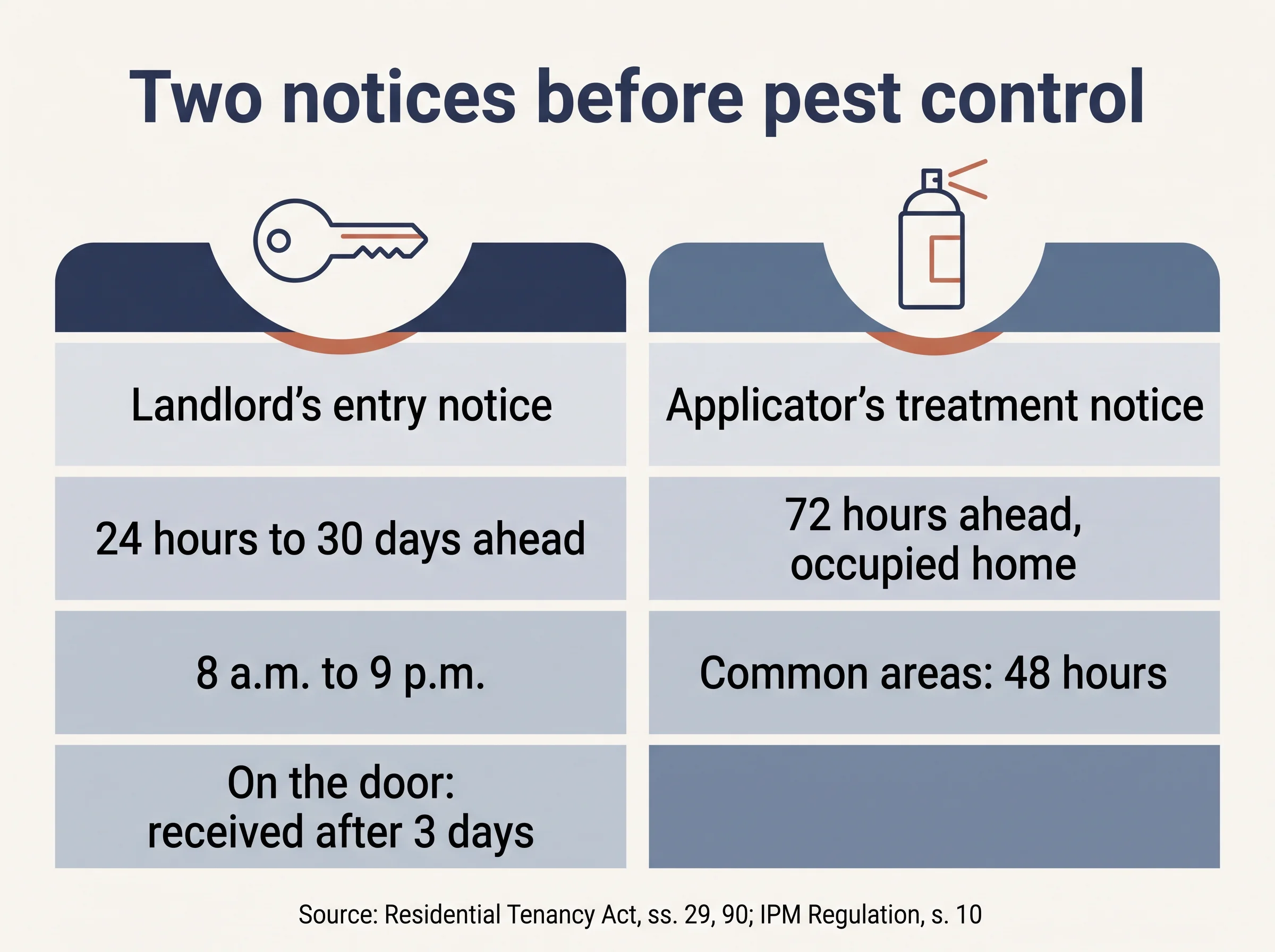
Notice before pest control in a BC rental usually means two notices: the landlord's written entry notice at least 24 hours and no more than 30 days ahead under RTA s.29(1)(b), and a licensed applicator's treatment notice at least 72 hours before pesticide use in an occupied home under IPM Regulation s.10(2).
This article explains what each British Columbia notice must say, who gives it, how to time the two together, and what a preparation sheet should cover.
How much notice must a BC landlord give to enter for pest control?
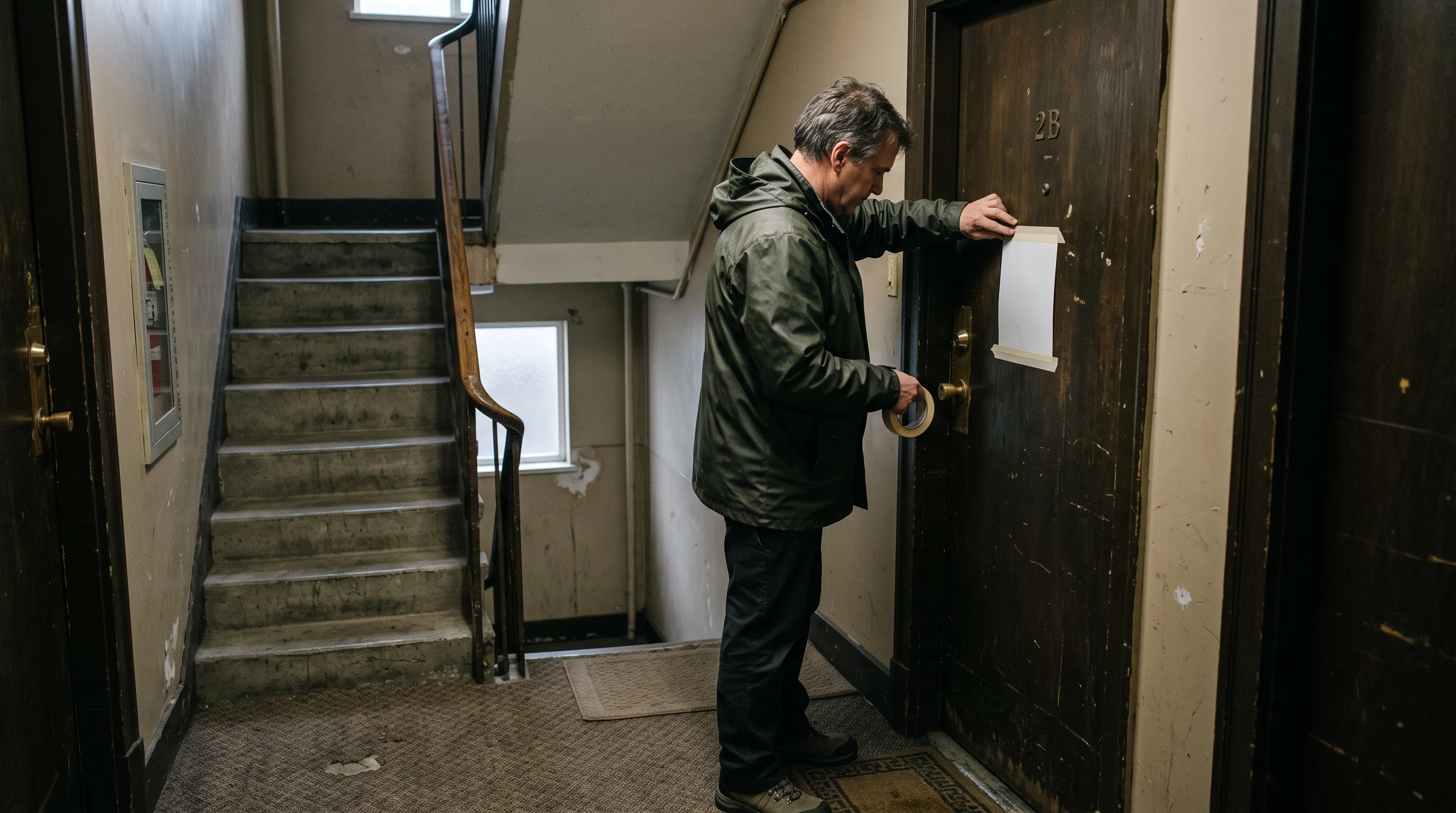
A BC landlord must give the tenant written notice at least 24 hours and not more than 30 days before entering for a planned pest treatment. Section 29(1) of the Residential Tenancy Act says a landlord must not enter a rental unit for any purpose unless one of a short list of conditions applies, and for a planned treatment the usual route is s.29(1)(b). The notice must state:
- the purpose of entering, which must be reasonable; and
- the date and time of entry, which must be between 8 a.m. and 9 p.m. unless the tenant agrees otherwise.
The Residential Tenancy Branch (RTB) adds two points on its landlord access page. BC landlords must give the same notice when an authorized third party, such as a contractor, enters on their behalf. And the tenant does not need to be home for the entry, as long as proper notice was given. Pest control is a reasonable purpose: the RTB lists completing necessary repairs or maintenance among common reasons for entry.
The other routes in s.29(1) also exist. A tenant can simply agree, at the time or within 30 days before the entry. An emergency where entry is necessary to protect life or property allows entry without notice, but a routine infestation is unlikely to meet that test. For a planned treatment, written notice is the safe course.
When is a BC entry notice treated as received?
The 24 hours run from when the BC tenant receives the notice, and RTA s.90 deems some delivery methods received later than the day they are used. The table shows the deemed dates, which apply unless the notice was actually received earlier.
| How the notice is delivered | Deemed received (RTA s.90) |
|---|---|
| Attached to the door | On the third day after it is attached |
| Left in a mailbox or mail slot | On the third day |
| Mailed | On the fifth day |
Our reading is the conservative one: if you post the notice on the door, count three days plus 24 hours before the visit. Handing it to the tenant avoids the gap. The full list of service methods is in RTA s.88, and our guide to serving documents in BC covers each one.
How much notice must a pest-control company give before treating a BC rental?
A licensed pest-control business in BC must give a treatment notice at least 72 hours before using a pesticide inside an occupied home. Section 10(2) of the Integrated Pest Management Regulation requires that notice to go to the occupant and, if different, to the owner or manager of the building or their agent. Section 63(1) lists what it must contain:
- a description of the treatment area;
- the name of the targeted pest;
- the pesticide's federal registration number and its active ingredient;
- the proposed date and start time, and proposed alternative dates and times;
- the licensee's name and licence number;
- a phone number for more information; and
- precautions to minimize exposure, including how long people should stay out of the treated area.
IPM Regulation s.10(10) says the 72-hour period can be shortened only with the consent of each person who has access to the treatment area and is entitled to the notice. Section 10(12) then requires the licensee, right after the treatment, to give the owner or manager written notice that the use happened and of any differences from what the treatment notice said.
Shared areas in a BC multi-residence building have a different rule. Under s.10(4), at least 48 hours before using a pesticide in a common area (such as a hallway, laundry room, or an outdoor area within 5 metres of an entrance or window), the licensee must give the owner or manager a treatment notice and either give it to each person with access or post it at the entrances for 48 hours after the use.
How should a BC landlord time the entry notice and the treatment notice?
In BC the applicator's 72-hour treatment notice is the longer period, so it sets the pace: serve the landlord's s.29 entry notice at least 72 hours before the first visit, not 24, so both run together. A practical sequence:
- Book the provider and get its treatment notice (or confirm when it will deliver one) with the date, start time and alternatives.
- Serve your section 29 entry notice at least 72 hours before the first visit, using the same date and time window.
- Attach the preparation sheet to your notice so the tenant has the full three days to prepare.
- Cover every visit. Each entry needs a notice naming its date and time and falling within 30 days of the notice. If follow-ups are already booked you can list them, but the conservative course is to confirm each later visit in writing as well.
- Keep proof of service, such as a photo of the notice on the door with a date, or the tenant's signed copy.
What should a pest-control preparation sheet cover in a BC rental?
No BC statute sets out a preparation sheet; it comes from the provider and depends on the pest and method. In general it tells the tenant:
- what to empty, bag or move (for bed bugs, typically bedding and clothing; for cockroaches, kitchen cupboards);
- what to wash or heat and how (HealthLinkBC's bed bug file recommends hot-water washing and the hottest dryer setting);
- how far to pull furniture from walls;
- what to do with pets, aquariums and food;
- how long people and pets should stay out after treatment, matching the precautions on the treatment notice; and
- what to avoid afterwards, such as cleaning treated baseboards for a set time.
Hand the sheet over early and in writing. Some tenants cannot do heavy preparation because of age, disability or illness; agreeing on help before the visit avoids a failed treatment.
Can a BC landlord make the tenant leave during pest treatment?
No. The RTB says BC tenants have the right to be present when a landlord enters, and a landlord cannot force tenants to leave when they enter. That sits awkwardly with treatments where the label or the provider says no one should be in the room for some hours. The practical answer is agreement: explain the re-entry period on the treatment notice, offer times that work for the tenant, and get the arrangement in writing. If a tenant will not cooperate at all, see our article on what a landlord can do when a tenant refuses pest-control entry.
How does pest-control notice work in a BC strata building?
In a BC strata, the strata corporation may arrange treatment of common property, and its applicator still owes common-area notices under s.10(4) of the IPM Regulation. Entry into a rented strata lot is still the landlord's s.29 notice to the tenant. Our guide to renting out a strata unit in BC explains how strata rules and tenancy rules fit together.
Who gives which notice before pest control in BC?
Four notices can apply to one pest treatment in a BC rental, and only one of them comes from the landlord.
| Notice | From / to | Timing | Source |
|---|---|---|---|
| Entry notice | Landlord to tenant | At least 24 hours and no more than 30 days before; purpose plus date and time between 8 a.m. and 9 p.m. | RTA s.29(1)(b) |
| Treatment notice, occupied home | Licensed applicator to occupant and owner or manager | At least 72 hours before pesticide use | IPM Regulation s.10(2); content in s.63(1) |
| Treatment notice, common areas | Licensed applicator to owner or manager, and delivered or posted for those with access | At least 48 hours before | IPM Regulation s.10(4) |
| Post-treatment notice | Licensed applicator to owner or manager | Right after the treatment | IPM Regulation s.10(12) |
Choosing a licensed pest-control provider: what should a BC landlord ask?
Ask whether the provider will prepare and deliver the section 10 treatment notice, and ask to see a sample. A provider that cannot name its licence number, which the notice must show, is a red flag. Our explainer on pest-control licences in BC covers what to check. For who pays for the treatment itself, see bed bugs in a BC rental: who pays, and for entry in general, BC landlord entry rules.
Frequently asked questions
Is 24 hours' notice enough before pest control in a BC rental?
For the landlord's entry, yes: RTA s.29(1)(b) requires written notice at least 24 hours and not more than 30 days ahead. But a licensed applicator using a pesticide in an occupied home must give a 72-hour treatment notice under IPM Regulation s.10(2), so in practice the visit cannot happen until 72 hours have passed.
Does a BC tenant have to be home for pest control?
No. The RTB says the tenant does not need to be home for the entry as long as proper notice was given. The RTB also says the tenant has the right to be present, and a landlord cannot force a tenant to leave.
Can the 72-hour pest-control notice be shortened in BC?
Only with the consent of each person who has access to the proposed treatment area and is entitled to the notice, under IPM Regulation s.10(10). Without that consent the licensed applicator must give the full 72 hours before using a pesticide in an occupied home.
Does the BC landlord's notice cover a contractor who enters?
Yes, and it is required. The RTB says landlords must give the same s.29 notice when an authorized third party, such as a pest-control contractor, enters on their behalf.
How much notice is needed for pest control in BC common areas?
At least 48 hours under IPM Regulation s.10(4). The licensee gives the owner or manager a treatment notice and either gives it to each person with access or posts it at the entrances for 48 hours after the use.
More guides are in the landlord hub and the tenant hub.
Have your tenancy paperwork ready
Find the British Columbia landlord and tenant forms we cover, each with a plain-language guide.