Saskatchewan's residential landlord and tenant law is The Residential Tenancies Act, 2006, not The Landlord and Tenant Act, which covers commercial leases. It caps deposits at one month's rent, requires 12 months' notice of a rent increase, sets 24 hours' written notice for entry, and leaves evictions to the Office of Residential Tenancies (ORT).
If you searched "Saskatchewan landlord tenant act", this guide puts every main rule for residential landlords on one page, with the section that sets it. The ORT, which older documents call the Rentalsman, runs the Act, issues the approved forms and decides disputes through its online portal.
At a glance
- Law: The Residential Tenancies Act, 2006, its Regulations and the Standard Conditions in Schedule 1.
- Lease: copy to the tenant within 20 days (s.19(2)); no application fees (s.23).
- Deposit: one month's rent maximum; return or claim within seven business days (s.25(1), s.32(1)).
- Rent increase: no cap; 12 months' notice and an 18-month first wait (s.54).
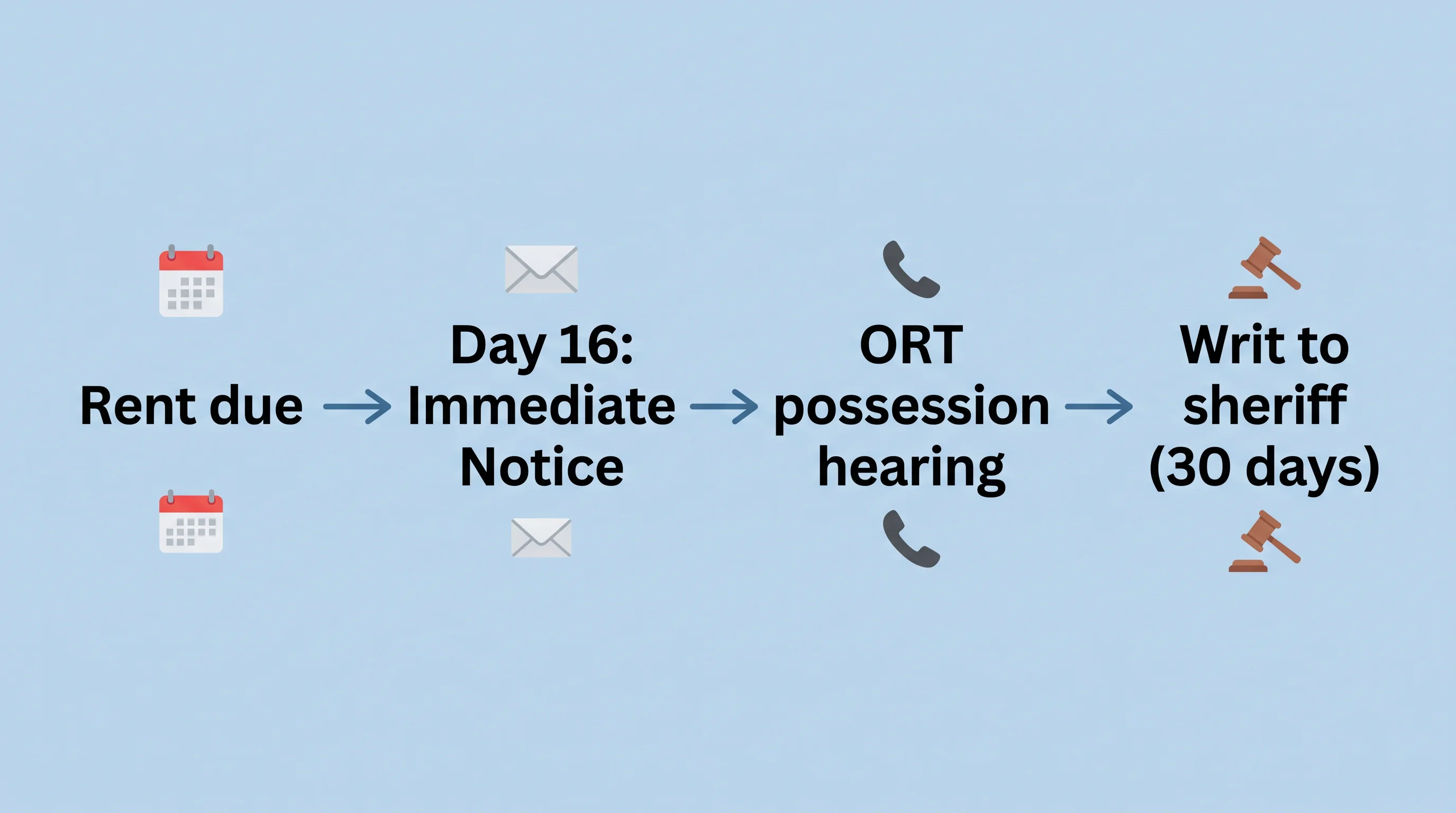
- Unpaid rent: Immediate Notice to Vacate once rent is 15 days or more overdue; serve it on day 16 or later (s.57(1)).
- ORT: $50 per application, one-year limit, up to $30,000 (Regs s.13(1)(a), s.11; s.71.1).
Saskatchewan Landlord Compliance Checklist
Get Free PDF →Which law governs landlords in Saskatchewan?
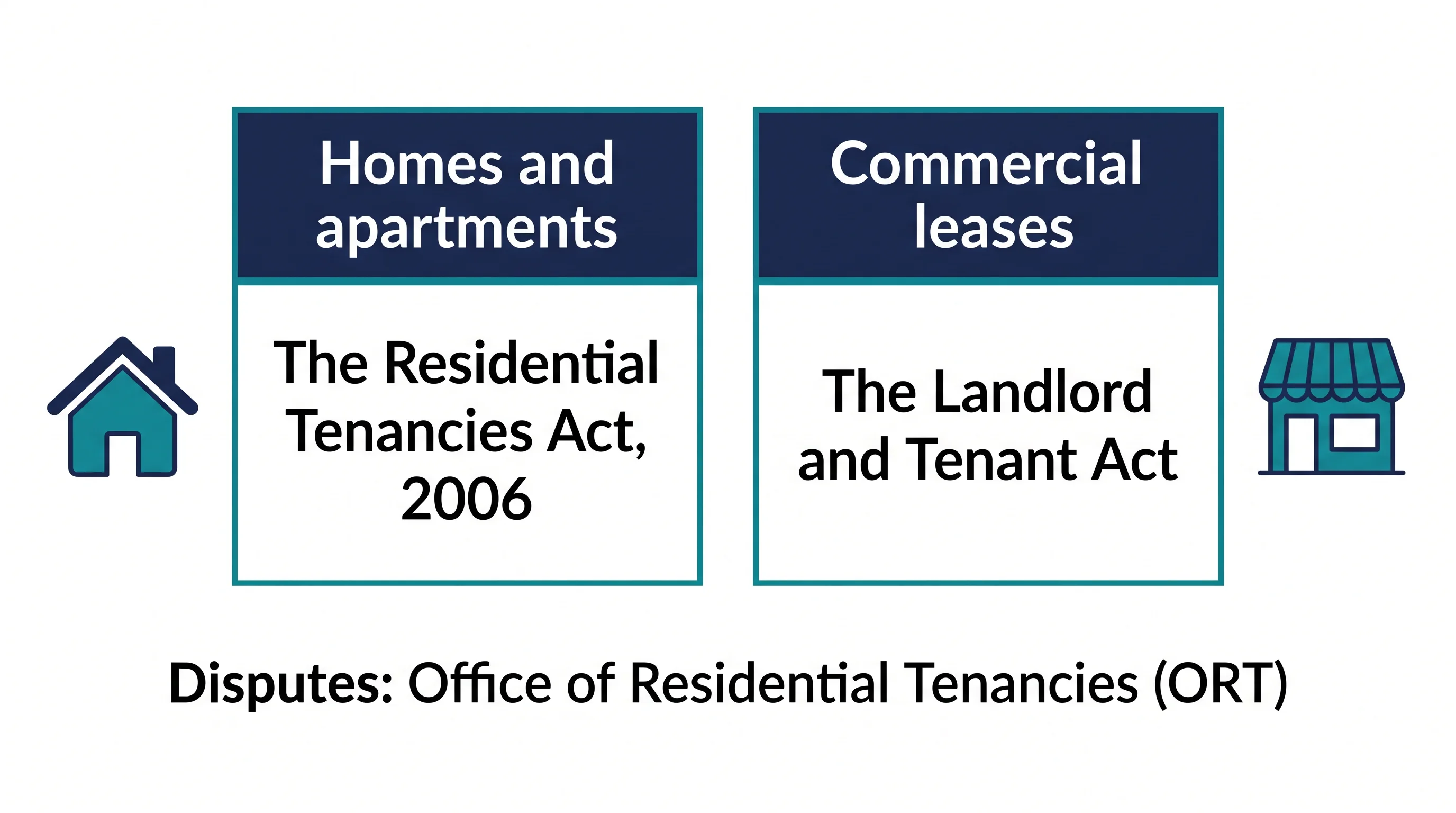
Residential tenancies in Saskatchewan are governed by The Residential Tenancies Act, 2006 and The Residential Tenancies Regulations, 2007. The ORT's page notes that commercial tenancies fall under The Landlord and Tenant Act, so that statute is the wrong one for a house, suite or apartment.
The Standard Conditions in Schedule 1 of the Regulations are part of every tenancy agreement (Regs s.4) and cannot be amended or removed (s.22(1)). Any agreement that the Act does not apply is void (s.6), and a term that is inconsistent with the Act, unconscionable or unclear cannot be enforced (s.7(2)). Some accommodation is outside the Act, including short hotel or bed and breakfast stays under six consecutive months, crisis shelters and licensed personal care homes (s.5).
Notices are made on the ORT's approved forms, which are created in its online portal under a Saskatchewan Account; a landlord's notice to end a tenancy must be in the approved form (s.63(e)).
What must a Saskatchewan lease include?

A written Saskatchewan tenancy agreement must contain the Standard Conditions, the correct legal names, the unit address, the landlord's address for service and phone number, an emergency repairs number if different, the start date, the term or period, the rent and due day, who pays utilities, the services included and the deposit amount and date (s.19(1)). Give the tenant a signed copy within 20 days (s.19(2)).
A fixed term of three months or longer must be in writing (s.20), and a written agreement with no end date is a monthly periodic tenancy (s.21). If you do not deliver the copy, or for an oral tenancy the written contact details, the tenant's obligation to pay rent is suspended (s.19(5)) until you obtain an order under s.19(6) or comply. In a building with common areas, post your legal name, service address and phone number near the main entrance (s.19(4)).
You may make reasonable written rules about use of the unit and its services and facilities, including banning cannabis, as long as tenants know about them (s.22.1). Do not charge application or screening fees (s.23), and do not demand rent in advance for future periods (s.40). The Act and Regulations are silent on late-payment and NSF fees: put any fee in the written agreement, keep it reasonable, and expect a hearing officer to refuse one that works as a penalty (s.7(2)).
What are the security deposit rules for Saskatchewan landlords?
A Saskatchewan landlord may take one security deposit, at the start of the tenancy, of no more than one month's rent (s.25(1), s.26(1)(a)–(b)), with no more than half payable at signing and the balance within two months after the tenant takes possession (s.26(4)). Hold it in trust, invested in Trustee Act securities or in a trust account at a bank, trust company or credit union (s.28–29).
Within seven business days after you know or should know the tenant has left, return the deposit, or return the undisputed part and serve the approved notice of claim at the forwarding address (s.32(1)–(2)). Interest is 0% if the tenancy ends within five years (Regs s.5(1.1)). Miss the seven-day step and the hearing officer must order the deposit returned unless exceptional circumstances apply (s.34(1), (3)). Do not write a clause that you keep any of it automatically (s.26(1)(c)).
How do rent increases work in Saskatchewan?
Saskatchewan does not cap the amount of a rent increase. For a periodic tenancy you must give 12 months' written notice, effective no earlier than the later of 18 months after the tenancy began and 12 months after the last increase (s.54(1)(a), (2)(a)), using the approved Notice of Rent Increase (formerly Form 5).
Members in good standing of the Saskatchewan Landlord Association Inc. or the Network of Non-Profit Housing Providers of Saskatchewan give six months' notice, with 12-month and six-month floors (s.54(1)(b), (2)(b); Regs s.8.1). A fixed-term rent can only rise as agreed at signing (s.53.1). You may not end or restrict a service or facility, or start charging for a free one, without the tenant's agreement or an ORT order (s.43). Bill 608, The Rent Control Act, 2025, is a private member's bill and is not law.
How can a Saskatchewan landlord end a tenancy?
A Saskatchewan landlord ends a tenancy by serving the right approved notice for the ground, and regains possession only if the tenant leaves or with an ORT order of possession and a writ directed to a sheriff (s.65). Seizing a tenant's belongings is prohibited except as the Act allows (s.12).
| Ground | Notice | Approved form (old number) | Section |
|---|---|---|---|
| Rent unpaid 15 days or more | Immediate | Immediate Notice to Vacate and Notice of Arrears (Form 7) | s.57(1) |
| Cause: repeated late rent, damage, disturbance, breach after written warning, refused entry and others | One month, day before a rent day; tenant may dispute within 15 days | Notice to Vacate: Cause (Form 8) | s.58 |
| Landlord or close family member or friend will occupy | Two months, periodic only | Notice to Vacate: Owner Occupy (Form 8b) | s.60(3)–(4) |
| Purchaser will occupy after a sale | One month, periodic only | Notice to Vacate: Purchaser Occupy (Form 8c) | s.60(3.1), (6) |
| Demolition, renovation, conversion, with all permits | Two months, periodic only | Notice to Vacate: Specified Uses (Form 8d) | s.60(3), (7) |
| Fixed term ending | Notice of intention at least two months before the end | Term Lease – Two Month Notice of Intention (Form 15) | Regs s.8.2 |
Count carefully on unpaid rent. Section 57(1) allows the immediate notice when rent is unpaid "15 days or more", but the Standard Conditions say "more than 15 days" (Schedule 1, s.17(1)), so serve on the 16th day after the due date or later. The Act does not say that a payment after service cancels the notice, and accepting arrears is not a waiver unless you agree in writing (s.60.1); put any arrangement to let the tenant stay in writing and expect the hearing officer to decide possession. Where the tenant disputes a cause notice within 15 days, you must apply to the ORT for possession; if they do not, they are deemed to accept it (s.58(5)–(6)).
Section 60 notices end only periodic tenancies (s.60(2)). If the purpose is not carried out, or the unit is not used for it for at least six months, the tenant can claim losses (s.62), and re-renting on other grounds is an offence with fines up to $300 for an individual and $1,000 for a corporation (s.79(4)–(5)). Compare Alberta's 14-day notice for unpaid rent.
How do you serve notices in Saskatchewan?
Serve a current Saskatchewan tenant personally, or post the notice on the front door of the unit and also send it by ordinary mail or electronically (s.82(2)(a)). Email alone does not serve a current tenant. Mail is deemed received on the third business day after mailing and electronic delivery on the next business day (s.82(4)–(5)). Registered mail is not one of the methods s.82(2)(a) lists, so do not rely on it.
What does a possession hearing and writ involve?
A Saskatchewan landlord applies for an order of possession through the ORT portal with the $50 fee, a true copy of the notice as served, a Certificate of Service, the written agreement and, for arrears, the rent ledger (ORT Rules of Procedure). Arrears to the date of the immediate notice and the filing fee can be claimed at that hearing. Hearings are usually by phone, and decisions are given in writing afterwards.
If possession is granted, the hearing officer orders a writ of possession directed to the sheriff at the judicial centre nearest the unit (s.70(13)). The writ expires 30 days after it is ordered unless another date is set (Regs s.10(2)), and the form tells landlords to deliver it to the sheriff at least five business days before it expires. Either side can appeal to the Court of King's Bench on a question of law or jurisdiction within 30 days (s.72(1)); a tenant appealing a writ for unpaid rent must first deposit one month's rent with the ORT for a certificate of payment of rent (s.72(1.3); Regs s.10.1).
What else must a Saskatchewan landlord do?
- Entry: written notice 24 hours to seven days ahead, a reasonable purpose and a four-hour window between 8 a.m. and 8 p.m. (s.45(1)(b), (2)).
- Repairs: keep the property in good repair and fit for habitation, including supplied services, wear and tear included (s.49(1), (4)).
- Locks: change a unit lock only with the tenant's agreement and new keys (s.48(2)).
- Assignment and sublet: written consent not unreasonably withheld; a fee of no more than $20 (s.50; Regs s.8).
- Abandoned property: property worth $1,500 or less may be disposed of after reasonable efforts to find the tenant; above that, ask the ORT for an order (s.85).
- Out-of-province owners: a landlord with no Saskatchewan residence or office must file a power of attorney with the ORT before carrying on business (s.83(2)).
- Records: keep adequate books and records (s.86).
Breaking the Act is an offence with fines up to $500 and up to six months' imprisonment for an individual, or up to $1,000 for a corporation (s.79(2)). For how neighbouring rules compare, see the Alberta landlord guide and Ontario vs BC landlord rules, and browse the Canadian Landlord Resource Center.
Frequently asked questions
Is The Landlord and Tenant Act the law for Saskatchewan rentals?
Not for homes. Residential tenancies fall under The Residential Tenancies Act, 2006; The Landlord and Tenant Act covers commercial tenancies, according to the ORT.
Can I charge a late fee in Saskatchewan?
The Act and Regulations do not mention late or NSF fees and set no amount. Any fee must be in the written agreement and must not be a penalty; a hearing officer can refuse an unreasonable term (s.7(2)).
How much notice do I need to raise the rent in Saskatchewan?
Twelve months' written notice for a periodic tenancy, and the increase cannot take effect until 18 months after the tenancy began or 12 months after the last increase (s.54). Members of a prescribed landlord association give six months.
Can I change the locks if the tenant stops paying?
No. You may regain possession only if the tenant leaves or with an ORT order and a sheriff's writ (s.65), and a tenant locked out without justification can apply for possession and punitive damages (s.66).
I live outside Saskatchewan. Do I need anything extra?
Yes. A non-resident landlord must file a power of attorney with the ORT appointing a person to receive notices and applications before carrying on business (s.83(2)).
What does it cost to apply to the ORT?
Every application costs $50 (Regs s.13(1)(a)), the fee is non-refundable (s.70(2.01)), and the hearing officer may order the other side to reimburse a successful applicant (Regs s.13(2)).
Running a rental in Saskatchewan comes down to using the approved forms, counting days carefully, serving notices by a listed method and keeping records good enough to show the ORT.
Saskatchewan Landlord Compliance Checklist
Get Free PDF →Get your rental paperwork right
Browse free landlord and tenant resources
Free • No signup required