In BC, the supportive housing Residential Tenancy Act question has a clear answer: the Act applies to supportive housing, except the sections on quiet enjoyment, landlord entry and guests. Transitional housing, emergency shelters, housing tied to treatment and assisted living residences are outside the Act, while seniors' independent living is covered in full.
Does the Residential Tenancy Act apply to supportive housing in BC?
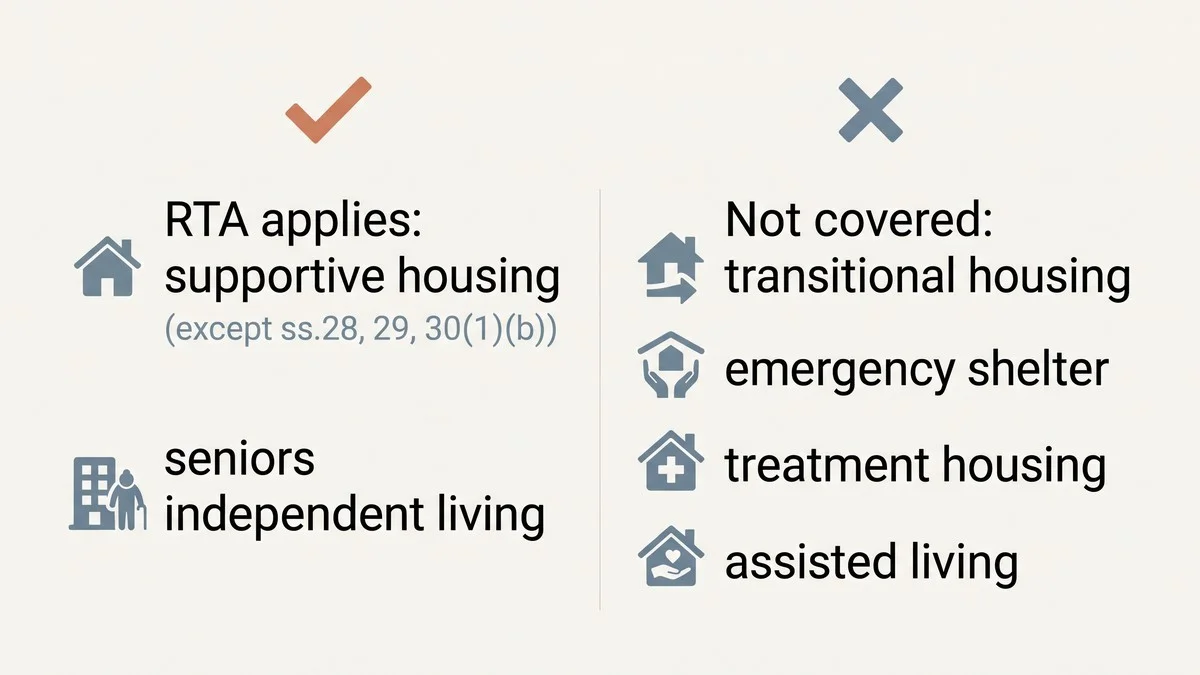
Yes, with three exemptions. RTB Policy Guideline 46 says a supportive housing rental unit is exempt only from section 28 (quiet enjoyment), section 29 (limits on landlord entry) and section 30(1)(b) (guests). Every other part of the Residential Tenancy Act applies, including notice rules, rent limits and deposits, and an operator's house policies must still be consistent with the Act.
To qualify, a unit must meet all four tests in section 4.2:
- the property is operated by a supportive housing operator (such as BC Housing, CMHC, a municipality or regional district or its housing corporation, a treaty first nation, a regional health authority or a qualifying non-profit);
- the tenant was assessed as experiencing or at risk of homelessness and as someone who would benefit from housing stability support;
- housing stability support is available to at least one tenant of the unit; and
- the unit is not provided on a temporary basis.
Is transitional housing covered by the RTA?
No, if it meets the definition. Section 4(f) excludes emergency shelter and transitional housing. Under section 1 of the Residential Tenancy Regulation, transitional housing is accommodation provided on a temporary basis, by a person or organization funded by a local, provincial or federal government for that purpose, together with programs to help tenants live more independently. All three parts must be met. Guideline 46 adds that making residents sign a "transitional housing agreement" does not decide the question.
What about treatment programs, assisted living and seniors housing?
| Housing type | Does the RTA apply? |
|---|---|
| Supportive housing (s.4.2) | Yes, except ss.28, 29 and 30(1)(b) |
| Transitional housing or emergency shelter | No (s.4(f)) |
| Housing provided in the course of rehabilitative or therapeutic treatment | No (s.4(g)(vi)) |
| Assisted living residence occupied by a resident | No (Regulation s.1.3) |
| Seniors independent living | Yes |
For treatment housing, Guideline 46 looks for two features: residency depends on actively receiving treatment or services from the provider, and it is time-limited. Independent living units stay under the RTA even when they share a building with other kinds of seniors housing.
Frequently asked questions
Can a supportive housing tenant complain to the RTB about quiet enjoyment?
No. Because section 28 does not apply, Guideline 46 says a tenant cannot apply for dispute resolution or make a Compliance and Enforcement Unit complaint about quiet enjoyment. The RTB must decline disputes about quiet enjoyment, entry and guest restrictions.
Can a supportive housing operator still end a tenancy for cause?
Yes. Sections 47 and 56 still apply, so an operator can serve a cause notice, including for illegal activity that affects other occupants' quiet enjoyment or safety. See the one-month cause notice.
Who has to prove the housing is excluded?
Guideline 46 says the person claiming the Act applies first shows an agreement to occupy for rent; the person claiming an exclusion or exemption must then prove it on a balance of probabilities.
Is a room shared with the owner covered?
No, but that is a different exclusion, section 4(c); see shared accommodation in BC. For tenants who are covered, BC tenant rights sets out the basics.
Know where you stand as a BC renter
Plain-language guides to every stage of a BC tenancy.
Free • No signup required