Selling a tenanted home in BC does not end the tenancy: the buyer becomes the new landlord on the same terms. The seller can show the unit with 24 hours' written notice, and only a buyer who will live there, or whose close family member will, can have the tenancy ended, through a Three Month Notice (RTB-32P).
Does a tenancy end when a BC rental is sold?
No. The Province's sell a rental property page says the tenancy continues under the same terms and no new agreement is needed. A landlord cannot end a tenancy just to sell. Whoever owns the property when the tenant moves out must return the deposits, so the buyer and seller should deal with them in the contract.
If neither the seller nor the buyer serves a proper notice to end the tenancy, it simply carries on under the original agreement after completion. For how a fixed term and a month-to-month tenancy each behave over time, see Fixed-Term vs Month-to-Month in BC.
How do showings work in a tenanted BC home?
Showings follow the entry rule in RTA s.29: written notice at least 24 hours and not more than 30 days ahead, stating the purpose and a time between 8 a.m. and 9 p.m. The Province adds:
- notice cannot be sent by text message;
- the landlord or agent must be present, and a lock box needs the tenant's permission;
- the tenant may stay, and the unit cannot be staged without the tenant's consent;
- all-day showings every Saturday for weeks can be unreasonable.
See BC landlord entry rules for the notice itself.
A few more points from the Province's showings page. Several showings may be booked on the same day, or on a reasonable number of scheduled days. With proper notice the unit can be shown when the tenant is out, and the landlord or agent must look after the safety of the tenant's things during the visit. Even with a lock box, the landlord or agent must still attend every scheduled showing.
What about open houses?
An open house needs the same written notice or the tenant's permission. Because several buyers may be in the unit at once with less direct supervision, the Province asks landlords to avoid holding many open houses in a short period, and points to the BC Financial Services Authority's recommendations for agents. The tenant may stay during an open house, but must not interfere with the sale, for example by making comments to buyers about the landlord or the condition of the property. A tenant who will be out should lock away valuables and restrain or remove pets.
Either side can go to the RTB as a last resort: the tenant to suspend or set conditions on entry, and the landlord if access is unreasonably refused.
Can a buyer ask for vacant possession in BC?

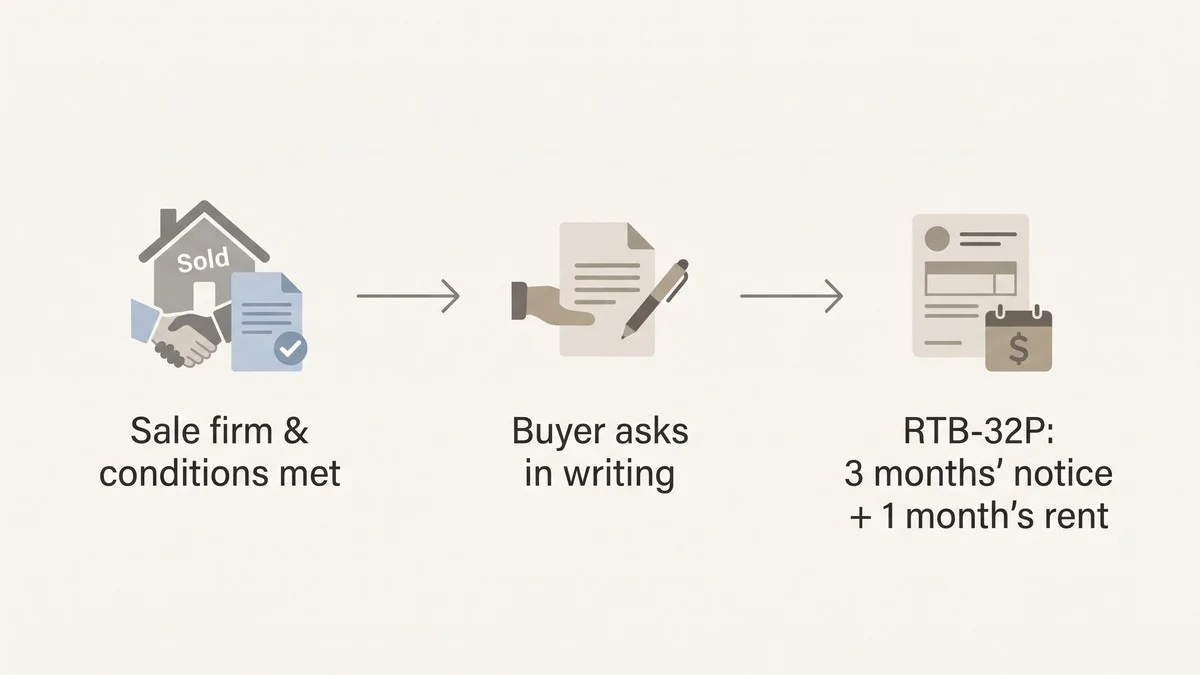
Only to move in. Under RTA s.49(5), the seller may end the tenancy once the sale is made in good faith, all its conditions are satisfied, and the buyer asks in writing because they or a close family member will live there.
| Buyer's plan | Can the tenancy end? |
|---|---|
| Buyer or close family moves in | Yes: seller generates RTB-32P on the RTB portal; 3 months' notice, 21 days to dispute |
| Keep renting it out | No: the tenancy continues |
| Demolish or convert | Only by the new owner, after title transfer, with all permits |
The tenant gets one month's rent, and a buyer who does not move in as stated may owe 12 months' rent (s.51(2)). The ground is not available in a non-strata building with five or more rental units (s.49(6.1)).
Who counts as the buyer's close family member?
A close family member is the buyer's parent, spouse or child, or the parent or child of the buyer's spouse (s.49(1)). The Province spells out that this does not include a brother or sister of the buyer or of the buyer's spouse. "Occupy" means to live there: the buyer or family member must intend in good faith to use the unit as living accommodation or as part of their living space.
Two other details in s.49 catch sellers out:
- The buyer must be buying at least half. A "purchaser" for this notice is one who has agreed to buy at least 1/2 of the full reversionary interest in the unit.
- A family corporation can qualify. If the buyer is a corporation whose voting shares are all owned by one individual (alone or with siblings or close family members), the ground is a shareholder or their close family member moving in (s.49(5)(c)(ii)).
What must the RTB-32P include, and when can it take effect?
The Three Month Notice for Purchaser's Use must be generated through the RTB's web portal; the Province says a notice to end tenancy other than a generated RTB-32P or RTB-32L is legally unenforceable. It must name the purchaser who asked for it and give their address (s.49(7)), and meet the general form and content rules in s.52.
The effective date must be:
- at least 3 months after the tenant receives the notice (Residential Tenancy Regulation, prescribed notice period for s.49(5));
- the day before rent is due; and
- for a fixed-term tenancy, not earlier than the date the term ends (s.49(2)(c)).
That last point matters for the closing date. If the tenant's fixed term runs past the buyer's possession date, the notice cannot end the tenancy before the term does, so the buyer takes over as landlord with the tenant still in place.
A worked example of the timing
Rent is due on the 1st, the tenancy is month-to-month, and the buyer wants to move in.
- March 3, 2027: all subjects are removed and the sale is firm.
- March 4: the buyer gives the seller a written request to end the tenancy because the buyer will live there.
- March 5: the seller generates the RTB-32P on the portal and hands it to the tenant in person.
- March 26: last day for the tenant to dispute (21 days).
- June 30, 2027: earliest effective date, the first day-before-rent-day at least 3 months after March 5. The tenant's one month's rent compensation is due on or before this date, or the tenant can simply not pay the last month's rent (s.51(1), (1.1)).
A completion and possession date set before June 30 would leave the buyer as landlord of an occupied unit for the gap, so buyers and sellers usually plan possession around the effective date.
Can the tenant leave before the effective date?
Yes. A tenant on a month-to-month tenancy who receives the notice can end the tenancy earlier by giving at least 10 days' written notice, paying rent only to their own end date, and still receive the one month's compensation (s.50). If they had already paid rent past that date, the landlord must refund it (s.50(2)).
Whoever holds the deposits at move-out must deal with them within the usual deadline; see The 15-Day Rule.
Who pays the 12 months' rent if the buyer never moves in?
The purchaser who asked for the notice. Under s.51(2) the buyer must pay the former tenant 12 times the monthly rent unless the buyer shows both that the purpose was accomplished within a reasonable period after the effective date and that the unit was used for that purpose for at least 12 months. The RTB may excuse the payment only where extenuating circumstances prevented it (s.51(3)).
More in the BC Landlord Resource Center.
Frequently asked questions
Does my tenant have to sign a new lease with the buyer?
No. The existing agreement carries over, though the buyer and tenant may sign a new one if both agree.
Can a tenant refuse showings?
Not when proper notice was given. The Province says unreasonable refusal can lead to a One Month Notice for cause.
Who returns the security deposit after a sale?
The owner at the time the tenant moves out, which is usually the buyer.
Can the buyer give the notice instead?
Yes, after taking possession: as the new landlord, the buyer can generate a Three Month Notice (RTB-32L) to move in. How that notice works: Ending a BC Tenancy to Move In.
Can the buyer's brother or sister move in instead?
No. Siblings are not close family members under s.49(1), so a notice for a sibling to move in does not fit the ground.
Can the sale contract require the seller to serve the notice?
The Province says serving the RTB-32P cannot be a condition of the sale. The notice can only follow a sale whose conditions have all been satisfied.
Buyer moving in?
See how the BC Three Month Notice for purchaser's use (RTB-32P) works.
Free • No signup required